

The G07's published position in the audio range is narrow, complete and unusual in exactly one respect. Its page prints five standard rows — a radio version, a cell arrangement, a charge ceiling, a charging method and a rated use — plus one feature line. Most of those five rows are shared with other models in the group. The feature line is shared with none of them. That single asymmetry is what makes this model comparable in a way most audio models are not, and it also decides what an honest comparison of the G07 can and cannot contain.
The comparison the documentation supports is this: it can place the G07 on the published bands within the eight-model audio group, it can show that the electrical rows leave two models indistinguishable, and it can point at the one row that separates them. The comparison it must refuse is any ranking of runtime between models, because a published rating without a test condition is not a measurement and a chart of ratings is not a performance result. This page works through both, and ends with the question to ask when a comparison refuses to resolve.
For the G07, no price, price tier, order minimum or delivery window is published, and the range is equally silent on every one of them, so nothing here compares models on cost.
G07 smart glasses how it compares: the audio models and the rows they share
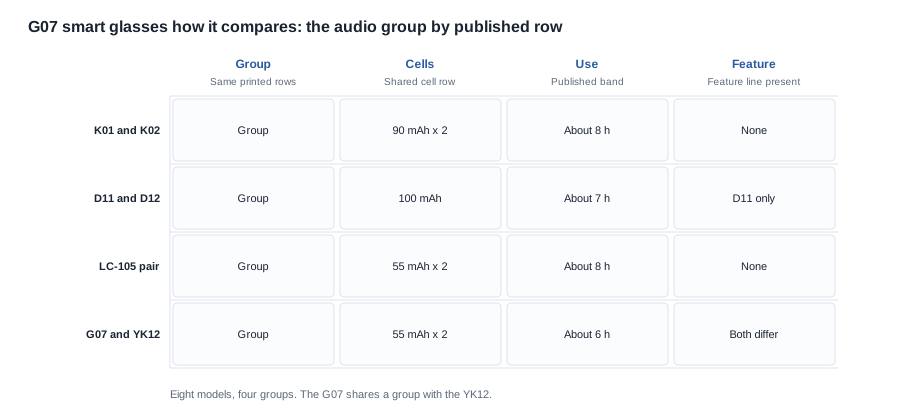
A range table is only as good as the grouping behind it, and the audio group groups itself cleanly once the rows are read across rather than down. The eight are the D11 and the D12, the LC-105-1 and the YK12, the K01 and the G07, and the LC-105-2 and the K02.
The eight models, grouped by what they publish
Read the five standard rows across all eight, and the group divides into four blocks rather than eight individual profiles. The first block is the pair on 90 mAh × 2 cells — the K01 and the K02 — which publish about eight hours of rated use, magnetic charging and a ceiling of two hours or less. The second is the pair on 100 mAh cells — the D11 and the D12 — which publish about seven hours, Type-C charging and the same ceiling. The third is the pair on 55 mAh × 2 cells publishing about eight hours: the LC-105-1 and the LC-105-2, also magnetic, also on the same ceiling. And the fourth is the pair publishing about six hours on that same 55 mAh × 2 arrangement: the G07 and the YK12.
Two further splits sit on top of that. On radio version, the K01 and the K02 publish V5.3 while the other six publish V5.4, so the V5.3 pair is also the 90 mAh pair. On feature lines, three models publish one and five publish none: the D11 carries a surround-sound descriptor with a long-endurance note, the G07 carries an ultra-slim note with a detachable temple, the YK12 carries a surround-sound descriptor with a slim temple, and the K01 and the K02, the D12 and the LC-105-2, and the LC-105-1 have no feature line on their catalogue pages at all.
The four groups a range table actually produces
The consequence of that structure is that a range table for this group does not have eight entries. It has four electrical blocks with a small number of single-row exceptions inside them, and the exceptions are all structural rather than electrical. A table that lists eight models in a row and fills the cells produces a wall of identical values that hides the only information the group contains.
The useful table is the grouped one: a column per standard row, a row per group, and the exceptions shown as a footnote against the group they sit in. In that form the G07 appears once, in the six-hour group, with a note that it is one of two models in that group and that the other one is distinguished by its feature line rather than by its electrical rows.
Why the group boundaries matter more than the ordering
The order in which models appear in a comparison is itself a claim, and it is the claim least supported by the documentation. Sorting by rated use implies a performance ordering. Sorting by cell capacity implies a different kind of ordering. Sorting alphabetically implies nothing, which is exactly why a published range table is often alphabetical — because any other order is an assertion the catalogue does not make.
Grouping by published row structure avoids the problem entirely. A group is a statement about which models print the same values, and that is a statement the catalogue supports. The G07 against the K01 works through a single pair in this way, and the weight comparison across the audio range shows the same method applied to a row the catalogue does not publish for anybody.
Where the G07 sits on the endurance bands the audio range publishes
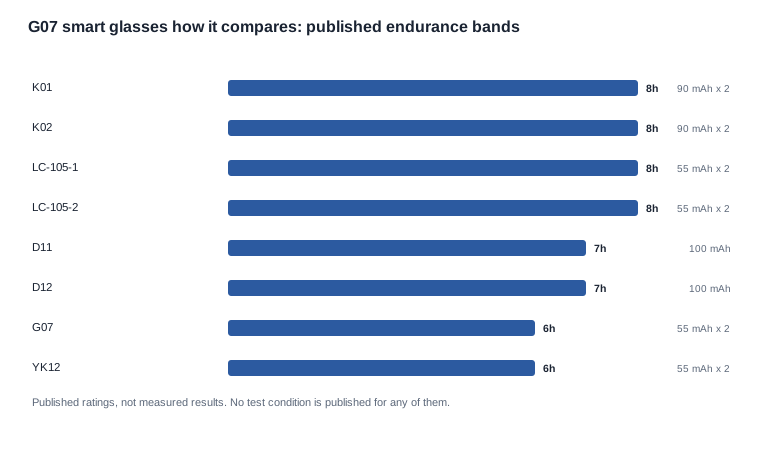
Across the eight audio models there are three published endurance figures, and the G07 sits in the shortest of the three. Saying that much is safe. Turning it into a performance comparison is not, and the distinction is the point of this section.
Three bands, not eight numbers
The bands are about eight hours for the four models on 90 mAh × 2 cells and on the 55 mAh × 2 pair at eight hours, about seven hours for the two 100 mAh models, and about six hours for the pair on 55 mAh × 2 cells at six hours. The G07 is one of the two models in that last group, and the four-model tier it belongs to covers about six to eight hours of published endurance — the LC-105-1 and the LC-105-2 print roughly eight hours on the same cell arrangement.
So the G07's own group is internally split, and that split is the more useful fact for a buyer. Within one cell arrangement, one pair publishes six hours and the other pair publishes eight. Whatever produces that difference, it is not the cell arrangement, and a buyer who treats the whole 55 mAh × 2 tier as a single endurance band has thrown away the most informative thing the catalogue prints about this group.
Why a bar chart of published ratings is not a performance chart
A chart of published ratings across the group is a legitimate thing to publish, as long as it is labelled correctly, and the labelling is where most range charts go wrong. The bars are ratings. No test condition is published for any of them: not the starting state, not the workload, not the radio environment, not the endpoint, and not the sample size. A bar chart of those values invites the reader to treat them as measured results, and a bar chart that invites that reading is worse than no chart at all because it looks like evidence.
The honest version of the chart carries the band structure, names the conditions that are missing, and refuses to present the bars as a ranking. Where a chart cannot be drawn honestly, the alternative is a band statement in prose, and for some audiences that is the better answer.
The question that turns the band into a comparison
One written request converts the band into something a buyer can plan against: the test conditions behind the published figure for each model in the group, plus the observed result of a timed session on one unit of each. With that, a buyer can compare like with like. Without it, the buyer has six numbers in three bands and a method that cannot be replicated, which is not a comparison at all.
The battery life analysis for the G07 sets out what that request contains, and the G07 against the LC-105-1 shows the same question applied to the sibling model that shares the cell arrangement but not the figure.

The detachable temple as the one published difference
Within the audio group, the G07's feature line is unique. What makes it useful is not that it is unique but that it separates two models the electrical rows cannot. That is a narrow and specific kind of value, and it is worth being precise about it.
The single separating row, and its scope
The G07's page names an ultra-slim build with a detachable temple. Within the eight audio models, no other page names a detachable part. Two camera models elsewhere in the catalogue name a detachable inner frame, so the claim has to carry its scope: this is the only detachable temple published among the audio models, and it is not the only detachable element in the catalogue.
The scope matters in two directions. Without it, the claim is false as written. With it, the claim is precise, and it can be checked against the catalogue in about a minute, which is the standard a published difference should meet.
The two models that cannot be separated on rows
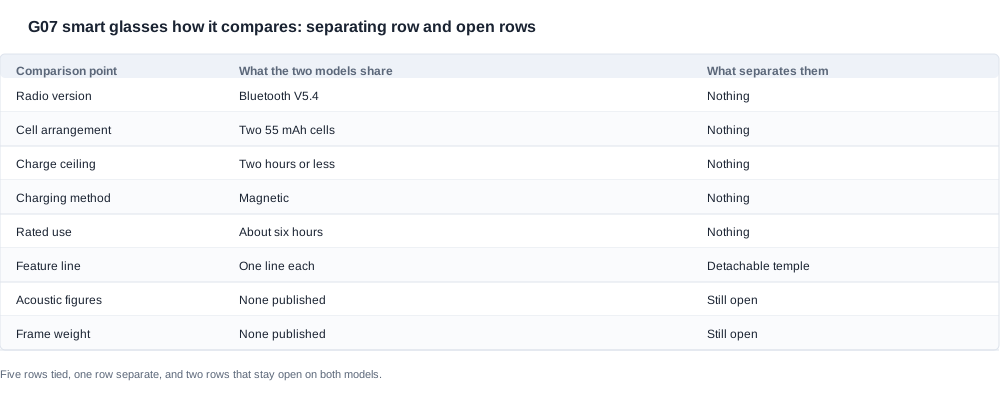
The G07 and the YK12 publish the same radio version, the same cell arrangement, the same charge ceiling, the same charging method and the same rated use. No table built on those five rows will separate them. The feature lines do, and they separate them in opposite directions: the G07's names a detachable temple, the YK12's names a surround-sound descriptor and a slim temple.
The discipline this imposes is about attribution as much as about comparison. A comparison sheet that places the G07 next to the YK12 must not carry the YK12's acoustic descriptor across, and a comparison sheet that places the G07 next to the LC-105-1 must not carry the eight-hour figure across. Both errors produce a document in which every visible number is individually correct and the conclusion is wrong.
How to write the comparison without a ranking
The form that works is a two-column screen rather than an ordered table. Column one states what the two models share. Column two states the single row that separates them and what each model does with it. A buyer reading that screen knows immediately whether the choice is meaningful for their brief, and a buyer whose brief needs neither row knows that the comparison does not apply to them.
What the comparison cannot settle, and how to ask it properly
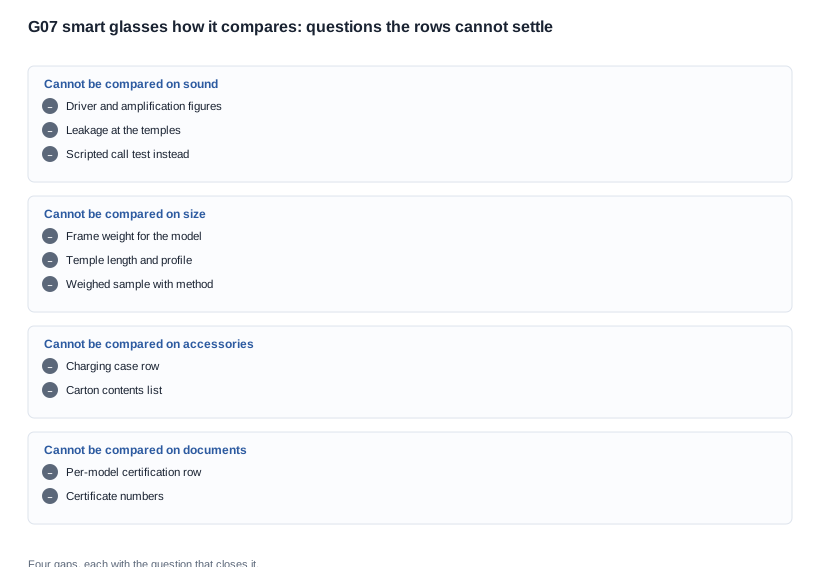
Four things fall outside what any comparison of the published rows can do for this model. Each of them is a genuine gap, and each of them has a corresponding question that converts the gap into an answer.
Four things the comparison cannot settle
The first is acoustic performance. No audio model publishes a driver, an amplification figure, a frequency response or a leakage value, so no comparison on sound is possible from the catalogue. The second is weight and geometry: no audio model publishes a weight, and the catalogue publishes a weight for one camera model only, so nothing in the range can be compared on physical size. The third is the charging accessory, because no audio model publishes a case row and the question of what is in the carton is open for all eight. The fourth is conformity, since there is no per-model certification row anywhere in the catalogue.
The questions that replace them
Each gap has a question that produces an answer rather than an opinion. For sound: a request for the acoustic figures, or a measured sample session using a scripted call test. For physical size: a weighed sample with the method recorded. For accessories: a written carton-contents list and a direct question about whether a case exists. For conformity: a document request naming the model, the market and the deadline, which the certification status of the G07 sets out.
The point of listing them together is that a comparison page which stops at the published rows will always leave a buyer with the same four gaps, and a buyer who has been told which four gaps those are can plan for them.
A shortlist discipline for the comparison
Once a comparison has been made, the next step is usually a shortlist, and a shortlist built on published rows alone will contain models that cannot be compared with one another. Two safeguards fix that.
The first requires every candidate to carry the same evidence set before it enters the shortlist: the published rows, the sample report and the written answers. A model with rows and no sample is a different kind of candidate from a model with all three, and mixing the two in one list invites a comparison the evidence does not support.
The second is to write the brief before the comparison and re-check it afterwards. The order matters, because a comparison conducted first tends to be shaped by whatever it finds: the criteria end up chosen after the fact, and they tend to be the criteria on which the candidate that was already favoured happens to win. Setting the criteria first is the cheapest way to keep an evaluation honest.
The trade-off worth acknowledging is time. A properly evidenced comparison takes longer than one assembled from a catalogue, and it is often less interesting, because the interesting differences are the ones the catalogue does not record. That is the correct result rather than a failure of the exercise.
How to record an answer
An answer to any of the four questions has to be recorded with the same discipline as the published rows: model named, date attached, method stated where a measurement is involved, and the source identified. A comparison document that mixes published rows and one-off answers without marking which is which becomes unreadable within two months, and a reader who cannot tell which is which will quote the whole thing.
Comparing G07 smart glasses without over-reading the specification
Three habits keep a range comparison for this model honest, and all three are cheap to adopt.
Three habits that keep a comparison honest
The first is to compare groups rather than models, because a group is a statement the catalogue makes and an order is a statement the catalogue does not. The second is to mark every number as published or measured, since the two behave differently in every downstream use. The third is to record, next to each comparison, the one thing the comparison cannot settle, so that a reader who takes the sheet as complete is told otherwise in the same line.
A fourth habit, if the comparison is going into a customer-facing page rather than an internal one, is to remove the comparison altogether. A range chart aimed at end buyers converts ratings into performance claims, and no amount of careful labelling in an internal document protects a marketing page that has had its caveats edited out.
What a buyer should verify before the order
Four verification steps sit between a comparison and an order, and each of them is cheap compared with the cost of discovering the problem after the goods have shipped.
Verify that the figures in the comparison came from the documents rather than from somebody's summary, by opening one of them. Verify that every model-specific statement names its model, because the group structure makes a copied value easy to misattribute. Verify that the sample report describes the same configuration as the model being ordered, since a first article from an earlier production run is not evidence about the current one. And verify that the commercial terms are quoted on the same basis as every other model in the comparison, since a quotation that includes an accessory set for one model and not for another is not like-for-like even when every line in it is correct.
None of these steps needs a supplier to be involved, which is what makes them practical: they can be completed before the order is placed, and they remove the four ways a comparison most often goes wrong in a way that only becomes visible after the shipment.
The document set a comparison should sit on
A defensible comparison for the G07 rests on four documents. The catalogue rows, which settle the group structure. A sample report, which settles the physical and acoustic questions for the units examined. A written supplier answer, which settles the accessory and conformity questions. And a quotation, which settles the commercial terms and without which the comparison cannot be extended to cost.
Three further articles in this set handle the neighbouring cases: the buyer review checklist covers what the sample report has to contain, the charging options covers the accessory programme, and the limitations of this model covers which of the gaps above are facts and which are missing rows.
What we can state today
What CYNRIN can state about the G07's place in the range is narrow and it does not need to grow. The G07 is one of eight audio models. It sits in the group on a 55 mAh × 2 cell arrangement, which spans about six to eight hours of published rated use across four models, and it is one of the two models in that arrangement publishing about six hours, the other being the YK12. It charges magnetically, over a ceiling of two hours or less, on Bluetooth V5.4. It is the only audio model publishing a detachable temple. And it publishes no weight, no acoustic figures, no charging-case row and no per-model certification line.
On G07 smart glasses, our position is that a comparison built on those statements is a true comparison, and that a comparison which claims more than they support is not. We will not publish a price or a rank for this model, and the published specification rows and the cost terms are the two documents a buyer should hold next to any comparison of G07 smart glasses they are asked to sign.
Next in this set
- The endurance figure behind the bands — the rating and its condition
- The rows a comparison rests on — the catalogue entries
- The commercial blanks a comparison cannot close — cost structure
- First-article evidence — the measurement half
- The accessory programme — what ships with the unit
- The silences on this page — facts apart from missing rows
- Document position — what a compliance file needs
- Weight across the range — the row nobody publishes


