
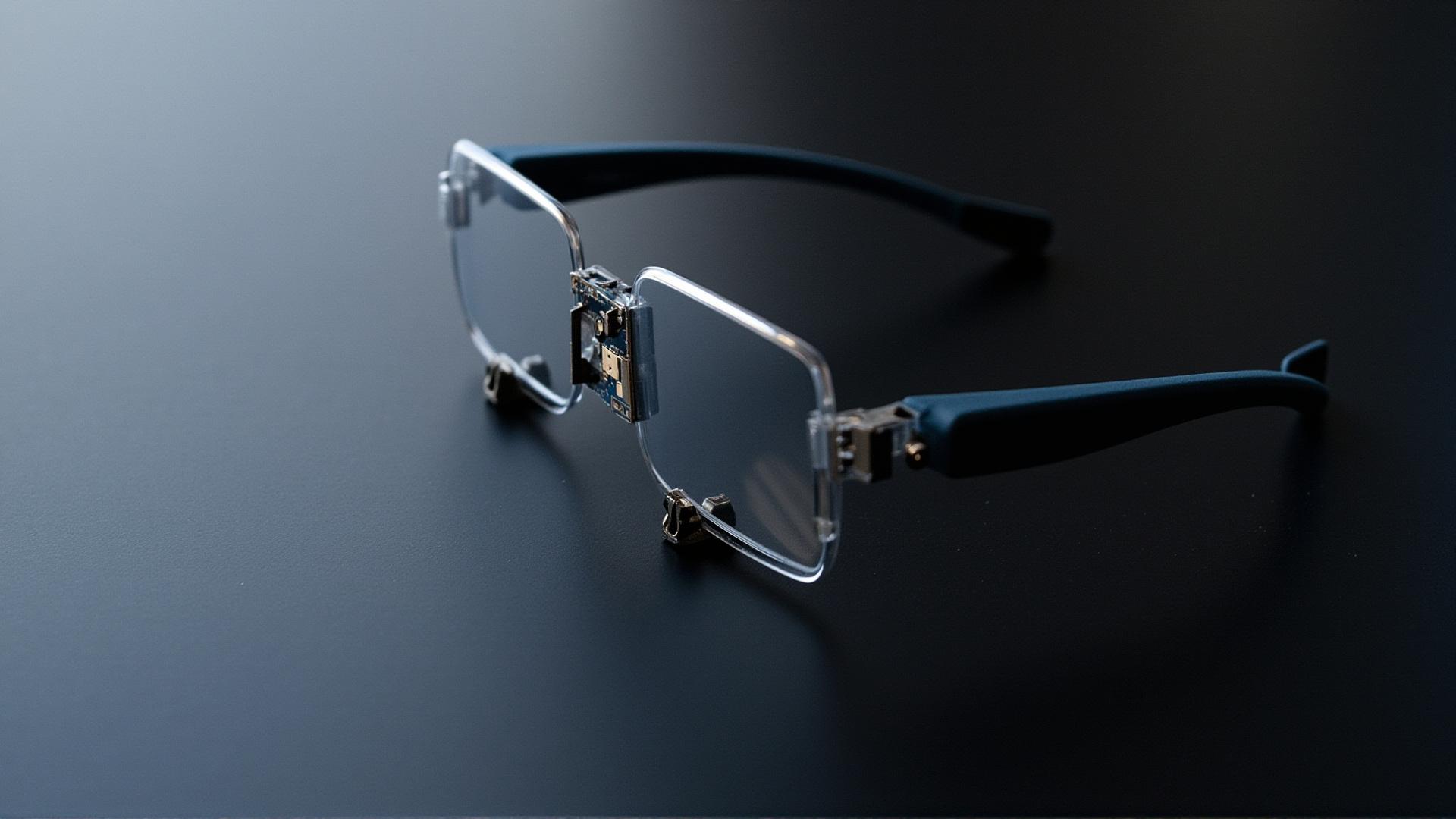
Customising the A05 is a matter of establishing what can be changed before deciding what should be. The published configuration is a lens-based electronic fogging element with posture and distance detection, a 40 mAh cell, about 20 hours of stated endurance and magnetic charging — and the customisation documentation for the category is thin enough that most of the programme has to be written rather than selected.
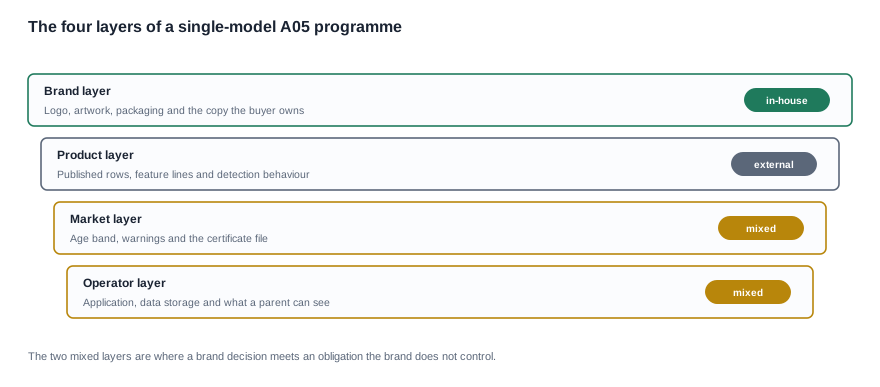
That distinction is the whole of this page. There is a layer of an A05 programme that a brand owns outright, a layer it can influence, and a layer it can only respond to. A buyer who treats all three as configurable will discover late that the third layer was never configurable at all.
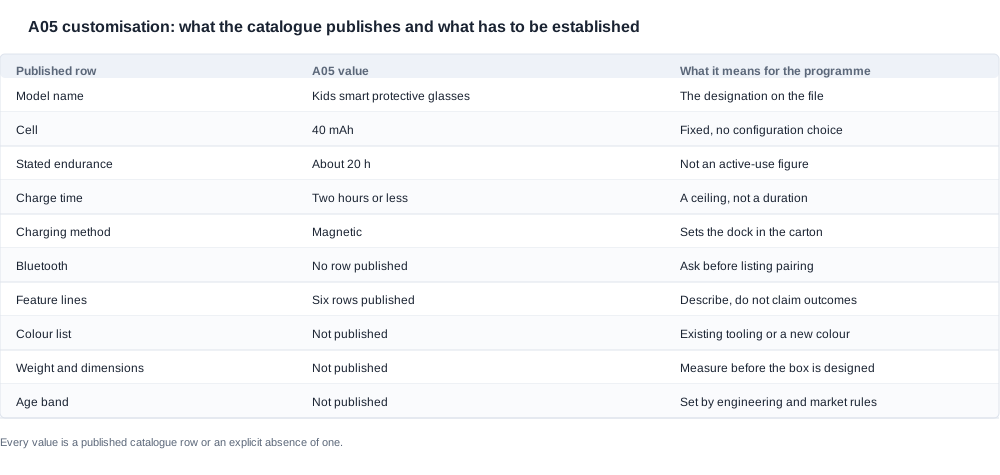
The A05 customisation layers, and who actually controls them
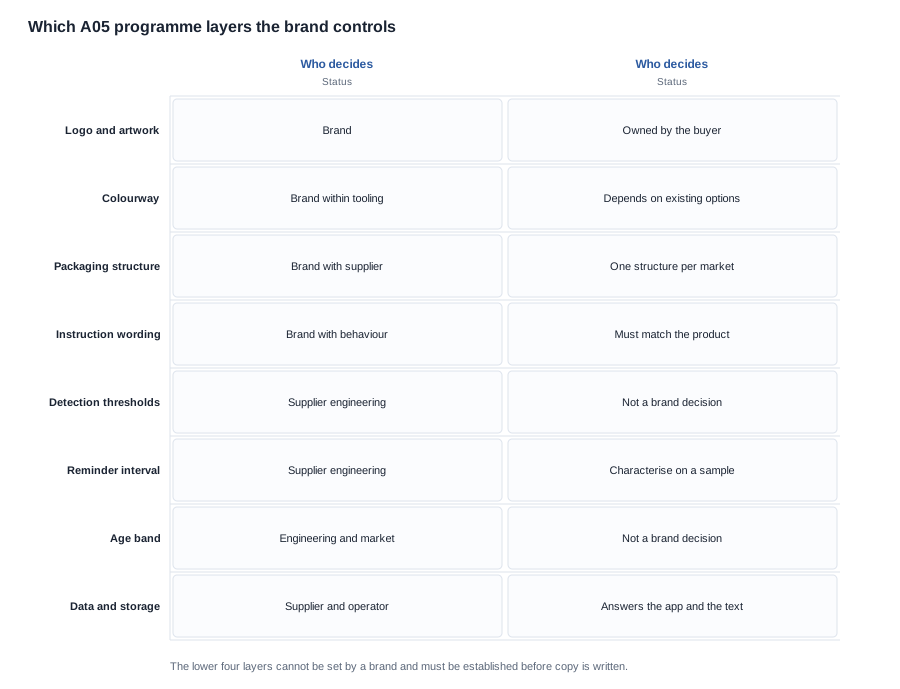
The brand layer, which the buyer owns outright
Artwork, logo placement and the printed material. These four axes apply across the category and none of them requires new engineering — with one proviso that governs the whole colour question. The catalogue publishes no colour list for the A05, so a colour request is either an option that already exists in the tooling or a new paint or a new plastic. The difference between the two is a cost and a lead time, and it is worth knowing which one a request is before the request is made rather than after it is quoted.
Packaging structure. The box, the insert, the language versions and the per-market leaflet. The kids box contents analysis works through what a carton in this category has to carry, and the packaging design reference covers fixing the artwork before any of it goes into production.
The application's presentation. The category publishes a customisation capability for the application and for the system interface. What it does not publish is the cost of a change in unit price, in minimum order quantity and in lead time, and those three have to be asked for together — because a firmware branch is an operating cost rather than a configuration, and it behaves like one.
The product layer, which the buyer can influence but not set
The detection behaviour. The thresholds, the intervals and the dismissal behaviour are engineering properties of the product, not brand properties. A brand chooses what the reminder says and what it looks like; it does not choose how often it fires. And firing too often is the fastest way to lose the child who then stops using the product — which means this is a question where the brand's commercial interest and the child's experience point in the same direction.
The six published feature rows. The catalogue lists a lens-based electronic element, a fogging unit, correct and incorrect posture-and-distance prompts, and lens clarity and lens fogging for the A05. Those are the rows as published, and describing them is straightforward. What cannot be done is converting them into an outcome claim about vision, eyesight or prevention — the rows describe what the product lists, not what it achieves for the wearer.
The endurance figure. About 20 hours is published, and it is a stated figure with no test condition published alongside it. It should be presented as a catalogue figure and never restated as an active-use duration, because the two are different assertions and the second one is not supported.
The market layer and the operator layer, which the buyer can only respond to
The age band. It is set by the physical product, the smallest detachable part and the market standards, and it drives the warnings, the claims and the conformity route in each destination. Nothing about it is a brand decision. The age suitability analysis covers the inputs that establish it, and the safety requirements piece covers the standards list per market.
The data position. Whether any detection data leaves the device, who operates the application, where it is stored and what a parent can see are not brand decisions. In a children's product these are the questions a school, a parent and a regulator all ask, and the answers determine what the application, the privacy text and the packaging are permitted to say. The privacy considerations piece sets out the seven questions.
The certification file. Our catalogue carries a company-level export certification page whose content is images rather than text, and the catalogue text contains no reference to CE, FCC or RoHS. There is no per-model certification row for the A05, so the file that names this model has to be obtained rather than quoted. The certification status for this model covers the request list, and the export considerations cover the market layer.

Building an A05 programme in the right order

The model split has to be settled first, even for a single-model programme
The A05 and the A06 publish identical specifications — the same 40 mAh cell, the same stated endurance, the same magnetic charging, the same six feature rows — and our documentation does not state what separates them.
That question has to be answered even if the programme will carry only the A05, and the reason is that the answer determines what the certification file is named against, what the artwork carries, and what the buyer's own catalogue entry says. If the answer turns out to be a colour or a packaging variant, the two models are one product with two SKUs and the file can name either. If the answer is a firmware or detection difference, the file may have to name both separately. A buyer who skips this question discovers the answer during the certification application, which is the most expensive place to discover it.
The A05 versus A06 specification comparison works through what the possible answers mean for a programme.
The age band is an input, not a decision
A recommended age band is not published for this model, and in a children's product it is not a marketing choice. It drives the warning text, the claims the pages are permitted to make, the small-parts assessment and the standards the product has to meet in each destination market.
Establishing it takes four inputs: a supplier's engineering input, a size and weight measurement, an identification of the smallest detachable part, and the standards list from a test house for the market. Three of those four are measurements or documents, which means they can be commissioned in parallel once the sample is in hand. That is the reason to order the sample early rather than after the artwork is designed.
The reminder behaviour has to be characterised before it can be written
The instruction a parent genuinely needs is what the reminder does, how often it fires, and how the child turns it off. None of that is published — the thresholds, the intervals and the dismissal behaviour are all open — so the instruction has to be written from a product that has been characterised.
This is a longer task than it looks, because the same characterisation produces four documents that have to agree with each other: the instruction card in the box, the product page, the support script and the training the distributor's staff will use. A discrepancy between the instruction card and the product page is a customer service problem before it is anything else.
The posture monitoring analysis covers what the detection functions are designed to observe, and the A05 buyer review checklist covers the sample-stage work that makes the instructions true.
What the six published feature rows can and cannot be asked to carry
Because these rows decide what the product pages are permitted to say, they deserve a closer reading than a bullet list gives them. The catalogue lists six rows for the A05: a lens-based electronic element, a fogging unit, correct posture and distance, incorrect posture and distance, lens clarity, and lens fogging.
Read as a set, they describe a device that watches posture and distance, and that changes the state of the lenses in response to fogging. That is a complete and coherent description of the published product. What the rows do not contain is any statement about what a child who uses it will experience in terms of vision, eyesight, comfort or development — and the absence is not an oversight in the catalogue, it is the boundary of what the rows are.
There is a specific trap here that is worth naming because it is easy to fall into accidentally rather than deliberately. A row about fogging invites a sentence about clarity, and a sentence about clarity invites a sentence about eyesight. The catalogue does publish a lens clarity row and a lens fogging row, which makes the first step of that chain look supported. But a published row describing a lens state is not a published measurement of visual performance, and no acuity figure, contrast figure or vision metric is published for this model.
So the discipline is to describe the mechanism and stop. The fogging unit is an accessory and a function row — it is not a lens parameter, and its presence in the list does not make the lens a different kind of lens. The posture and distance rows describe what is detected, not what is prevented. A page that says the product reminds a child when posture or distance is wrong is describing the published rows accurately. A page that says the product protects a child's eyesight is making a claim that no document in our catalogue supports, and in a children's product that is the kind of claim a compliance lead will have to answer for.
The practical test is simple. Ask what document would be shown to a customer, a school or an inspector who asked the page to justify the sentence. If the answer is the catalogue row itself, the sentence is fine. If the answer would require something else, the sentence has gone past the documentation and has to come back.
How the fogging and posture rows affect the accessory decision
The fogging unit is the one published feature row that raises an obvious accessory question, and it is worth separating the two parts of it. A fogging unit may be an integrated function of the frame or a separate item that has to be supplied, cleaned and replaced. Our documentation does not say which, and the difference matters to a programme because a consumable accessory carries its own minimum order quantity, its own shelf life questions and its own packaging position in the box.
So the question to ask is whether the fogging function is integral to the A05 or a supplied accessory. If it is integral, the programme carries one less SKU and one less replenishment line. If it is supplied, then the programme carries a consumable whose minimum order quantity, replacement interval and carton position all have to be settled along with everything else — and the kids box contents analysis is where that position should be worked out.
There is a second, quieter consequence in the posture and distance rows. Two rows — correct posture and distance, and incorrect posture and distance — describe a two-state response. A two-state response that fires on every occurrence of a state is different from one that fires periodically while the state persists, and a parent reading the instruction card needs to know which one it is. That is part of the characterisation in the gate list, and it is the reason the instruction card is written from a sample rather than from the row.
The data position is not only a privacy question
The seven questions in the privacy considerations piece decide the compliance side, and they are the ones a school or a regulator will ask. But there is a commercial consequence to the same answers that a buyer planning a programme should price in.
If the detection data stays on the device, the product is a self-contained wearable and the operating commitment is small — no operator, no storage, no data-processing relationship to manage, and a support script that answers to the child and the parent. If the data leaves the device, the programme acquires an application to operate, a jurisdiction to store data in, a privacy text to write per market, and a retention policy to define. That is a materially different product to run, and the difference should be made before the artwork is commissioned rather than discovered when the packaging is being written.
The same answers determine what the box contains and what the distributor has to be trained to say. A buyer who closes this gate early can write one instruction card and one support script; a buyer who closes it late has to write them twice and reconcile the differences afterwards.
The colourway and the fit accessories come out of measurements
With no published colour list and no published frame dimensions or weight, the fit accessories and their sizes have to be established from a sample before the box is designed. This is the step most likely to be skipped, because the accessories look like a merchandising choice — and it is not, since an accessory sized against a frame nobody has measured will not fit the frame that arrives.
The six gates on an A05 programme
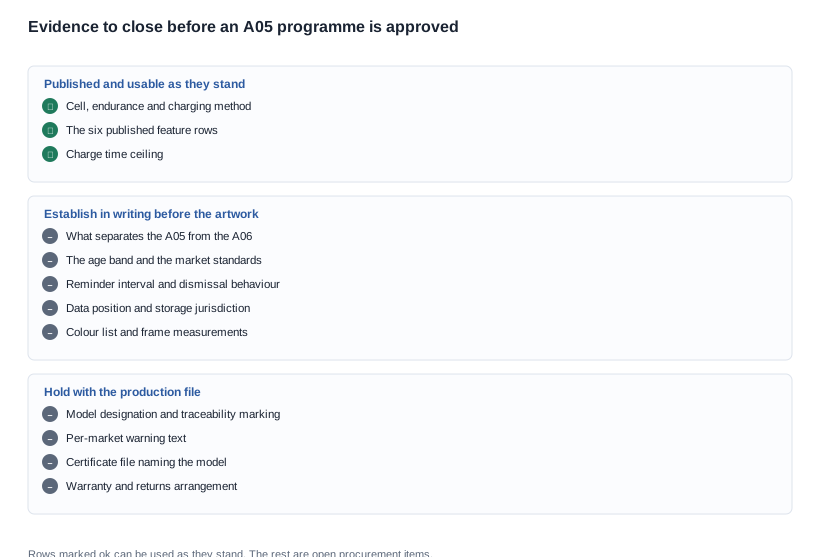
Six items gate everything else, and the order among them matters because two of them have external lead times.
- What separates the A05 from the A06, described in the supplier's own words.
- The age band the product will carry, and the standards behind it, market by market.
- The reminder interval and the dismissal behaviour, written the way the product behaves.
- The data position — the operator, the storage jurisdiction, and what a parent can see.
- The colourways, the fit accessories and the frame measurements, taken from a sample.
- The designation, the per-market warning text and the certificate file, frozen together with the proofed sample.
Items one and two are the ones that cannot be parallelised, because items three, four and six all wait on them. Items three, four and five can be worked on in parallel once a sample is in hand. Item six is the last because it names the model and the warnings, which depend on everything above it.
Qualifying the sample and freezing the file
Approve a sample against a written specification rather than against an impression: the model designation, the detection configuration, the battery capacity, the charging interface, the colour, the packaging contents, the marking, the firmware version, and the logo placement with its dimensions and finish.
Then freeze the artwork, the production file, the marking, the model designation and the certificate application together, and store the locked artwork, the proofed sample, the production file and the certification file as one package. The reason for storing them as one package is that the sample is the only physical evidence of what was approved — a buyer who keeps the artwork and the certificate application but loses the sample has no way to settle a question about the delivered unit.

The commercial terms an A05 programme has to settle
A children's programme carries a different cost structure from an adult one, and the difference comes from the obligations rather than the hardware.
The terms that respond to the order
Unit price at volume tiers, packaging specification, delivery splitting, payment nodes tied to inspection, the warranty period with a stated response, and the terms of a pilot order.
The minimum order quantity that matters is the one on the full delivered configuration, not the one on the frame. Because the charging method is magnetic, a dock ships with the unit, and the dock has its own minimum order quantity. A buyer who negotiates the frame minimum and assumes the accessory follows it will find the accessory minimum is the binding constraint, and that it determines how small a replenishment order the channel can place.
The age band also affects the commercial shape. A band with a tighter small-parts requirement can mean a more restricted market and a longer conformity route, which affects the size of a sensible first order. This is one of the reasons the band has to be settled before the quantity rather than after it.
The terms fixed by the process
Certification cost and its timeline follow the process and the testing body, and they are per product family rather than per order. Tooling is frequently amortised across a first order instead, so ask which of the two is being quoted, because the two are often bundled into a single line that hides which one carries the volume.
Four clauses that belong in the agreement
- The model designation, the published rows of the configuration ordered, and the six feature rows as the catalogue lists them.
- The warning text per market, the age band it is written for, and the operator and responsible-person details.
- The reminder behaviour as characterised — the interval, the dismissal behaviour and the wording that will appear on the card, the page and the support script.
- The data position: what is collected, what leaves the device, who operates the application and where it is stored.
The claims an A05 programme cannot make, and the rows it cannot restate
Any vision claim, any eyesight-protection claim, any prevention claim, and any statement that the detection functions produce an outcome for the wearer. The published rows describe what the catalogue lists, and that is as far as they go.
Also excluded: a recommended age band that the documentation does not support, the 20-hour figure restated as an active-use duration, a colour list that has not been confirmed, a frame weight that has not been measured, and any certification number that has not been supplied in writing.

Four ways an A05 programme goes wrong
The A05 and the A06 were carried as two models because they have different names. The symptom is a range with two product pages, two packaging structures and two certificate applications for one product. The root cause is treating a model designation as a product difference. The prevention is to settle the split question in writing before any of the artwork is commissioned.
A feature row was turned into a benefit claim. The symptom is a product page that says the glasses protect a child's eyesight, and a compliance question that nobody in the business can answer. The root cause is reading a list of catalogue rows as an outcome. The prevention is to describe the rows and stop there — the fogging unit, the posture and distance prompts, the lens clarity and fogging entries, and nothing more.
The reminder was designed rather than characterised. The symptom is a parent dismissing the product, because the prompt fires in situations where the child is behaving correctly. The root cause is designing the behaviour from what the brand wanted the product to do rather than from what the product does. The prevention is to characterise a sample and write the instruction card from the result.
The data position was left open until the privacy text was due. The symptom is a page that says nothing about data because nobody could establish what there is, and a parent support queue with no answer. The root cause is sequencing the privacy text before the answer. The prevention is to close the data position before the copy is written, which is why it sits above the artwork in the gate list.
Where CYNRIN stands on customising the A05
The A05 is a capable product whose programme is limited more by its documentation than by its hardware, and the six gates at the top determine everything below them. We will describe the published detection functions and we will not attach any health, vision or prevention claim to them, because the category carries real regulatory risk and no supporting evidence is published for it.
We will not publish a recommended age band that our documentation does not support, and we will not present the 20-hour endurance figure as an active-use figure. Where our own documentation is incomplete — the certification numbers for specific models, the minimum order quantity, the lead time, the unit cost, the colour list and the frame measurements — we will say it is incomplete rather than offer an estimate that becomes a commitment.
What we will do is narrow the programme to the decisions that are actually yours and name the ones that are not. Tell us the buyer, the target age band, the markets and the volumes, and we will tell you which of the six gates are already defined and which have to be closed first.
Six items to settle before the first order
- How the A05 differs from the A06, described in the supplier's own words.
- The age band the product will carry, and the standards behind it, market by market.
- The colourways, the fit accessories and the frame measurements.
- The reminder interval and the dismissal behaviour, written the way the product behaves.
- The data position, the operator and the storage jurisdiction.
- The designation, the per-market warning text and the certificate file.
Related reading
- The model duplication — A05 versus A06 specification comparison
- The behaviour behind the instructions — kids smart glasses posture monitoring
- The sample-stage work — A05 smart glasses buyer review checklist
- The market layer — kids smart glasses export considerations
Send us the buyer, the target age band, the markets and the volumes, and we will tell you which of the six items are already defined and which have to be closed first.


