
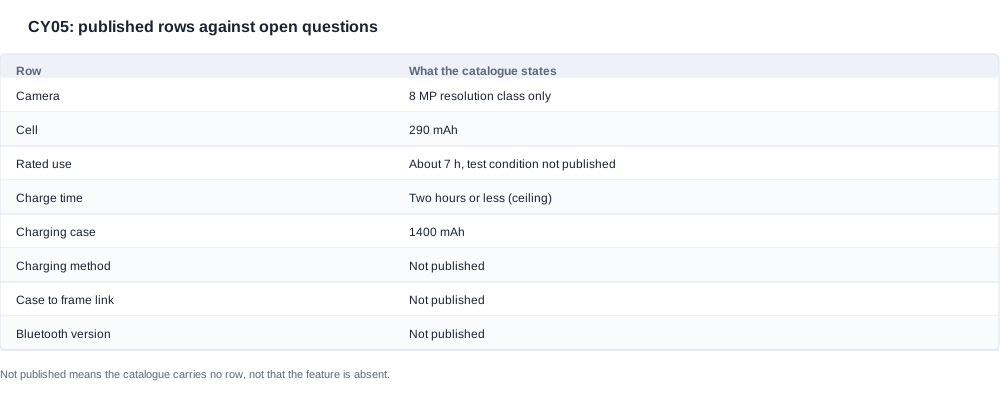
This camera model publishes an eight-megapixel resolution class, a 290 mAh cell, an approximately seven-hour rated runtime, a charge time of two hours or less, and a 1400 mAh charging case. It does not publish how the frame charges, how the case itself takes charge, or how charge travels from the case to the frame. On a product whose case is the largest branded surface in the box, that omission decides the box contents, the spare-parts plan and the transport paperwork before anyone commits to a first order or to a launch date.
The CY05 is one of four camera models whose catalogue page carries a case capacity but no charging-interface row at all, and that single absence shapes a brand programme more than any of the identity decisions that usually come first. The other three sit on the same 290 mAh platform, and one of them adds a published Type-C interface together with a choice of case capacity, which is the closest thing the catalogue offers to an answer. That is not a reason to pick one model over another: no price, tier, delivery or volume comparison is published for any of them, and we do not quote one. It is a reason to ask one precise question early, because the answer determines whether your box needs a cable, a dock, an adaptor or nothing at all, and whether a second lithium cell travels with the consignment.
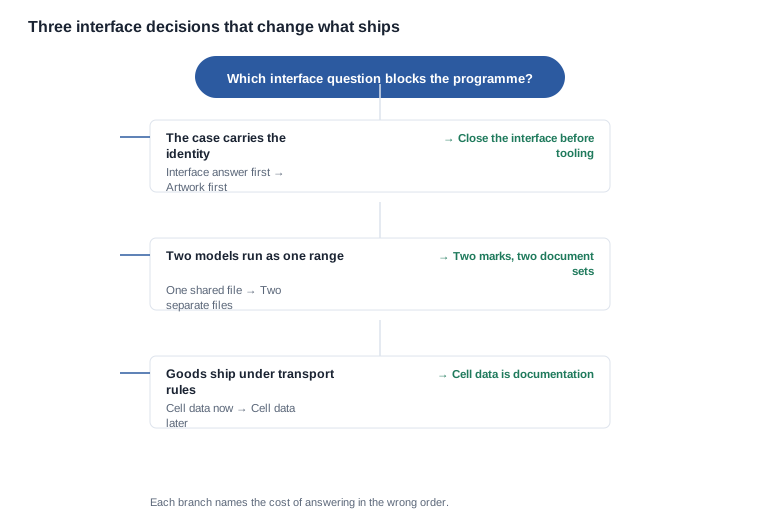
The conclusion for a procurement lead is short. Three lines have to close before any artwork is commissioned, and one of them — the charging method — is not a row in the catalogue at all, so it can only be closed by asking, in writing, for this model. Everything below is sequenced around that fact rather than around the logo.
CY05 published rows, and the charging method the catalogue leaves out
The catalogue page for this model is short, and the shortness is itself the first piece of information. Here is the complete set of what it states, with nothing added:
- Camera: the eight-megapixel resolution class, and nothing further about it.
- Cell: 290 mAh.
- Rated use: about seven hours, with no test condition attached.
- Charge time: two hours or less, written as a ceiling rather than a measurement.
- Charging case: 1400 mAh.
What each of those five lines does and does not license
The resolution class is not an image-quality claim. The catalogue publishes the eight-megapixel figure for this model and stops there — no sensor model, no field of view, no frame rate, no video format, no stabilisation, no low-light behaviour, no storage capacity, no file format. Eight megapixels is a bucket that eight camera models in the catalogue share; the three 13-megapixel models sit in a different bucket. A listing that says "8 MP" is accurate. A listing that says "8 MP for crystal-clear photos" is a claim the catalogue does not support, and a buyer who expects a published sensor specification will not find one here.
The rated runtime has no test condition, so it cannot be scheduled against. About seven hours is a catalogue figure under conditions the catalogue does not state: no volume level, no screen state, no ambient assumption, no pairing profile. It is enough to describe the class of the product and not enough to plan a shift, a filming day or a clinic session. Ask what the seven hours assumes, and get the answer in the same document as the sample.
The charge time is a ceiling, and the wording matters. Two hours or less is an upper bound. It does not mean the product charges in two hours, and it does not say how long a charge takes from the state the cell is actually in when a customer picks it up. Do not convert it into "refills in under two hours", which is a different assertion that the catalogue does not make.
The case capacity is the biggest published number in the row, and the least qualified. 1400 mAh is a real figure for the case, and it is the number that drives parcel volume, insert design and the freight conversation. But a capacity tells you nothing about how the case is charged, how it reaches the frame, or whether it reports its own state.
What the page does not state
For this model the catalogue carries no row for the charging method or charging interface, no Bluetooth version, no colour list, no ingress protection rating, no weight, no temple or lens dimensions, and no per-model certification entry. It also carries no price, no minimum order quantity, no lead time, no capacity statement and no warranty period — none of those are published for any model in the range, and we will not manufacture them for a quotation. The practical reading is that this model has a case with a published capacity and an unpublished interface, and every other open question above is answered the same way: by asking.
Three states, not two
The most common mistake in reading a short specification is to treat "not stated" as "not present". The catalogue actually distinguishes three states, and the distinction decides what you can write in a listing.
- Published and specified: a value exists, here the five rows above.
- No row at all: the catalogue simply does not carry that line for that model. The charging method on this model is in this state.
- Explicitly excluded: the catalogue says so in words. Elsewhere in the range, one camera model has no charging-case row, and three camera models carry no case row at all — which is not the same statement.
The procurement consequence is worth writing down. A row that is absent cannot be sold as a feature, cannot be assumed absent, and cannot be used as a differentiator — it has to be closed by a written answer before the artwork starts, because a listing that mentions an interface you cannot evidence is a claim you will have to withdraw.

What the missing charging interface decides downstream
The charge path is not an engineering footnote on a camera product. It is the point where a customer meets the product for the first time, and on a model whose case is a branded object in its own right it decides several lines of the programme at once.

The box contents
A cable-only audio product ships one cable. A case-equipped product has to answer what the customer plugs into what, and the answer determines the accessory list, the printed quick start, the market leaflet and the barcode count per market. Because the interface on this model is not published, the accessory list cannot be assumed to match a neighbouring model on the same platform. The charging case options analysis covers what a case does to the parcel once you know its shape; the shape itself is part of the answer you are asking for.
The case as a branded surface
The case is what a customer opens before the frames, and it is where a brand's identity lands if the brand wants it to. That makes the case artwork, the insert and the case colour the three highest-value customisation surfaces on this model — and it makes them the three most expensive to get wrong. An insert tooled around a case that then changes size or shape is a reprint, and the insert is the part that costs.
The freight consequence nobody prices first
Case capacity is a proxy for volume, and volume is what the freight quote is calculated on. Two cases of the same nominal capacity are not the same parcel: shape, closure, hinge and insert all move the packed dimensions, and a packed dimension decides how many units fit on a pallet and how many cartons fill a container. Because the case for this model is described only by its capacity, the packed unit weight and the carton count are not derivable from anything published, and a freight budget built on an assumption here is the budget that surprises. The packed weight analysis for camera glasses sets out what has to be measured on a physical unit, and why a supplier's carton data is the only honest source for it.
The spare-parts and returns line
Whatever the charge path turns out to be, it defines what a customer loses when something goes wrong: the frame, the case, a cable, or a dock. Each of those is a return reason and a support cost, and each is priced into the aftersales budget. If the answer includes a proprietary dock, that dock is a second moulded part with its own approval cycle, its own colour story and its own stock position — a fact that belongs in the commercial conversation before the first order, not in the returns policy afterwards.
The transport paperwork
A case is a second lithium cell in the consignment, and the transport documentation has to cover it. The scope of that documentation depends on the cell, and the cell is identified by its capacity and its chemistry — so the missing interface line on this model is also a missing document that has to be requested before a container is booked, not before a box is printed.
Six questions to ask before the artwork exists
- How is the case charged, and is the answer a cable, a dock or contact points? Ask for this model and this case capacity, and get the answer in writing rather than inferred from a neighbouring model.
- How does charge reach the frame from the case? Direct contact, a dock in the case, or an adaptor — each implies a different accessory line and a different return scenario.
- Does the case indicate its own state? If it does not, the packaging and the quick start have to explain charge level to a customer who cannot see it.
- Is there a second case capacity available for this model? Only one model in the range publishes two case capacities, so this is not a given, and a two-tier retail structure depends on the answer.
- What is in the box per launch market? The cable or dock, the insert, the printed materials in the market language, and the markings.
- Does the case configuration change the conformity position? A different case is a different configuration, and the paperwork has to name the configuration that actually ships.
None of those questions is answered by the catalogue, and none of them should be answered by a guess. That is also why a due-diligence step belongs at the front of this programme rather than at the end of it: the questions to ask here are cheap to ask before artwork and expensive to ask after a case insert has been tooled.
CY05 against CY03: identical published rows, one unanswered question
Two models in this catalogue publish the same specification line for line: eight megapixels, a 290 mAh cell, about seven hours of rated use, a charge time of two hours or less, and a 1400 mAh charging case, with no charging-method row on either page. The same 290 mAh platform also carries a 13-megapixel model with the same case capacity and no charging row, and a 13-megapixel model that does publish a Type-C interface and offers a 900 or 1400 mAh case.
What that comparison lets you do is narrow but real. It lets you reason about platform sharing. Models on one platform can plausibly share a firmware branch, a supplier qualification, an inspection plan and a documentation package, which is what makes a second and third model cheaper to launch than the first. It also lets you see where the catalogue is genuinely thin: four camera models carry a case capacity and no interface, and one of them — the L2 Utral — publishes an interface and two case capacities. The model readiness overview maps which camera models sit on shared platforms.
What it does not let you do is build a range on an assumed difference. If you plan to sell two of these as separate products, a document naming one model does not cover the other, the mark on the box is not interchangeable, and the listing copy is not interchangeable. That is the question to close, and it has to be closed in writing: what differs between these models, and is the difference hardware, firmware, or only the configuration?
The honest answer is also the commercially useful one. A platform that shares a cell, a case family and an app branch lets a brand launch one model properly and add the second as a variant, because the second costs documentation effort rather than development effort. That is a structural fact about the range, not a price comparison, and we are not publishing prices, price bands or volumes for any model here. If you need a portfolio comparison, choosing a camera model sets out the structural axes to evaluate on, and the CY05 against CY03 positioning note covers the duplication in the documentation.

The sequence that closes the open lines in a CY05 brief
Most programme delays on a camera model are not caused by the work itself but by the sequence: a step that depends on an unanswered question gets started anyway, and the answer arrives later. Here is the order we would send a brief in, and what it costs to reverse it.
- Lock the model designation and the firmware branch. The model number appears on the box, the mark, the manual, the certificate application and the transport paperwork. If the designation can change later, every one of those documents has to be reissued. Settle it first, in writing, with the firmware branch named.
- Close the charge path. The charging method, the case-to-frame link, the case state indication and any second case capacity. These are the four answers that change the accessory list and the insert, so they must land before the artwork.
- Fix the case configuration and its surfaces. Which capacity, what the insert holds, what the case colour is, and how the case is marked. The case artwork is the largest printed surface in the programme; approve it against a physical unit, not a render.
- Set the brand layer. Bluetooth device name first, because it is embedded in firmware and appears in the pairing instructions, in the packaging and in every support ticket afterwards. Then logo placement, confirmed against a drawing because the moulding constrains it, then colourway, then the packaging artwork for each market.
- Build the box contents list per market. The frame, the case, the cable or whatever the charge path requires, the quick start in the market language, the warranty card, the operator details and the compliance markings. The list is per market, so it multiplies the packaging stock keeping. The entry level box contents analysis covers the accessory positions model by model.
- Freeze the file. Artwork, production file, marking, model number and the certificate application stored as one package, with the approved sample sealed alongside it. The export documentation checklist covers the paper that travels with the goods.
Two consequences of getting this order wrong are worth naming explicitly. If the case artwork is approved before the interface is closed, the insert has to be reworked when the accessory list changes, and rework on a tooled insert is the most expensive kind of rework in the programme. If the firmware branch is named after the packaging is printed, the device name on the box and the device name in the firmware diverge, and the pairing instructions become wrong in a way that generates support tickets rather than returns.

The file to hold before the first order
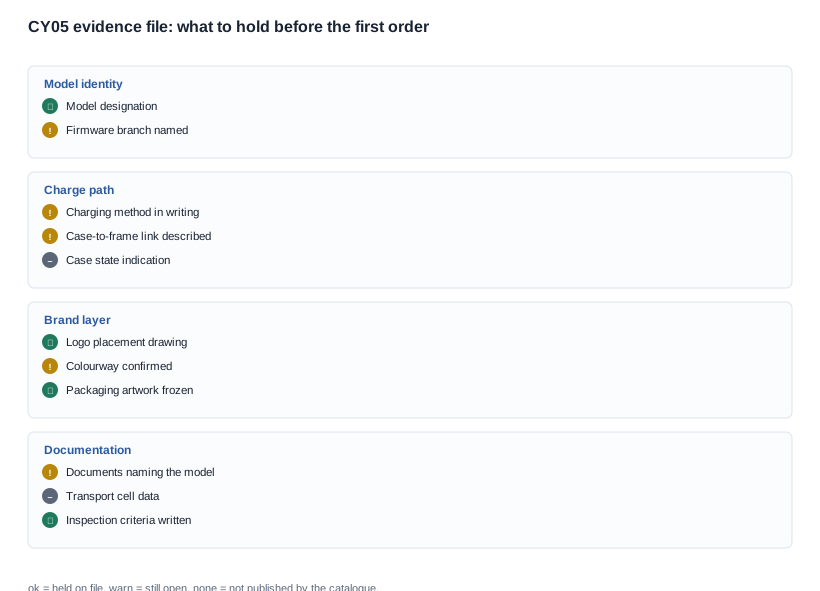
The evidence file is what makes a second order safer than the first. This is what we would ask a buyer to hold, and what a supplier should be able to produce on request.
| Evidence | Who owns it | Due when | If it never arrives |
|---|---|---|---|
| Model designation and mark artwork | Buyer approves, supplier produces | Before print | Nothing downstream can be finalised |
| Charging method and case-to-frame link | Supplier answers in writing | Before the case insert is tooled | The box contents list is unverifiable |
| Case configuration and capacity | Supplier confirms | Before the artwork is approved | The insert and the freight assumptions are guesses |
| Firmware branch and device name | Supplier confirms | Before pairing copy is written | The packaging instructions contradict the product |
| Certificate file naming the model | Supplier issues | Before the consignment is booked | The goods have no documented conformity position |
| Transport cell data for the case | Supplier provides | Before the container is booked | The second cell is undocumented |
| Approved sample, sealed | Buyer approves and stores | Before the production run | There is no reference unit for inspection |
| Written inspection criteria | Buyer writes, supplier accepts | Before the run is released | Inspection is a negotiation instead of a check |
Two things in that table are worth keeping in view. First, the certificate file is a question about the configuration that ships: the catalogue's one export certification page is a set of images rather than text and no mark appears in the catalogue wording for this model, so the documents that name this model and its final configuration are something to request in writing from the supplier, not something to read off a product page Second, the approved sample and the written inspection criteria are the two items the buyer controls, and they are the two that most often get skipped when a launch date arrives early.
The inspection criteria deserve a sentence of their own, because the specification rows on this page cannot be written into a pass or fail rule. Nobody can inspect "about seven hours" without knowing what the seven hours assumes, and nobody can inspect "8 MP" without the resolution class being the agreed reference. The practical form of a criterion on a camera model is a reference unit plus an agreed list of what is being judged: the frame and case markings, the accessory count in the box, the printed insert in the market language, the device name in the firmware, and the camera output against a scene the buyer has defined. The CY05 buyer review checklist works through the full acceptance list, and the brand guideline mapping step is where the moulding usually pushes back on the identity.
What CYNRIN can evidence on the CY05 today
The published row for this model is short and we will quote it exactly as it stands: eight-megapixel resolution class, 290 mAh, about seven hours of rated use, a charge time of two hours or less, and a 1400 mAh charging case. The charging method is not published, and that gap is stated in our own documentation rather than filled with a plausible answer.
That is also where our position on this model sits. We will not quote a case capacity for a neighbouring model, we will not turn a resolution class into an image-quality claim, we will not present about seven hours as a working day, and we will not publish a price, a minimum order quantity, a lead time, a volume or a warranty period in an article — our internal documentation still holds conflicting minimum order quantity figures that have not been arbitrated, and a programme built on a number we cannot stand behind is a reprint waiting to happen. We will also not describe the camera in terms the catalogue does not support, and we will not present an unpublished interface as though it were a published feature.
What we will do is answer the charge-path questions for this model in writing, confirm what is available for the configuration you are actually buying, and tell you which parts of the programme are already defined and which have to be closed first. The family sits on our AI camera glasses range page, and the route a brand programme normally follows — from a first conversation to a sealed sample — is set out in partnering with a factory that ships.
Related reading
- Where this model sits on a shared platform — which camera models are ready for a brand programme
- What a case does to the parcel — charging case options for camera glasses
- The paperwork that travels with the goods — export documentation checklist
Send us the model, the markets, the volume and the brand elements you need, and we will tell you which of the open lines are already closed and which one we would chase first.


