

The S7 is the sport camera model in the CYNRIN catalogue, and it publishes one attribute that the rest of the camera family does not: an IP54 ingress marking. It is also one of the models with the thinnest documented commercial envelope in the range, because the catalogue gives the S7 a name, a cell, a runtime band, a charge ceiling, a charging method and an ingress rating, and stops there. There is no published Bluetooth version, no published unit weight, no published charging case capacity, no published colour list, no published size range, no published certification reference and no published price, minimum order quantity, lead time, sample cost or warranty term.
That combination is the working condition for a private-label programme on this model. A procurement lead who treats the IP54 marking as a finished compliance argument builds a claim that cannot be supported the moment a market authority asks for the report behind it. A procurement lead who treats it as the published feature it is, and who converts every other silence into a written request before the purchase order is raised, can build a sport programme on this platform without over-claiming anything.
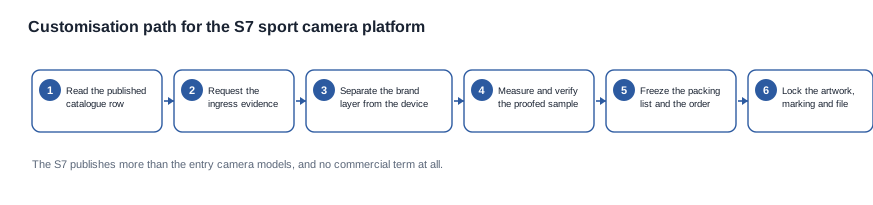
What follows is that programme in the order it runs. First the published row and an honest reading of what it licenses. Then the separation of the brand layer from the device, because the identity work has a fixed sequence and an irreversible order. Then the verification pass, where each open field becomes a written request with a named owner. Then the commercial terms, which are not published at all and therefore have to be requested rather than assumed. And finally a hypothetical launch, clearly marked as a reconstruction, that shows where the published record runs out.
The reader here is the buyer. Every step below is something a sourcing team can execute: a question to put in writing, a line to add to the purchase order, a document to freeze, a row to add to a comparison sheet.
What the catalogue publishes for the S7
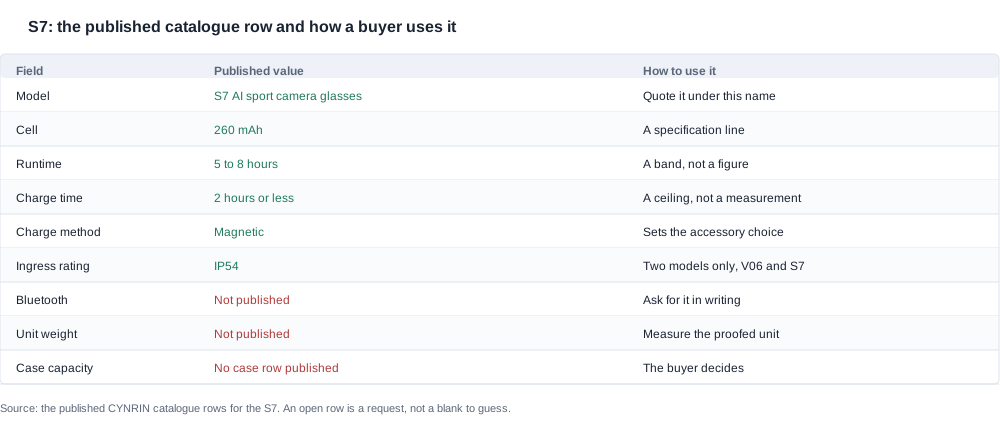
The published row for the S7 is reproduced below exactly as the catalogue states it, with the open fields shown as open rather than filled with an assumption.
| Catalogue field | Published value for the S7 |
|---|---|
| Model designation | S7 |
| Catalogue name | S7 AI sport camera glasses |
| Battery cell | 260 mAh |
| Runtime | 5 to 8 hours |
| Charging time | 2 hours or less |
| Charging method | Magnetic |
| Ingress protection rating | IP54 |
| Bluetooth version | Not published for camera-series models |
| Unit weight | Not published for this model |
| Charging case capacity | No case row published for this model |
| Price, order terms and warranty | Not published |
Four readings of that row matter more than the others.
The runtime is a band, not a figure. The camera models in this catalogue publish their runtime, and the S7 belongs to the 5-to-8-hour group that covers the entry and mid tiers of the family. The honest commercial claim is therefore a range with its boundaries stated. Turning a range into a single number in a listing, a spec sheet or a sales deck is a claim the published record does not support, however reasonable the number sounds.
The charge time is a ceiling. Two hours or less is the published limit for reaching a full charge from the magnetic dock. It is not a typical charge time, it is not a fast-charge claim, and it cannot be shortened in marketing copy into a promise of a specific duration. A buyer who quotes it as a ceiling has a defensible line; a buyer who quotes it as an average has invented a measurement.
The charging method is magnetic, and the S7 is one of three rows in the catalogue — with the V03 and the V06 — that carries no charging case capacity row at all. The consequence is practical: whatever ships in the box to charge the frame has to be specified, weighed and frozen by the buyer, because the catalogue does not describe it.
The ingress rating is the distinguishing row. An IP54 marking appears against exactly two models in the catalogue, the V06 and the S7, which makes it a genuine differentiator for a sport programme rather than a table-staking line item. It is also published as a marking and not as a test record. The catalogue publishes no test report number, no laboratory name, no test standard and no report date for it, and the export certification page is an image page without a per-model certification row. The conclusion for a brand is precise: the S7 can be described as carrying an IP54 marking, exactly as a cell capacity or a charging method can be described, while the evidence behind that marking remains a document the buyer has to obtain in writing. On the export paperwork, the catalogue body carries no CE, FCC, RoHS or RED reference for any model, so there is no certificate number, no test report identifier and no conformity claim that can be printed for the S7 on the strength of the catalogue alone.
One further published fact belongs here because it is easy to misapply. The only unit weight published anywhere in the catalogue belongs to the MT6, at 158 g for the eyewear body measured without its 1200 mAh folding case. The S7 publishes no weight of its own, so a buyer must not carry the MT6 figure across, and must not treat the existence of a weight somewhere in the range as evidence that one exists for this model. The only defensible route to a weight is a measurement on the proofed unit in the state it will ship, written into the specification sheet with the measurement conditions attached.

Where an S7 private-label programme separates the device from the identity
Identity work on this model follows the same fixed sequence as the rest of the camera range, but two steps carry more commercial weight here, because what the sport context implies downstream.
The firmware device name leads. The pairing string set in firmware propagates into the pairing instructions, the quick start card, the packaging artwork, the marketplace listing and every support ticket that arrives afterwards. A late change means reissued artwork, a re-run print and a wave of pairing questions from customers holding the wrong name. The factory should supply the string and the change procedure in writing, and the brand should treat it as a long-lead item rather than a small edit.
The logo is placed against the moulding. A private mark on this platform means establishing where surface area exists on the temple, what the minimum print area is, which marking process the factory accepts, and what a curved surface will not take. The brand guidelines for OEM ready platforms covers the mapping step in which the hardware constrains the identity, and it surfaces that constraint before artwork is produced rather than after the proof arrives.
The colour is established, not chosen. The catalogue publishes no colour list for the S7, so the merchandising plan begins with a question rather than a selection: which colourways exist in the tooling for this model, which are shared with the V06 that sits on the same platform, and what a new colour costs in tooling and in lead time. A new colourway is a manufacturing decision with a price attached, and it belongs in the budget before the brand owner expresses a preference.
The size system is the commercial spine of a sport programme. No size range is published for the S7, so the size matrix has to be built from physical units rather than read from a chart. That matrix decides the carton plan, the number of stock-keeping units per size, the size guide in the listing and the point-of-sale selection process, which is why it cannot be settled after the packaging artwork is drawn. The fit and sizing analysis for the sport range covers how to build that matrix from samples, and the durability testing piece covers the joints and the cycle count that have to survive it.
The box is per market, and the accessory configuration sits inside it. The frame, the charging accessory that ships with it, the printed quick start in the market language, the warranty card, the market leaflet and the compliance markings together form the contents list, and that list changes market by market. The packaging options analysis for the sport range covers what each accessory and each market does to the carton, and the AI camera glasses shipping weight breakdown covers how the packed unit drives the parcel arithmetic.
The marking and the model number lock last. The model number on the label, the marking on the device, the artwork, the production file and the paper that travels with the goods form one set and are frozen together. The model selection analysis for the sport range sets the range decision against the alternatives, and the V06 versus S7 battery and charging comparison covers the pairing decision for a buyer running two models from one supplier relationship.
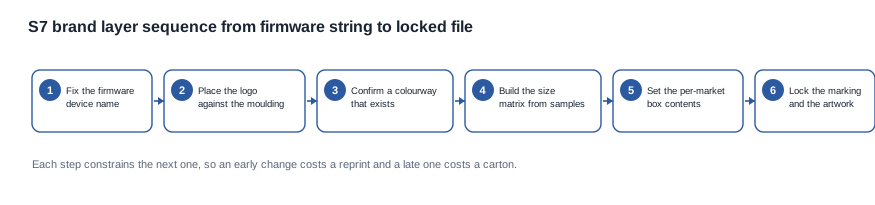
The deliverable of this stage is a single signed document: a brand layer specification listing the device name string, the logo artwork with its permitted placement and dimensions, the confirmed colourway, the size matrix, the per-market box contents, the model number and the marking. Everything downstream inherits from that document, and anything that contradicts it is a change request rather than an adjustment.

Verifying an S7 specification before the purchase order is placed
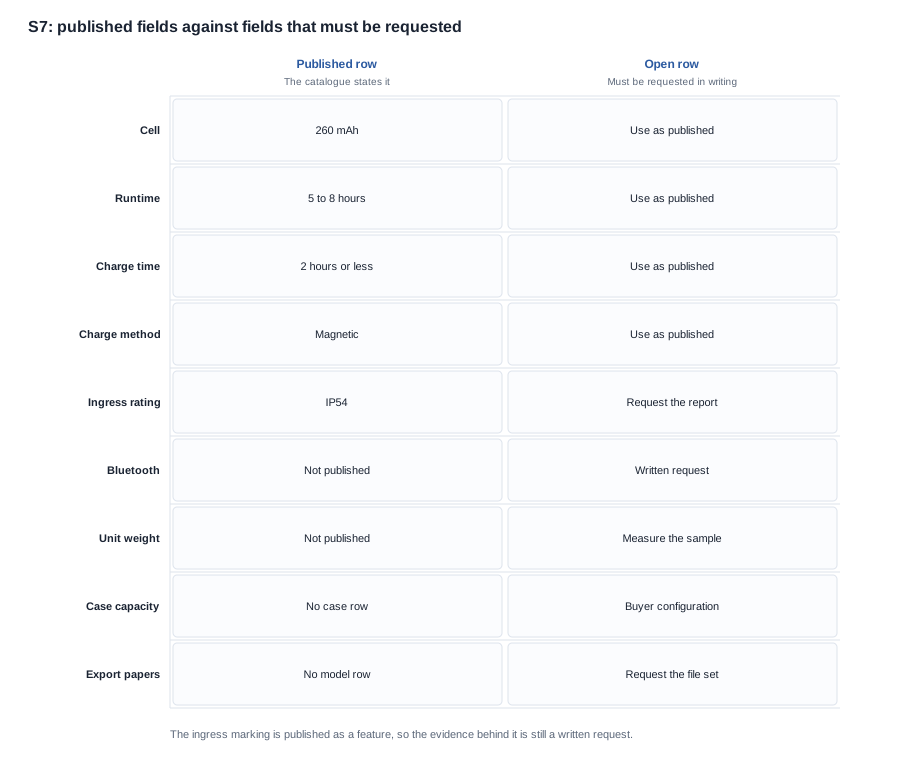
Verification on this model is a conversion exercise. Six published parameters stay exactly as they are, and every other field becomes a written request with a named owner and a date. The specification sheet should carry the parameter, the value or the word pending, and the source of the value, so that no later reader can mistake an assumption for a published fact.
| Parameter | Value on the S7 | Source status | Who closes it |
|---|---|---|---|
| Battery cell | 260 mAh | Published | Catalogue |
| Runtime | 5 to 8 hours | Published band | Catalogue |
| Charging time | 2 hours or less | Published ceiling | Catalogue |
| Charging method | Magnetic | Published | Catalogue |
| Ingress rating | IP54 | Published marking, evidence requested | Factory |
| Bluetooth version | Not published | Written confirmation needed | Factory |
| Unit weight | Not published | Measure on proofed sample | Buyer and factory |
| Charging case | No case row published | Configuration decision | Buyer |
| Export documents | No per-model row published | Written request needed | Factory |
| Sensor and lens detail | Not published | Written confirmation needed | Factory |
Two of these rows need a specific procedure rather than a general request.
The IP54 evidence is the most valuable document in this programme and the easiest to leave vague. The request should name what the buyer needs: the test standard against which the ingress marking was established, the laboratory that performed the test, the report number, the report date, and the sample identification the report covers. A reply that repeats the marking but supplies none of those details has not closed the row, it has restated it. The certification status for this model sets out the difference between a marking on a published row and a report a buyer can file, and it is the reference to read before the request goes out.
The unit weight cannot be sourced from any published row, because the only weight published belongs to a different model and excludes that model's folding case. A measurement on the proofed production unit, in shipping configuration, on a calibrated scale, is the only route. That number then supports the freight calculation and the parcel profile, and it is defensible because its provenance is written down beside it.
The sample session closes what no specification can carry. Approve against the written sheet rather than against a demonstration unit, and check the framing, because no field of view is published for this model and the framing is what the customer judges. Time the charge cycle against the published ceiling rather than against an expectation. Compare the firmware string on the unit against the signed brand layer specification. Confirm that the accessory configuration in the box matches the packing list that was already frozen. The common questions for this model works the same ground from the buyer's side, and the durability testing piece covers the verification method for the joints and cycles that a sport programme claims.
Change control is the step that gets skipped. The specification sheet needs a version number and a rule: any change to a cell, a firmware string, a colourway, a size variant, a logo placement, a marking or a box content requires a new version, a new approval and a new sample cycle. That rule is cheap to write and expensive to omit, because the cost of an unlogged change is a carton that has to be reworked, re-labelled and re-shipped, or a size guide in the listing that no longer matches the units in the box. The export documentation checklist covers the technical file and the paper that travels with the shipment, and that file has to carry the same version number as the specification it was produced against.
The practical due diligence question to ask the factory before you order is not about the hardware at all. It is which document set will accompany this model into the destination market, who signs it, and how a change to the production file invalidates it. A supplier who can answer that in a single reply is a supplier whose technical file can be versioned. A supplier who cannot is a supplier whose documentation will be assembled after the first shipment.

Pricing and order terms for an S7 private-label run
No commercial term is published for the S7. The catalogue carries no price band, no minimum order quantity, no lead time, no sample cost, no warranty term, no production capacity figure and no payment schedule. That absence is not a gap in this article; it is the condition the buyer works under, and the correct response is a structured written request rather than an estimate that later hardens into a commitment.
Send the request as one package so that the answers can be compared side by side. Ask for the unit price at the proposed quantity band, the MOQ per model and per colourway and per size variant, the tooling or non-recurring engineering charge and whether it applies per colourway, the sample order cost and whether it is credited against the first order, the lead time from deposit to shipment together with how much of it is queue time rather than production, the warranty period and what it covers, the monthly production capacity for this platform, the payment terms and the incoterms, and the freight profile with carton dimensions and gross weight.
Every answer goes into the same comparison table, one column per supplier and one row per term, and each cell is marked with its source: written quotation, catalogue, or measured on a sample. A term answered verbally carries a different mark from one answered in writing, because a verbal answer is not evidence and cannot be placed in a purchase order. The shipping weight breakdown explains why the measured packed weight belongs in this table rather than in a side conversation, since the packed unit and the bare frame produce different cartons, different freight classes and different landed costs.
Then write the purchase order so that it closes the same gaps. A workable order for this model names the model designation and the catalogue name exactly as published, the agreed configuration row by row including the firmware device name, the colourway, the size variant, the logo placement and the marking, the packing list with carton quantity, carton dimensions and gross weight, the packaging artwork version, the document list that must travel with the goods including the ingress evidence and the export file, the inspection criteria, the defect remedy, the warranty term, the payment terms, the incoterms, and the lead time with its start condition.
Freezing the packing list deserves its own line. On this model the packing list is the only place where the charging accessory configuration becomes binding, because the catalogue publishes no case row for the S7 and the accessory therefore sits with the buyer. Once the packing list is frozen with the accessory configuration inside it, the packed weight follows from the measured frame weight plus the measured accessory weight, and the carton plan, the freight class and the landed cost follow from that. A packing list changed after the print run is a new print run, not an adjustment.
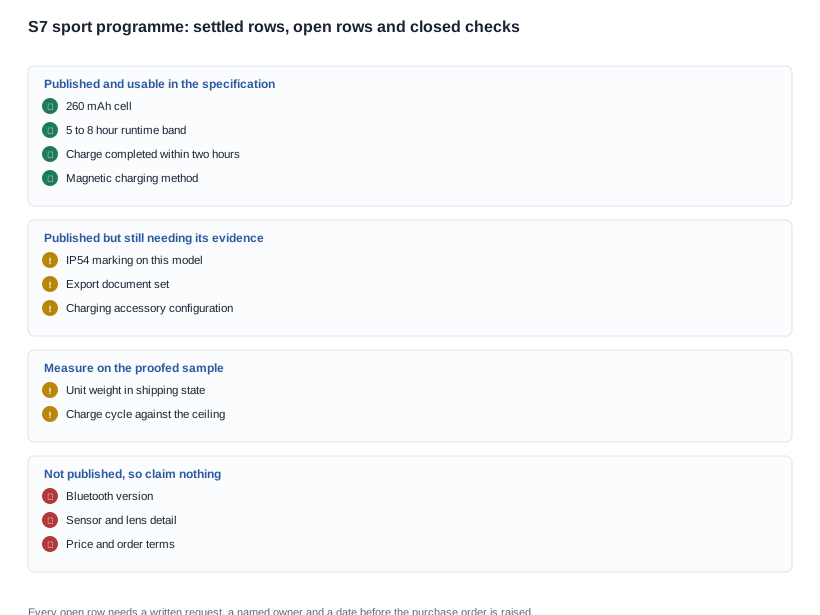
Where CYNRIN stands on the S7 private-label question. We will not publish a certification reference the catalogue does not contain, so the buyer should ask for the export documents in writing before the artwork is locked. Our position is that the ingress marking is a published feature of this model, and a feature still needs its evidence before it can become a claim in a listing or on a carton.
Three commercial risks sit behind that position, and they are the ones to negotiate on. The first is the accessory configuration, because it changes the packed weight and therefore the freight class, and the catalogue publishes no case row to constrain it. The second is the size matrix, because a size range that is agreed late multiplies both the carton plan and the stock-keeping units a channel partner has to carry. The third is the documentation set, because an unresolved export file is the kind of risk that stops a shipment at a border rather than at a factory gate. Naming all three in the quotation request, with a date against each, is the difference between a supplier evaluation and a negotiation.
The export documentation checklist covers the paper that travels with the goods, and the packaging options analysis covers the configurations that determine the packed unit. Together they give the buyer the inputs that decide the landed cost on a model where the catalogue publishes no commercial row at all.
A hypothetical S7 launch, and the limits of the published record
The following is a reconstruction, not a case study. No customer, no order, no volume and no figure in this section comes from a real programme, and it should not be read as a record of one. It is included to show how the stages connect when they run in sequence.
A brand owner has decided to enter the sport camera category with the S7 as a single SKU rather than a range. The reasoning is that the ingress marking gives the listing a technical line the entry camera models cannot have, and that one model keeps the approval chain short. The operating assumption is two markets, one language to start, one colourway, and a size matrix of two or three variants depending on what the samples show.
In the first stage, the buyer issues one written request built from the open rows of the specification table: the Bluetooth version, the ingress test evidence with its standard, laboratory, report number and date, the export document set, the charge accessory configuration, and a sample order request with its cost and terms. The factory replies in writing. The ingress row is the one that matters most, and a reply that carries the marking but not the report identifier leaves that row open rather than closed.
In the second stage, the brand layer specification is signed: the firmware device name string, the logo placement confirmed against the moulding, the colourway confirmed as existing in tooling, the size matrix built from the sample units, the model number, the marking, and the box contents for each of the two markets. The artwork is produced against that document, and the print file is frozen in the same stage rather than at the end of the programme.
In the third stage, the sample arrives and the measurement session happens. The unit is weighed in shipping configuration, the charge cycle is timed against the published ceiling, the firmware string is compared against the signed specification, the framing is assessed because no field of view is published, and the accessory configuration is checked against the packing list that was already frozen. The measured weight is written into the specification sheet as a measured value, and it is the only weight figure the brand is entitled to publish.
In the fourth stage, the commercial request is answered. Price band, MOQ, lead time, sample order cost, warranty, capacity, payment terms and incoterms arrive as a written quotation, the terms are entered into the comparison table with their sources marked, and the purchase order is raised against the frozen artwork version, the frozen packing list and the versioned document set.
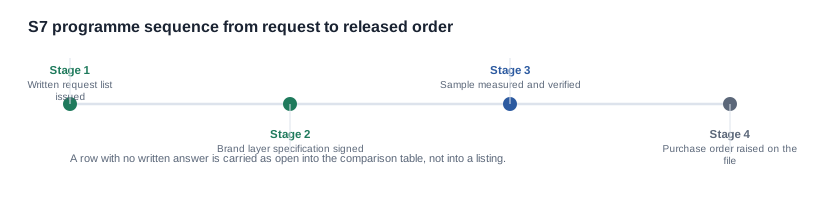
What the published record cannot do is worth stating as plainly as what it can. It cannot supply a unit weight, so the brand publishes none until it has measured one on a proofed unit. It cannot supply a Bluetooth version, so that row stays open until the factory answers in writing. It cannot supply a camera resolution or a lens description, so the listing describes the function in plain terms and quotes no numeric specification it cannot evidence. It cannot supply a charging case capacity, so the accessory configuration is the buyer's decision and appears inside the packing list. It cannot supply a certification reference, so no conformity claim, no certificate number and no test report identifier is printed until the documents arrive. And it cannot supply a single commercial term, so the unit price, the MOQ, the lead time, the warranty and the sample order cost all enter the programme as written answers to a specific request rather than as catalogue figures.
That is the practical shape of an S7 private-label programme. The model is not hard to customise because the hardware is complicated. It is thin on published data, and a thin record is workable as long as every blank is treated as an open request rather than a fact to be assumed.
Related reading
- The range decision — sport smart glasses which model to pick
- The size system — sport smart glasses fit and sizing
- The paperwork — S7 smart glasses certification status
Send us the market, the channel and the expected volume, and we will tell you which of the open rows are already defined for the S7 and which have to be established in writing before the artwork starts.


