

The V03 is the least documented camera model in the CYNRIN catalogue, and that single fact shapes the whole customisation programme. A procurement lead who expects a colour chart, a unit weight, a certification number and a price band on the first call will stall on this platform. A procurement lead who accepts that the published record is short, and who builds the programme around closing each missing row in writing before the purchase order is raised, can put a private-label camera SKU into production without making a single claim the factory cannot support.
What follows is that programme in the order it actually runs. First the published catalogue row and the honest reading of what it does and does not license. Then the separation of the brand layer from the device, because the identity work has a fixed sequence and an irreversible order. Then the verification pass, where unpublished rows become written confirmations attached to the quotation. Then the commercial terms, which are not published at all and therefore have to be requested rather than quoted. And finally a hypothetical launch, clearly marked as a reconstruction, that shows where the published record runs out.
The audience here is the buyer, not the wearer. Every recommendation below is an action a sourcing team can execute this week: a question to put in writing, a line to add to the purchase order, a document to freeze, a row to add to a comparison sheet.
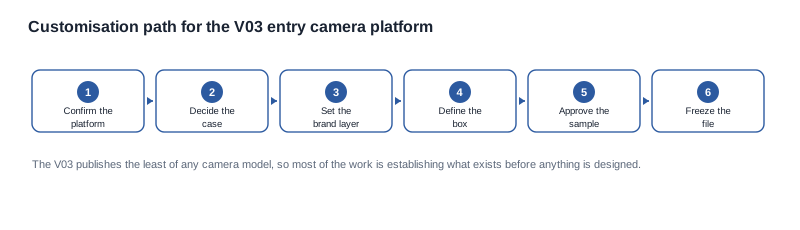
What the catalogue publishes for the V03
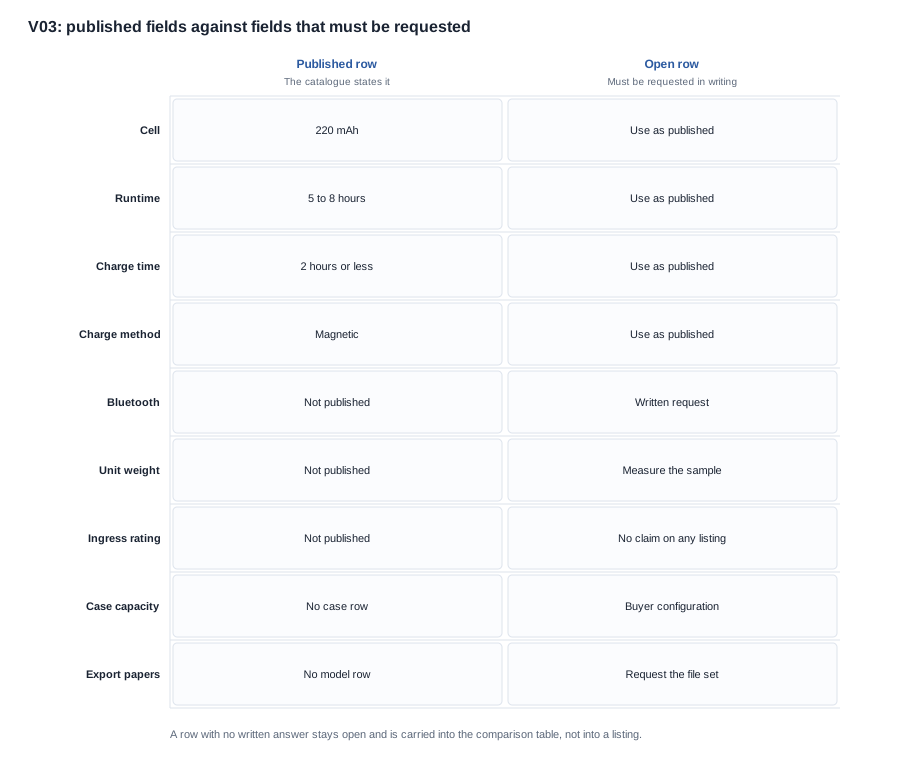
The published row for the V03 is short, and almost every commercial decision on this model descends from it. The table below reproduces the catalogue fields exactly as they stand, including the fields that are deliberately left open.
| Catalogue field | Published value for the V03 |
|---|---|
| Model designation | V03 |
| Catalogue name | V03 AI camera glasses |
| Battery cell | 220 mAh |
| Runtime | 5 to 8 hours |
| Charging time | 2 hours or less |
| Charging method | Magnetic |
| Bluetooth version | Not published for camera-series models |
| Ingress protection rating | Not published for this model |
| Unit weight | Not published for this model |
| Charging case capacity | No case row published for this model |
| Price, minimum order, lead time, warranty | Not published |
Three features of that table drive everything else. The runtime is published as a band rather than a figure, so any marketing copy that turns "5 to 8 hours" into a single number is already outside the record. The charging time is published as a ceiling, not a measurement, so the correct claim is that a full charge completes within two hours and never that it completes in some shorter time the buyer happens to prefer. And the charging method is magnetic, which matters because a magnetically charging frame needs a pad, a dock or a case in the box, and the catalogue publishes no case capacity row for the V03.
The wider catalogue gives the buyer useful context without filling the gaps by inference. Eleven camera models publish a runtime figure, and the V03 sits inside the 5-to-8-hour group that covers the entry tier of the camera family. The V03 and the V06, and the S7 are the rows that carry no charging case row at all, so if a buyer is comparing models on packed weight, the comparison starts from the shipping carton rather than from a case specification that does not exist for these three.
Two more catalogue facts are worth stating plainly, because they are the ones most often assumed. First, an ingress protection rating appears against only two models in the range, the V06 and the S7, both marked IP54; the V03 carries no ingress rating, so no water-resistance language can appear anywhere in the brand, the packaging, the listing or the support material for this model. Second, the only published unit weight anywhere in the catalogue belongs to the MT6, at 158 g for the eyewear body measured without its 1200 mAh folding case. That figure is not transferable to the V03, and a buyer who wants a weight for the V03 has to obtain one by measurement on a proofed unit and record it in the specification sheet as a measured value.
The export paperwork follows the same pattern of silence. The catalogue body carries no FCC, CE, RoHS or RED reference for any model, and the export certification page is an image page without a per-model certification row, so there is no published certificate number, test report number, laboratory name or report date that can be attached to the V03. The correct commercial conclusion is not that the model is uncertified, and it is not that it is certified. It is that the catalogue does not publish a certification reference for it, and that the buyer has to request the documents in writing before any compliance marking or market claim is printed.
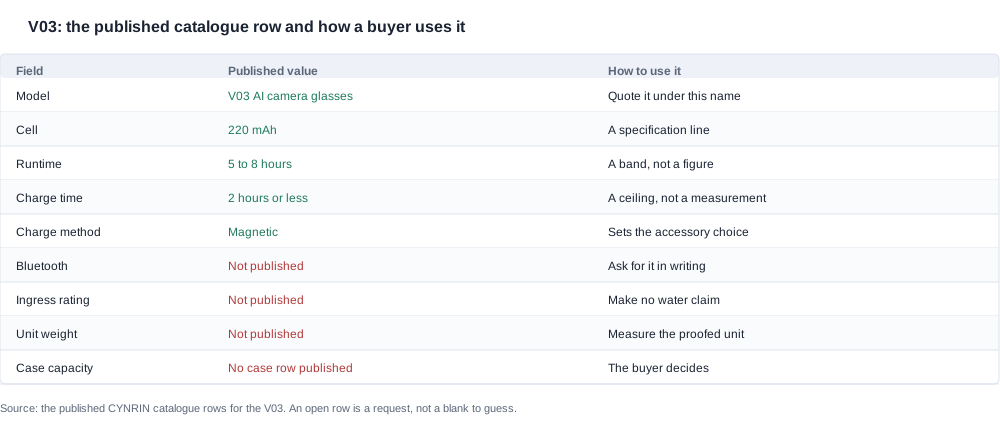
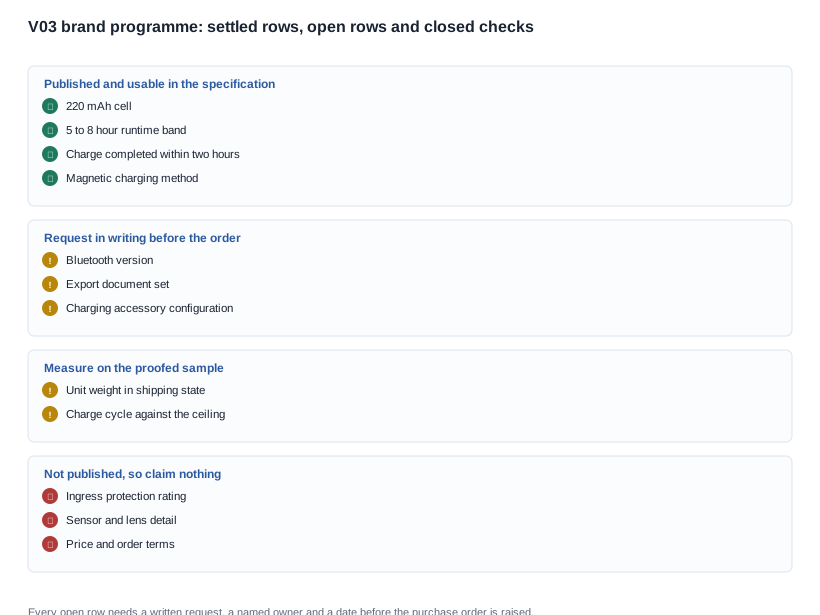
Read this way, the V03 is a platform with a well-defined electrical envelope and an undefined commercial envelope. The cell, the runtime band, the charge ceiling and the charging interface are settled facts that can be used in a specification, a listing and a sales conversation. Everything else — weight, ingress protection, Bluetooth version, colour, lens, sensor resolution, case capacity, certification and every commercial term — is a question that belongs in a written request, answered before the purchase order.

Where a V03 private-label programme separates the device from the identity
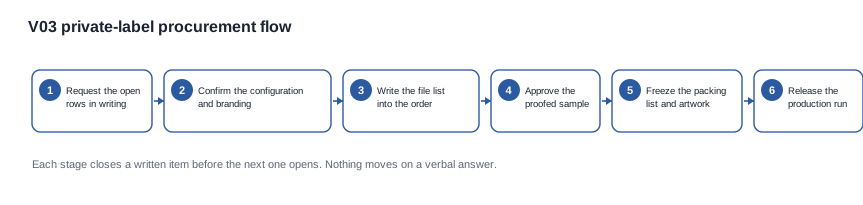
Private-label work on this model is not a design exercise. It is a sequence in which each layer is constrained by the one below it, and several of the steps can only be closed once the factory has answered in writing. The order below is not a preference; it is the only sequence that avoids rework charges.
The device name comes first. The Bluetooth device name shown during pairing is set in firmware and then propagates into the pairing instructions, the quick start card, the packaging artwork, the marketplace listing and every support ticket that follows. Changing it late means reissuing artwork, re-running the print, and answering a wave of pairing questions from customers holding the wrong name. Ask the factory for the firmware string and the process for changing it, and treat the answer as a long-lead item rather than a small edit.
The logo is placed against the moulding, not on it. A private label on this platform means finding out where surface area actually exists on the temple, what the minimum print area is, whether the marking is screen-printed, pad-printed or laser-etched, and what the factory will and will not put on a curved surface. The brand guidelines for OEM ready platforms covers the mapping step where the hardware pushes back on the identity, and it catches that constraint before artwork is produced rather than after the proof arrives.
The colour is established rather than chosen. The catalogue publishes no colour list for the V03, so the merchandising plan starts with a question: which colourways exist in the tooling for this model, which of them are shared with other models on the same platform, and what a new colour requires in tooling cost and lead time. A new colour is a manufacturing decision with a price attached, not a preference, and it should be priced into the programme before the brand owner falls in love with it.
The box is per market. The frame, the charging accessory that ships with it, the printed quick start in the market language, the warranty card, the market leaflet and the compliance markings together form the contents list, and that list changes from one market to the next. Every additional market language multiplies the packaging SKUs and the print lead time. The entry level options analysis sets out what each accessory does to the box, and the charging case options piece covers why the absence of a published case row makes the accessory configuration the first commercial question rather than a packaging detail.
The marking and the model number are fixed last, together. The model number on the label, the marking on the device, the artwork, the production file and the paperwork that travels with the goods have to be locked as one set. Which models are OEM ready maps the platform structure, and the export documentation checklist covers the paper that has to accompany the shipment. Locking them separately is the classic way a brand ends up with a box that says one model number and a device that says another.
Two links belong in this section rather than at the end of the article. The V03 Pro customisation piece covers the sibling model that shares this platform, which matters when a buyer intends to run a two-model camera range from one supplier relationship. The bulk ordering analysis covers where the measurement of the packed unit belongs in a pricing sequence, because the packed unit and the bare frame do not produce the same carton, the same freight class and the same landed cost.
The practical output of this stage is a single document: a brand layer specification, signed by both sides, that lists the device name string, the logo artwork with its permitted placement and dimensions, the colourway confirmed as existing in tooling, the per-market box contents, the model number and the marking. Everything downstream inherits from that document, and everything downstream that contradicts it is a change request rather than an adjustment.
Verifying a V03 specification before the purchase order is placed
Verification on this model is mostly about converting silence into evidence. The catalogue gives the buyer six usable parameters. The specification sheet has to hold all of them plus the open rows, each marked with its source, so that no later reader can mistake an assumption for a published fact.
Start with the published rows, transcribed exactly: model designation V03, catalogue name V03 AI camera glasses, 220 mAh cell, 5-to-8-hour runtime, charge completion within two hours, magnetic charging. Then append the open rows with the status of each, so the sheet becomes the request list rather than a description. The practical format is a three-column table with the parameter, the value or the word pending, and the source of the value.
| Parameter | Value on the V03 | Source status | Who closes it |
|---|---|---|---|
| Battery cell | 220 mAh | Published | Catalogue |
| Runtime | 5 to 8 hours | Published band | Catalogue |
| Charging time | 2 hours or less | Published ceiling | Catalogue |
| Charging method | Magnetic | Published | Catalogue |
| Bluetooth version | Not published | Written confirmation needed | Factory |
| Unit weight | Not published | Measure on proofed sample | Buyer and factory |
| Ingress rating | None published for this model | Written confirmation needed | Factory |
| Charging case | No case row published | Configuration decision | Buyer |
| Export documents | No per-model row published | Written request needed | Factory |
| Sensor and lens detail | Not published | Written confirmation needed | Factory |
Three of these rows deserve a specific procedure rather than an email.
The Bluetooth version is the one that most often gets assumed. The camera series does not publish a Bluetooth version for its models, so the buyer must not write a version into the specification sheet from memory or from another product in the range. The correct instruction to the factory is to state the version in the quotation response, in writing, so it becomes part of the order record.
The unit weight cannot be copied from any other row, because the only published weight in the catalogue belongs to a different model and excludes that model's folding case. The only reliable route is measurement: weigh the proofed production unit, in the state it will ship, on a calibrated scale, and write the result into the specification sheet as a measured value with the measurement conditions attached. That number then supports the freight calculation and the comfort claims in the listing, and it is defensible because its provenance is written down.
The export documents need a named artefact. The catalogue publishes no per-model certification row, so the request should ask for the document set that will accompany this model in the destination market, with the issuing body, the document number, the test report number and the test standard named in the reply. A reply that cannot supply those four items has not closed the row, and the brand must not print a compliance marking that the supplier has not evidenced.
Once the rows are closed, the sample does the last part of the work. Approve against the written specification rather than against a demonstration unit, and check the things a specification cannot carry: the first-person framing, because no field of view is published and the framing is what the end customer judges at the moment of use; the charge cycle, measured against the published ceiling rather than against an expectation; and the firmware string, which must match the one written into the brand layer specification. The published V03 specifications and features records what is on the record, and the V03 pre-order checklist works the same ground from the buyer's side.
Change control is the part that gets skipped. The specification sheet needs a version number and a rule: any change to a cell, a firmware string, a colourway, a logo placement, a marking or a box content requires a new version, a new approval and a new sample cycle. That rule is cheap to write and expensive to omit, because the cost of an unlogged change is a carton that has to be reworked, re-labelled and re-shipped. Scaling up an OEM ready platform covers the second and third model in a range, where a versioned specification becomes the thing that makes an additional SKU cheap instead of a second negotiation.
Pricing and order terms for a V03 private-label run
No commercial term is published for the V03. The catalogue carries no price band, no minimum order quantity, no lead time, no sample cost, no warranty term, no production capacity figure and no payment schedule. That absence is not a gap in the article; it is the condition the buyer has to work under, and the correct response is a structured request rather than an estimate.
The request itself is simple and should be issued in one package so that the answers can be compared side by side. Ask for the unit price at the proposed quantity band, the minimum order quantity per model and per colourway, the tooling or non-recurring engineering charge and whether it is per colourway, the sample cost and whether it is refunded or credited against the first order, the lead time from deposit to shipment and how much of it is queue time versus production, the warranty period and what it covers, the monthly production capacity for this platform, the payment terms and the incoterms, and the freight profile including carton dimensions and gross weight.
Put every answer into the same comparison table, one column per supplier, one row per term, and mark each cell with its source: written quote, catalogue, or measured. Rows that come back as a verbal answer rather than a written one should carry a different mark, because a verbal answer is not evidence and cannot be placed in a purchase order. The bulk ordering analysis sets out why a measurement belongs in this table rather than in a side conversation with the account manager.
Then write the purchase order so that it closes the same gaps. A workable purchase order for this model names the model designation and the catalogue name exactly as published, the agreed configuration row by row including the firmware device name, the colourway, the logo placement and the marking, the packing list with the carton quantity, the carton dimensions and the gross weight, the packaging artwork version, the document list that must travel with the goods, the inspection criteria, the defect remedy, the warranty term, the payment terms, the incoterms and the lead time with its start condition.
Freezing the packing list deserves its own line in the order. On this model the packing list is the only place where the charging accessory configuration becomes binding, because the catalogue publishes no case row and the accessory decision therefore sits with the buyer. Once the packing list is frozen with the accessory configuration inside it, the packed weight can be calculated from the measured frame weight plus the measured accessory weight, and the freight class, the carton plan and the landed cost follow. A packing list changed after the print run is a print run, not an adjustment.
Where CYNRIN stands on the V03 private-label question. We will not publish a certification reference the catalogue does not contain, so the buyer should ask for the export documents in writing before the artwork is locked. Our position is that a commercial term is only a term once it is in writing, which is why every item on the list above is requested as a written answer attached to the quotation rather than as a verbal indication carried into a purchase order.
The export documentation checklist sets out the paper that has to travel with the goods, and the charging case options analysis covers the accessory configurations and what each one does to the packed unit. Read together with the entry level options piece, they give the buyer the three inputs that decide the landed cost on a model where the catalogue publishes no commercial row at all.
A hypothetical V03 launch, and the limits of the published record
The following is a reconstruction, not a case study. No customer, no order, no volume and no figure in this section comes from a real programme, and none of it should be read as a record of one. It exists to show how the stages above connect when they run in sequence.
A brand owner has decided to enter the camera category with a single entry SKU rather than a range, on the reasoning that the entry platform carries the least specification risk and the shortest approval chain. The operating assumption is one market to start, one language, one colourway.
In the first week, the buyer issues a single written request built from the open rows in the specification table: the Bluetooth version, the export document set, the charge accessory configuration, and a sample request with its cost. The factory replies in writing, and the two rows that were genuinely open — the Bluetooth version and the export document set — close. The ingress row closes by confirmation that no rating is published for this model, which is an answer too, and it is the answer that stops a water-resistance line from appearing in the listing.
In the second week, the brand layer specification is signed: the firmware device name string, the logo placement confirmed against the moulding, the colourway confirmed as existing in tooling, the model number, the marking, and the box contents for the single market. The artwork is produced against that document, and the print file is frozen the same week rather than at the end of the programme, because artwork drift is the most common source of a re-print.
In the third week, the sample arrives and the measurement session happens: the unit is weighed in shipping configuration, the charge cycle is timed against the published ceiling, the firmware string is compared against the signed brand layer specification, and the framing is assessed because no field of view is published for this model. The measured weight is written into the specification sheet as a measured value, and it is the only weight figure the brand is entitled to publish.
In the fourth week, the commercial request is answered. Price band, minimum order, lead time, sample cost, warranty, capacity, payment terms and incoterms arrive as a written quotation, the terms are entered into the comparison table, and the purchase order is raised against the frozen artwork version and the frozen packing list. The accessory configuration is inside the packing list, so the packed weight and the carton plan follow from it rather than being estimated.
What the record cannot do is worth stating as clearly as what it can. It cannot supply a weight, so the brand publishes none until it has measured one. It cannot supply an ingress rating, so the brand publishes no water-resistance claim. It cannot supply a certification reference, so the brand prints no compliance marking and makes no conformity claim until the documents arrive in writing. It cannot supply a camera resolution or a lens description, so the listing describes the function in plain terms and quotes nothing numeric. It cannot supply a Bluetooth version, so the buyer holds that row open until the factory answers. And it cannot supply a single commercial term, so the unit price, the minimum order, the lead time, the warranty and the sample cost all enter the programme as written answers to a specific request rather than as catalogue figures.
That is the practical shape of a V03 private-label programme. The model is not difficult to customise because the hardware is complicated. It is thin on published data, and a thin record is manageable as long as the buyer treats every blank as an open request rather than as a fact to be guessed.
Related reading
- The platform structure — OEM ready platforms which models are ready
- The catalogue rows for this model — V03 smart glasses specifications and features
- The buyer's own checklist — V03 smart glasses what to check before ordering
Send us the model, the brand elements, the markets and the expected volume, and we will tell you which of the open rows are already defined for the V03 and which have to be established in writing before the artwork starts.


