
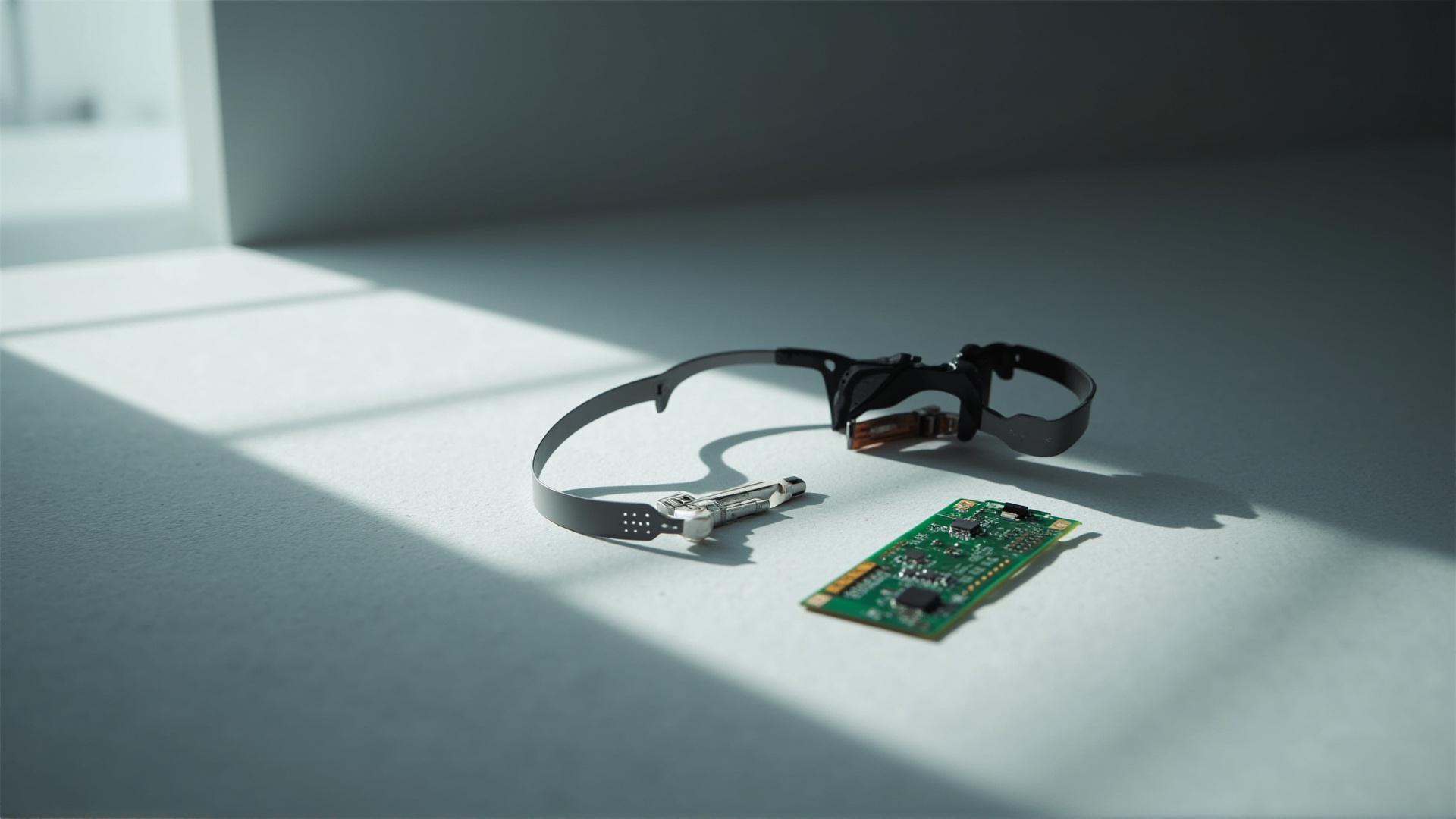
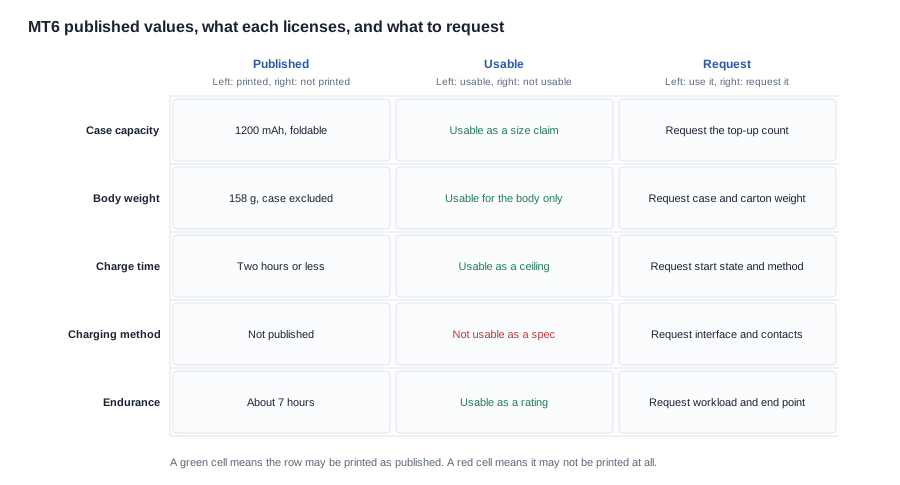
The MT6 smart glasses publish eight megapixels, a 265 mAh cell, a charge time of two hours or less, roughly seven hours of rated use, a 1200 mAh foldable charging case and a body weight of 158 g. Two of those rows are unusual enough to shape everything else about the product: the case folds, and the 158 g applies to the glasses body alone rather than to the body plus the case. The charging method, by contrast, is not published at all. A quick-start card written for this model therefore cannot name a cable, a port or a dock, and a freight calculation cannot use the case weight, because neither figure exists in our catalogue. What a procurement team can do is work outward from the foldable case, because a case that folds changes the take-out rhythm, the storage footprint and the transport declaration at the same time, and all three land on the buyer's cost sheet before a single unit ships.
MT6 smart glasses how to use: the foldable case sets the operating line
The feature row our catalogue prints for this model is short and unusual. It carries three ideas in one line: portability, an ultralight note, and a 158 g body paired with a foldable charging case. Read as a single marketing phrase it says very little. Read as three separate statements it says almost everything about how the product is handled, and it is worth separating them before anything is ordered, because a procurement team that treats "158 g, foldable" as one number will mis-plan the packaging and mis-state the shipping weight.
The 158 g is the weight of the glasses body, including the 265 mAh cell and the camera. The folding case is a separate object with its own 1200 mAh capacity and its own weight, and that weight is not published. The consequence for a buyer is immediate and unglamorous: the unit weight that goes on the packing list is 158 g plus an unknown, and every freight, insurance and courier calculation built on that number inherits the unknown. This is not a defect in the data. It is the correct state of a catalogue that publishes the figure it can stand behind and no more, and the professional response is to request the missing weight in writing rather than to estimate it from a similar model.
The second consequence is structural, and it is where the fold matters most. A rigid case supports one motion — the frame goes in, the frame comes out. A folding case adds a hinge, and a hinge adds states. The case is now flat or upright, open or closed, folded or unfolded, and each combination has a different footprint, a different handling instruction and a different failure mode. A frame seated in a folded case may not charge. A hinge may not survive the folding cycle a distributor expects. A flat case may not stand on its own. None of these are catalogue facts, because our catalogue publishes no charging-method row, no hinge specification and no case weight for this model, and no instruction page exists for it. What a buyer can do is treat the hinge as a designed joint that must be specified, the way a buyer would treat any other mechanical interface arriving in a consumer package.
The third consequence concerns the rhythm of a working day, and it is the part most often left out of operating instructions. A foldable case turns charging from an event into a habit. With a fixed dock or a fixed cable, charging happens at a location. With a case that folds, charging can happen in a bag, in a vehicle, on a bench, at the end of a shoot, and the case becomes the place where the product lives rather than the place where it is stored. That is the argument the fold makes, and it is a genuine product benefit for a camera model aimed at people who shoot away from a desk. It is also the argument a buyer must check on a sample order, because the benefit depends entirely on the case staying closed and the frame staying seated in a moving bag, and that is exactly the behaviour our catalogue does not describe.

The sequence above is a proposal, not a procedure. Each arrow corresponds to a question the catalogue leaves open: whether the frame charges with the case closed, whether the indicator is on the case or on the temple, how many folds the hinge is expected to survive, and whether a case that has been folded shut for a week still reports a usable charge. A buyer who wants a quick-start card can print a version of that sequence with a placeholder for each unknown, but a buyer who wants a card that will not generate support tickets has to resolve the four questions first, which is what the rest of this page is for.
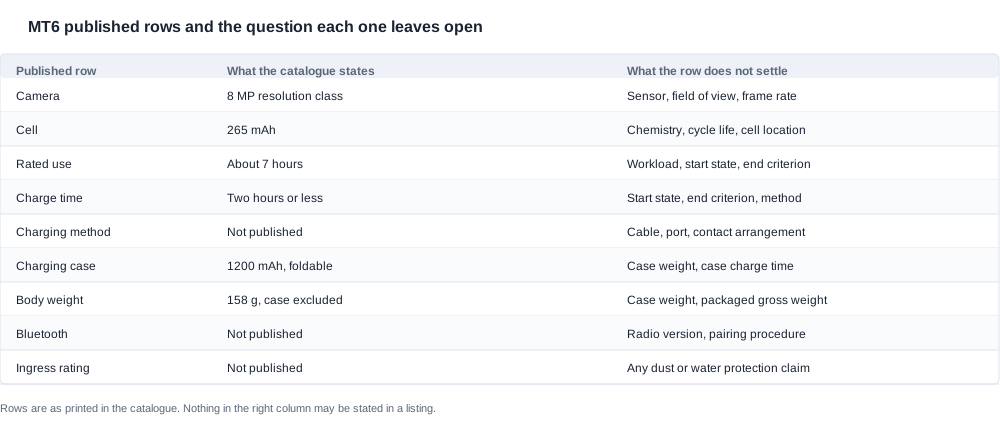
What the MT6 catalogue publishes, and what the foldable case leaves open
Work along the first column of the table and read the third against it; the shape of the gaps is not random, and that shape is the argument of this section. Our catalogue publishes a specification wherever the figure is a settled, printable number, and it publishes nothing wherever the answer would depend on a production configuration that varies between units. The camera row is the clearest example: the catalogue prints the eight megapixel resolution class for this model and stops there — no sensor, no field of view, no frame rate, no video format, no storage size and no low-light figure A buyer who writes "8 MP camera" on a listing is inside the data. A buyer who writes "8 MP with a named sensor" is not.
The electrical rows follow the same discipline. The cell capacity of 265 mAh is published. The rated use of about seven hours is published as a manufacturer rating; the catalogue attaches no workload definition to it, and no start state and no end criterion either. The charge time is published as two hours or less, which is a ceiling rather than a duration. A reading of exactly two hours falls inside what the catalogue permits, so the row may not be reworded as a shorter period, and with no published start state and no completion criterion it cannot be converted into an operational interruption window either. Those three rows can go on a product page in a form a quality team can sign off. What cannot go on the product page is any statement about what the seven hours consists of.
The charging row is the one to be most careful with, because it is the row a buyer is most likely to fill in from a neighbouring model. Our catalogue publishes a charging method for most of the models in this family: some by magnetic contact, some by a Type-C port, and for four camera models including this one, the charging method is not published at all. What is published for the MT6 is the case capacity of 1200 mAh and the fact that the case folds. So the honest position is that this model ships with a 1200 mAh foldable charging case and that the method by which the frame itself is charged is not stated in the catalogue. Filling that gap from a sibling model is a factual error in a listing, and it is one of the errors that a distributor's quality audit finds in the first sample delivery.
The same discipline applies to the case. There is no case weight, no case charge time, no statement about how many times the case can top up the frame, no indicator description and no statement about whether the case itself is replenished through the frame or through a separate port. The catalogue publishes the case capacity and nothing else about the case, and a buyer who needs the number of top-ups or the gross weight has to ask for it.
A buyer weighing this model against a shortlist should apply one set of criteria to every candidate rather than a different set to each, and the three rows that decide this one are the charge interface, the camera detail and the case weight. The same request should go to every supplier, because the rows that separate the candidates are exactly the rows none of them publishes by default, and a due-diligence file that leaves those rows out is incomplete. The complete published row set for this model is collected in MT6 smart glasses specifications and features, and the items this model does not publish are listed separately in MT6 limitations. The wider picture of how camera models differ on their published rows is in how camera models differ on their published battery rows, and the case-versus-cable question across the camera range is in the case-versus-cable question across the camera range.
Charging the MT6 when the charging method is not published
Four of the camera models in our catalogue publish a case capacity and a battery capacity but no charging method or charging-interface row. The MT6 is one of them, and it is the one of the four that also publishes a folding case, which makes the gap sharper here than elsewhere in the range: the case exists, the case has real capacity, and the interface between the frame and the case is exactly the thing the catalogue does not describe.
There is a professional way to write the quick-start card around this gap, and it is not to guess. The card can be written in three layers. The first layer states what is published, without embellishment: the frame carries a 265 mAh cell, the frame charges in two hours or less, the frame is rated for about seven hours, and a 1200 mAh foldable case ships in the box. The second layer describes the motions that follow from the published facts and hold regardless of interface — seat the frame in the open case, close the case, read the charge state, remove the frame. The third layer is a set of blanks that a supplier document fills in: which connector or contact arrangement is used, whether the case charges the frame with the lid closed or open, where the indicator sits, and how the case itself is replenished. Written this way, the card is publishable today, and the blanks are visible to everyone who handles the product, which is a far better position than a card that guesses and generates returns.
The charge-time ceiling deserves to be written on the card in exactly the published form. Two hours or less is a limit the supplier commits to, not a prediction about how long a particular unit takes on a particular day, and the distance between those two readings is the distance between a specification and a liability. The same applies to the endurance rating, which is about seven hours under an unstated workload. Buyers routinely ask for the test method behind a rating, and for this model the request is entirely reasonable: the workload, the start state, the end criterion, the ambient conditions and the build configuration of the measured sample are all things a supplier can document, and none of them are things our catalogue publishes. The general argument for making a supplier document a rating before it goes on a listing is set out in how a published rating becomes a number that survives an audit, and the charging interface questions for this specific model are in MT6 smart glasses charging options.
The commercial consequence of leaving the charging row unfilled is larger than it looks. A magnetic-charged product and a port-charged product impose different accessory logistics: one needs a proprietary contact assembly, the other needs a cable the customer already owns. Our catalogue splits seventeen models on magnetic charging and seven on Type-C, and the four models whose method is unpublished sit in neither camp. A distributor building a channel assortment cannot place this model on a shelf until that is resolved, and a supplier who cannot answer it in writing has told the buyer something important about the documentation discipline of the programme.
The practical instruction for the operating routine is therefore short and should be printed in this form: the MT6 charges in two hours or less from its own 265 mAh cell, and the interface by which it does so is a documented blank. That is the whole of what can go on a card today, and a card that says exactly that is defensible in front of a channel auditor.
The MT6 case as a power reserve: 1200 mAh against a 265 mAh frame
It is tempting to read the two capacities as a ratio, and the arithmetic is worth doing carefully because it is one of the few derived figures a buyer can legitimately compute from published data. The case publishes 1200 mAh and the frame publishes 265 mAh. Simple division gives roughly four and a half times the frame's capacity held in the case. That number is a derivation from two published figures, not a published claim, and it should be labelled as such in any document that carries it — a quality team reading a specification sheet will otherwise treat a derived ratio as a supplier commitment.
Even a derived ratio tells a buyer very little on its own, because three of the inputs are missing. The catalogue does not publish the case's own charge time, so there is no published basis for how long the case takes to refill. It does not publish the conversion efficiency between the case and the frame, so the fraction of the case's capacity that actually reaches the frame is unknown. And it does not publish the number of top-ups the case can deliver, which is the figure an operations team would actually use. The honest conclusion is that the case holds substantial published capacity relative to the frame, and that the number of full frame charges it supports is a question for the supplier.
That question has a second layer that procurement teams routinely miss. A charging case is a second battery in the package, and the case here holds more than four times the energy of the frame cell. That changes the transport file rather than just the operating routine: the number of cells in a consignment, the classification of those cells, and the documentation that travels with them are all affected by a package containing two batteries of different sizes. The compliance argument for a buyer who ships this model is set out in battery transport compliance, and the specific question to raise with the supplier is whether a test summary has been produced for the case cell as well as for the 265 mAh cell, or whether the two are covered by a single document that names both.
There is also a storage point that sits outside the electrical rows entirely. A case that folds goes into a bag, and a bag goes into a vehicle, and a vehicle in a warm climate is a hot environment for a lithium cell. Our catalogue publishes no storage temperature, no self-discharge figure, no storage duration rating and no recommended interval between charges for either the frame or the case. For a buyer planning distribution this is not a minor omission: a product that sits in a warehouse between the container arriving and the channel order landing needs a storage and rotation policy, and the policy has to be built on something other than an assumption. Ask the supplier for the storage temperature range and the recommended maximum time between charges, for both the frame and the case.
The design point remains the strongest argument for the case, and it is worth repeating in the commercial conversation because it is a product position the published data does support: the fold makes the product genuinely portable in a way a fixed dock cannot, and the published 1200 mAh capacity and the 158 g body weight together make the case a credible part of the product rather than an accessory bolted on afterwards. What the published data does not support is a claim about how many charges the case holds, how long it takes to fill, or how much it weighs. The wider trade-off between a case and a cable across this catalogue is developed in does a charging case add much weight, and the after-sales consequence of shipping a case with every unit is in after-sales support and packaging for returns.

The MT6 158 g body and the freight calculation behind it
The 158 g figure is the single most useful number our catalogue publishes for this model, and it is also the one most likely to be misused in a listing, so it deserves a section of its own. It is the weight of the glasses body, including the 265 mAh cell and the camera. It does not include the folding charging case, whose weight is not published. It is not a bare frame weight, it is not a weight without electronics, and it is not a packaging weight. Across the whole twenty-eight model catalogue this is the only weight we publish, which means there is no comparative figure to borrow from a sibling and no way to triangulate a case weight from a similar product.
For a buyer the number matters in three separate places, and only the first is answered. Unit weight for the freight invoice is 158 g plus the unpublished case weight plus the carton, so it cannot be finalised from the catalogue alone. Dimensional weight is the second place, and this is where the fold has a real commercial consequence: a folding case changes the shipped depth of the package, and if the packaging is designed around the flat case the carton collapses, which lowers volumetric weight but also lowers the transit protection the product has. Third, handling and insurance declarations depend on the packed figure, and an incorrect one produces a claim dispute at the port rather than in the warehouse.
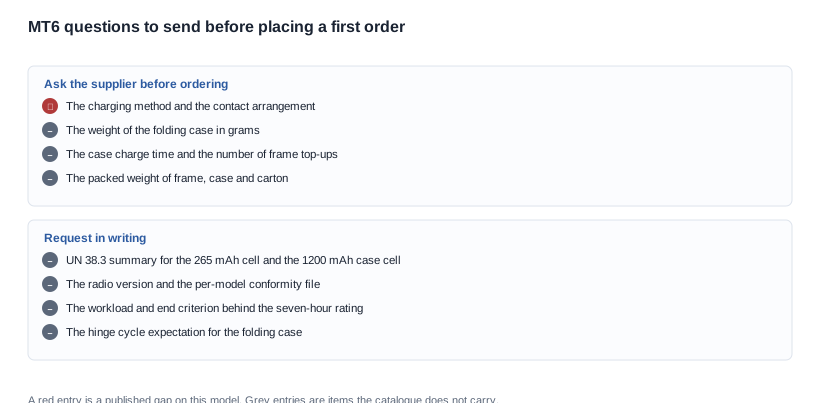
The professional approach is to ask for four numbers in one line of correspondence: the weight of the case alone, the weight of the frame packed with the case, the carton weight, and the carton dimensions. With those four, the freight cost per unit becomes a calculable figure and the per-unit landed cost stops being an estimate. The same request belongs in the quality-control file, because a packed-weight figure that drifts between production lots is a common cause of a freight invoice dispute that nobody can reconstruct afterwards. The camera-range view of packed weight is in the camera-range view of packed weight.
The other commercial consequence of the fold sits in the packaging design rather than in the freight rate, and it is the one a buyer should raise before the first tooling conversation rather than after. A product that folds has a design decision to make about the packed state: does the case ship folded, which saves carton volume and makes the product read as a single flat object in a bag, or does it ship open with the frame seated, which determines whether the first customer experience is a case that opens or a hinge that has to be discovered. Either answer is workable. Neither is published, and the answer changes both the carton specification and the opening sequence in the quick-start card. A buyer running a channel that merchandises on unboxing, which is most e-commerce channels, should make that decision explicitly rather than accepting whatever the factory chooses.
The MT6 pre-order file: the foldable case, the 265 mAh cell and the row still open
What to request in writing before the first purchase order
The list below is short because the published data is short, and each item closes a specific open question in the sections above rather than covering a general concern.
- The charging method for this model, the interface arrangement, and whether the frame charges with the case lid closed.
- The weight of the folding case in grams, the packed weight of frame plus case, and the carton weight and dimensions.
- The case charge time, the conversion efficiency into the frame, and the number of full top-ups the case supports.
- The workload, start state and end criterion behind the roughly seven-hour rated use.
- The charge-time test condition behind the two-hour-or-less ceiling, including the start state.
- The storage temperature range and the recommended maximum interval between charges for the frame and for the case.
- The hinge cycle expectation for the folding case, and what the supplier regards as a defective hinge.
- A UN 38.3 test summary covering both the 265 mAh frame cell and the 1200 mAh case cell.
- The radio version and the per-model conformity documentation, since our catalogue publishes no radio row for the camera models and no per-model certification row anywhere.
- The camera specification the catalogue leaves out: the sensor, the optics, the capture rate, the recording format, the storage capacity and the file format.
The conformity file for a model that ships with a charging case has to describe the set rather than the frame, and that is the complication this model adds to an otherwise ordinary request. Nothing in what we publish for this model identifies it as CE, FCC or RoHS certified, our catalogue prints no certification line for any of its twenty-eight products, and the export-certification page it carries is a set of images rather than extractable text, so each of those marks has to arrive with the supplier's own file. A radio placed on the European market is governed by the Radio Equipment Directive (EU) 2014/53/EU, and qualification under the Bluetooth programme is a separate matter the buyer confirms in the member database. What makes the request specific to this product is the folding case sitting in the same box: the declaration has to state whether the case falls inside the declared configuration or alongside it, and if it falls inside, the case's own test documentation has to be part of the same file. A declaration written for the frame alone leaves half the package undescribed, and a buyer who ships against it is shipping against a file that does not match the carton.
Turning the request into acceptance conditions
A written request is worth less than a written acceptance condition, because a request can be answered with a brochure line while an acceptance condition has to be met. The practical sequence is to convert each of the ten items above into a condition that appears in the purchase order, to run a sample order against those conditions, and to record the results in the model file so that the next order does not have to re-open the same questions. The sample step matters more than it is usually given credit for, because several of the unknowns on this model are behavioural rather than documented — whether a frame stays seated in a moving bag, whether a folded case charges at all, whether a hinge survives a month of being folded flat in a pocket. None of those are answerable from a document, and all of them are visible in a single unit within a week of delivery.
The commercial sequence, and where to fix the evidence
The commercial terms in this category are negotiable in principle, and the reason is structural: the factory controls price, volume tiers, packaging, payment nodes and the warranty term, and it controls all of them at once. Certification cost and the duration of a conformity process are not on that list, because they are set by the testing laboratory and the authority rather than by the supplier. The practical consequence is that a buyer who negotiates the price first and the evidence afterwards will concede more than necessary, because every term becomes the currency in which missing documentation gets paid for. A buyer who attaches the acceptance conditions to the first purchase order negotiates from a materially stronger position, because the open items on this model are the items that decide whether the product can be listed and shipped at all.
The sequence that works is the one that fixes evidence before money: send the ten questions, let the supplier answer in writing, take a sample order, test against the conditions, and only then discuss quantity, price and delivery schedule. Channels that want a private-label platform should read the difference between a platform and a one-off order in the difference between a platform and a single order, and the operational version of the same argument for an e-commerce channel is in how to choose smart glasses for e-commerce.
Where the MT6 catalogue stops, and what it leaves open
Six rows and three feature notes are printed for this model, and none of them is turned here into a charging instruction, a hinge specification, a case weight, a storage policy, a certification claim or a runtime test method. We also do not rank the MT6 against the other camera models in the family. The catalogue does not publish enough to support that ranking: the charging method is missing, the camera detail is missing, and the case weight is missing, and each of those is capable of changing the answer.
What the foldable case does give a buyer is a coherent product position that the published data does support. A 158 g camera body, a 1200 mAh case that folds flat, and a seven-hour rating are three numbers a channel can build a listing around, provided the listing says what they are and does not say what they are not. If the MT6 is on your shortlist, send us the quantity band, the destination market, the packaging format you have in mind, and the listing copy you intend to publish. We will mark which of your lines a published row already supports, which ones have to be supplied in writing before they can go on the page, and which ones we would cut rather than soften. Send the questions first — that is the step that saves money on this model, and everything above exists to tell you what to put in them.


