
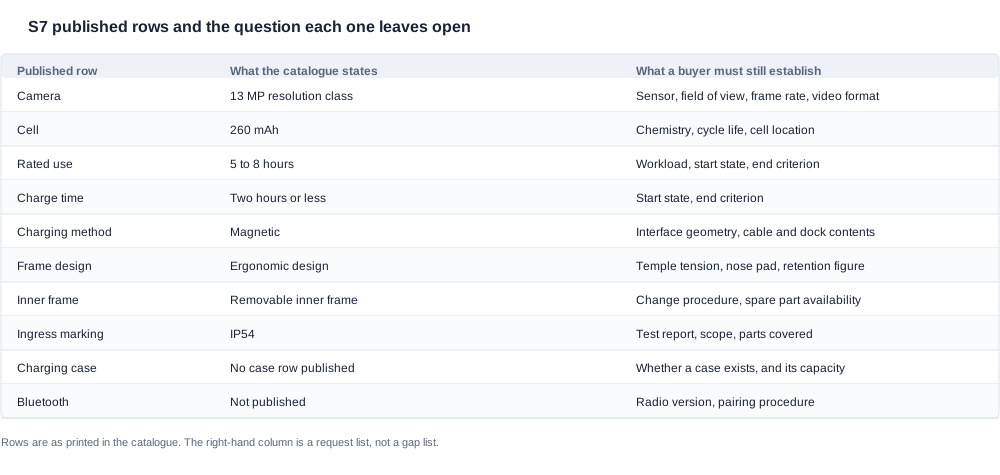
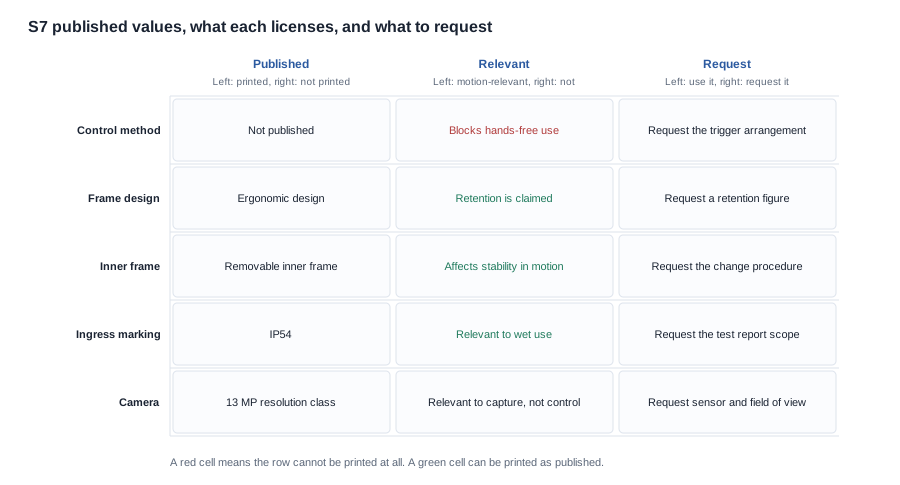
For the S7 our catalogue prints thirteen megapixels and a 260 mAh cell; charging is magnetic and takes no more than two hours, the endurance range runs from five to eight hours, and the frame carries an ergonomic design, a removable inner frame and an IP54 marking. What none of those rows settles is the thing a sport deployment actually turns on: how a person triggers a recording while their arms are moving. The catalogue publishes no control method for this model, no retention figure, no camera specification beyond the resolution class, and no charging-case row. So the honest version of an operating routine for the S7 is not a step-by-step procedure the buyer can print today; it is the set of decisions the buyer has to close, in the order that keeps a person looking at the road rather than at a screen.
S7 smart glasses how to use: hands-free operation while the body is moving
An operating routine for a sport camera model is usually written as though the wearer is stationary. For a procurement team the routine is not the deliverable; the acceptance criteria behind it are. That convention is what makes most of them useless. A person running a trail, riding a bicycle, working a building site or moving through a warehouse is not sitting still with a free hand, and the difference between the two situations is not a detail of the instruction — it decides which parts of the product have to work and which parts can be ignored. The S7 smart glasses are published for this kind of use, and the four feature notes our catalogue prints for the model point in a consistent direction: an ergonomic frame design, a thirteen-megapixel camera, a removable inner frame, and an IP54 marking for water and dust protection. None of them is a control note.
That absence is the single most consequential thing about the model, and it is worth stating plainly rather than working around. Across the whole catalogue there is no published touch row for any model, and the only row anywhere that describes a physical control belongs to the AR glasses entry rather than to this product. So a buyer cannot write "tap the temple to start a recording" on the S7 card, because no published row supports it. What a buyer can write, and what a product that is genuinely usable in motion has to have, is a control that can be operated with a hand that is busy, that does not require the wearer to look at the frame, and that produces a visible confirmation without a screen in the field of view.
That is a specification, and it is a specifiable one. The buyer who needs the S7 for a moving deployment has to turn it into a line in the purchase order rather than a line in a brochure: the control arrangement, whether it is a button, a voice command, an external remote or a physical shutter on the case, the number of actions needed to start a capture, and what the wearer receives as confirmation. Each of those has an ergonomics cost, and the ergonomics cost is what makes the answer a procurement decision rather than a detail. A control that needs two actions is unusable at running pace. A control that needs the wearer to look is unusable on a bicycle. A control that produces no visible confirmation leads to a wearer who keeps pressing it.
The endurance range matters here as well, and its shape matters more than its value. Five to eight hours is a range rather than a figure, and a range is a statement that the outcome depends on conditions the catalogue does not publish: what the camera is doing, whether the radio is connected, how much of the session is capture rather than idle. For a deployment that expects a shift, a half-shift or a full training block, the practical consequence is that the operating routine has to be built around the bottom of the range, not the top, and that the low end has to be confirmed on a sample under the workload the customer will actually impose. The published range is a starting point for an acceptance test, not a substitute for one.
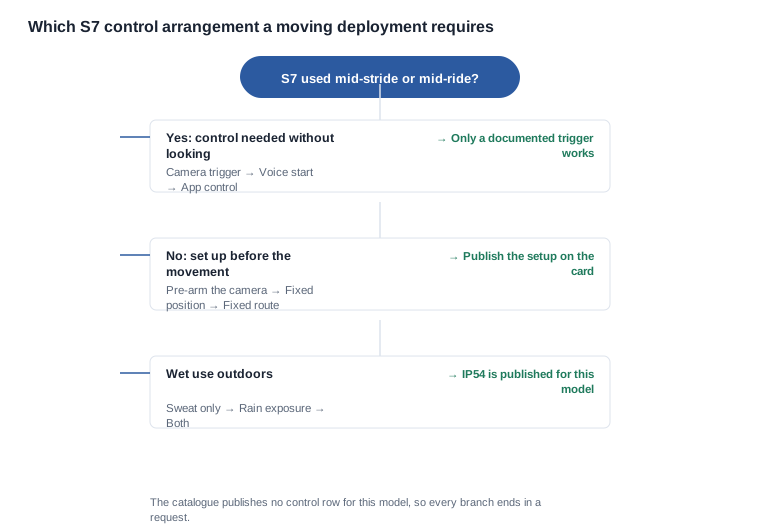
The decision structure above is the part of the routine that a buyer can settle before the product arrives, and it is worth doing in that order. Each branch is a question to ask the supplier rather than a preference to hold, and the criteria for choosing between the answers have to be written down before the answers arrive, not after. If the deployment is genuinely hands-free, the control arrangement has to be documented in writing before anything else, because it determines whether the rest of the routine is even possible. If the deployment allows a setup step before movement begins, the routine can be published as a setup-and-go card and the control question becomes a smaller one. And if the use is outdoors and wet, the published IP54 marking is the third leg of the argument, which is the subject of the next section.
What the S7 publishes about stability, and what the IP54 marking covers
Two of the four feature notes on this model carry weight in an outdoor deployment, and they are the two a buyer is most likely to over-read. The first is the ergonomic frame design. That is a design descriptor, not a measurement. The catalogue publishes no temple tension value, no nose-pad specification, no adjustment range, no frame weight in grams and no retention figure, so a listing that turns "ergonomic design" into "stays put on a downhill run" is making a claim the data does not carry. The second is the removable inner frame, which is the more interesting of the two because it is a structural feature with a real operating consequence: a part that comes out changes what a user has to do between sessions, and the catalogue publishes no change procedure, no spare-part availability and no service position for it.
The IP54 marking is the third note and the one that needs the most care, because it is the only published ingress statement this model carries and because a partial reading of it is the standard way a buyer ends up with a liability they did not price. In the IEC 60529 system, the first digit of an ingress rating describes solid-particle protection and the second describes water. IP54 therefore declares a fifth-level dust protection and a fourth-level water protection, and the fourth level is protection against water splashing against the enclosure from any direction. It is not a submersion rating, and it is not a statement that the product can be worn in heavy rain for a sustained period, washed under a tap, or used with the charging contacts exposed.
Three further boundaries matter for a buyer, and none of them is published for this model. First, a rating is a property of the tested configuration: the catalogue does not state whether the IP54 marking covers the frame as supplied, the frame with a fitted inner frame, or one specific assembly, and that has to be established in writing. Second, an ingress rating covers an enclosure, not an interface, and the S7's charging contacts, the removable inner frame joint and the camera area are all interfaces where a rating can be compromised. Third, the case is a separate question entirely. No charging-case row appears on this model's page, which means the catalogue does not say whether a case exists; if one does exist it will carry its own rating, its own weight and its own transport treatment. A buyer who wants the case rated for the same use has to ask for it separately.
How a buyer evaluates all of this is set out in the verification discipline behind an ingress claim and in the commercial framing of a water-resistance claim, and the broader commercial question of what a rating is worth to a channel is covered in the general return-handling protocol.
One further point belongs here because it is a boundary rather than a feature. Everything the catalogue says about the camera on this page is the thirteen megapixel resolution class; the sensor, the field of view, the frame rate, the video format, stabilisation, low-light behaviour and storage capacity are all outside what it publishes. In a moving deployment those omissions are not academic, because capture quality under motion is a function of exactly the parameters the catalogue does not print, and because a buyer who cannot state a storage capacity cannot state how many clips a session can hold. The S7's published rows are set out in full in S7 smart glasses specifications and features, and the items it does not publish are listed in S7 smart glasses common questions.

Running and cycling with the S7: the controls the catalogue does not publish
The two deployments that most often put a camera frame under real stress are running on open ground and riding a bicycle. They stress it differently and they have different answers, and a procurement team that writes one routine for both will end up with a card that is wrong for one of them.
In running, the frame experiences vertical impact at a rate tied to the runner's stride, and the head itself is the heaviest and least controlled part of the body. A control that has to be found by touch is a control that will be pressed by accident; a control that requires the wearer to look down is a control that will cost a fall. The requirement that follows is not that the control be small or cheap, but that it be operable with one hand without visual confirmation, and that the confirmation be perceptible without visual confirmation. That points to a physical control with a distinct tactile signature, or to a voice-activated arrangement, and it is worth asking the supplier directly which of the two the S7 uses, because the catalogue publishes neither.
In cycling, the constraint is different and stricter, because the wearer's attention and both hands are already committed. A cycling user typically has no hand available at all, which rules out any physical control on the frame or the case and makes the answer either voice activation or a remote mounted somewhere the rider can reach without taking a hand off the bar — and the latter reintroduces the same visual-confirmation problem in a different form. The published feature that matters most in this deployment is the removable inner frame, precisely because it is the one structural feature that addresses retention directly, and precisely because the catalogue does not publish how it is changed or what it is meant to do.
There is a third deployment in the same family that a buyer should not skip, and it is the one most often served by the same feature set: a fixed-position workplace where the wearer is moving but not travelling, such as a warehouse aisle, a construction site or a site inspection. In that case the frame has to survive a whole shift of vibration and knocks, and the operating routine has to assume the device is being used in a way that makes a small control hard to reach. Here the endurance range and the removable inner frame both matter, and the IP54 marking covers a different set of risks than in the first two deployments.
Across all three, the acceptance question is the same, and it is testable on a sample order. A buyer who is comparing sport models should hold every candidate to the same criteria, because a model that publishes a control method is not thereby better suited to movement than one that does not publish it but does deliver a working trigger; the comparison is only fair if the missing rows are requested from every supplier on the shortlist. The buyer should define a motion workload — a running pace over a defined distance, a route with a specified surface and a specified duration — and a capture workload, and then require the supplier to demonstrate the control arrangement and the retention under that workload. The result belongs in the sample record. A control method that has only been demonstrated while standing still has not been demonstrated at all for this use case, and that is the failure this section exists to prevent.
Sweat, rain and the S7 cleaning line between sessions
An outdoor camera frame accumulates two different things, and conflating them produces a cleaning routine that either damages the product or fails to protect it. Rain is water: it dilutes, it carries particulates, and it is the substance the published IP54 marking is written against. Sweat is not water. It is a saline solution with a different behaviour on coatings, seals and printed surfaces, and its residue is the harder of the two to remove once it has dried. The catalogue publishes no test method for sweat exposure, no chemical-resistance statement and no cleaning interval for this model, so a routine that claims to handle both has to be built as a procedure a buyer specifies, not as a claim the catalogue supports.
The line that works in practice has three segments, and each one exists for a different reason. The first segment is the wipe-down at the end of a session, while the residue is still damp, using a soft dry or lightly dampened cloth and no solvent. The reason for the no-solvent rule is not caution for its own sake: our catalogue publishes no lens material, no coating and no surface finish, and solvents that are entirely appropriate for one type of lens or temple finish can permanently haze another. That is precisely the kind of detail a supplier has to supply in writing before a cleaning instruction can be published, and it is one line in a technical file that a buyer can obtain.
The second segment is the drying step, and it is the one that gets skipped. A frame that goes back into a bag damp, or into a case, or onto a shelf in a vehicle, will dry in a closed volume, and dried salt residue in a joint is harder to remove than wet residue. The catalogue publishes nothing about the removable inner frame's joint, so the routine has to treat that joint as the point of attention: dry the frame before refitting, and separate the inner frame from the outer frame if the supplier permits it. The third segment is the inspection, which is the only segment that produces a record, and the record is what a quality team needs.
The inspection checklist for a returned unit is short and it is not a comfort question. Look at the camera area, the charging contacts and the inner frame joint for residue. Check that the contact surfaces are free of residue and continuous, because a contaminated contact is a charging fault and will be reported as a battery fault. Check the frame for movement at the temple and at the inner frame joint, because a joint that has loosened under vibration is a retention fault that will be reported as a product fault. And check the IP54-relevant surfaces for damage, because a cracked or deformed enclosure invalidates the published rating in a way that no amount of cleaning can restore. The full protocol for this kind of return inspection, and how it differs from a general clean, is set out in the general material on contact condition and in the camera-range fault-finding guidance.
The commercial link between the cleaning line and the order form is direct and is often missed, and it belongs in the total cost of ownership calculation rather than in the returns budget. A published ingress rating only protects a channel if the channel's own handling preserves it. If the cleaning instruction in the shipped documentation is wrong, the rating is voided in the customer's hands, and the returns data will show it as a product defect rather than as a documentation defect — which is the most expensive way to discover it. So the cleaning procedure is a line in the acceptance conditions, and the supplier's own recommended procedure is a document to request before the first shipment. A supplier that has no procedure for a wet-use model has told the buyer something about the engineering of the model, and a supplier that has one has removed a whole class of returns from the forecast.
The S7 acceptance file for a moving-body deployment
The questions that close the control gap
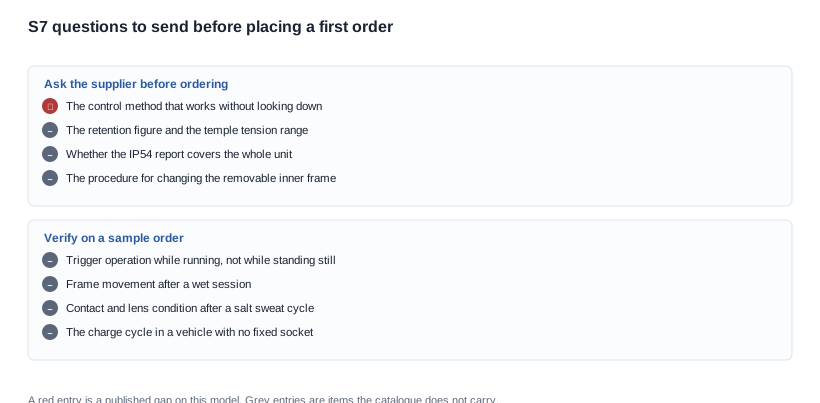
A buyer evaluating this model for a moving deployment should treat the list below as the shortlist criteria, in the order they are cheapest to close. The control arrangement comes first because it decides whether the deployment is possible at all, and it is the item most often left to a sample demonstration that turns out to have been staged. The retention figure and the inner-frame procedure come next, because they determine whether the frame stays put and whether the channel can service the product without a return. The ingress report and the cleaning procedure follow, because they determine the returns rate the business case is built on. The camera configuration and the case question come last, because they shape the listing rather than the operation.
- The control arrangement that starts a capture without the wearer looking down, and the number of actions it takes.
- The confirmation the wearer receives, and whether it is perceptible without visual attention.
- The retention arrangement, including any temple tension figure, nose-pad specification or adjustment range.
- The procedure for removing and refitting the inner frame, and whether replacement units are available.
- The IP54 test report, including which configuration was tested and which components were covered.
- The recommended cleaning procedure and the interval between sessions for a salt-sweat environment.
- The camera detail absent from the catalogue, including storage capacity and video format.
- Whether a charging case exists for this model, and if so its capacity, weight and ingress marking.
On the last item, the position has to be stated carefully because it is a category-wide trap. Our catalogue publishes a charging-case row for some camera models and not for others, and for three of the camera models — this one among them — it publishes no case row at all. A missing row means the item is not published, which is not the same statement as the item not existing. So the correct formulation is that the catalogue carries no charging-case row for this model, and the question of whether one ships is a question for the supplier. The distinction matters commercially in both directions: a buyer who assumes a case exists will plan an accessory programme that may not exist, and a buyer who assumes none exists will leave a demand unserved.
Verification on a sample order
The sample order is the point at which a due-diligence file becomes evidence rather than correspondence, and the difference between the two is the difference between a control method that has been evaluated and one that has been taken on trust.
The sample order is where the acceptance conditions are actually met, and for this model the sample has to be used in motion. A sample that is only handled at a desk has evaluated a different product from the one being ordered, which is the most common red flag in a due-diligence file and the easiest to avoid. The buyer should specify a route or a treadmill pace with a defined surface and duration, a capture workload that matches the intended use, and a wet-session condition for the cleaning inspection. The results — the control method in use, the frame position after the session, the state of the contacts and the inner frame joint, and the state of the enclosure surfaces — are the record that the acceptance conditions were tested rather than assumed. That record is what makes the first bulk order an order against known behaviour.
Six published rows, and the ones a deployment still has to close
The honest summary for a buyer comparing this model against others in the sport range is a list of what is published, a list of what has to be requested, and a trade-off that can only be priced once the requests are answered. A buyer who wants to know which model to select for a specific deployment should build the comparison on the same criteria for every candidate, including the rows each supplier has not published, because the missing rows are where the operational differences live.
Our catalogue publishes six specification rows and four feature notes for this model, and we do not extend them into a control method, a retention figure, a cleaning procedure, a camera specification, a case capacity or a certification claim. We also do not compare the S7 against the other sport models in the range on any basis, because the rows that would decide such a comparison are the ones the catalogue does not print. The camera resolution class of thirteen megapixels, the magnetic charging, the five-to-eight-hour range, the removable inner frame and the IP54 marking are all usable in a listing, provided the listing says what they are.
The S7's published set is coherent for the deployment it describes: a frame designed for the human head, a camera class for capture, an inner frame that addresses retention, and an ingress marking for outdoor exposure. What a buyer has to add is the layer the catalogue cannot publish — how the device is operated when the body is moving, and how it is returned to service when the session is wet. If the S7 is on your shortlist, send us the deployment, the motion workload, the expected session length, and the listing copy you intend to publish. We will tell you which lines are supported by a published row and which have to be documented by the supplier before they can appear. The broader sport-range considerations are in the range-level fit question, and the range-level value discussion is in S7 smart glasses value for money.
For a channel that treats this model as part of a broader e-commerce assortment rather than a single deployment, the sourcing and packaging questions sit in the sourcing and packaging questions for a channel, the freight figures for the camera range are in packed-weight figures for the camera range, and a platform programme rather than a one-off order is covered in a platform programme instead of a one-off order. Send the eight questions in this section first; everything above exists to tell you what to put in them, and the sport range is described in more detail in sport smart glasses.


