
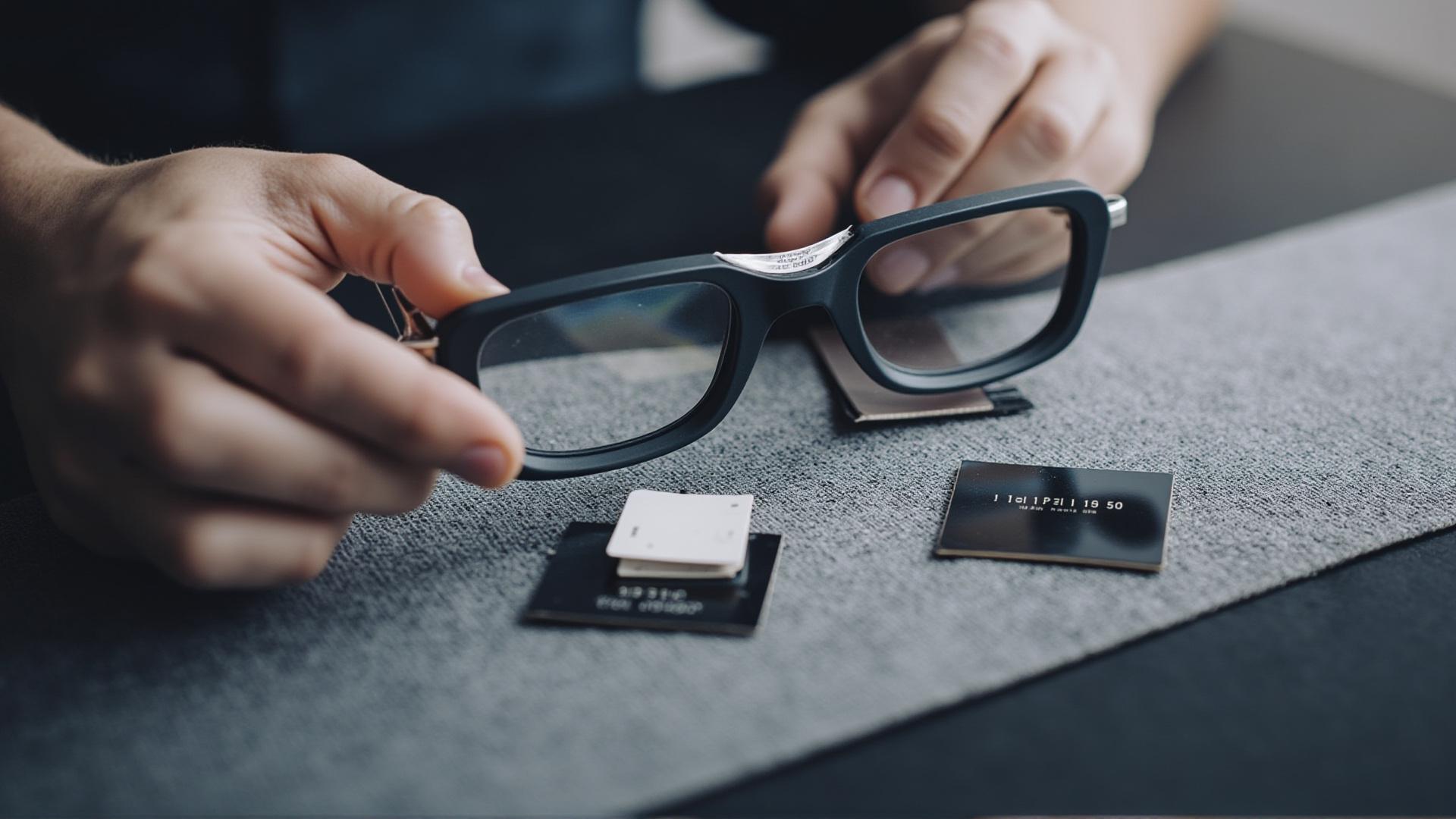
We do not hold the user documentation for this model, so we will not write an operating procedure we have not tested. What we can do is more useful for a buyer: identify the question that has to be answered before any instruction is written, and it is the one printed in the catalogue as a feature row. The V03 Pro publishes a 220 mAh cell, a charge time of two hours or less, a five-to-eight-hour rated use, Type-C charging, an eight-megapixel camera, flexible temples, a photochromic lens and three colour options — and it is one of the four camera models in our catalogue — the S7 and the V06, and the V03 and the V03 Pro — for which no charging-case row is published at all. The lens row is what changes the operating routine, because a lens that darkens with the light makes the product state-dependent, and the catalogue publishes no switching time, no darkening range and no transmission figure for it.
V03 Pro smart glasses how to use: the photochromic lens and the indoor-outdoor switch
A conventional camera frame behaves the same way wherever it is used, which is why the operating instructions for one can be written once. A frame with a photochromic lens does not. The same product produces a different optical state in an office, in open sun, under a canopy, in a vehicle and at night, and the transitions between those states happen on a timescale the catalogue does not publish. That single fact reorganises the whole question of how the product is used, because a routine written as a sequence of steps now has to be written as a sequence of states, each with an entry condition that nobody has measured.
The published configuration is short and specific. This model is published with a photochromic lens, flexible temples and a Type-C charging port, in orange, off-white and black. Everything a buyer would want to know about how that lens behaves is absent: there is no published switching time in seconds, no statement of how dark the lens becomes, no light-transmission figure for either the clear or the dark state, no description of the light threshold that triggers the change, no statement of how the lens behaves at low or high temperature, and no published method for resetting it. A listing that claims a fast transition, a specific tint depth or a specific contrast improvement is therefore writing specification data that does not exist in our catalogue.
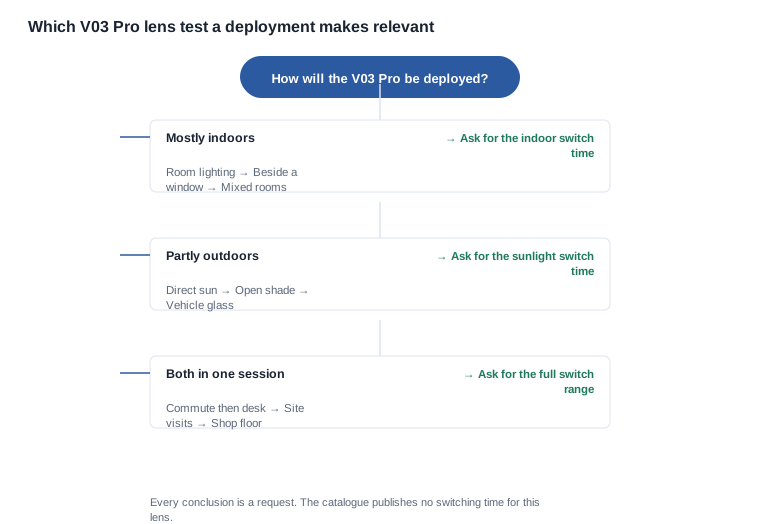
For a procurement team the practical consequence is a test, not a description. The switching behaviour has to be measured on a sample order, because the answer determines whether the product can be sold into the deployments that matter to the channel. A buyer whose customer base is indoor retail staff needs a lens that does not darken under shop lighting. A buyer whose customer base is site inspectors working outdoors needs a lens that darkens fast enough to be useful in the first minute of a bright scene. A buyer whose customer base drives between the two needs to know what the transition looks like from inside a vehicle, where the glazing itself changes the light reaching the lens. Three different products with the same catalogue row, and the row cannot separate them.
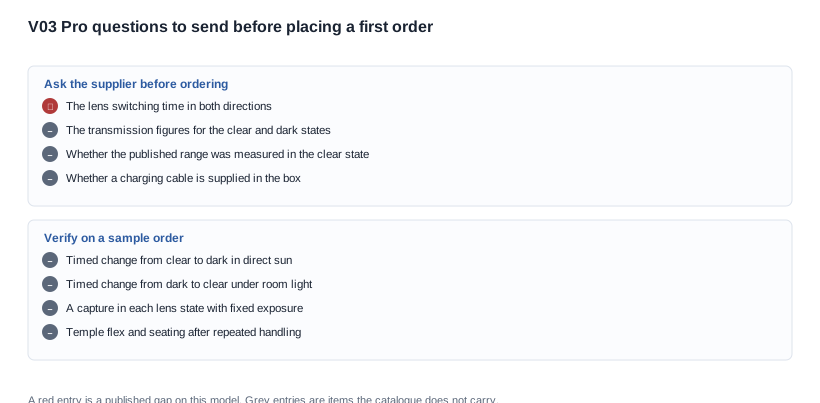
The decision structure below is the version of that question a buyer can settle while the sample is still in the warehouse, and the order matters because the deployment determines which measurement has to be taken. Note what the conclusions are: each one is a question for the supplier, not a claim about the product, because the catalogue supports neither an answer nor a promise here.
There is a second, quieter consequence of a state-dependent lens, and it concerns the channel rather than the customer. A product whose appearance changes with the light is harder to photograph, harder to merchandise and harder to keep consistent across a listing, a sample and a returned unit. The three published colour options are named in the catalogue, but the visible colour of a photochromic frame is the interaction between the base colour and whatever state the lens is in at that moment. A channel that shoots its own product imagery therefore needs to know whether the imagery should show the clear state or the dark state, and the catalogue gives no basis for deciding that. It is a small point, and it is the kind of point that becomes expensive when a dozen listings are shot against an inconsistent reference.
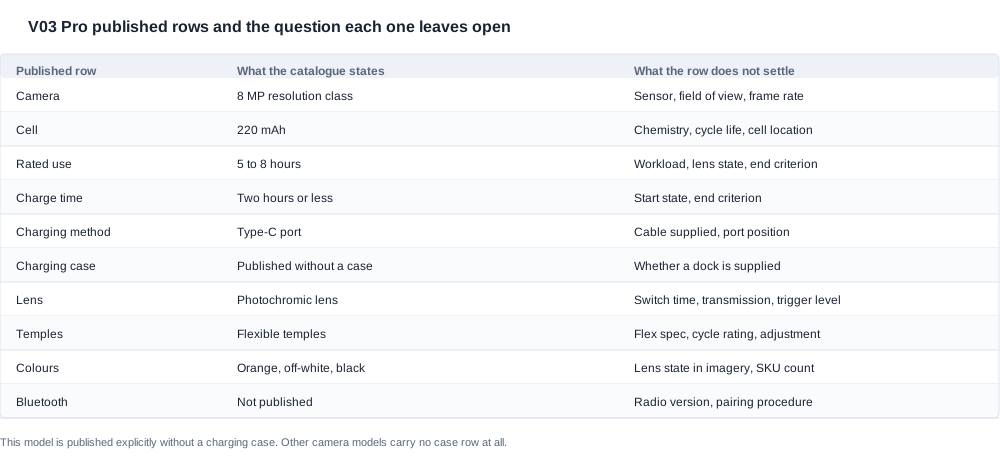
What the V03 Pro publishes, and the case row it explicitly does not carry
The third column of the table names what each published row leaves open, and the pattern it shows is the one used across the whole camera range: it does not go on to the optics, the capture rate, the recording format, stabilisation, storage size or low-light performance A buyer who needs to state what the camera can do in a listing has to request those details; a buyer who has to build a comparison between camera models should build it on the rows that are published rather than on the ones a competitor's brochure adds.
The case row is the interesting one, and it has to be stated precisely because this model is different from the other camera models in the range. Seven camera models in our catalogue ship with a case, and this one is one of the four for which the catalogue prints no charging-case row. For those four, the only defensible formulation is that the catalogue prints no charging-case row for that model and nothing beyond it, because an unprinted row is an unpublished item rather than a confirmed absence. A buyer can therefore plan a charging line for this product only on the strength of a supplier answer, and a buyer who has assumed a case ships with it has mis-read the catalogue rather than merely filled a gap. That is the difference between a documented configuration and an open one, and it is worth putting in writing before the first order.
That distinction has practical consequences in two directions. A distributor who has built an accessory programme around magnetic cases and a cable will find that this model needs neither, which simplifies the box and reduces the part count in a way that is genuinely valuable for logistics. And a distributor who has promised a buyer a case with every camera model has to correct the promise for this one before the first shipment, because a promised accessory that does not exist is a returns problem rather than a documentation problem.
The lens row deserves one further note about data hygiene, because it is the kind of item that gets merged with a neighbouring entry by accident. Our catalogue also carries a separate page for an AI electrochromic model, which publishes its own set of rows and is a different entry from this one. The photochromic lens published for this model is this model's own feature row, and it should not be read across from the electrochromic entry, nor the other way round. Buyers assembling a camera range from the catalogue should keep the entries separate and verify any lens-related claim against the page for the model it belongs to. The lens-related questions in a general sense are covered in photochromic smart glasses and the buyer-facing evaluation of them in how to choose photochromic smart glasses, but the operating data for this model is the supplier's to supply.
The published configuration for this model is collected in full on the AI camera glasses range page, and the range-level charging comparison, including how the Type-C models differ from the magnetic ones, is in the charging-case question in the camera range.
The Type-C charging line for the V03 Pro
Charging for this model runs through a Type-C port, which is published as a feature row, and that single fact determines the shape of the entire charging routine. The catalogue places this model among the seven models that charge over Type-C, and the practical meaning of that is straightforward: the customer can charge the frame from a cable and a power source they already own. There is no proprietary contact assembly to ship, no dock to stock, and no accessory that has to be found before the product can be used. For a camera model that also publishes no charging case, that combination is coherent — the cable is the entire charging line.
The routine that follows is short, and it is the shortest of any of the models in this family. The frame is charged over Type-C in a time of two hours or less, and the routine is: connect, wait, disconnect, put the frame back on. What the catalogue does not publish is what a buyer would need in order to write that routine for a customer. It does not publish whether a cable is included in the box, where the port sits on the frame, the connector specification beyond the Type-C designation, whether the port is recessed or exposed, whether the frame accepts power while switched off or only while operating, or whether the frame can be charged in a partially folded state.

The published charge time of two hours or less is a ceiling and must be printed as one. It is a limit the supplier commits to, not a prediction of how long a particular unit takes. A reading of exactly two hours remains inside what the catalogue permits, so the published row cannot be restated as a shorter period. The catalogue states neither where the charge starts nor where it is judged to be complete, so the row cannot be turned into an operational interruption window either. For a product with no case, that second point matters more than it would for a model that ships with one, because the interruption is the whole of the downtime rather than a step in a longer process.
The endurance row is a range, five to eight hours, against a 220 mAh cell, and the catalogue attaches to it neither a workload definition nor a start state or an end criterion. A range of this shape is a statement that the outcome depends on how the camera is used, and for a model whose distinguishing feature is a state-dependent lens there is a specific additional question: how much does the lens state itself affect the power draw. Our catalogue publishes nothing on that question for this model or any other, and it is a reasonable one to ask, because a lens that changes its optical state is doing work during the transition, and a buyer writing a listing should know whether the published range is measured in the clear state or the dark one. The general argument for requesting the workload behind a published rating is in the method for reading a published rating.
There is one more commercial point about a Type-C product that is worth making early in a sourcing conversation. Because the interface is a standard one, the accessory cost for this model in the field is close to zero, and the logistics cost is close to zero as well: there is no proprietary part to replace, and a customer who has lost the cable can buy one anywhere. A magnetic-charged model carries a spare-parts line and a supply risk that a Type-C model does not. That is a genuine advantage of the published configuration, and it belongs in the business case rather than in a footnote — particularly for a channel selling into markets where accessory availability is uneven. The wider range argument is in the e-commerce sourcing considerations and the certification and file question in AI camera glasses certification for camera glasses.
The flexible temple row, the three colours, and what they change
The second published feature row on this model is a pair of flexible temples, and it is more consequential than a short descriptor usually is, because a flexible temple is a mechanical tolerance and a wear point. Our catalogue publishes the row and nothing beyond it: there is no hinge count, no cycle rating, no material, no temple length, no adjustment range and no frame weight. A buyer therefore cannot state a durability figure for the temples, cannot state a replacement policy, and cannot tell a channel what happens when a temple is bent too far.
The operating consequence is that the frame's handling changes. A rigid temple is designed around one posture; a flexible one is designed to be put on and taken off repeatedly, bent in a bag, folded against the lens, and handled by people who are not thinking about it. That is precisely what a camera model with a photochromic lens and a flexible temple pair invites, and it is why the storage instruction matters more here than it does for a model with a fixed frame. A routine for this product should include a stowage step — the frame stored with the temples relaxed rather than folded hard against the lens — and that step exists because the temple row is published and the lens row is published, and the two of them interact.
The interaction is also a service question. If the lens is the feature that justifies the price, and the lens is integrated into the frame, then a scratched or damaged lens is a total loss rather than a serviceable component, and the spare-parts question becomes a channel question. Our catalogue publishes no lens as a separate item, no removal procedure, and no replacement price or availability, so the position a buyer can take is that no lens replacement is published for this model, and whether one is possible is a question for the supplier. A channel running a returns service on a camera product needs to know the answer before it sets a return policy, because the cost of a lens replacement and the cost of a frame replacement are different commercial decisions.
The three published colour options — orange, off-white and black — interact with the lens in a way that is easy to miss. A photochromic lens changes the appearance of the whole product, so the visible colour a customer sees is the base colour filtered through a state that moves. That has three consequences a buyer should plan for. The first is listing consistency, which is the merchandising point made earlier. The second is inventory: three colourways on a model with a state-dependent lens is three different sample units to photograph and three different units in the channel, and a range buyer should decide the colour assortment against the SKU cost rather than against the catalogue. The third is a return reason that will appear in the data — a customer who received an off-white unit in the clear state and expected the dark state, or the reverse, may describe the product as not matching its photograph. The way to avoid that category of return is to make the state explicit in the listing copy, and a listing that shows the product in one state while describing it as photochromic is creating the expectation it will later be judged against.
The correct handling of a photochromic product in a listing, then, is not to hide the state but to name it. A photo taken in open sun and a photo taken under room lighting are two different products, and the buyer should decide which one represents the listing, state it, and keep the reference consistent across the channel. The lens-care side of that discipline is covered in photochromic smart glasses care instructions, and the general way of testing this class of product before a bulk order is in how to test photochromic smart glasses.
Before the first V03 Pro order: the lens row, the Type-C line and the missing case row
The criteria behind the photochromic questions
- The switching time of the published photochromic lens in seconds, measured in both directions.
- The light-transmission figures for the clear and the dark state, and the trigger threshold.
- Whether the lens behaviour changes with temperature, and over what range.
- The camera specification the catalogue does not print: sensor, field of view, frame rate, video format, storage capacity, file format.
- Whether the published five-to-eight-hour range was measured in the clear lens state or the dark state.
- Whether a charging cable is included in the box, and where the Type-C port sits on the frame.
- The temple flex specification, the cycle rating, and the policy for a temple that has been bent beyond its range.
- Whether the lens can be replaced independently of the frame, and if so the procedure and the availability.
- The radio version, and the per-model conformity documentation.
This model raises a question about the file that a plain camera product does not, because its published feature is a photochromic lens configuration and the lens is part of what the customer receives. No CE, FCC or RoHS marking appears anywhere against this model in our published material, no product in the catalogue carries its own certification line, and the export-certification page is a set of images rather than text, so the supplier must produce both a technical file and a declaration of conformity. For a radio sold in the European Union the instrument in force is the Radio Equipment Directive (EU) 2014/53/EU, while Bluetooth membership is checked independently by the buyer in the member database. The question specific to this product is whether the lens configuration sits inside the declared radio configuration or alongside it. A supplier may hold a declaration written for a clear-lens build and treat the darkened configuration as a cosmetic variant, and a buyer who ships the lens version under a declaration written for the clear one ends up with a file that does not describe the product. The request is therefore precise: which configuration the declaration was written for, and what happens to it when the lens state changes in use.
How to test the lens on a sample order
The lens test is cheap to run and easy to get wrong, so the acceptance criteria should be written before the sample arrives rather than after. A workable protocol is: charge the frame fully, record the clear-state appearance under a fixed indoor light source, move the unit into direct sun and time the change to a stable dark state, then return it indoors and time the change back. Take a capture in each state, because the question of whether the lens affects the recorded image as well as the view is worth answering explicitly, and keep the same exposure settings in both. Record the ambient temperature alongside the timings, since a lens that behaves differently in a cold warehouse and a hot vehicle is a lens whose switching data needs a temperature range attached to it. The result is a small data sheet with two numbers in it, and those two numbers are what convert the published photochromic row from a descriptor into a specification.
The commercial position, and what the catalogue settles
We publish the six specification rows and three feature notes this model carries, and we do not extend them into a switching time, a transmission figure, a temple cycle rating, a lens replacement policy, a charging-cable commitment or a certification claim. We also do not rank this model against the other camera models in the range. The rows that would decide such a ranking are the ones the catalogue does not print, and a ranking built on published rows alone would be a ranking of documentation depth rather than of product capability.
What the published configuration does give a buyer is a coherent and unusually serviceable combination. A Type-C port on a model whose case row the catalogue does not print means the accessory supply chain for this product runs on a cable rather than on a case, and the channel's cost of servicing it is close to zero. A photochromic lens and a flexible temple pair give a customer-facing reason to choose it over a plain camera frame, and the three published colours give the range an assortment without a large SKU count. The buyer's task is to turn the lens row from a descriptor into a measured specification, and to decide which lens state the channel photographs, because those two decisions carry the whole commercial argument for this model.
If the V03 Pro is on your shortlist, send us the target deployment and its lighting conditions, the quantity band, the destination market, and the copy you intend to publish. We will indicate which of your lines the published rows support, which need a written answer from the supplier, and which we would leave out of the copy. Send the questions first, and the rest of the work becomes a comparison you can actually make. The range-level selection guidance sits in the range-level selection guidance, and a private-label programme rather than a one-off order is covered in how to customize V03 Pro smart glasses.


