
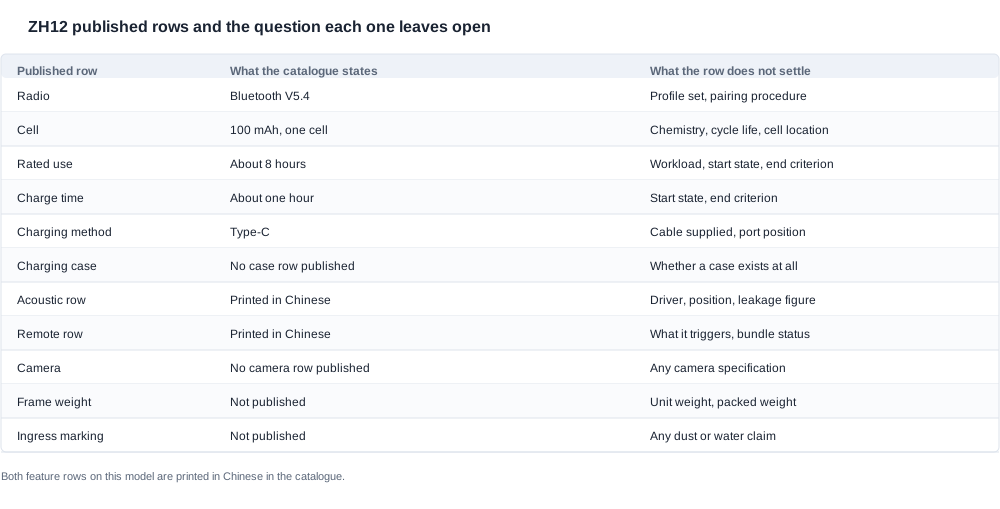
The ZH12 publishes Bluetooth V5.4, a 100 mAh cell, Type-C charging, a charge time of about one hour, roughly eight hours of rated use, a remote-photo row and a stereo surround-sound row that the catalogue prints in Chinese as 立体环绕音. Two things about that set of rows matter more than the rest. The charge time is one of only two shorter charge figures in the whole catalogue, and it is the reason this model behaves differently from the rest of the range over a working day. And the two feature rows are printed in Chinese, while other models in the same part of the catalogue carry their feature rows in English — which means a product map built by searching for English keywords will silently drop both of this model's distinguishing features, and the rows that get dropped are the ones a buyer would use to describe the product.
ZH12 smart glasses how to use: reading a catalogue row printed in Chinese
The language inconsistency is not a curiosity. It is a data-quality condition with a direct commercial consequence, and the consequence is that the rows most likely to be missed on this model are the two that describe what the product actually does. Our catalogue prints feature rows in English for most of its products, and it prints them in Chinese for this one. A buyer assembling a product map, a category tree or a channel listing by keyword will search for the English phrasing and find nothing, and the two rows that get dropped are the remote-photo row and the acoustic row. A category tree built that way files a product with an excellent charge time and no description of why anyone would choose it.
There is a second consequence, and it is the more serious one. The acoustic row on this model is 立体环绕音. Other models in the catalogue carry a row that is written in English and is read as a surround-sound configuration, and the temptation is to render 立体环绕音 into the same English phrase and file the two together as one acoustic tier. The catalogue does not do that, and a buyer should not either: the Chinese row carries an additional spatial term that the English rows used elsewhere do not carry, so a rendering that flattens it is a rendering that loses a distinction the catalogue is making. Two products whose rows read as the same phrase in English are two products whose acoustic configurations have not been shown to be the same.
That is why we carry this row in the form the catalogue prints it, and why we do not substitute an English product name for it. A catalogue exists to be the record, and a record that quietly renames a feature is not a record any more. The practical consequence for a buyer is a request rather than a translation: ask the supplier to state in writing what the configuration consists of, what the spatial element denotes, and how it differs from the configuration published for the other models. A supplier who has documented the configuration will answer in a paragraph; a supplier who has not will not be able to, and that is worth knowing before the product is listed.
The same treatment applies to the second Chinese row on this model, the remote-photo row, and there the question is sharper still because this model publishes no camera row at all. We will come back to that, because it is a bundle question rather than a configuration question, and it is the item most likely to cost a buyer money if it is assumed rather than asked.
The general discipline for reading a catalogue row in any language is worth stating, because it applies beyond this model. A row is a label attached to a product. A label tells a buyer that something is present and deliberately not much else, and the first thing a listing should do with a label is reproduce it accurately, and the second thing is to ask what sits behind it. What sits behind this model's rows is a set of answers that only the supplier has.

What the ZH12 publishes: a single cell, an hour of charging and two feature rows
Read the table as a series of published figures and the gaps sitting beside them. The electrical rows are five: the radio version, the charge time, the cell capacity, the rated use and the charging method. The feature rows are the two Chinese ones. The first thing to notice in the electrical rows is the cell: 100 mAh on a single cell, which is a different arrangement from the two-cell configurations published for several other models in this catalogue. The published figure is the value and the count, not a total, and any comparison across the range has to compare the arrangements rather than the bare milliamp-hour numbers.
The charge time is the distinguishing row and it needs to be quoted exactly. The catalogue publishes about one hour for this model, and about one hour is the published figure for one other model in the range; the remaining twenty-six models publish two hours or less. Those are two different published statements and the difference between them is not cosmetic — an hour of charging changes what a product can do inside a break, and two hours or less does not. The row is also the one most at risk of being over-read in the other direction, because the catalogue publishes no start state and no end criterion for it. "About one hour" is a figure with an approximation in it and no stated endpoints, so a buyer should not treat it as a promise that a given break will restore a full charge. The end criterion is the item to request: whether an hour from empty means a full charge, and whether the last part of the curve is slower than the first.
The endurance row is approximately eight hours, and the catalogue attaches no workload definition to it, no start state and no end criterion of any kind. For a product with a one-hour charge figure, the pairing of the two rows is the commercial shape of the product: a long working window and a short recharge, and a buyer can plan a roster around that pairing in a way it cannot plan around a long charge. That is the strongest argument this model has, and it is available from the published rows alone.
The charging method is Type-C, and this model sits with six other products that charge the same way. The operational consequence is the same one that applies across the catalogue: the customer charges from a cable and a source they already own, there is no proprietary contact assembly to stock, and a lost cable is not a support event. No case row is printed against this model, so whether one ships is an open point and the contents of the box have to be confirmed before planning.
The published set for this model is collected in ZH12 smart glasses specifications and features, the items it does not publish are in ZH12 smart glasses common questions, the charge-time and endurance reading is in ZH12 smart glasses battery life, and the certification questions in ZH12 smart glasses certification status.
The 立体环绕音 row and what an audio buyer has to establish about it
The acoustic row is the one a buyer is most likely to get wrong, and there are two separate ways to get it wrong. The first is the translation, which has been dealt with above: the row reads 立体环绕音, it is printed in Chinese, and it is not interchangeable with the English surround-sound row used elsewhere in the catalogue. The second is the assumption that a configuration row is a performance statement, and it is not. The row says the product is built with this configuration. It says nothing about the size of the elements, nothing about the frequency range, nothing about how much of the output reaches the ear and how much reaches the room, and nothing about where the source has to sit relative to the ear for the configuration to work as described.
So the procurement question is not "is this a good acoustic row" but "what is behind this row, and how does it differ from the other rows in the range". The three things an audio buyer needs from any open-ear product, whatever the label, are the same three, and none of them is published for this model. The first is how much of the programme a person standing beside the wearer hears rather than the wearer, measured at a stated distance. The second is whether the wearer's own voice is intelligible to the far end of a call in a stated noise condition, which is a microphone question rather than an output question. The third is the position constraint: where the source has to sit relative to the ear for the result to hold, because a frame that is positioned for retention and a frame that is positioned for sound are not always the same frame.
Those three are testable on a sample order in under an hour, and each of them yields a figure that carries its own condition, and that is the only shape in which an acoustic claim survives a customer comparison. The point is worth making in a slightly wider frame: in a category where the feature rows are the marketing copy, the products that win the comparison are the ones whose suppliers will put the three numbers on paper, and the products that lose are the ones whose only answer is a descriptor.
There is a commercial argument underneath this that is easy to miss. An audio row that cannot be stated in English without a loss of meaning is an asset for a channel that can explain it and a liability for a channel that cannot. A buyer who is building a listing for this model in a market where the product has to be described in one sentence has a real problem with a Chinese-language feature row, and the solution is not a creative translation. It is a supplier document that describes the configuration precisely enough for the buyer to write the sentence. That document is the first item on the request list for this model.
The general way of evaluating this class of product is in the range-level evaluation of this class of product, and the range-level selection guidance in the selection guidance for the sport range.
The remote-photo row and the bundle question behind it
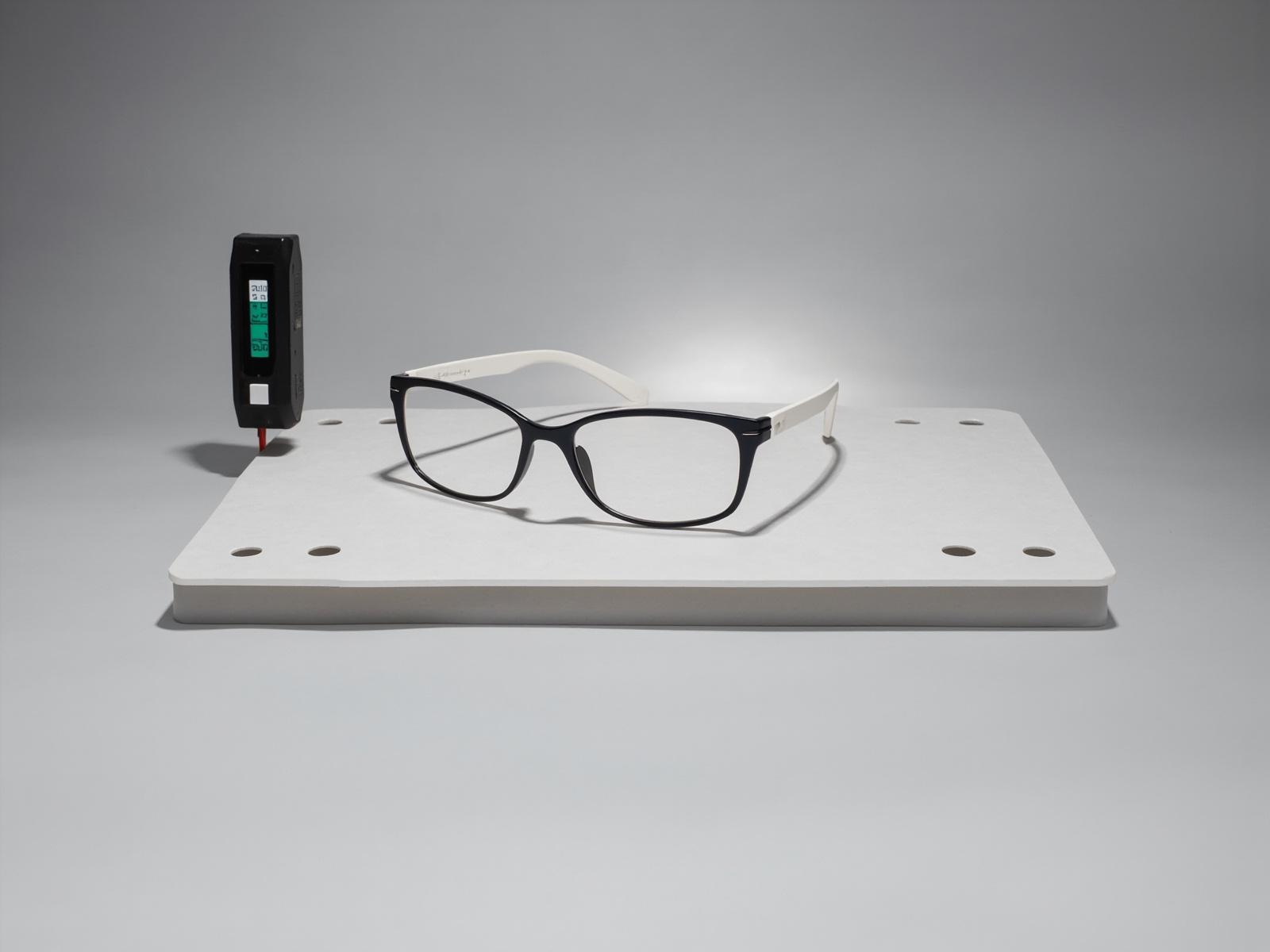
The second Chinese row on this model is a remote-photo row, and it creates the sharpest question in the file. This model publishes no camera row. It is a sport-glasses entry with a Bluetooth radio, an acoustic row and a 100 mAh cell, and there is no camera specification anywhere on its page. Yet the catalogue prints a row that describes a remote for taking photographs. The catalogue does not say what the remote triggers, and this page is not going to guess: whether it operates a camera on a paired phone, whether it belongs to a bundle with a separate device, and what the pairing requirement is, are all questions for the supplier.
The reason this matters commercially is the bundle. A remote is an accessory with a manufacturing cost, a packaging volume, an inventory line and a return-reason surface, and the difference between a remote that ships in the box and a remote that has to be bought separately is a direct difference in the unit cost and in the customer experience. A buyer who assumes the remote is included has under-costed the unit and may have promised something the box does not contain; a buyer who assumes it is not included may have left a genuinely differentiating accessory off the product page. The published row establishes that the feature exists. It establishes nothing about the bundle, and the two questions have to be asked separately.
The acceptance test for the answer is simple and it belongs on a sample order. The remote is pressed in a defined situation, and the record notes what happened, what it controlled, what it paired with, and what the wearer received as confirmation. If the answer is that the remote operates a phone camera, then the pairing procedure and the supported phone list are part of the documentation the buyer needs, because a customer whose phone is not on that list cannot use the feature that differentiates the product.
There is a second reason to settle it early, and it is the certification one. A remote that transmits a shutter command is a radio device, and the technical file for this model has to describe the configuration as it is actually shipped. A configuration with a remote in the box is not the same configuration as a configuration without one, and a declaration of conformity that covers the frame alone does not cover the bundle. This is a small point and it is the kind of small point that surfaces during a market surveillance check rather than during a pre-shipment inspection.

The range-level guidance on sport products is in sport smart glasses buying guide and the usage context in sport smart glasses for cycling, and the fit question in bluetooth audio glasses comfort and fit.
The ZH12 procurement check: what a buyer can write down today
Total cost of a late gap, in the order that matters
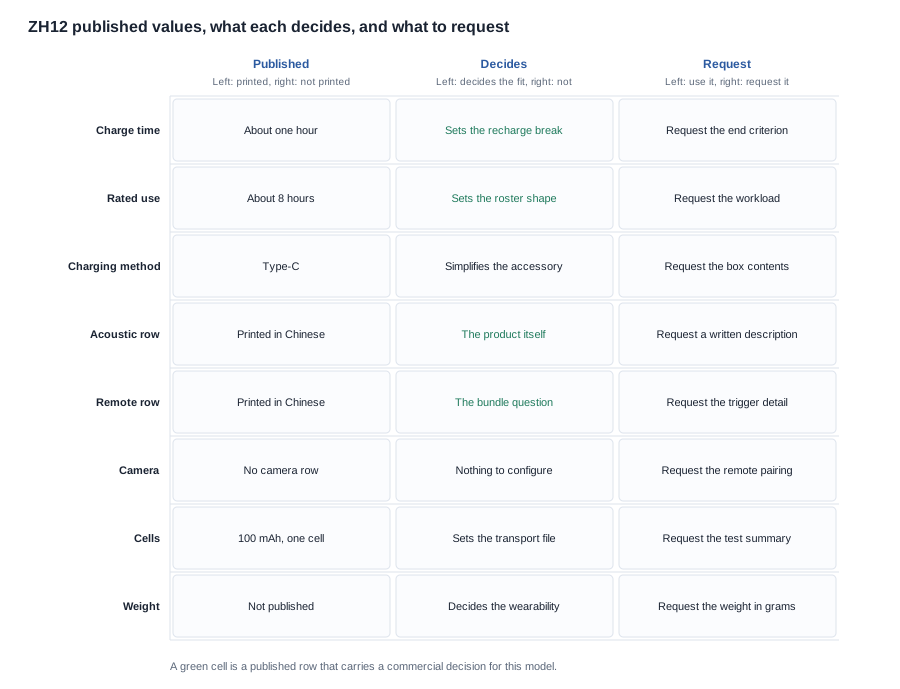
The list is ordered by how expensive the gap is to close late, and a buyer evaluating several products in this part of the catalogue should hold every candidate to the same criteria. The two Chinese rows come first because they are the product; the electrical rows come second because they are already published; the bundle and the certification file come last because they are the most easily corrected once the product is on the shelf. The red flag to watch for in a supplier's reply is a characterisation of the acoustic row rather than a description of it, because a characterisation is what the catalogue already contains and a buyer who accepts it has added nothing to the file.
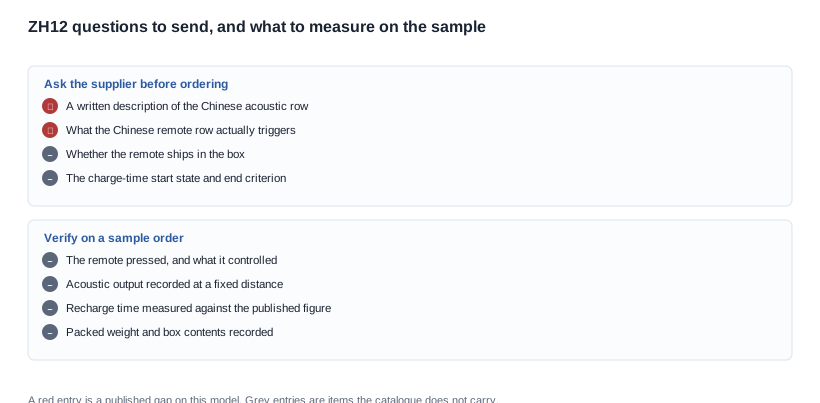
- A written description of the acoustic configuration published as 立体环绕音, including what the spatial element denotes and how it differs from the surround-sound rows published for other models.
- The driver position relative to the ear, and the position tolerance the configuration requires.
- The acoustic figures: the output measured at a stated distance, plus the microphone pickup in a stated noise condition.
- The remote-photo row in full: what the remote triggers, what it pairs with, and the supported device list.
- Whether the remote ships in the box or is a separately sold accessory, and the packaging impact of either.
- The charge-time start state and end criterion behind the published figure of about one hour, and the figure's basis.
- The workload behind the eight-hour figure, with its start state and its completion criterion.
- The box contents, including the Type-C cable, and whether a charging case is supplied.
- The frame weight as shipped, the packed weight, and the ingress position for this model.
- The radio version confirmation, the per-model conformity documentation covering the shipped bundle, and the transport documentation for the 100 mAh cell.
The file for this model has to describe the bundle that actually ships, and the fact that no charging case is published for it turns that into more than a formality. This model appears in our catalogue with no CE, FCC or RoHS marking attached to it, the catalogue prints no certification line for any individual product, and its export-certification page holds images rather than text, which leaves the technical file and the declaration of conformity as documents that have to be requested from the supplier. On the European market a radio product falls under the Radio Equipment Directive (EU) 2014/53/EU, while a Bluetooth qualification is a confirmation the buyer obtains from the member database rather than from a product page. What is specific here is the correspondence between what is in the box and what the paperwork describes. A model with a Type-C port whose catalogue page prints no charging-case line has a small bundle: the frame, a cable and the instructions, and each of the three has to be accounted for. A file written for a configuration that includes a charging accessory does not cover a bundle without one, and the instructions a customer receives have to name the same configuration as the declaration, or the product in the customer's hand and the product in the file are two different products.
The routine the published rows already support
Some of this can be written today, without the supplier, and it is worth separating that part from the part that cannot. The published rows support a six-step routine: charge the frame over Type-C, allow about an hour, confirm the charge state, put the frame on and position the source, use the audio configuration, and return the frame to its charging point before the eight-hour mark. That routine is publishable because every step in it traces to a published row, and the charge time is quoted in the catalogue's own form.
Whether a buyer should select this model at all is a question that has to be answered on the same basis for every candidate, and the common basis is the set of rows each supplier does not print. A comparison built only on published rows measures documentation depth rather than product capability, so the missing rows have to be requested in the same form from every supplier on the shortlist, and the answers have to be read against the same criteria. A total-cost view that includes the accessory bundle, the charge-time cycle and the documentation effort is a fairer basis for selection than a feature-count comparison, and it is the one a procurement manager can defend afterwards.
What cannot be written today is the part that depends on the two Chinese rows. The positioning instruction, the acoustic description in a form a customer can be given, and the remote behaviour are all supplier questions, and the quick-start card has to carry a blank for each until they are answered. A card with three clearly marked blanks is a defensible artefact. A card with three guesses is a support-cost centre.
What the catalogue settles, and what it does not
We publish the five specification rows and two feature notes this model carries, the feature notes in the form the catalogue prints them, and we do not translate them into an English product name, rename them, or merge them with the rows published for other models. Nothing here turns them into a driver specification, a leakage figure, a microphone figure, a bundle commitment, a positioning instruction, a runtime test method, a weight, and we make no certification claim either, and we do not publish an ingress position for this model because our catalogue carries no ingress marking for it. Nor do we rank it against the other sport models, since the rows that would settle such a ranking are precisely the ones our catalogue leaves unprinted.
What the published rows do support is a genuinely distinct product position that a buyer can take to a customer today. A one-hour charge figure is not a rounding of the catalogue's standard and it is the fastest charge in the range, and paired with an eight-hour rated use it gives a roster shape that no other model in the catalogue offers on published data. The acoustic row and the remote-photo row give the product a reason to be chosen that is not the battery, and both of them are rows a buyer must request in written form before they can be described precisely.
If the ZH12 is on your shortlist, send us the deployment, the roster pattern the product has to fit, the market and the language the listing will run in, and the copy you intend to publish. We will show which of your lines the catalogue already carries, which have to be documented by the supplier, and which we would strike from the copy. Send the questions first — for this model in particular, the two Chinese rows are the whole product, and they are the two things worth asking about.


