

Buyers who land on the ZH12 are usually doing one of two things. Either they are comparing it against the D17 and the YKC02 because all three sit in the sport category, or they have already decided they want a sport-category model and they are trying to work out which published rows they can actually rely on before they request a quotation.
The trouble with that second scenario is that a lot of the questions buyers ask are answered on a product page with far more confidence than the published catalogue supports. The ZH12 has a short, unusually specific published row, and a lot of what a buyer wants to know about it simply is not in that row. This article takes the questions we are asked most often and answers each one strictly against what is actually published, and it is explicit about the difference between a published specification and a question you need to put to the supplier.
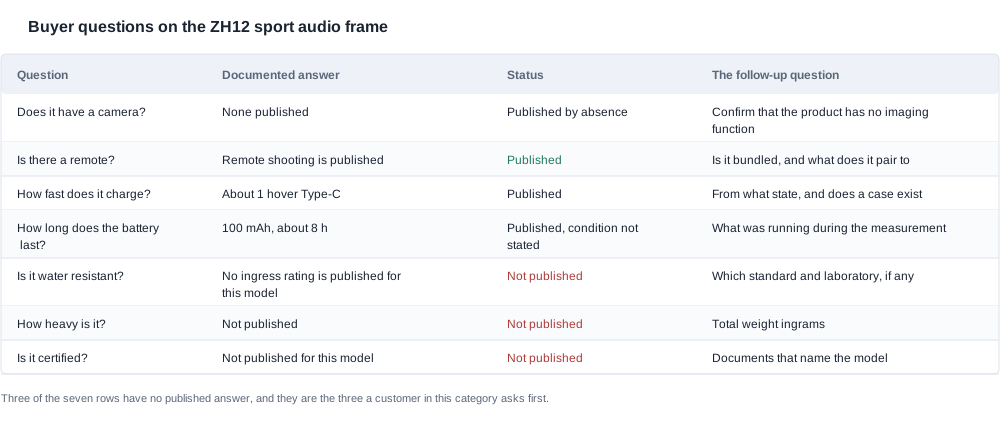
One framing point before the questions start. In the CYNRIN catalogue, the sport category is exactly three models: the YKC02, the D17 and the ZH12. That is the whole group. The ZH12 is not an audio-tier model, and it is not a camera-tier model. It publishes a feature row of two entries only — remote control photo and stereo surround sound — and it has no camera row at all. If a buyer is looking for a camera specification on the ZH12, the honest answer is that none is published, and that is not a formatting oversight we can confirm either way.
What the ZH12 actually is
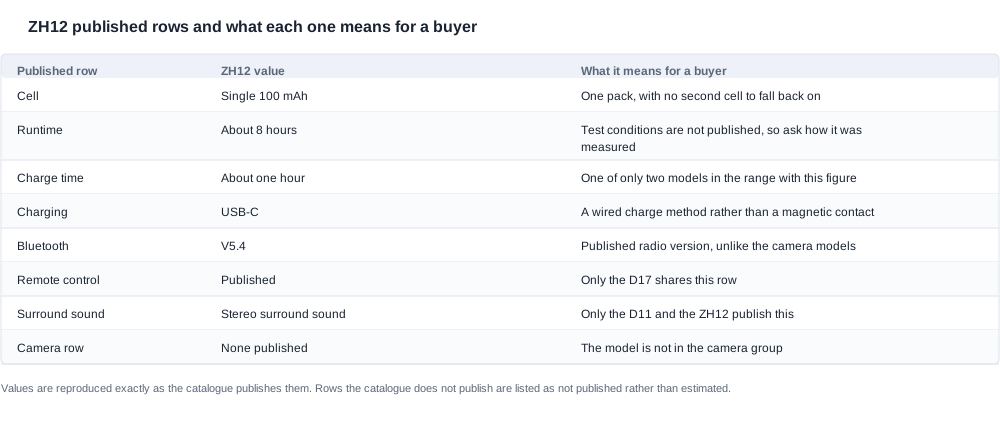
The ZH12 is a sport-category smart glasses model. Its published row reads as follows.
- Cell: a single 100 mAh cell.
- Runtime: approximately 8 hours.
- Charge time: approximately one hour.
- Charging: USB-C.
- Bluetooth: V5.4.
- Feature row: remote control photo, plus stereo surround sound.
That is the complete published row for the ZH12. It is a single cell design, not a dual cell design, and that single fact has real consequences when you compare it with the YKC02 further down the category. Whenever we write the ZH12 up for a customer we will reproduce this row exactly as it stands, we will keep the qualifiers attached to the figures, and we will not pad it out with attributes that belong to other models in other groups.
The remote control shutter is worth dwelling on for a moment, because it is one of only two places in the entire 28 model catalogue where a remote control is published. The other is the D17. Nowhere else in the range does the catalogue publish a remote control, which means the ZH12 and the D17 are the only two models where a buyer can legitimately plan a remote-driven shutter as part of the product proposition. For a brand selling a sport model, that matters commercially: it is a demonstrable feature that can be shown in a store or on a product video, and it is the reason the sport category exists as a category rather than as a set of audio glasses with a sport colourway.
The stereo surround sound entry matters just as much commercially, and it is just as rare. Across the whole catalogue, the D11 and the YK12 publish a surround sound row in the audio group, the YKC02 and the D17 publish one in the sport group, and the ZH12 publishes the Chinese 立体环绕音 line, so across 28 models there are five places where a surround sound claim is published. The audio group is otherwise audio, and only two of the eight audio pages carry the surround sound label. If a buyer is writing a landing page for the ZH12, the surround sound claim is supported by the catalogue. The claim has to be written at the level the catalogue supports and no further.
The single cell is the design decision that most shapes how a buyer should treat the ZH12's runtime figure. A one-cell architecture means the pack is thinner and the weight distribution is simpler, which is the right trade for a sport model that is worn for a long session and then put away. It also means there is no second cell to fall back on, so the eight hour figure is the whole story on a single charge and any degradation of usable runtime shows up directly in the customer experience. For a buyer writing a product page, the honest framing is a published runtime of approximately eight hours from a single 100 mAh cell, and the eight hour figure should be presented as the published figure rather than as a promise of continuous use, because the catalogue does not publish the test conditions that would let anyone state that with confidence. The one-cell choice also explains why the ZH12 publishes a charge time of approximately one hour while a two-cell design such as the YKC02 is published at two hours or less. A smaller pack charged on one USB-C line simply returns to full in less time, and the two published rows are consistent with each other once you understand that architecture.
It is worth being explicit about the order of operations here, because sport-category sourcing conversations tend to start with the charge time and end with the wrong model. If the remote control shutter and the surround sound are the reasons you are looking at the ZH12, the single cell is not a compromise you are accepting reluctantly. It is the mechanism that makes the fast charge and the published runtime compatible, and it is one of the clearest examples of why two models can look similar on a price sheet and behave completely differently on a spec table. The YKC02 holds more total cell capacity across two cells and gives you none of the ZH12's feature row. The ZH12 holds less total cell capacity in one cell and gives you both. Those are different products aimed at different buyers, and the published rows make that plain without a single line of marketing language.
Now the charge time, because it is the row that most often produces a mis-statement. The ZH12 publishes approximately one hour. Across the catalogue, 26 of the 28 models publish a two hours or less figure, which is a ceiling rather than a measurement. The D17 is the only other model that publishes approximately one hour. So when a buyer tells a colleague that the ZH12 charges in about an hour, that is correct and it is one of the two strongest published differentiators the model has. When a buyer instead generalises the catalogue into "these glasses charge in about an hour", that generalisation is wrong for every other model.
What the ZH12 is not
It is more efficient to be clear about this early, because a surprising number of the questions that arrive at our desk are really requests for specifications the ZH12 does not carry.
It is not a camera model. There is no camera row for the ZH12 anywhere in the catalogue. The camera group is a distinct group of 11 models — the MT5 and the MT6, the V03 Pro and the V06, the CY05 and the S7, the L1 Pro and the V03, the CY03 and the L2 Utral, and the KY06 — and the ZH12 is not in it. The published camera resolutions in the catalogue are 8 MP on eight models and 13 MP on three models, which are the L1 Pro and the L2 Utral, and the S7. None of those figures attaches to the ZH12. If a buyer needs image capture, the ZH12 is the wrong model and no amount of negotiation will change that, because this is a catalogue category boundary rather than a supply constraint.
It is not an audio-tier model. The audio group is eight models: the K01 and the K02, the LC-105-1 and the YK12, the LC-105-2 and the G07, and the D12 and the D11. The ZH12 publishes a surround sound row, which is a feature, but it does not sit in the audio group and it does not carry the audio group's row set.
It has no published ingress rating. The only two models in the whole catalogue with a published IP rating are the V06 and the S7, and both of them publish IP54. Nothing is published for the ZH12. A buyer who needs a wet-weather claim has a genuine problem here, and the correct answer is not "IP54" or "IPX4" or any other guess. The correct answer is to ask the supplier what the ZH12's ingress situation actually is and to require it in writing before you make a claim on packaging. Our guidance on how to frame that question sits in the sport smart glasses water resistance options article, and the certification question has its own ZH12 certification status piece covering what evidence to ask for.
It has no published weight. The only public weight in the entire catalogue is the MT6 at 158 grams, which is the glasses body and explicitly excludes the 1200 mAh folding case. Nothing is published for the ZH12. This is a real limitation for a sport model, because fit and comfort claims in the sport category tend to lean on weight, and the sport smart glasses weight comparison article covers how that comparison has to be structured when the catalogue gives you only one data point.
It has no published colours, dimensions, lens material, certification status, price, MOQ, lead time, sample policy, warranty or capacity. Certification in particular deserves emphasis: CE, FCC, RoHS, RED and EN 18031 do not appear in the catalogue body at all. That is not a statement that the ZH12 lacks them, and it is not a statement that it holds them. It means the catalogue does not publish them, so any claim you make has to rest on documents you have actually seen. Our certification status article for the ZH12 sets out exactly what to request.
It has no capacitive-touch row and no translation row anywhere in the catalogue. No model in the range publishes either, so nobody should be told that the ZH12 has touch controls or live translation on the strength of a page they read somewhere. Where a specification is missing from the catalogue we will mark it as not published and put it on the written question list, rather than leaving a reader to guess what the silence meant.

The questions buyers ask before ordering
Is the remote control a phone accessory, or does it work on its own? This is the single most common question we get, and the published record does not answer it. The catalogue says remote control photo and nothing about the pairing topology. It is entirely possible that the remote is a Bluetooth accessory that pairs to the glasses and works standalone, and it is entirely possible that it is a shutter accessory that needs a paired phone. We will not assert one over the other. Put the question in writing: does the remote operate the glasses directly, does it require a paired phone in range, does it require an app, and does it pair independently of the phone. Then make the answer a condition in the purchase order rather than a point of trust. The same question applies to the D17, since the remote is published on both models. Our article on sport smart glasses remote control options covers the comparison more broadly.
How does the about-one-hour charge time really compare with the rest of the range? Against the published ceiling, it is roughly half. Every other model except the D17 publishes a two hours or less figure, so the ZH12's published charge time is the fastest in the catalogue alongside the D17. The important discipline here is that the comparison is about-one-hour against a ceiling. You are not comparing a measurement with a measurement; you are comparing a measured figure against an upper bound that may in practice be much closer to one hour for some models. For a buyer writing launch copy, the defensible claim is that the ZH12 is one of two models in the range with a published charge time of about one hour. That is a clean, verifiable statement. The indefensible version is "the fastest charging glasses we sell", which the catalogue does not support because it cannot support a ranking against a ceiling.
Are the ZH12 and the D17 the same product with a different name? No, and this matters because buyers often ask it in the other direction too — whether they should be treated as equivalent for sourcing. The published rows differ. The D17 has a 115 mAh single cell and approximately 7 hours of runtime; the ZH12 has a 100 mAh single cell and approximately 8 hours of runtime. That is an unusual combination, a slightly smaller cell with a slightly longer published runtime, and it is precisely the kind of detail that tells you these are two distinct products rather than a rebadged SKU. The feature rows also differ, in that the D17 publishes remote control photo plus surround sound while the ZH12 publishes remote control photo plus stereo surround sound. The two share the fast charge time, the single cell architecture, the USB-C charging and the V5.4 Bluetooth, and they diverge on cell, runtime and the wording of the sound row. Treat them as two products with a shared design language.
How does the ZH12 sit against the YKC02? The YKC02 is the third sport model and the comparison is instructive because the two are built on opposite architectures. The YKC02 uses two 70 mAh cells, the ZH12 uses one 100 mAh cell. The YKC02 publishes approximately 8 hours of runtime, which is the same published runtime as the ZH12, reached with roughly forty percent more total cell capacity spread across two cells. The YKC02 publishes magnetic charging and a charge time of two hours or less; the ZH12 publishes USB-C and approximately one hour. The YKC02 publishes no remote control row, no camera row and no surround sound row at all. So the YKC02 is the two-cell, magnetically charged, quieter model of the group, and the ZH12 is the one-cell, fast-charging, remote-and-sound model. The trade-off for a buyer is straightforward: if remote control and stereo surround sound are the proposition, the ZH12 is the only model in the sport category that delivers both, and the cost of that proposition is a single-cell design.
How long does the eight hour runtime actually last, and how do I find out? The published figure is approximately eight hours. The catalogue does not publish the test conditions behind it, and that is the part you need. Ask whether the eight hours is continuous audio playback, intermittent playback with gaps, or a mixed profile that includes the remote shutter. Ask what codec and what volume level were used, because those two variables can move a runtime figure by a large margin. Then, and this is the part buyers skip too often, order a sample and run your own measurement on your own use profile. A sample costs far less than a pilot order and it settles the runtime question, the remote control question and the build quality question in one pass. If you are planning to place this in a private label range, our article on how the ZH12 compares across the range shows how the published rows stack up against the rest of the catalogue, and our guide on how to compare smart glasses battery life covers how runtime is normally measured on this class of product.
What should I expect commercially from a model with this few published rows? A short published row cuts both ways. On the positive side, everything that is published on the ZH12 is unusually specific: an exact cell capacity, a named charge time, a named Bluetooth version and a two-entry feature row. That is more actionable than a model that publishes marketing adjectives. On the negative side, the gaps are real, and gaps cost money later because each one is a separate written exchange with the supplier and a separate line in the purchase order. A buyer who arrives with the questions below already answered has saved several rounds of clarification, and the time saved usually costs less than the sample. We will put the answers to those questions in writing for you before you commit to anything, and we will tell you plainly where an answer is a commitment and where it is only an expectation.
What happens if the remote fails, or if a unit fails inside the warranty period? This question is usually deferred until something goes wrong, which is the wrong order. The remote is the most visible and most handled part of a sport model, and it is the part most likely to be lost or dropped, so it deserves its own spares line. Ask what the replacement remote costs, whether it ships separately, and what the lead time is. Then ask what happens to the unit itself — replacement, repair, or credit — and how long that process takes in practice. Warranty terms are one of the commercial fields the catalogue does not publish for any model, so this has to come from a document rather than a web page, and the ZH12 certification status article covers the wider question of what evidence to request alongside those terms.
Where does the ZH12 sit against the camera models? It does not compete with them, and that is a strength for a buyer who wants a clean range architecture. A brand that stocks the ZH12 alongside a camera model such as the S7 or the V06 is offering a shutter-driven, sound-led sport product next to an image-capture product, which gives the customer a genuinely different reason to choose rather than a spec-sheet increment. The S7 and the V06 also publish IP54, which the ZH12 does not, so a buyer who needs a weather claim must choose deliberately rather than by default. Our AI camera glasses category article covers the camera side of the range, and the S7 certification status and S7 common questions articles show how the same discipline applies to a model that does publish its camera and ingress rows.
How do the camera and audio groups publish rows that the ZH12 does not? The camera group publishes a camera row that includes resolution — 8 MP across eight models, 13 MP across three — and the V06 and the S7 publish IP54 as well. The audio group publishes a Bluetooth version on the models where it applies and, on the D11, a surround sound row. The ZH12 publishes its own Bluetooth version, its own charge time, its own cell and its own two-entry feature row, but publishes none of the camera attributes and none of the ingress attributes. So the honest summary is that the ZH12 is well documented on the rows that define it as a sport model and silent on every row that would define it as something else.
Questions to ask in writing
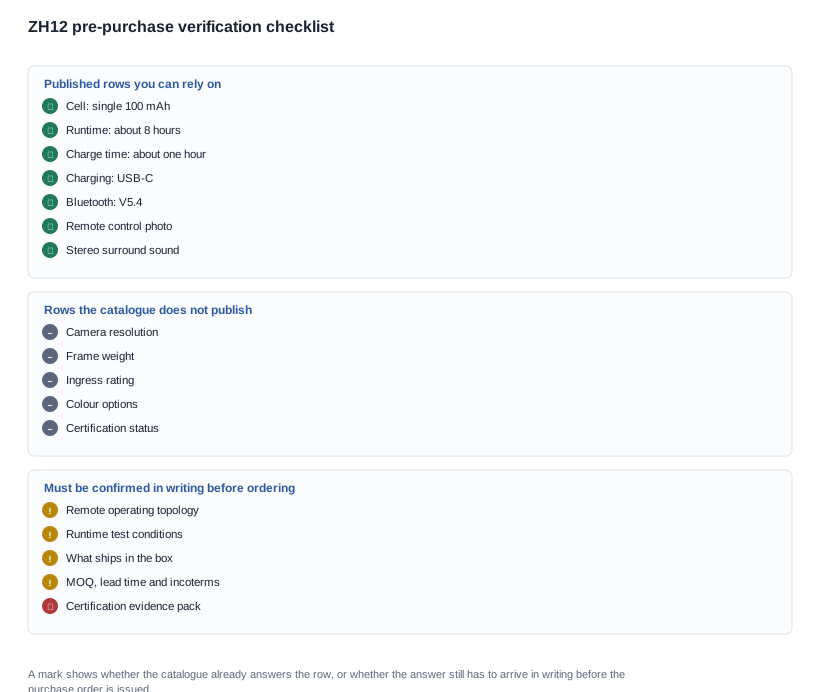
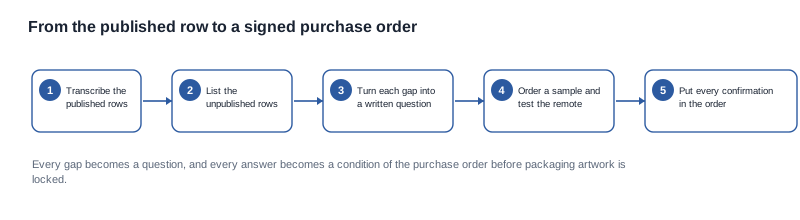
The single most valuable thing a buyer can do with a specification row this short is to convert every gap into a written question and every answer into a condition of the purchase order. Below is the sequence we work through with buyers, and it is the reason we will not publish a number we cannot stand behind.
- Ask for the configuration in writing. Specify the model name as it appears on the device and on the packaging, the cell configuration, the runtime figure and the test conditions behind it. Runtime claims are the easiest thing in this category to fudge, so ask how the eight hours was measured — continuous playback or intermittent use, which codec, what volume level.
- Ask what ships in the box. The retail unit, the charging cable, the remote, the case, the spare nose pads, the printed documentation and the language of that documentation. Sport smart glasses packaging options are discussed separately, and the answer to "what ships with the remote" is the question that most often surprises buyers.
- Ask for the remote's operating topology. The three answers you need are whether it works without a phone, whether it needs an app, and whether it pairs over the same Bluetooth version the catalogue publishes.
- Ask for the documentation pack. Export documentation for a sport model usually covers the packing list, the user manual, the warranty card and the test report. Our OEM ready platforms and export documentation article covers what a complete documentation pack looks like when you are preparing for a purchase order.
- Ask for certification evidence. Not a status claim, but the actual documents: test reports, declarations, and the applicable standards for the destination market. Nothing in the catalogue publishes CE, FCC, RoHS, RED or EN 18031 status, so this evidence has to come to you directly.
- Ask for the commercial terms. MOQ, lead time, incoterms, tooling or customisation charges, packaging costs, sample policy, warranty terms and spares availability for the fast-turn parts. Samples are usually the fastest way to settle the remote control question and the runtime question at once, and a pilot order is the fastest way to settle the packaging and documentation questions.
- Ask for after-sales cover. Spare units or spare remote controls, the replacement policy for a unit that fails inside the warranty period, and the lead time on a spares reorder. A sport model with a remote has two failure points, not one, and the remote is usually the easier one to replace.
- Negotiate on the terms that are actually open. Lead time, packaging format, MOQ on a first pilot order, incoterms, and the sample policy are the levers with room in them. Tooling and customisation charges are worth challenging when they are quoted as fixed, and worth asking about as an item when they are open. We will be straightforward about which of these we can move and which are structural, so that you spend your negotiating effort where it changes the landed cost rather than where it does not.
Throughout that sequence we will keep to one rule: anything that is not published stays a question until you have the answer on paper, and anything that is published stays exactly as the catalogue states it. That rule is what keeps a landing page, a spec sheet and a purchase order saying the same thing, and it is the reason the ZH12's published row is short rather than padded. The model publishes seven rows plus a two-entry feature row, and every one of them is defensible.
There is a practical discipline to the written-confirmation step that is worth stating explicitly, because it is the difference between a specification that survives contact with a customer service team and one that does not. Any answer you receive should be phrased so that it can be copied directly onto a product page, a carton, or a manual, without an editorial pass in between. If an answer needs a qualifier to be true, the qualifier belongs in the copy. If the answer is that something is not available, then the copy should not mention it at all. Buyers who apply this rule end up with far fewer late-stage corrections than buyers who accept a friendly approximation and fix it later, and the corrections are always more expensive when they arrive after artwork is locked and packaging is printed.
If you are still deciding which model from the sport category to put at the centre of your range, the sport smart glasses buying guide lays out the shortlist logic, and the ZH12 specifications and features article collects the same published rows in a single reference table. If the question is more about which buyer the model suits, the ZH12 best for article sets out the fit. For a like-for-like comparison across the whole range rather than inside the sport group, our article on how the ZH12 compares across the range covers the group boundaries in detail.


