
Buyers reach this page with two lists: the questions they could not settle from the catalogue, and the questions they never thought to ask in advance. Some of those have a published answer that can be quoted, with its source attached, in a purchase order. Others have no answer anywhere in the catalogue, and saying so is more useful than guessing. This page separates the two lists, shows which comparison rows actually exist, and sets out what a purchasing team should request in writing, and in what order, before any purchase order is placed.
K01 common questions: the answers the catalogue supports
The published K01 rows are few: the battery configuration, the charging method, the Bluetooth version, the rated runtime, and the charging duration. Every other answer on this page has to be built on top of those five, and the rest of this page is an argument for treating that silence as information rather than as a gap to fill with a plausible sentence.
What is the battery? The catalogue publishes 90mAh*2 for this model, which is two cells of 90mAh rather than one larger cell. The published row does not say whether those two cells charge together or in sequence, or whether the runtime figure assumes both cells in good condition. That is the most consequential open question on the model, because every downstream statement about standby time, daily use and replenishment rests on it.
How does it charge? Magnetic charging is the published method, and the charging duration row reads up to 2h. That entry is a ceiling rather than a typical figure: only two models in the whole catalogue publish a faster figure of about 1h, so this model sits on the common charging-time row rather than on a fast-charge row. The catalogue publishes no charging case capacity for this model either, which means a case quoted as adding extra hours cannot be assumed.
Which Bluetooth version? V5.3 is published. Only fourteen of the 28 models publish a Bluetooth version at all, and the eleven camera models publish none, so this row is one of the few places where a number can be quoted without qualification. The version still does not describe pairing behaviour, multipoint behaviour, or the practical range you will meet in a warehouse or on a shop floor.
How long does the battery last? The published runtime is ~8h. It is published without a test condition attached, which means the figure has to be read as a label value rather than as a measured result under a defined load.
Does it translate, take prescription lenses, or survive water? None of these has a row. There is no translation row anywhere in the 28-model catalogue, no capacitive touch or gesture control row for any model, and an ingress protection rating appears for only two models, IP54 on V06 and S7. Prescription lens options and offline translation are therefore supplier questions, and no optical or hearing claim can be derived from the catalogue.
Those five published rows are also the honest answer to the question that follows any launch, which is what may be written on the product page. The family this model belongs to is described on the Bluetooth audio glasses pillar page, the mechanics of the audio category are set out on the open-ear audio page, and the version-specific detail a competitive comparison usually needs is collected in the specifications and features reference. Each of those inherits the same limit: if a row is not in the catalogue, it is not claimed.
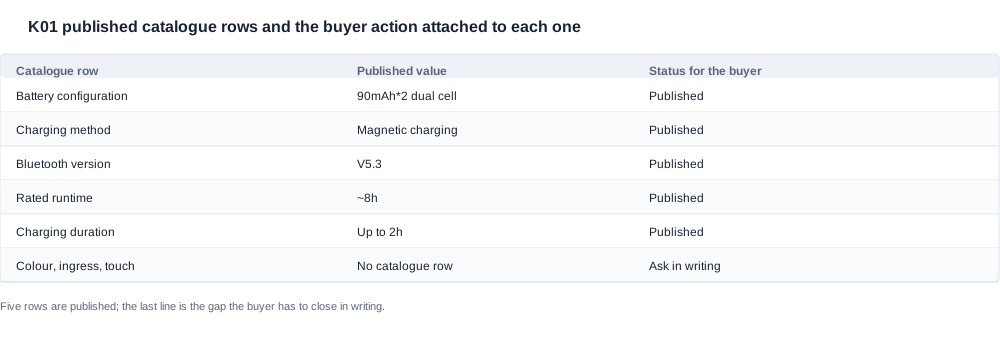
Figure 1 — K01 published catalogue rows and the buyer action attached to each one.
How to tell a published K01 row from an assumption
A published row is a line that exists in the catalogue for this specific model, carries a value, and states something a third party could check. An assumption is everything else: a value inherited from a neighbouring model, a value a competitor publishes, or a value that sounds reasonable. The distinction matters because assumptions migrate into product pages, then into tender responses, and eventually into a purchase order that nobody can defend.
Three tests are short enough to apply in a meeting:
- Does a row exist for this model? Not for the category, not for a similar model, for this model.
- Does the row carry a value? Some rows are present but empty of numbers, and an empty row is not a specification.
- Is the value quoted, or inferred? A quoted value can be repeated with a source attached. An inferred value can only be repeated with a caveat attached.
Applied to the questions buyers raise most often, those tests produce a clean split. The catalogue publishes 90mAh*2, magnetic charging, V5.3, ~8h and up to 2h for this model, and those five entries survive all three tests. A touchscreen, an ingress rating, a colour range, a physical mass figure, a camera resolution, offline translation and a noise-cancelling specification all fail the first test, because no row exists for this model. The catalogue's own records make the point without any interpretation: colour rows exist for only two models in the range, a mass figure appears for only one model in the camera group, and the catalogue contains exactly one control-surface row in total, which belongs to an AR-glasses entry described as an indicator light plus a button. A button is not capacitive touch, and no touch row may be borrowed from it.
The k01 smart glasses common questions that recur in buying sessions fall into two groups: rows the catalogue publishes, and rows it leaves open. The comparison below separates the two for the three neighbouring models most often placed next to this one.
K01 against K02, D11 and D12 on the rows each model publishes. This model and K02 share a battery configuration of 90mAh*2 and a charging method of magnetic. D11 and D12 each publish a single 100mAh cell and Type-C charging instead. The split buyers notice is not the battery. It is that D11 publishes a surround sound row and D12 does not, which makes that pair a controlled comparison of one audio feature rather than of the whole device.
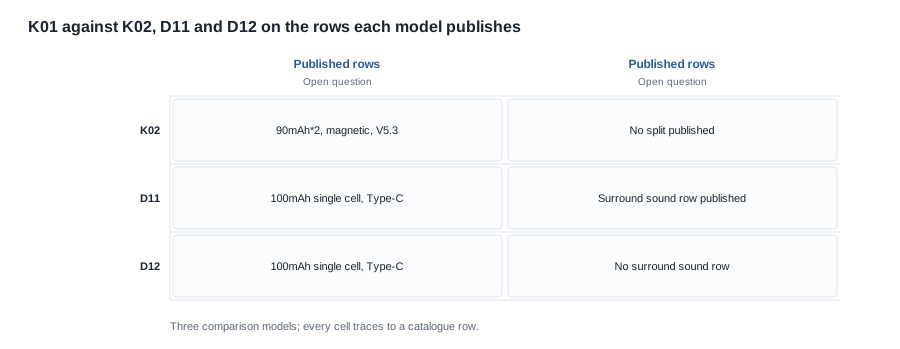
Figure 2 — K01 against K02, D11 and D12 on the rows each model publishes.
Two rows in that table are limits rather than differences, and both are easy to misread. The catalogue publishes no runtime row for the neighbouring models in this comparison, so a claim that this model lasts longer than K02 is not supported by any published figure. And because the charging-time row is a ceiling, comparing two charging times tells you which one is faster in the worst case, not which one is quicker in normal use.
If the row-level detail behind those comparisons is what you need rather than a summary of them, the K01 against K02 specification comparison and the K01 against D11 selection note walk the published rows one at a time and mark what the catalogue leaves open.
The practical output of this section is a one-page assumption register. Write down every claim your team is already using, then put a mark next to each one: published for this model, published for a different model, or published nowhere. That mark decides where the claim may be used at all, and it is cheaper to make before the claim reaches a listing than after.
The cost of leaving an assumption in place is not abstract. A runtime claim with no source behind it becomes an after-sales conversation later, because the distance between a laboratory figure and a full day of field use is where returns come from. A water-resistance claim with no ingress rating behind it becomes a problem at destination-market inspection, and that cost lands on the shipment rather than on the catalogue. A translation claim with no row behind it becomes a listing that a competitor can correct in a single comment. In each case the figure that had to be closed first was the one that would have been quoted most often.
The K01 questions a buyer should put in writing
Most buying sessions stall on questions that were never written down, because a verbal answer leaves no record to attach to the order. The list below is the version that works for this model, in the order it should be sent.
- Confirm the battery configuration for the exact item code you are quoting: two 90mAh cells, and a written statement of whether they charge together or in sequence.
- Ask what ~8h measures, and ask for the test condition behind the figure rather than the figure alone.
- Ask what up to 2h measures: from an empty cell, from a partly charged cell, or with both cells in the dock.
- Ask what ships in the carton, including how many magnetic charging cables and whether a spare is orderable.
- Ask whether this model has a charging case, and if it does, how many extra hours the case adds and how many full recharges it holds.
- Ask for pairing behaviour in writing. The version is published, so the open items are multipoint handling, device memory, and reconnection behaviour.
- Ask whether any translation function exists and whether it runs on the device without a network, and which languages are covered.
- Ask whether any touch or gesture control exists on this model and, if it does, what the control surface actually is.
- Ask whether the model carries an ingress protection rating and, if it does, which document states it.
- Ask whether prescription or magnetised lens inserts are available for this frame and who fits them.
- Ask which documents travel with the goods for your destination market, and request copies before the order is released.
- Ask for the commercial terms in writing, including order quantity, delivery schedule and after-sales cover, rather than a verbal assurance.
Ordering is not cosmetic. The first three questions change the specification you are selling, so they must be closed before anything else is agreed, and everything downstream inherits their wording. The document and lens questions decide whether the item can reach its destination market at all, so they run in parallel rather than after. The commercial terms come last for a simple reason: they are the only group that can still change once the specification has been fixed, and a specification change after a commercial commitment is the expensive kind.
A sample unit settles a different set of questions from a document. The written questions above close what the supplier can state; a sample closes what only physical behaviour can answer, which is pairing stability, the real charging time from a partly charged state, and the actual feel of the magnetic dock. Requesting one costs less than discovering the answer after a bulk shipment has landed, and the sample request page is the fastest route to a unit. The buyer review checklist sets out the inspection order for when that unit arrives.
There is a fourth category of question that is easy to forget and expensive to discover late: the ones about what the goods look like when they arrive. Packaging artwork, labelling rules for the destination market, the language of the manual, the serial and batch marking on the box, and the spare-parts list are all things that a product page never mentions and a customs broker always asks about. They cost nothing to ask, and they are the questions with the longest turnaround once the order is moving.
K01 charging, runtime and the two-cell question
The two-cell structure is the most quoted fact about this model and the least understood one. A published 90mAh*2 row means two cells of 90mAh are fitted. It does not mean they charge in parallel, it does not mean the runtime figure is the sum of two identical duty cycles, and it does not mean a single failed cell is detectable by the end user. A single cell that stops accepting charge will not announce itself, and the only protection available is asking how the pair is wired and how the device behaves when one cell lags.
Runtime comes next, and the published figure needs a condition attached before it can be used. The catalogue states ~8h for this model without saying what was running during those hours: audio playback at a given volume, standby with the connection open, or a mixed profile. Those produce very different field results, and the difference between them is the whole argument for closing the question in writing. Until the condition is known, the number belongs in an internal comparison and not on a retail listing.
Charging is where the ceiling distinction does the most work. The published duration is up to 2h, and only D17 and ZH12 publish a faster figure of about 1h. Treating up to 2h as a typical figure would overstate how quickly a unit is ready in normal use, because the worst case is what that row reports. Asking whether the published figure assumes an empty cell or a partly charged one is a cheap question with a large practical answer: a channel that ships in weekly batches cares about the partly charged case, because that is the state units arrive in.
Charging methods across the 28-model catalogue: magnetic charging covers 17 models, Type-C covers 7, and 4 models publish no charging method at all. Those four are L1 Pro and MT6, and CY05 and CY03, and the practical reading of that last group is straightforward: for them, the method cannot be assumed and must be asked for. For this model the answer is published as magnetic, and the channel implication is that a magnetic dock in the carton is not an accessory decision but a packaging decision that has to be made before the first print run.
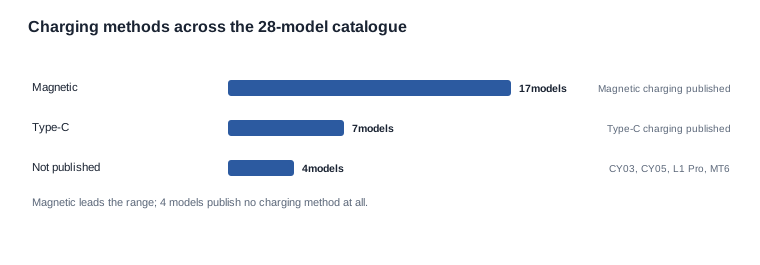
Figure 3 — Charging methods across the 28-model catalogue, counted in models.
The comparison with D11 and D12 is worth keeping in the same frame. Both publish a single 100mAh cell and Type-C charging, so a channel that has standardised on one cable type across the range has to make a deliberate decision about where the magnetic units sit, and a channel standardising on magnetic has to decide where the Type-C units sit. Neither choice is answered by the catalogue; both are answered by which units a channel actually sells.
Two more rows remain open on charging and both need a written answer. The catalogue publishes no charging case capacity for this model, so any plan that relies on a case extending the interval between charges has no published basis and must be validated on the sample unit. And the number of magnetic cables in the carton is not published at all, which is the kind of detail that decides whether a promotion can include a spare cable.
If your team is building the argument from scratch rather than adjusting an existing one, the battery life technical page explains the measurement logic behind a runtime figure, the K01 battery life article covers how the same row behaves under different duty cycles, and the charging options article compares the charging methods across the range. The decision that remains yours is which of these rows you will not ship without, and that decision is cheaper to make on paper.
What to request from the supplier for the K01
A written answer sheet beats a catalogue extract, because the extract shows what is published while the answer sheet shows what is confirmed for the order. The request itself is short, and it works better when it asks for dated documents rather than for assurances.
- A specification sheet with a revision date. Not the catalogue page: a dated sheet that names the item code, so the row you rely on can be traced to a document version.
- An answer sheet keyed to your question list. One line per question, with the answer, the person who gave it, and the date. That turns a conversation into an attachment for the order file.
- A sample unit. Not a photo and not a rendering. The sample is what closes the questions no document can close.
- Certification documents that apply to this order. Not a general list of company certificates: the documents relevant to the item code and to your destination market, requested as readable copies.
- Packaging and label artwork for approval. Artwork is a specification too, and it is usually the one that arrives last.
- Firmware and app details, including how updates are delivered and for how long they are maintained.
- After-sales terms and spare parts. What is available, for how long, and under what conditions, in writing rather than as a summary.
- Commercial terms. Order quantity, delivery schedule, after-sales cover and the terms for repeat orders, all in a document that can be attached.
Verification order before a purchase order, in five stages. The stages are short because each one ends with an artefact rather than a conversation:
- Collect the published specification sheet and mark the revision date on it.
- Map each row you intend to quote to a written value, with the source named.
- Mark the rows the catalogue leaves open, and send them as the question list.
- Test a sample unit against the answers you received, focusing on the rows you cannot read.
- Archive the answers, the sample results and the approval in one file per order.
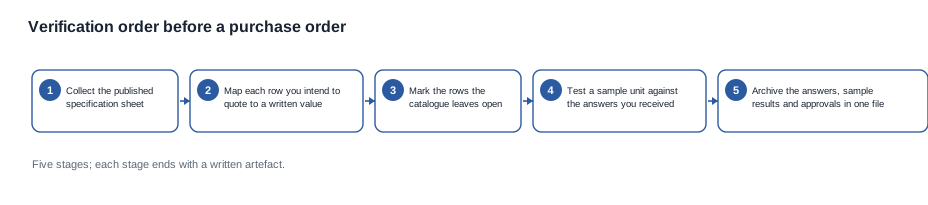
Figure 4 — Verification order before a purchase order, in five stages.
The order matters because stage five is only meaningful if the earlier stages produced something. A file that starts at stage five is a folder of good intentions, and it is the reason some specifications get re-argued every renewal. The same logic applies to customisation work: if the branding is yours rather than ours, the artwork approval and the labelling rules move into stage two instead of stage five, and the customisation guide for this model sets out what can be changed at that stage. Private-label programmes carry the same structure with a packaging layer on top, and the private label options article covers that layer specifically.
Two questions decide how deep the request needs to go. If the order is a one-off sample, the specification sheet and the answer sheet are enough, and the certification documents can follow with the commercial terms. If the order repeats, the answer sheet has to carry a document version and an expiry condition, because a written answer that expires leaves the buyer exactly where they started, and the OEM-ready product route exists for that case.
The last item on the request list is the one buyers most often leave out: a request for the evidence itself. When a specification matters enough to be printed on a listing, ask for the document that supports it and keep a copy. It takes one line in the request and it removes the most common source of a dispute six months later, which is a spec that changed without anyone noticing.
Where CYNRIN stands on the K01's open items
Where CYNRIN stands on the K01's open items. We will publish the five rows the catalogue supports and stop there. Our position is that a specification claim has to trace back to a catalogue row for the exact model, so we do not publish a translation, touch control, ingress protection, colour, camera resolution or physical mass claim for this model, because no row supports any of them.
That position has a practical cost, and it is worth stating plainly. A page that publishes five rows is shorter and less persuasive than one that publishes fifteen. A buyer comparing us against a competitor with a longer published sheet may read the shorter sheet as the weaker product. We would rather correct that reading later, with a documented answer, than absorb the cost of a claim we cannot support when a customer tests it.
The same rule applies to compliance language. The export certification page on this site is an image page carrying ten patent certificates, eight of them design patents and two of them utility models. We will not convert that page into a compliance statement, and we will not write that our catalogue states CE, FCC and RoHS, because it does not. If your shipment needs specific documents, request them for the item code and the destination through the certification checklist page, and ask for the copies in the same message as the specification sheet rather than as a separate favour later.
On the comparison rows, the rule is the same. Where a neighbouring model publishes a row that this model does not, we say that the catalogue publishes no split rather than manufacturing a difference, because a difference that cannot be traced becomes a commitment by accident. Where a row is published for both, we quote both values with their conditions attached, which is how the model selection guide is built across the range.
None of the k01 smart glasses common questions about translation, touch control or water resistance can be closed from the catalogue alone, and the honest position is to ask rather than to fill the gap. When we do have a written answer for a specific order, we attach it to that order, so the answer travels with the goods instead of living in a message thread that disappears.
The deliverable for a buyer is therefore a short answer sheet with the catalogue rows on one side and the confirmed values on the other, filed under the item code it belongs to. Our side of that deliverable is narrow and specific: fill in the published rows accurately, leave the open rows visibly open, and put a name and a date against every confirmed value.


