
The L2 Utral and the V03 sit in the same camera glasses catalogue and both publish a pixel count, a cell capacity and a charging figure. Read as a spec sheet, that makes them appear to be two points on one scale. Read as two catalogue pages, they are not comparable in the way a spec sheet implies, and the reason is a label. On the L2 Utral page the row called charge duration carries a charge limit of two hours or less, and the run time sits on a separate endurance row. On the V03 page the row called charge duration carries a run time of five to eight hours, and the charge limit sits on a separate charge time row. The same two words, one label, two different quantities. Every other row on the two pages separates the two models without ambiguity, and a buyer who knows which row is which can compare them properly. A buyer who does not will publish a charge figure next to a run time and call it a specification.
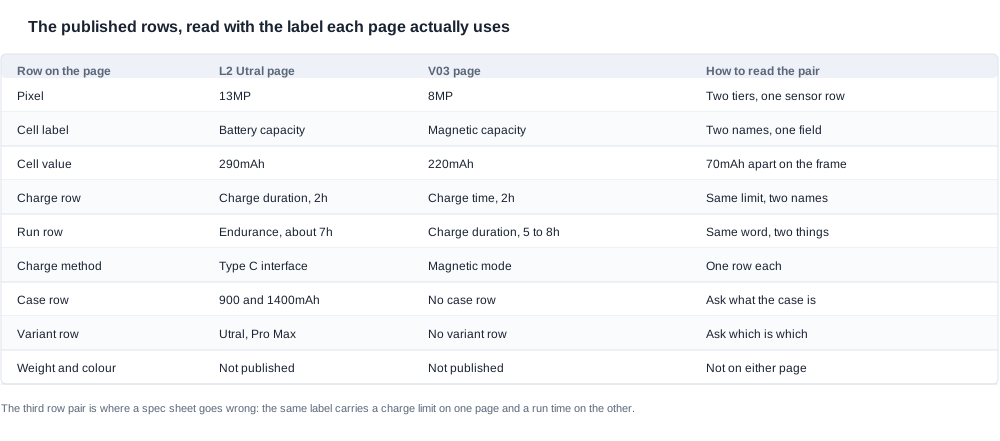
The published rows, read with the label each page uses
The table below is the two pages side by side, but the fourth column is the part that matters for anyone building a product page or a channel comparison sheet. It says what the difference actually is, and it says what to do with it.
| Row on the page | L2 Utral page | V03 page | How to read the pair |
|---|---|---|---|
| Pixel | 13MP | 8MP | Two tiers, one sensor row |
| Cell label | Battery capacity | Magnetic capacity | Two names, one field |
| Cell value | 290mAh | 220mAh | 70mAh apart on the frame |
| Charge row | Charge duration, 2h or less | Charge time, 2h or less | Same limit, two names |
| Run row | Endurance, about 7h | Charge duration, 5 to 8h | Same word, two quantities |
| Charge method | Type C interface | Magnetic mode | One row each |
| Case row | 900 and 1400mAh | No case row | Ask what the case is |
| Variant row | Utral, Pro Max | No variant row | Ask which is which |
| Weight and colour | Not published | Not published | Not on either page |
Three of those rows are ordinary and behave the way a spec sheet expects. The pixel row separates the two models at thirteen against eight megapixels, and the catalogue confirms that the camera range divides eight models at eight megapixels and three at thirteen, so the tier is real and repeatable. The cell row separates them at 290 against 220 milliamp hours, a difference of seventy milliamp hours on the frame. The charge method row separates them at a Type C interface against a magnetic mode.
The fourth row is where the naming gets interesting but harmless. Both pages publish a two-hour or less charge limit; the L2 Utral page calls it charge duration and the V03 page calls it charge time. Same number, two words, no ambiguity, because each page states it once.
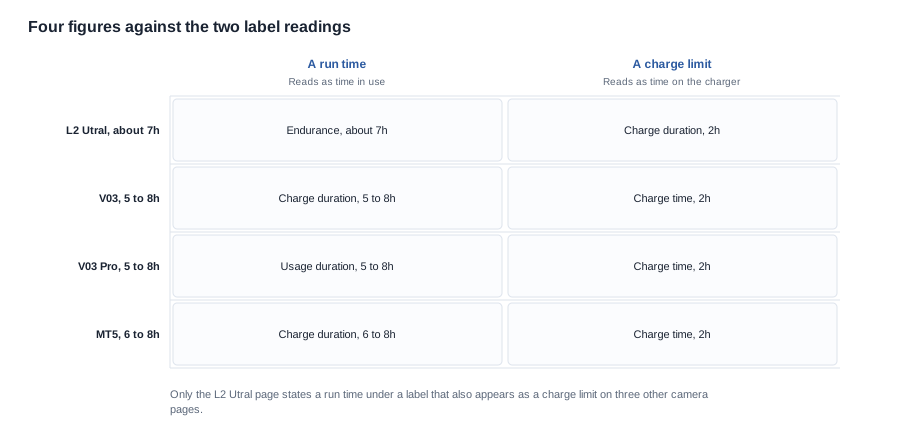
The fifth row is the one that breaks. The L2 Utral page has an endurance row reading about seven hours, and a separate charge duration row reading two hours or less. The V03 page has no endurance row at all. It has a charge time row reading two hours or less and a charge duration row reading five to eight hours. Read across the two rows and the table appears tidy: about seven hours against five to eight hours, a point figure and a range. That reading is wrong, and it is wrong in a way that changes the conclusion, because the figure on the V03 page that reads five to eight hours is a run time filed under a label that the L2 Utral page uses for a charge limit. Anyone who copies the number into a comparison sheet as a charge duration has copied a run time into a charge field.
Why one label carries two quantities, and how to tell them apart
The catalogue is not inconsistent about the figures. It is inconsistent about the words, and the two are easy to separate if you know which row to read. The rule is mechanical, it can be checked on every page, and it needs no memory of which model is which.
Look at the page and ask one question: is there a run row on it? The camera pages use a small set of labels for how long the product runs and for how long it takes to charge. On the L2 Utral page, the CY03 page, the CY05 page, the L1 Pro page and the MT6 page, the charge duration row and the endurance row sit next to each other, so charge duration there can only mean the charging limit. On the V03 page, the KY06 page and the MT5 page, the charge time row and the charge duration row sit next to each other, so charge duration there can only mean the run time. The remaining camera pages, V06 and V03 Pro, and S7, use usage duration for the run and charge time for the limit, and neither of those two words is used anywhere else in the set.
So the catalogue uses four labels across the camera range for two quantities. Charge time, charge duration, usage duration and endurance. Five pages pair charge duration with endurance, three pages pair charge time with charge duration, and three pages pair charge time with usage duration. If a page has a run row next to the charge duration row, the charge duration row is a limit. If the page has a charge time row instead, the charge duration row is the run time. No page states both quantities under the same word, which is why the catalogue can be read reliably once the rule is known.
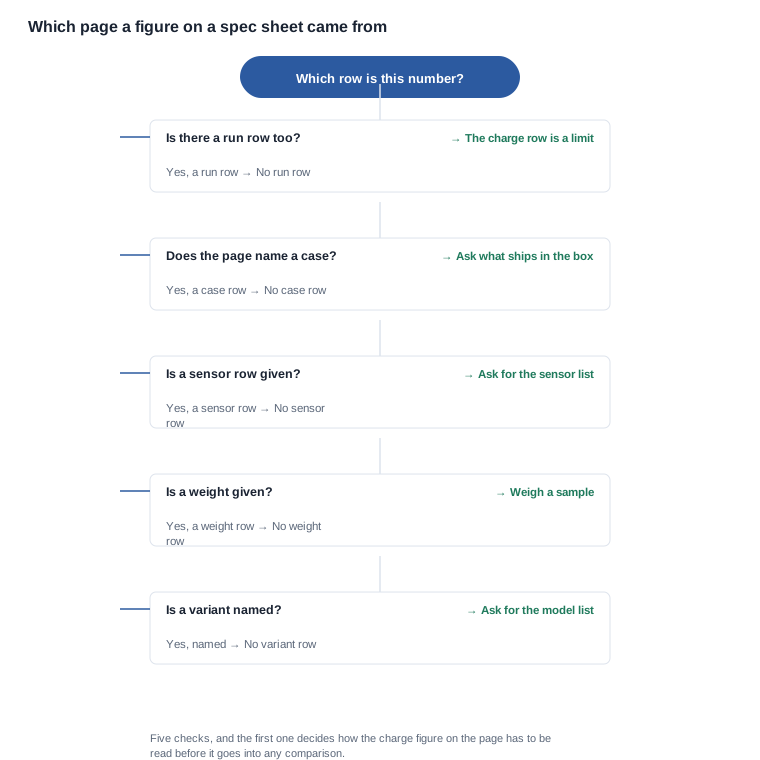
This matters for the pair specifically, because the two pages sit on opposite sides of the rule. The L2 Utral is one of the five pages that state a run time on an endurance row, and the V03 is one of the three that state it on a charge duration row. Compared against the L2 Utral, the V03 therefore appears weaker on paper than the number actually is, because the V03 run time of five to eight hours is a range and the L2 Utral figure of about seven hours is a point. A range is the more informative disclosure, because it implies more than one condition was measured. A point implies a single measurement taken under conditions the catalogue does not describe. Neither figure carries a test condition on either page, so neither can be read as a working day, and the two cannot be ranked against each other on paper.
There is a second-order point in the same place. If a page states a run time as a point, the reader has no way to know the spread. If a page states a run time as a range, the reader knows the product was measured under at least two conditions and knows the envelope. A procurement comparison that treats a point as a promise and a range as a hedge inverts the evidence. The how to compare smart glasses battery life method piece covers the questions to ask about the condition behind either kind of figure.
The case row, the variant row and what each one does not say
The L2 Utral page publishes a charging case row reading nine hundred and one thousand four hundred milliamp hours, and a variant row naming two variants, Utral and Pro Max. The V03 page has neither row. There is no case capacity for the V03 and no variant name for the V03, which means two questions cannot be answered from the catalogue for that model: whether a case exists, and whether the magnetic charge mode is delivered with one.
The L2 Utral is the only camera model in this catalogue that publishes two case capacities in one row. Every other camera page that has a case row publishes a single value: the L1 Pro and the CY05, and the CY03 each publish one thousand four hundred, and the MT6 publishes one thousand two hundred with a foldable case noted separately. That makes the L2 Utral row a genuine structural difference rather than a specification lead, because it gives a channel two configurations of the same model to plan around. It is worth being precise about what that row does and does not establish. The page prints both capacities and prints both variant names, and it does not state which capacity goes with which name. Anyone building a product page that pairs a name with a capacity is making a decision the catalogue has not made for them, and the decision has to be confirmed before it goes live.
The V03's charge method row reads magnetic charging mode. Magnetic charging is the method on the KY06 and the MT5 pages too, but those two pages state it in a longer form that names a charging case alongside the magnetic charge, so the accessory is at least acknowledged there. The V03 page names the mode and stops. The catalogue is not saying the V03 ships without an accessory, and it is not saying the V03 ships with one. It is not saying either, and the difference between those two silences is the difference between a two hundred and twenty milliamp hour frame that arrives with a pad and one that arrives with a case, which is a different product in the carton and a different parcel. The AI camera glasses charging case options piece covers what the accessory in the box does to the cost structure, and the AI camera glasses shipping weight piece covers the parcel.
Two further points on the case row. First, the nine hundred and one thousand four hundred figure belongs to the case, and the two hundred and ninety belongs to the frame, and the two numbers are not alternatives to each other, so a product page that presents them in one column without a label will produce a comparison that nobody can reproduce. Second, the two hundred and twenty milliamp hour cell of the V03 is not the smallest in the range, despite being lower than the L2 Utral. The MT5 and the V03 Pro both publish two hundred and twenty milliamp hours, and the MT5 page also publishes a case row and a magnetic charge that names a case. So the V03 shares its cell capacity with two other camera models, and the L2 Utral shares its cell capacity with the CY03 and the L1 Pro, and the CY05. Cell capacity is a class attribute in this catalogue, not a differentiator, and neither model can be positioned on it.
Where the two models genuinely separate, and where they do not
Taking the rows that are unambiguous, the L2 Utral and the V03 separate on four points and are identical or blank on the rest. That is a real difference set, and it is the whole of the published difference set. The criteria for comparing the two models on published rows are these four:
- Pixel tier. Thirteen megapixels against eight, and the catalogue divides the camera range eight to three on that line, so the tier is repeatable.
- Cell capacity. Two hundred and ninety milliamp hours against two hundred and twenty, a difference of seventy on the frame.
- Charging interface. A Type C interface row against a magnetic charging mode row.
- Case row. A published row carrying two capacities against no case row at all.
On colour, neither page publishes a row, and the only camera pages in the catalogue with a colour row are the V03 Pro, which lists three, and the V06, which lists four. On frame weight, neither page publishes a row, and the only camera page in the whole catalogue with a weight is the MT6 at one hundred and fifty-eight grams, which is also the only foldable case note. On the Bluetooth version, neither camera page publishes a row, and the camera range publishes none at all; the Bluetooth version rows belong to the audio models. On the ingress rating, neither page publishes a row, and only the V06 and the S7 carry an IP54 marking. On colour, weight, ingress, Bluetooth and every optical and capture parameter, the two models are equally undocumented.
That last point is the one to carry into a procurement conversation. The 13 against 8 megapixel tier is a shelf argument that a customer can see in a listing, and it is the reason the L2 Utral exists as a separate model. It is not an imaging quality argument, because the sensor model, the lens, the field of view, the capture format, the frame rate and the storage arrangement are not published for either model. A megapixel count is a number of sites on a sensor, and the way those sites are used depends on sensor size, lens aperture and processing, none of which appear on either page. The camera imaging notes cover the parameters that decide the result, and the L2 Utral limitations analysis sets out the full gap list for the thirteen megapixel model.
There is also a certification point to make plainly, because a spec sheet comparison often runs to the certification row and finds it empty. The catalogue contains an export certification page at company level whose content is presented as images, and that page carries the company's patent certificates. There is no per-model certification row on the L2 Utral page, and there is none on the V03 page, and there is no per-model certification row anywhere in the camera range. So the certification position for either model, in any destination market, is a document request rather than something the catalogue can settle, and it belongs in the same list as the sensor model and the frame weight.

What to ask, in the order that makes the answers useful
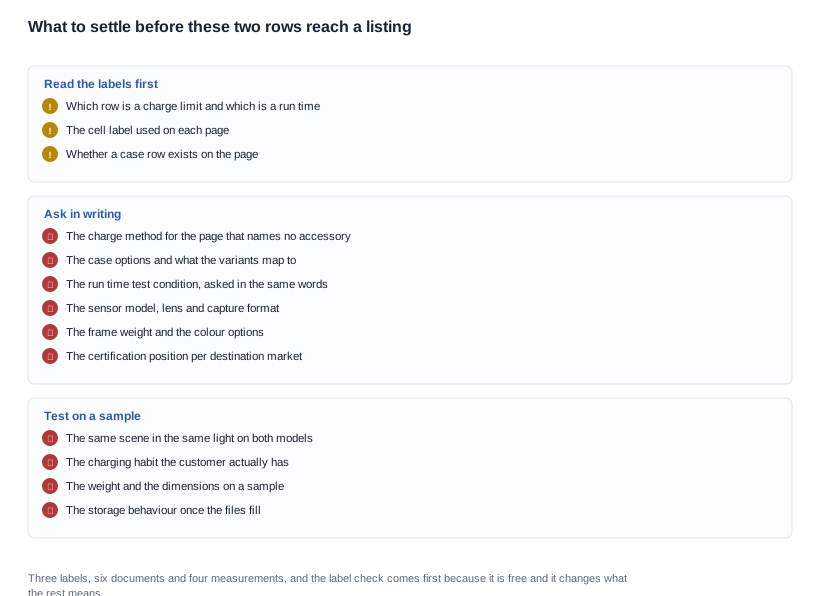
A comparison of two models is finished when the remaining unknowns are converted into questions with a name against them. The order matters, because the first group is free and changes how everything after it should be read.
Read the labels before anything else. Confirm which row on each page is a charge limit and which is a run time, and note the cell label each page uses, since the catalogue uses two names for the frame cell. This costs nothing, needs no supplier contact, and it is the step that stops a five-to-eight-hour run time from being published as a charge duration. Check too whether the page you are reading has a case row at all, and whether it names a variant, because the presence of those rows changes what can be read and what has to be asked.
Then ask, in writing, and ask both models the same way. What is the charge method, for the page that names no accessory. What case options exist, and which capacity maps to which of the two published variant names. What is the run time test condition, and what was the state of the product when it was measured. What is the sensor model, the lens, the field of view, the capture format and the frame rate. What is the frame weight and what colour options are available. And what is the certification position for each model, in each destination market, as a document rather than a claim.
Then test on a sample, because these are the ones no document will settle. Run the same scene in the same light on both models, with the same capture settings, and keep the files. Charge each in the way the customer will actually charge it, because a magnetic mode and a Type C interface are different habits, not different speeds. Weigh the frames and measure them. Fill the storage and watch what happens to the next capture, because what a camera does when the files fill is a published nowhere and a shipped behaviour everywhere.
The L2 Utral best-for analysis piece covers the thirteen megapixel model in detail, and the model readiness overview maps the camera platforms. For the eight megapixel entry point, the V03 best-for analysis piece covers that model, and the AI camera glasses entry-level options piece places it against the rest of the eight megapixel group, which also includes the CY05 and the CY03, the KY06 and the MT6, and the V03 Pro and the V06, and the MT5.
How to read the L2 Utral and V03 comparison without over-reading it
The position is narrow and we will state it plainly. The L2 Utral and the V03 are not two points on one specification scale, and the row that makes them look like they are is the row that means different things on the two pages. We will not publish a charge duration for the V03, because the figure the catalogue files under that label is a run time. We will not present the thirteen against eight megapixel difference as an image quality claim without a sensor model and a lens, and we will not present either endurance figure as a working day, because neither page states a test condition. We will not quote a weight, a colour, an ingress rating, a Bluetooth version, a certification number or a case capacity for the V03, because the V03 page does not contain them, and we will not treat the absence of a row as a value of zero or as a different answer.
What this comparison does support is a set of four clean separations and a long list of shared unknowns. The four separations are the pixel tier, the cell capacity, the charging interface and the case row. The shared unknowns cover the sensor and the lens, the capture parameters, the frame weight, the colour options, the Bluetooth version, the ingress rating, the per-model certification position and the run time test condition.
Three red flags to watch for in any two-model sheet that claims to be built on this catalogue. The first is a charge duration of five to eight hours presented against a run time, which means a run time has been filed under a charge label. The second is a weight, a colour or an ingress rating quoted for a camera model whose page carries no such row, which means the number came from a different page or from a different model. The third is a certification mark written next to a model name, which the catalogue does not carry for any camera model at all.
A channel that puts the two lists on the same page as the model rows, with the labels as published and the blanks left blank, ends up with a comparison it can defend. A channel that fills the blanks with the other model's numbers, or moves a run time into a charge field, ends up with a comparison that will not survive the first technical question from a customer who has read the catalogue. Before you commit to either arrangement, the trade-offs are worth naming: the four separations are structural and will not change with a volume quote, and everything in the shared unknowns list can change with a technical file or a sample, so the sequence that respects that distinction is the one that closes the cheap items first and the measurement items last. A shortlist built on the published rows and a shortlist built on a supplier quotation are two different lists, and only the first can be assembled from the catalogue alone.
The published rows for the L2 Utral are set out in the L2 Utral smart glasses specifications and features piece, and the published rows for the V03 are set out in the V03 smart glasses specifications and features piece. For the accessory economics around the case, see the AI camera glasses charging case options piece.
Send us the two model pages you are working from and the markets you are quoting into, and we will tell you which rows you can state and which ones you have to ask for.


