

The LC-105-1's published rows point at one kind of channel and rule out several others, and the reason is a shape rather than a specification: this model publishes five specification rows and no feature rows at all. Five rows means a radio version of 5.4, a pair of 55 mAh cells, a charge ceiling of two hours, a rated use close to eight hours and a magnetic interface — and nothing else. What is missing is as much a part of the description as what is there: no acoustic descriptor, no temple or hinge note, no touch row, no ingress rating, no frame weight, no charging-case row and no pointer to a per-model certification file. In a range where three of the eight audio models publish one or two feature notes, the LC-105-1 belongs to the group whose entire case has to be made from its electrical rows and its endurance figure. That is an unusually clean position for a channel whose pages get audited, because every claim on the page can be traced to a row a reviewer can check in seconds. It is a poor position for a channel whose pages compete on a lead feature, because there is no lead feature to use. One caveat belongs at the front of this page, and it concerns the model's own framing: our catalogue prints no frame weight for any audio model, so a lightness claim cannot be substantiated here for the LC-105-1 or for any of its neighbours, and it must not appear on a listing. No price, order quantity or lead time is published, so what follows is a screen built from published rows rather than a ranking of this model against another.
Lc-105-1 smart glasses best for: a specification-led model in a feature-led range
The buyer who reaches this page is usually building a range rather than buying one product: a brand owner deciding which audio models go into a first line, a channel buyer assembling a shelf plan, or a distributor putting together a catalogue that has to survive a marketplace compliance review. In all three cases the selection question is not "is this the best model" but "which channels can this model actually be sold into without a claim problem". That distinction is the whole of this page, because the LC-105-1 is unusually clean on one axis and unusually empty on another.
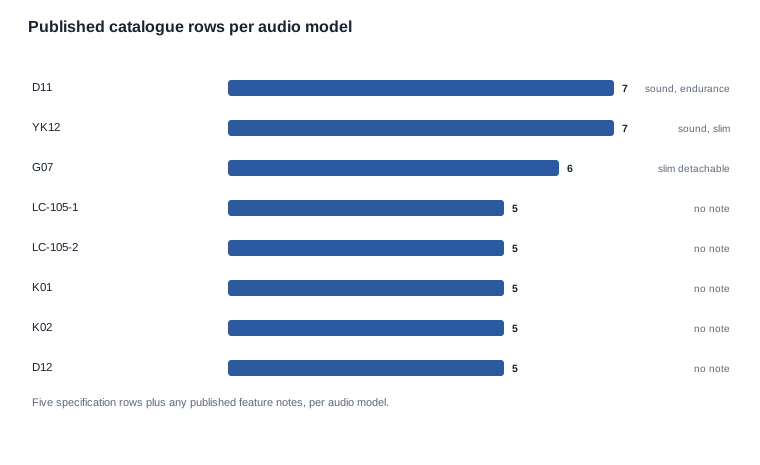
Count the published catalogue rows per audio model and the shape of the range becomes obvious. Every audio model publishes the same five specification rows — radio version, cell configuration, charge ceiling, rated use, charging method. On top of those, three models publish feature notes: the D11 publishes two, a surround-sound descriptor and a long-endurance note; the YK12 publishes two, a surround-sound descriptor and a slim-temple descriptor; the G07 publishes one, an ultra-slim detachable temple. The remaining five — the LC-105-2 and the K01, the K02 and the LC-105-1, and the D12 — publish no feature note at all. The LC-105-1 therefore sits in the group whose listing has to lead on the specification table rather than on a feature line, and inside that group it carries exactly the same five rows as everybody else.
For a channel whose pages are audited, that emptiness is an advantage, and it is worth saying why rather than treating it as a gap to apologise for. A specification-led listing can be checked mechanically: the radio version on the page is the radio version in the catalogue, the cell configuration is the cell configuration in the catalogue, the charge ceiling reads the way the catalogue reads. Nothing has to be inferred, nothing has to be hedged, and nothing has to be withdrawn later when a competitor reads the copy carefully. A feature-led listing cannot be checked that way, because a descriptor is a judgement by the manufacturer and a buyer has no way to test it against a catalogue. The LC-105-1's thin sheet is the reason its copy is cheap to audit, and that is a real commercial property even though it is not a marketing one.
The second half of the same property is where the drafting work goes. Because there is no feature to carry the page, every line a buyer wants to write has to come from one of five rows, and the discipline is to write each of them in the wording the catalogue uses. The table below is the whole of what can be said, with the version that fails review beside it, because the most common failure on a specification-led listing is not exaggeration but transposition — a row imported from a neighbouring model or from another category.
| Published row | Published value | Wording that survives review | Wording that fails review |
|---|---|---|---|
| Bluetooth version | Version 5.4 | Bluetooth 5.4 | Bluetooth 5.4 with multipoint |
| Cell capacity | 55 mAh × 2 | Two 55 mAh cells | A 110 mAh battery |
| Charge time | Two hours or less | Charges in two hours or less | Charges in under two hours |
| Rated use | About 8 hours | Rated for about 8 hours of use | Up to 8 hours of battery |
| Charging method | Magnetic | Magnetic charging | Magnetic charging, case included |
| Feature notes | None published | No feature descriptor | Surround sound or a detachable temple |
That table is short enough to print and strict enough to work as a pre-publication check, and it is the reason the LC-105-1 suits the channels whose pages are specification tables and does not suit the channels whose pages are campaign pages. The endurance figure, which is the model's strongest published row, is handled in more detail in the LC-105-1 battery life analysis, including the workload question that has to be answered before the eight-hour figure is quoted as anything more than a rating.
The channels this model's published rows open, and the ones they close
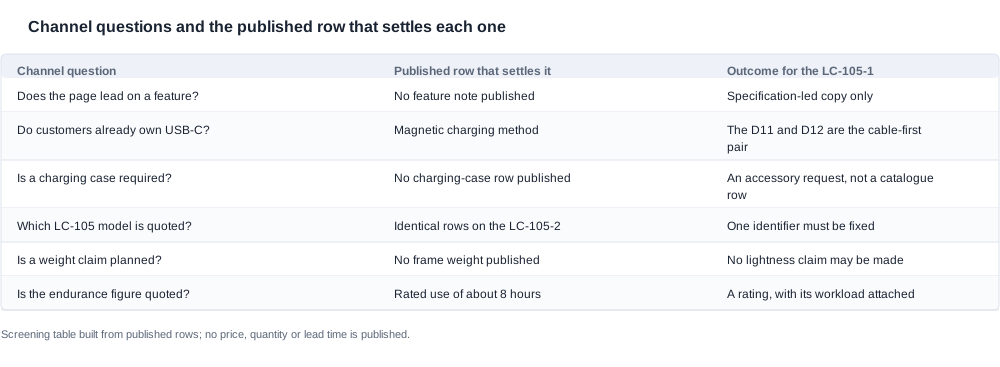
A screen is only useful if it produces a decision, so here is the tree in the form a channel buyer would work it: which branch of the business this model belongs to, and which published row settles that.
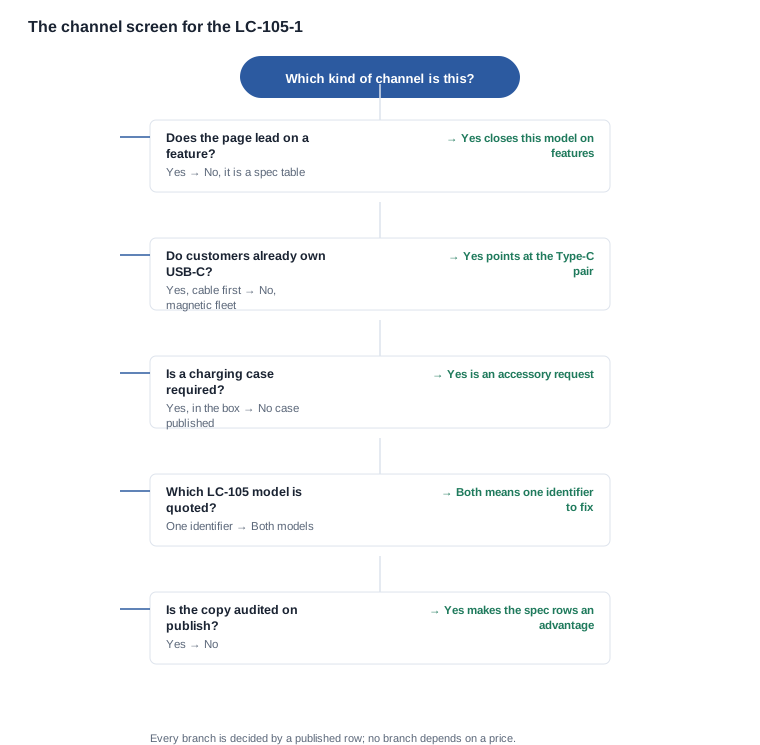
The first branch opens. A channel that sells specification — a wholesale price list, a business-to-business procurement portal, a product catalogue where the page is a table of parameters — can publish the LC-105-1 with very little drafting risk, because its page and the catalogue say the same thing. That channel also gains from the fact that this model publishes the highest rated use in the audio range, at about eight hours, on a magnetic interface and the current radio version. The advantage is not that the listing sounds impressive; it is that the listing is verifiable and the reviewer has nothing to interrogate.
The second branch closes. A channel that competes on a lead feature — a campaign page, a short video, a marketplace listing whose first line has to carry the product — cannot use this model, because there is no feature to carry it. The sound descriptor published by the D11 and the YK12 is not available here, the detachable temple published by the G07 is not available here, and no acoustic, driver, leakage or microphone figure is published for this model at all. A buyer who writes a feature line for the LC-105-1 has copied it from a neighbouring model, and a competitor who reads the catalogue will find the copy.
The third branch closes for a different reason. A channel whose customers already carry a standard USB-C cable and nothing else has a friction problem with this model, because magnetic charging is a specific interface and a specific accessory rather than a cable the customer owns. The D11 and the D12 are the pair in the audio range that publish Type-C charging, and for a cable-first customer base they are the models that need no accessory programme at all. This is not a quality judgement on either; it is an ecosystem judgement, and it is the kind of thing that decides a range before a single unit is ordered. The weight comparison across the audio range is worth reading alongside this branch for a related reason — it shows how a buyer handles a dimension the catalogue publishes for no audio model at all.
The fourth branch is the one most often closed by accident rather than by decision. No audio model in this catalogue publishes a charging-case row. The models that do publish a case capacity are camera models — the L1 Pro and the CY03, and the CY05 — each at 1400 mAh, the L2 Utral at 900 or 1400 mAh, the MT6 at 1200 mAh in a folding case — and a capacity must never be carried across from one of those onto an audio listing. For the LC-105-1 the correct position is that the catalogue lists magnetic charging and lists no case capacity for this model. A buyer who wants a case in the box is requesting an accessory programme, and that request belongs in the quotation with its own specification, its own packed weight and its own effect on the freight rate.
The eight hours and the six hours, read as a range comparison
There is one comparison in this range that a channel buyer will make whether or not anybody invites it, and it is better to make it deliberately than to have it made by a customer. Four models in the audio range publish a rated use of about eight hours — the K02 and the K01, and the LC-105-1 and the LC-105-2 — and two of them publish about six hours, the G07 and the YK12. The striking part is where the split falls. The models publishing six hours are not the ones with less energy stored: the G07 and the YK12 carry the same 55 mAh × 2 configuration as the LC-105-1, and the LC-105 pair publishes eight hours on it. Meanwhile the K01 and the K02 publish the same eight hours on a larger 90 mAh × 2 configuration. So the top figure in the range sits on the smallest cell configuration we publish for any audio product, and the bottom figure sits on that same configuration. Capacity explains nothing here, in either direction.
What that means for a listing is not that the eight-hour figure is doubtful. It means the figure is a rating produced by a method the catalogue does not disclose, and that the method is evidently not consistent across the range, or the ratings would not invert against capacity in the way they do. A channel can therefore publish "rated for about 8 hours of use" for the LC-105-1, because that is what the catalogue publishes, and it can publish the figure next to the cell configuration, because both are published rows. What a channel cannot do is present the eight hours as the longest endurance in the range as though the range were measured under one protocol, because a customer who checks the catalogue will find a six-hour figure on an identical cell configuration two models away. A comparison table that sorts the range by endurance and implies the ordering is a performance result is the line that fails review, and it is a line that is easy to write by accident.
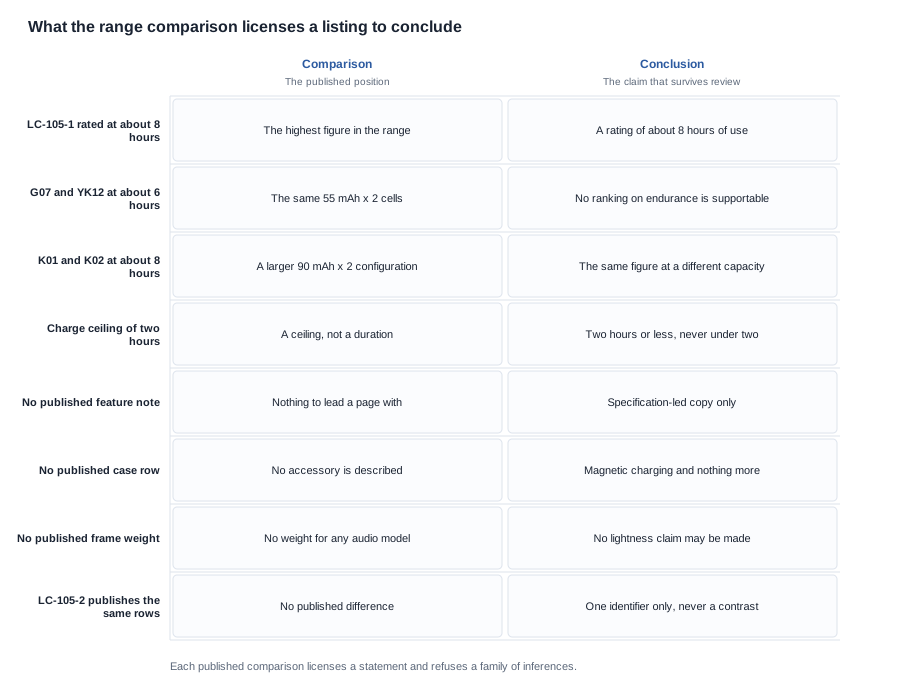
The second-order point concerns the cell configuration itself, and it is the reason this model is more interesting to a range planner than a catalogue reader would expect. Two 55 mAh cells is the smallest published audio configuration in this catalogue — the single-cell models publish 100 mAh and the paired models publish 90 mAh × 2 — so the LC-105-1 carries the top published endurance figure on the least stored energy of any audio model here. That is a genuine efficiency story, and it is exactly the story the catalogue cannot substantiate on its own, because it publishes no consumption figure, no standby figure, no radio current and no test method. The honest way to use it is as a question to the supplier rather than as a claim to the customer: ask what the eight-hour figure is made of, and a supplier who answers with a workload definition has given the buyer a condition that can be written into an order.
For a buyer choosing between models in this range, the practical conclusion is that endurance cannot be the ranking axis. It can be one published row among several, and it is a row that the buyer should attach a condition to. The axes that can be ranked are the ones the catalogue makes comparable: the charging interface, since a magnetic interface and a Type-C interface put the product into different ecosystems; the cell configuration; and the published feature inventory, which separates the models with a note from the models without one. The G07 smart glasses best for page runs the same screen from the opposite end of the range, and the catalogue rows behind this model are the baseline every one of these comparisons should be read against.
LC-105-1 or LC-105-2: resolving a twin the catalogue cannot resolve
The LC-105-2 publishes exactly the same rows as this model — two 55 mAh cells, a charge time of two hours or less, a rated use of about eight hours, magnetic charging, Bluetooth version 5.4, and no feature note of any kind. The catalogue publishes no difference between them, which makes the choice between the two a decision the catalogue cannot inform. For a range planner that has a direct consequence: carrying both models means carrying two products that no published row separates, and carrying one means being able to put the whole published sheet on the page without qualification.
That choice has to be made on grounds that live outside the catalogue, and those grounds are all unpublished, so they all have to be requested. Lead time is the most obvious one, since two models with identical specifications and different availability are not interchangeable for a launch. Minimum order quantity is the second, because it determines whether a small channel can test the market with one model or has to commit to a volume that suits neither. Packaging and what goes in the box is the third, because a magnetic interface makes the accessory decision part of the range decision. Availability of a sample configuration is the fourth, because the eight-hour figure and the rest of the specification have to be seen on the sample that will represent the production unit. And the commercial terms themselves — unit price at the quantity band, payment nodes, warranty, defect allowance — are the terms that will actually separate the two in practice, and none of them are published either.
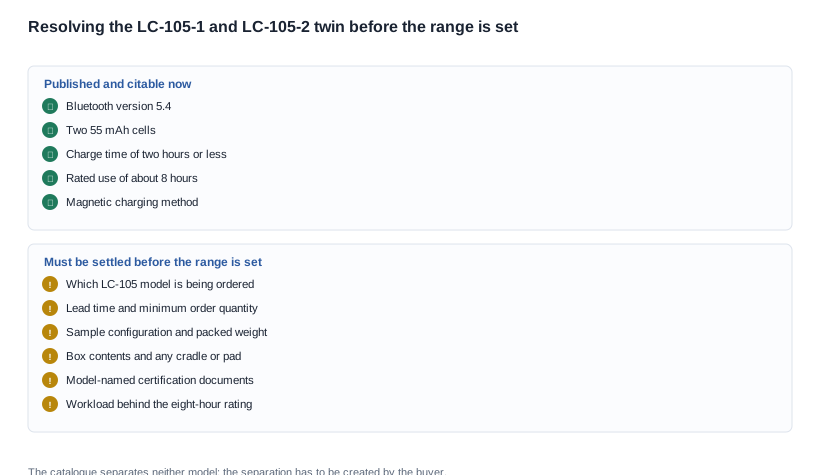
Once one of the two is chosen, the operational consequences are unglamorous and they are where the money leaks. The model identifier has to appear on the purchase order, on the packing list, on the carton, on the product marking and on the artwork, because a range that carries an LC-105 without fixing which one is a range that will eventually ship a mixed batch. The listing copy has to name one identifier rather than the family. The certification evidence has to name the same identifier, because a document set covering one model is not evidence for the other. The spare-parts and warranty position has to cover the same identifier, so that a customer complaint can be answered with a record. And the stock plan has to be built for one model, because stocking both without a published difference means carrying twice the inventory for one product proposition.
The LC-105-1 limitations analysis sets out the full set of documentation gaps on this model, and it is worth reading before the range is fixed rather than after, because several of those gaps are cheap to close with a request and expensive to close with a reprint. The customisation path for this platform covers what a brand can and cannot specify on a model of this type, and the who needs the LC-105-2 analysis works the twin from the other side. Between the two of them they make the point that the catalogue's silence about the difference between the two models is a fact about the catalogue and not a statement that the two products are interchangeable in any other respect.

From shortlist to publishable listing: the six-line rule
Because this model offers no feature to carry a page, the page has to be built from five rows, and the build is simpler than it sounds if it is done as six lines rather than as prose. A specification-led listing for the LC-105-1 contains six lines and nothing else, and each one has a fixed wording.
- The radio line. "Bluetooth 5.4", taken from the published radio version row, with no claim attached to the version number itself — no multipoint, no range, no codec, no pairing behaviour.
- The capacity line. "Two 55 mAh cells", taken from the published cell configuration, with no derived total printed beside it and no claim that the capacity produces the endurance figure.
- The charging line. "Magnetic charging", taken from the published charging method row, with no case, dock, cradle or cable inclusion claimed, because no charging-case row is published for this model.
- The charge-time line. "Charges in two hours or less", in the catalogue's own ceiling wording, because "under two hours" overstates a figure that permits exactly two hours.
- The endurance line. "Rated for about 8 hours of use", taken from the published rated-use row, upgraded from a bare rating to a rated figure with a workload attached as soon as the supplier has confirmed the workload, the start state and the end criterion.
- The omission line. Nothing. The absence of a feature note is handled by leaving the feature section off the page rather than by writing a negative line about it, because a negative claim is still a claim and still needs a source.

Running that check before publication is a checklist rather than an opinion, and it costs a buyer about ten minutes per product page. The criteria are short: every line on the page points at a published row, the ceiling wording is intact, no derived total is presented as a published figure, no figure has crossed a category boundary, and the model identifier is fixed. The red flags are equally short: a frame weight appearing on an audio page, a case capacity appearing on an audio page, an acoustic descriptor on a model that publishes none, and an endurance figure presented as a ranking. Where a buyer wants to know how to choose between models rather than how to write one page, the questions to ask are the same in a different order — what is published, what is not published, and which of the unpublished items the supplier will put in writing before the first order. That ordering is worth keeping, because the first question tells a buyer what can be published today, the second tells a buyer what to request, and the third tells a buyer what will still be open on the day the order is placed.
Those six lines are the listing, and everything else on the page has to earn its place separately. The pack shot, the use-case copy and the brand story are all legitimate, but none of them may repeat a specification in wording that differs from the catalogue, because a mismatch between the marketing block and the specification table is the most common way an otherwise compliant listing gets pulled. If the marketing block wants to say "eight hours of battery", the specification table has to say the same thing in rating wording, or the two have to be reconciled before publication.
Two operational steps sit alongside the drafting, and both of them are cheaper than a reprint. The first is the sample: weighing a packed unit and measuring a packed unit is the only route to a packed weight or a parcel dimension for the freight rate, and on a magnetic-charging model it is also the only way to see whether a cradle or a pad is a sensible thing to put in the box. The second is the document request, which has to name the model and the market and has to produce a conformity file, a signed declaration and the test reports tied to this specific identifier — the radio framework for the European market is the Radio Equipment Directive (EU) 2014/53/EU; the separate EMC Directive 2014/32/EU sits alongside it, and a Bluetooth SIG listing is one the buyer can resolve independently in the member database. No mention of CE, FCC or RoHS appears in our catalogue text for any model, and there is no per-model certification row, so those papers are requested from the supplier rather than assumed.
On the commercial side the sequence is the one that works across the range, and it is not complicated. The cost of conformity testing and the time it takes are set by the laboratory and the authority and are not commercial variables; what a buyer controls is whether the factory will commit in writing, and when the papers will be handed over. Everything else — order breaks, packing, payment milestones, defect allowance, warranty term, production lead time — sits open for negotiation, and it negotiates more easily once the acceptance condition exists, because the risk a supplier is quietly pricing is the risk of an unquantified endurance claim rather than the risk of a known one.
The LC-105-1 screen in one page, and what to send us
This model earns its place in a range that is sold on specification rather than on features, and its strongest published row — a rated use of about eight hours — is also the row that most needs a condition attached before it reaches a customer. What we publish for the LC-105-1 is five specification rows and nothing else: no feature note, no frame weight, no charging-case capacity, no test method, nothing pointing at a per-model certification file, and no commercial terms of any kind — no price, no order minimum, no lead time, no warranty term. We would rather hand over that short and accurate list than a longer one we cannot substantiate, and we will not present a lightness claim for this model or for any other audio model in the catalogue, because no audio model publishes a weight. We will also not rank the LC-105-1 against the LC-105-2: the two sets of rows match one for one, and what separates them is not in the catalogue.
For the wider range, the models either side of this one are set out in LC-105-2 versus D12 use case comparison, the screen applied across all eight audio models is in the model-selection guide for the audio range, and the accessory economics that decide the magnetic-charging branch are in Bluetooth audio glasses charging options.
If you are working through the screen, send us the channel type, the customer profile, whether the range is catalogue-led or campaign-led, the two LC-105 models you have quoted, and the copy you intend to publish. We will tell you which branch you are on, which of your six lines are already supported, which one needs a workload before it can go out, and whether the range would be better served by a model that publishes a feature note. Send the copy first — it is the document where the mistakes actually happen, and it is the cheapest one to correct.


