

MT5 smart glasses vs V03 Pro which one to choose is a packaging decision more than a hardware decision, because these two models share a platform and then diverge on exactly one row. Both are eight-megapixel camera models with a 220 mAh cell and a charge time of two hours or less. The MT5 ships with a charging case whose capacity is not published. The V03 Pro has no charging-case row, and carries a Type-C interface, three printed colourways and a photochromic lens described only by name.
So the honest framing is this: the V03 Pro is the model with a documented product identity and no accessory, and the MT5 is the model with an undocumented accessory and a thinner page. Which one suits a channel depends on which of those two problems the channel can absorb — and this article sets out the criteria rather than naming a winner.
MT5 smart glasses vs V03 Pro which one to choose: what the two models share
Start with the shared rows, because they narrow the decision considerably.
Same resolution class. Both are published in the eight-megapixel group, alongside the CY05 and the KY06, and the V03 and the V06, and the MT6 and the CY03. Neither publishes a sensor model, a field of view, a frame rate or a video format, so neither supports an imaging claim beyond the resolution class itself.
Same cell. Both are published with a 220 mAh cell, the smallest in the camera group. Any freight argument that favours a smaller cell applies equally to both models and therefore decides nothing between them.
Same charge ceiling. Both publish a two-hour-or-less charge time, as a ceiling rather than a measurement, with no starting state of charge and no completion criterion attached.
Same documentation gaps. Neither publishes a weight, a Bluetooth version, a per-model certification row or a runtime test condition. The Bluetooth absence applies to all eleven camera models; the certification absence applies to the whole catalogue.
Different runtime shape. The MT5 publishes six to eight hours as a range. The V03 Pro publishes five to eight hours as a range. Both are wide disclosures with no stated condition, and neither can be ranked against the other.
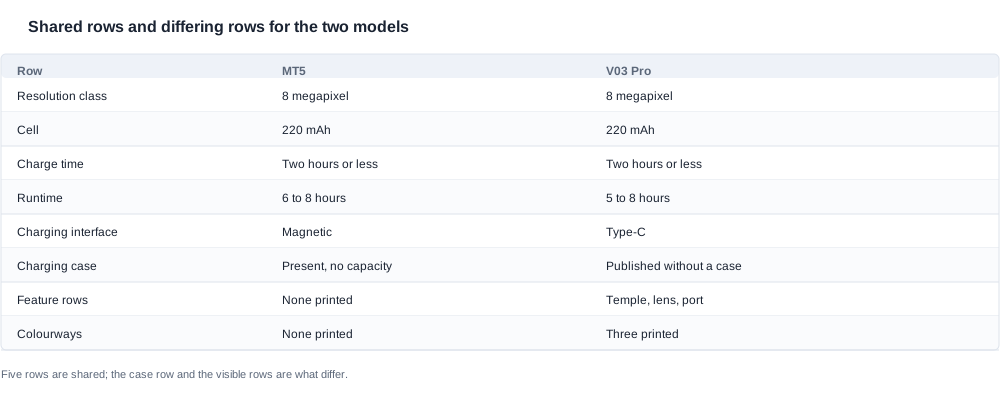
What this list establishes is that the shared platform carries no differentiator. A channel building both models is not buying two tiers of hardware; it is buying two packaging strategies on one hardware tier, and that is a legitimate reason to range both, provided the channel can describe the difference without claiming something the documentation does not support.
The case row is the difference that decides most decisions
This is where the two models separate, and where most of the confusion in buying conversations originates.
The MT5 case row. The model is documented as shipping with a charging case, and the capacity of that case is not published. Across the eleven camera models, five print a case capacity, two are documented with a case and no capacity, one has no charging-case row, and three carry no case row at all. The MT5 is in the second group.
The V03 Pro case row. The model has no charging-case row. It is the only camera model in the catalogue where the documentation makes that statement outright, and being the only one matters: a settled fact and an open question are different things to plan around, and conflating them is the most common error made when this group is written up.
Why the distinction changes a decision. An explicit "no case" means the carton is knowable in principle, the accessory question is closed, and the in-box copy is complete. An unsized case means the carton is not knowable, the accessory is not sourceable, and the in-box copy is incomplete until someone supplies a number.
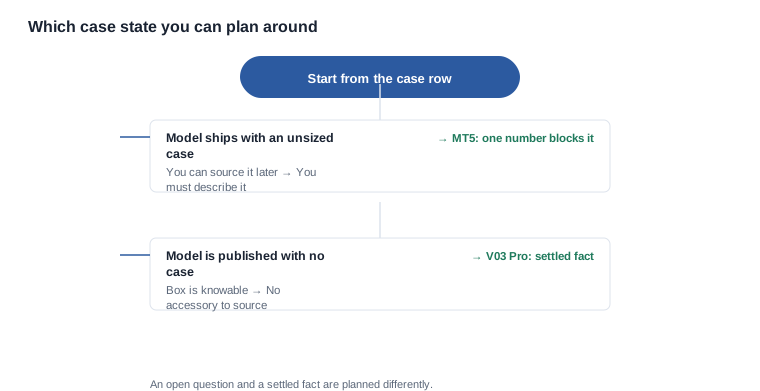
For a reseller, that difference usually decides the question on its own, because a reseller's product page has to describe the box accurately on day one. For a brand building a private label line, it is less decisive, because the brand may intend to sell the case as a separate line once its capacity is known — in which case the gap is a scheduling problem rather than a blocker.
The AI camera glasses charging case options analysis covers the accessory economics across the range, and the shipping weight breakdown covers how the parcel arithmetic resolves once a packed unit has been weighed. Neither can be completed for the MT5 today, because the case is unsized.

Two kinds of visible difference, only one of them characterised
The V03 Pro carries three feature rows that the MT5 does not: a flexible temple, a photochromic lens, and a Type-C charging port. It also publishes three colourways. The MT5's page carries no feature rows at all.
That is a genuine difference in what a customer can see, and it is the strongest argument the V03 Pro has in a channel that competes on visible product difference. Two cautions apply, and both are about how far the rows may be carried.
The photochromic lens is a name, not a characterised lens. No lens performance data of any kind is published for it — no transmission figure, no change speed, no tint depth, no temperature range, no wavelength band. The catalogue also does not use the word in the product name itself; the phrase appears only as a feature row. What can be published is that the page describes a photochromic lens. What cannot be published is any statement about how quickly it changes, how dark it gets, or under what conditions. The photochromic smart glasses buying guide sets out the five checks that turn a lens name into a lens specification, and the V03 Pro best-for analysis covers that model's decision profile in full.
The colourways are a real differentiator. Three printed colourways give a range a visible product difference without a new platform, which is exactly what a channel building a small line needs. No other camera model in the catalogue publishes colour rows except one other, so this is a genuine structural advantage rather than a marketing claim.
The flexible temple is a description, not a measurement. No articulation range, no material and no durability figure is published, so the row supports the statement "described as having a flexible temple" and nothing beyond it.
The MT5 has no comparable visible difference to offer, which is not a weakness of the hardware so much as a thinness of the documentation. It also means that a channel listing the MT5 next to the V03 Pro has to describe the MT5 entirely from its four standard rows, which is possible and honest but not compelling.

How to choose when the choice is about the range
If the decision is about a single unit, the criteria above are enough. If it is about a range, four questions change the shape of the decision entirely.
Do you want two configurations of one cell platform, or two products? The MT5 and the V03 Pro both sit on the 220 mAh cell, so a range carrying both is a range carrying one hardware tier with two carton strategies. That is efficient for sourcing and inefficient for listing, because two products sharing every visible specification except the box will confuse a shopper unless the difference is explained clearly.
Is your accessory strategy owned centrally or by the channel? If centrally, an unsized case is a sourcing problem with one owner. If the channel owns it, an unsized case becomes a documentation problem distributed across every seller, and the cost of closing it multiplies.
Are you building for a market where photochromic capability is a demand driver? If yes, the V03 Pro's lens row is a differentiator that no other model in the eight-megapixel group offers. If no, it is an unexplained feature that adds questions rather than answers.
How long is your first production window? The MT5's open item is one number. If the supplier's response time fits inside the window, the decision is easy. If it does not, the model enters production with an undescribed accessory, and that becomes a permanent property of the listing.
The V03 Pro smart glasses specifications and features list and the MT5 limitations analysis are the two published baselines, and the MT5 and L2 Utral form factor comparison covers the third architecture on the same catalogue platform. For the wider context, the AI camera glasses which model to pick overview sets out how these two sit among the eleven camera models.
A word on what this comparison is not. It does not rank the two models, and it does not recommend one. No price, unit price, price tier or landed cost is published for either, so there is no basis for a value judgement; and neither model's documentation supports a performance claim that would make one preferable on capability. The choice is a choice about which kind of incompleteness your channel can manage.
The question set that closes this decision
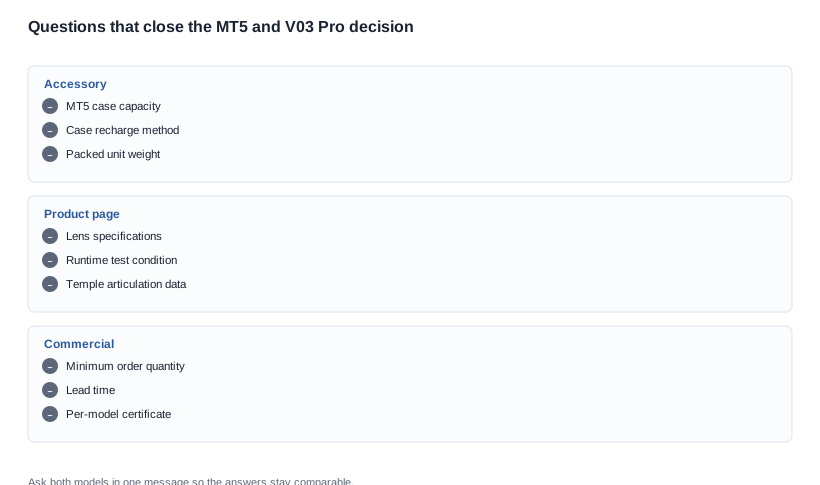
Seven questions, asked of the supplier covering both models in one message, convert this comparison from a preference into a decision. Ordered by how much each answer changes the outcome:
- What is the MT5's case capacity, stated with a unit? One number closes the largest open item on either model.
- What does the MT5's case do — recharge the frame or hold a spare cell? Unpublished for every case in this catalogue.
- What is the packed unit weight of each model as it ships? The V03 Pro's answer is knowable today; the MT5's is not. Getting one without the other makes the comparison unfair rather than complete.
- What are the lens specifications behind the photochromic row? Transmission range, change conditions, response time and any rated figure, plus the test method. If none exists as a figure, that is itself the answer and the row stays a name.
- What is the runtime test condition for each model? Camera state, radio state, battery endpoints, sample size. Both models publish wide ranges with no condition, and both need the same four sub-questions.
- What are the minimum order quantity, lead time, sample policy and warranty terms per model? None of this is published, and it belongs in the same document as the specification annex so the two do not drift apart.
- **What compliance documentation exists per model?The catalogue carries a single company-level export certification page holding ten patent certificates — eight appearance-design patents and two utility-model patents — and no per-model certification row anywhere. For European Union buyers the relevant buyer-side instrument for radio equipment is the Radio Equipment Directive (EU) 2014/53/EU; the electromagnetic compatibility directive, (EU) 2014/32/EU, is a separate requirement and is frequently confused with it. Check that the model designation on any document matches the order.
Reading the answers before you commit
Responses arrive in four shapes: closed, partial, referred and restated. Only the first closes an item. A partial answer — a number with a unit but no condition — can still go into a specification provided the assumption is written on the face of it. A referred answer points at a listing or a neighbouring model and resolves nothing. A restated answer needs the same question asked again, more narrowly.
Two failure modes are specific to this pair and worth naming in advance. The first is the photochromic row drifting into a performance claim: someone copies "photochromic lens" from the feature list into a description that implies a change speed or a tint depth the documentation has never stated, and the claim is then impossible to defend. The second is the two models' runtime ranges being set side by side as though they were comparable, when the lower bound differs and no protocol accompanies either.
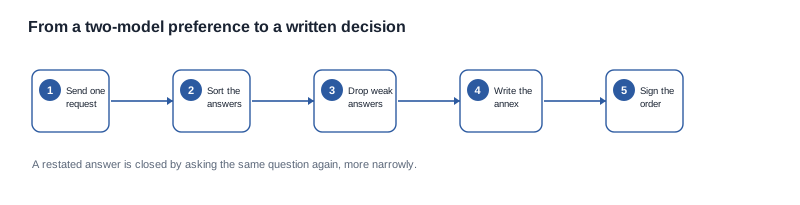
The trade-offs to negotiate are narrow and worth naming. A supplier who will not publish a case capacity may still commit to one contractually, which is worth more for planning than a published figure because it carries a remedy. A supplier who cannot commit to a packed unit weight can usually commit to a tolerance band. A supplier with no lens data can usually commit to running a measurement on sample units. Each is a smaller ask than a public specification change, and each closes the same gap.
What neither model publishes, and what that forces you to write
Both models are thin in the same places, and a range listing them side by side has to be written around those gaps rather than through them.
No weight is published for either model, so no freight statement, no portability claim and no carrying statement can be made. No frame dimensions are published, so no size claim can be made. No Bluetooth version is published for either, which is true of all eleven camera models in this catalogue and false of every audio model — so a device-management policy question cannot be answered from the catalogue for either product. No sensor model, field of view, frame rate or video format is published, so the eight-megapixel figure stays a resolution class on both.
None of these absences is unusual for a catalogue at this level, and all of them have the same consequence for a buyer: the listing has to be built from four to six rows, and every row has to carry only the claim it supports. In practice that means a page of about two hundred words per model rather than eight hundred, and a page that is more defensible than a longer one. Buyers who find that limiting should treat it as a request-list item rather than filling the space with inferences.
There is one asymmetry worth naming here, and it runs the other way from the case row. The V03 Pro's colourways give a page something concrete to lead with, and its feature rows give a designer something to photograph. The MT5 has neither. A channel that competes on visual presentation will find the MT5's page thin and the V03 Pro's page workable, and that is a legitimate reason to prefer one over the other — provided the preference is about presentation rather than about capability.
Cost, tooling and the range decision
No price, unit price, price tier, minimum order quantity, lead time or tooling charge is published for either model, and none can be derived from the documentation. What can be said is directional and physical: the MT5 carries a second lithium cell in the unit whose capacity is unknown, and the V03 Pro carries no accessory. That is a statement about what is in the box, not about what it costs.
For a brand, the range decision also involves the customisation surface, which is where the value on a shared platform is actually created. The AI camera glasses customisation options piece sets out the axes available, and the OEM ready platforms which models are ready overview maps which models carry a documented surface. Note the discipline that applies there too: no customisation fee, minimum or turnaround is published, so any figure quoted back is a quotation term and belongs in the purchase order rather than on a product page.
Two structural points close the commercial side. First, carrying both models on one cell tier halves the number of hardware platforms a buyer has to qualify, which reduces the number of inspection routines, spare part sets and quality control procedures. Second, it creates two listings that are nearly identical to a shopper, which costs explanation work on every page that carries them. Which effect dominates depends entirely on whether the channel's competitive advantage is operational or commercial — and that question has a different answer for almost every buyer.
A closing note on sequencing, because this pair invites a particular kind of delay. The MT5's open item is a single number, and it is tempting to treat the decision as blocked until it arrives. It is not blocked; it is priced. A buyer can proceed on the explicit basis that the case capacity will be supplied before the first shipment and that the carton artwork is released only after it is, and that is a defensible position recorded in the specification annex. What is not defensible is proceeding without recording the assumption, because an unrecorded assumption travels into production and becomes invisible exactly when it starts to cost money. Write the assumption down, attach an owner and a date to it, and the choice between these two models becomes an ordinary commercial decision rather than a waiting exercise.
The same discipline applies to the V03 Pro's lens row. If no lens specification exists, that fact should be written into the annex as a permanent boundary rather than as a pending item, because a row that can never be characterised should not sit on the list looking temporary. A permanent boundary is easy to plan around; a permanently pending item quietly delays the artwork review every quarter.
What we will publish for these two models is every published row as it appears: the shared cell and resolution class, the two-hour-or-less ceiling, the two runtime ranges, the magnetic and Type-C interfaces, the unsized case on one, the explicit absence of a case on the other, the feature rows and the three colourways. What we will not publish is a lens performance claim, an imaging claim, a weight, a case capacity, a price or a recommendation. The choice belongs to the buyer, and the criteria for making it are the seven questions above, each of which the catalogue can answer for one model and leave open for the other.


