

OEM ready platforms are frequently discussed as though the channel were chosen first and the product range adapted to it afterwards. That order rarely survives contact with the range itself, because the published product structure imposes requirements that a channel either can meet or cannot — and it is cheaper to find that out before the packaging is designed than after. This piece sets out how to match a channel requirement against what is actually published, which parts of a channel decision are decided by structure and which by your own commercial judgement, and what to ask before committing. It does not recommend a channel, and it does not make claims about market size, share or growth; those belong in separate market reading, and this is a selection framework built on catalogue facts.
OEM ready platforms and the channel question the range can actually answer
Start from what the range publishes, because that is the part of the decision you can settle from documentation rather than from opinion.
Twenty-eight models are described, in several structurally different groups: eleven camera models, eight audio models, three sport models, children's models, an AR model, a bone-conduction model and a photochromic model. Within those groups the variation is not uniform. Among the eleven camera models, five publish a charging-case capacity, two are described with a case whose capacity is not published, three have no case row at all, and one has no charging-case row. Two camera models publish colour options — three colours on one, four on the other — and no other model in the range publishes a colour row. Two models publish an ingress protection rating. Exactly one model publishes a weight, and that figure explicitly excludes its foldable charging case.
Those facts describe a range that is uneven in a specific way: a small number of models carry the information a channel programme needs, and most do not. That is not a criticism of the range, and it is not unusual for hardware catalogues. It does, however, mean that a channel decision has to be made with two different levels of confidence — high for the handful of models with published detail, low for the rest.
The practical consequence is that the channel question is really a configuration question. "Which channel" is usually answered downstream of "which configuration, for which market, with which published information behind it". A channel that merchandises on colour needs models with published colour rows. A channel that sells a bundle needs a documented case. A channel with a compliance questionnaire needs documents per model that the catalogue does not carry. Each of those is a filter applied to the range, and the filter that fails is the one that matters.
This is also why channel strategy for a range like this tends to be decided model by model rather than range by range. The range-level question — which channel overall — has an answer that is a function of the mix you choose, and the mix is a decision you make before the channel question has real content.

Channel structures and what each one demands
Four channel structures account for most private-label smart eyewear programmes, and each one imposes a different set of requirements on the range.
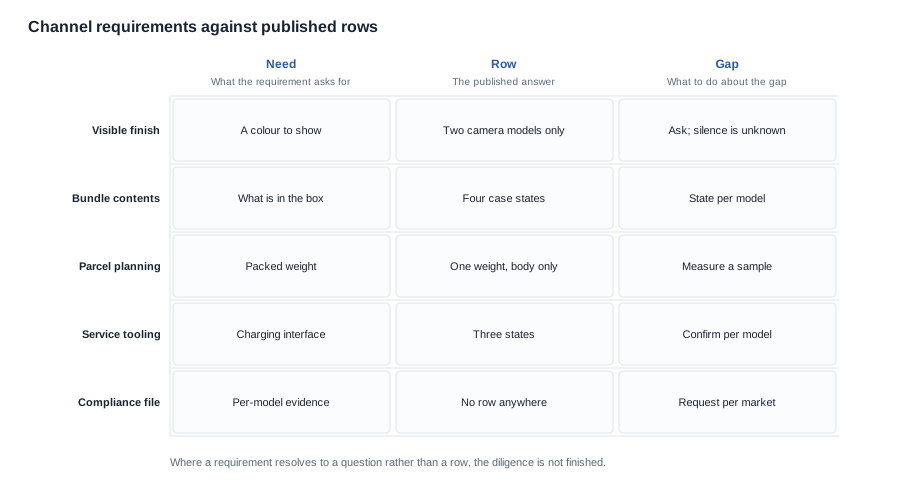
Single-configuration retail. One product, one listing, one price point. The demands are narrow and testable: a colour or finish the customer can see, a packaging format the retailer will accept, a warranty statement the retailer can print, and a returns process that does not depend on a spare-unit pool you do not hold. What makes this structure hard in this category is that the range publishes colour information on two models only, so for most models the visible finish is a question to ask rather than a fact to plan around.
Bundle or multi-item retail. A device sold with a case, an accessory set or a second item. The demands are configuration-heavy, and the four case states in this range have to be handled one by one. A bundle plan built on an assumption about which models ship with a case will be wrong for at least one group, because the absence of a case row is not the same statement as the documented absence of a case.
Distribution to resellers. Multiple customers, multiple channels downstream, and a catalogue that has to describe the product correctly for people who will never see it. The demands are data quality above all: consistent naming, consistent attribute handling, and an answer to the question of who supports the end customer. The accessory surfaces a reseller will ask about are covered in charging case options, and the case configuration map is worth holding alongside any reseller-facing document.
Project and enterprise supply. Sold into an organisation rather than to a consumer, often on a defined configuration list. The demands are different again: a stable configuration across years, a defined support path, and a compliance position per model and market. This structure is the least dependent on merchandising detail and the most dependent on documentation depth, which makes it the structure most constrained by the catalogue's silence on certification.
Each structure has a different failure mode, and the failure mode is worth naming in advance because it is what a channel decision is actually buying risk against. Single-configuration retail fails on an unexpected finish. Bundle retail fails on a case assumption. Distribution fails on a naming error in a data feed. Project supply fails on a compliance gap at renewal.
Mapping published structure onto channel requirements
The mapping is more useful as a table than as a discussion, because the point is that each channel requirement resolves to a specific row somewhere in the documentation — or to nothing at all.
| Channel requirement | Which published row answers it | If the row is silent |
|---|---|---|
| Visible colour or finish | Two camera models publish colours | Ask; treat silence as unknown |
| Bundle contents | Four distinct case states | Confirm configuration per model |
| Retailer product description | Camera class published for 11 models | Sensor detail not published |
| Product photography | Two colour sets published | Request finish samples |
| Parcel and freight | One weight, body only | Measure packed units |
| Return and warranty process | Not published | Agree in the contract |
| Compliance questionnaire | No per-model row | Request documents per market |
| Spares and service | Charging method split three ways | Confirm interface per model |
| Range naming for resale | Two variant names on one model | Resolve correspondence yourself |
Two features of this mapping matter more than the individual rows. The first is how many rows resolve to a question rather than a fact — that ratio is the real measure of how much due diligence a channel decision in this category requires. The second is that the rows are independent of each other, which means a channel can be perfectly viable on merchandise and completely unviable on compliance, or the reverse. Evaluating a channel on the rows that are published tends to produce a confident decision with an unexamined basis.
There is also a modelling discipline here. Where a channel needs an attribute the catalogue does not publish, record it as an open item with an owner rather than filling it with an assumption from a neighbouring model. Shared specification rows are not a shared platform, and a channel programme that inherits an assumption from an adjacent model will surface the error at the point where it is most expensive — usually a listing that has already been live for some weeks.
The accessory and configuration questions behind the bundle row are treated in more detail in how to build a product line across the range, and the packaging decisions that follow a channel choice are covered in packaging options.

The configuration questions that decide a channel programme
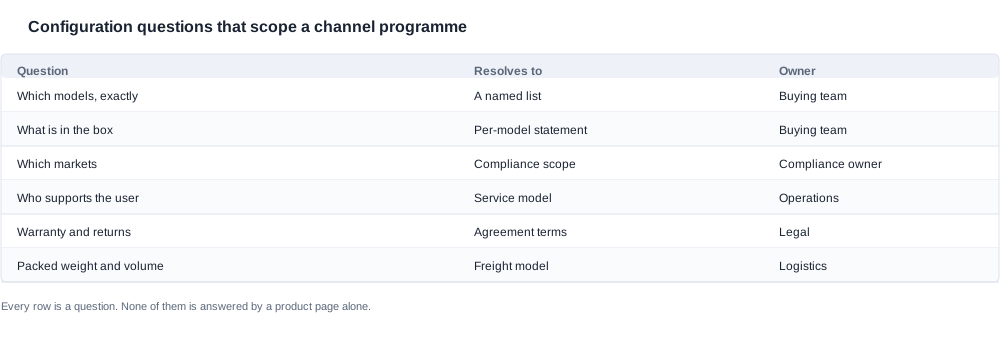
Four questions do most of the work in turning a channel ambition into a scopeable programme. Each has a documented answer or a recorded gap, and each should be settled before artwork.
Which models, in which configuration? Name the models individually. Do not refer to "the camera models" or "the sports models" as a group in a purchase order or a retailer catalogue, because the group members differ on case state, on colour publication, on ingress rating and on interface. A group-level description survives review and fails at fulfilment.
What is in the box, per model? Resolve the four case states into a per-model statement of what is included. Where the catalogue publishes no case row, that is a question to ask; where it publishes an explicit absence, you already have the answer and should not re-ask it. Getting this wrong produces either a customer promise the configuration cannot meet or a cost the commercial model did not carry.
Which markets does this configuration ship to? The market list determines the compliance request, and it is the item with the longest lead time in the whole programme. It also constrains the channel choice: a channel that serves a market your documentation does not cover is not available, regardless of how well it fits commercially.
Who supports the end customer? For distribution and project supply this is a structural decision rather than a service decision, and it determines whether you need a spare-unit pool, a replacement policy and a defined turnaround. None of that is published in product documentation and all of it belongs in the agreement before the first order.

Evidence a channel decision needs before it is made
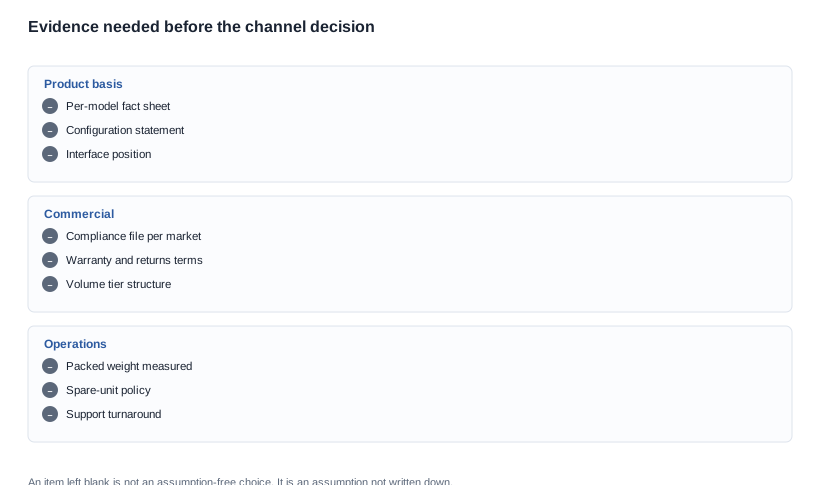
The channel decision is usually made under time pressure with incomplete information, and the failure mode is not a wrong decision so much as a decision whose basis was never written down. Six items give it a basis, and all six can be gathered before anything is ordered.
- A per-model fact sheet covering the rows that matter to your channel, with each unpublished row marked as unpublished rather than left blank.
- A configuration statement per model, naming what is in the box and what is not.
- A compliance position per model per market, documented as either a file reference or an explicit open item with an owner.
- Measured packed weight and volume for the configurations you intend to ship, since the one published weight excludes its case and freight planning cannot run on a partial figure. Freight and parcel modelling is covered in shipping weight and in logistics planning.
- An interface and service position per model, because the charging method splits into three states across the camera range and service tooling depends on it.
- An agreed warranty and returns position, which appears in no product document and has to be negotiated.
Model readiness against the channel requirement is the upstream filter, and it is set out in which models are ready. The commercial structure around the choice — volume tiers and the terms that follow them — is covered in pricing tiers.
Two things this piece deliberately does not do. It does not rank the range or recommend a model for a channel, because the catalogue publishes no price data and a ranking built on published structure alone would be a ranking of nothing. And it does not describe market conditions, competitive position or demand trends; those are separate subjects, and the useful background reading on them is kept separate in the market trends and competitor landscape notes rather than mixed into a selection framework.
Turning the evidence list into a decision you can defend
Collecting the six items above is only half the task. The other half is producing a channel decision that somebody else can audit six months later, which requires the decision itself to be written down with its basis attached.
The format that works is short. State the channel structure you have selected and the reason, in terms that reference the evidence rather than the ambition. State the configurations the decision covers, by model name and by what is in the box. State the markets it assumes. Then state, explicitly, the open items and what happens if they resolve badly. That last sentence is the one that distinguishes a decision record from a summary, and it is the sentence that gets read when the programme needs to be defended.
How to evaluate the trade-offs rather than assert them. Every channel structure in this range buys something with something else. Single-configuration retail minimises configuration risk and accepts the risk of an unexpected finish. Bundle retail raises the value of the offer and raises the risk of a case assumption. Distribution multiplies the revenue surface and multiplies the description-error risk, because every downstream listing is a place for an attribute to be lost or mistranslated. Project supply reduces merchandising exposure and increases documentation exposure. The criteria for choosing between them are therefore not preferences — they are questions about where your organisation's failure modes are cheapest and slowest to correct. A listing error is fast and cheap to correct and embarrassing. A compliance gap is slow and expensive and does not stay contained.
Where the criteria should be weighted explicitly. Three criteria carry most of the decision in practice: documentation depth for the models you have selected, the ratio of open items to closed items on the configuration sheet, and whether your service model can absorb the returns the channel will generate. A channel with a high open-item ratio can still work — open items are normal early in a programme — provided each one has an owner and a date, and provided none of them sits on the critical path for artwork approval.
What to negotiate rather than discover. The agreement should cover the configuration each model ships in, what the customer-facing description may state, who owns declarations on the outer package, how warranty and returns are handled, and what happens when a specification changes between orders. Those five items are ordinary commercial terms and none of them appears in product documentation. Leaving them to be discovered is the standard way a channel programme acquires a problem it cannot solve commercially.
Before you commit, run the decision against a scenario. Take the single open item most likely to resolve badly and ask what the programme looks like if it resolves badly. If the answer is that the listing has to be pulled or the configuration has to change, you now know the cost of that item, and you can decide whether to close it before committing or to accept it knowingly. An unquantified open item is the one that surprises everyone, and the scenario exercise costs an hour.
Then write the decision down and date it. Channel decisions are revisited more often than people expect — usually because the range has changed or because a market has opened. A dated record with its evidence attached turns that revisit into a comparison rather than a fresh argument, and it makes clear which assumptions have since been confirmed and which are still carrying weight.
The underlying question this section keeps returning to is simple. A channel fit is not a property of the product; it is a property of a product configuration, a documentation position and a service model. Change any one of the three and the fit has to be re-evaluated, which is why the record is worth keeping. It also means a channel decision should be reviewed on a fixed cycle rather than whenever it is convenient to raise it again.
Sequencing: from channel choice to a first repeat order
The order of operations below is what keeps a channel programme from having to be restarted.
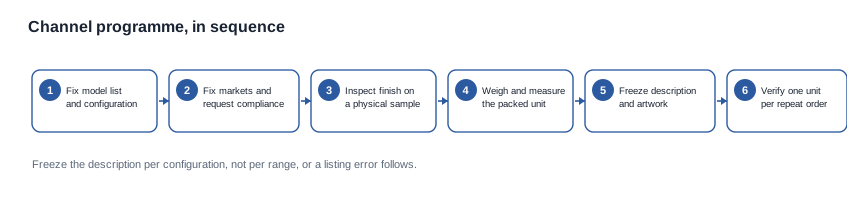
Before the first order, settle the model list, the per-model configuration, the market list and the compliance request. These four items have the longest lead times and the widest blast radius, and every one of them changes what the artwork has to say.
At the sample stage, verify the finish against a physical unit rather than a render, weigh and measure the packed configuration, photograph every surface, and record what is in the box. This is the only point at which all four are observable.
Before the first bulk order, freeze the product description, the artwork and the compliance file against the specific configurations, and put the warranty and returns position in the agreement. A description frozen per configuration rather than per range is what prevents the listing error that a range-level description eventually produces.
Across repeat orders, verify rather than assume. Take one unit from each order against the frozen description, keep the record, and treat divergence as a defect. The scaling question — what has to be true before volume increases — is treated in scaling up, and the consumer-facing context for camera models specifically is in use case guide.
The channel decision itself is then a consequence of the work rather than a precursor to it. A channel that fits your configuration set, your documentation position and your service model is a sound choice; one that requires information the range does not publish is a decision taken on an assumption, and the assumption will be tested by the first customer who asks a question your description cannot answer.
Related reading
- Model readiness for a channel brief — OEM ready platforms which models are ready
- Commercial structure — OEM ready platforms pricing tiers
- Programme growth — OEM ready platforms scaling up
- Range building — smart eyewear range new vs established models
Tell us the channel you are considering, the markets you would ship to and the configuration you expect to lead with, and we will tell you which of the published rows have to be closed before that channel decision is real, and which of them can be settled after the first order.


