

Selecting smart glasses by market japan and korea requirements is one question with two answers, and buyers who separate it too early end up doing the work twice. Japan and Korea are usually filed together in a market plan because both are East Asian destinations with a single dominant language, a 2.4 GHz radio environment and a demanding consumer-safety apparatus. What they do not share is the conformity architecture: the two systems are administered separately, they attach their conformity marking to different parties, and the importer obligations fall in different places. Treating them as one destination produces a plan where the compliance work is done once and neither market is actually covered.
This guide is therefore organised as a single decision with two branches. It sets out what the two systems have in common, what genuinely differs, which parts of the answer come from our published catalogue and which parts have to be requested in writing, and what a procurement team has to settle commercially before it commits to a two-market launch. It is a framework, not a compliance position: our published records do not contain a per-model conformity row for any entry, and the technical detail a Japan or Korea launch needs arrives as a written answer from the supplier and as advice from a local party.
Selecting for Japan and Korea: why these two are handled as one decision
The shared part is real and it is worth stating in full, because it is the part that justifies putting both destinations in one programme rather than two.
Both markets operate the 2.4 GHz industrial, scientific and medical band that a Bluetooth product sits in. Neither destination is a place where a radio product arrives and starts working; in both, the radio position has to be established before the product is placed on the market, and in both the establishment is a document held by a party that can be named. Both markets require the safety information to be presented in the local language on the product and the packaging rather than in an English-only insert. Both expect the consumer to be able to identify, in the local language, the economic operator behind the product.
The structural similarity is in the layers, and there are four of them: the radio layer, the electrical-safety layer, the product-safety and consumer-information layer, and the labelling layer. That is why a Japan or Korea launch shares a work programme with other destinations even though the instruments differ.
The differences are where the cost hides, and there are three of them that a procurement team should price before it commits.
The administration differs. Japan's radio conformity is administered under the radio law, and the conformity assessment route a product takes depends on the category it falls into and whether the assessment is a conformity examination or a certification by a registered body. Korea's radio framework is administered under its own radio waves legislation, and the certification it issues covers radio performance together with the safety and electromagnetic compatibility side in a single scheme. The practical consequence is that the paperwork Korea asks for is not a subset of what Japan asks for, and a supplier's Korean file cannot be reused as evidence in Japan.
The importer obligation falls in a different place. Japan's product safety regime places obligations on the party that imports the product into the market, including registration of the importer with the local administration, and those obligations attach to whoever puts the goods into circulation rather than to the factory. Korea's scheme places a declaration and marking obligation on the party responsible for placing the product on that market. Neither obligation is met by a factory document, and a buyer who assumes the factory's certificate covers the importer's registration will discover the gap at the point of import.
The product-safety treatment is not the same. The category questions run in different directions. A product worn on a face, carrying a cell, a transmitter and on some models a camera, raises different questions in each market about what has to be declared, what has to be marked on the product itself rather than on the box, and what a consumer must be able to find in the local language.
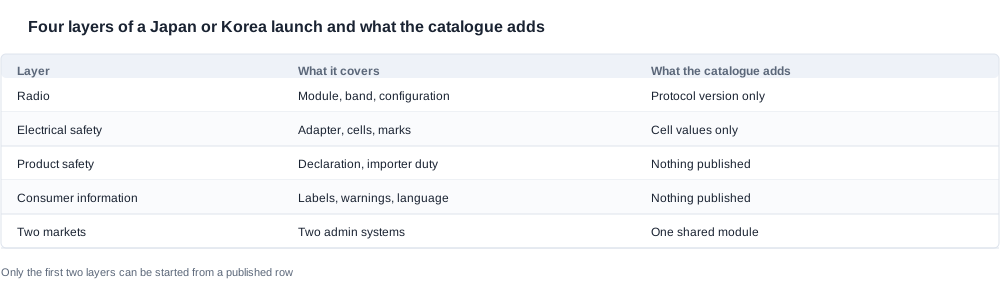
One more common feature deserves attention because it is easy to assume away. Neither market is a place where an English-only carton can be corrected with a sticker. The consumer-information layer in both markets is assessed on the product and the packaging as presented, so the artwork cycle is part of the compliance work and cannot be left to the last month of the programme.

Selecting the radio position: the same silence in two different systems
Here the two markets are more alike than the paperwork suggests, because in both cases the catalogue's contribution is the same partial one.
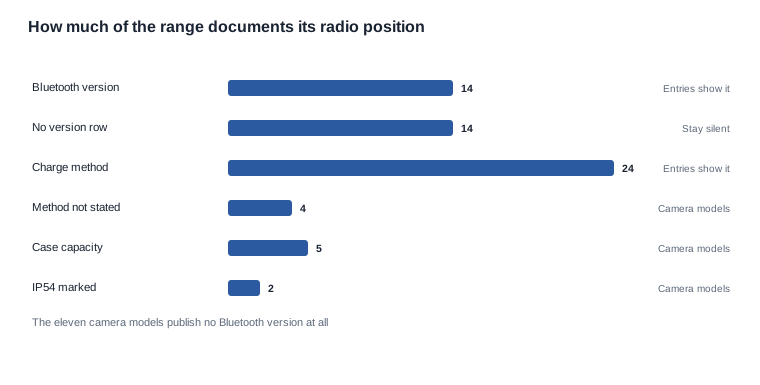
Our catalogue documents a Bluetooth version on fourteen of the twenty-eight entries. All eight audio models publish one — V5.3 on the K02 and the K01, V5.4 on the other six — as do all three sport models and three further entries. The remaining fourteen publish no version at all, and the silence falls on the eleven camera models plus three more rows: the A05, the A06 and the bone-conduction model.
That silence is the central radio fact for a Japan or Korea launch, and it has a direct commercial consequence. For the eight audio models and the three sport models, the protocol is documented and the remaining radio questions are about the module, the configuration and the file. For the eleven camera models, the radio position has to be established from scratch in writing, per model, before the product can be placed on either market — and a camera product that records stills and video and publishes no radio row is not a product without a radio.
The frequency question itself is unpublished everywhere. Our specification set carries no operating band, no transmit power, no antenna description and no channel plan for any of the twenty-eight entries. Two things follow for a buyer.
The first is that the protocol version cannot be used as a proxy. V5.3 on the K01 and the K02 tells a buyer what the protocol is and nothing about what the radio is configured to do; our own product record notes that any difference between those two models has to come from something other than the published rows. A buyer who reads the version as a proxy for a radio position will be surprised at the point of filing, and the surprise arrives late enough to affect a launch date.
The second is that the radio file has to be produced per destination, and the destination answers do not substitute for one another. Japan and Korea each require their own position, and a document prepared for one does not cover the other. This is the point at which the two-market decision either pays off or becomes twice the work of a single-market launch: if the module is the same and the file is per destination, the technical work is shared and the administrative work is not, and the supplier should be asked to state exactly which part is shared.
Neither market appears anywhere in our published specification set. Our catalogue is organised by product type rather than by destination, and it carries no conformity row for any entry; the technical detail a Japan or Korea file needs has to come from a written request to the supplier and, in the end, from a local adviser who can confirm the current position for the product category and the date of the launch.
Selecting the electrical and product-safety layers: where the adapter question starts
The electrical layer is where a buyer is most likely to be surprised, because the catalogue says nothing that would prompt the question.
Our published specification set covers the device side thoroughly: a cell figure, a charging interface where one is stated, a charge ceiling and a runtime figure for every entry. It says nothing at all about a mains adapter, and it says nothing about a plug. There is no adapter row for any of the twenty-eight entries, no row describing what ships in the box beyond the unit and, where published, the charging case, and no plug specification anywhere in the set.
That gap matters more for Japan and Korea than it does for a European launch, because in both markets the electrical-safety instrument attaches to the power-supply equipment itself rather than to the wearable. If an adapter ships, the adapter is the item that has to be examined and marked, and the battery is a separate question from the adapter in at least one of the two markets. If the product ships with a USB cable and no adapter, the electrical-safety question may not arise at all — and that is a decision with a real commercial consequence, because supplying an adapter adds a component to the bill of materials, a certification item to the file, a plug standard to the packaging and a warranty item to the agreement.
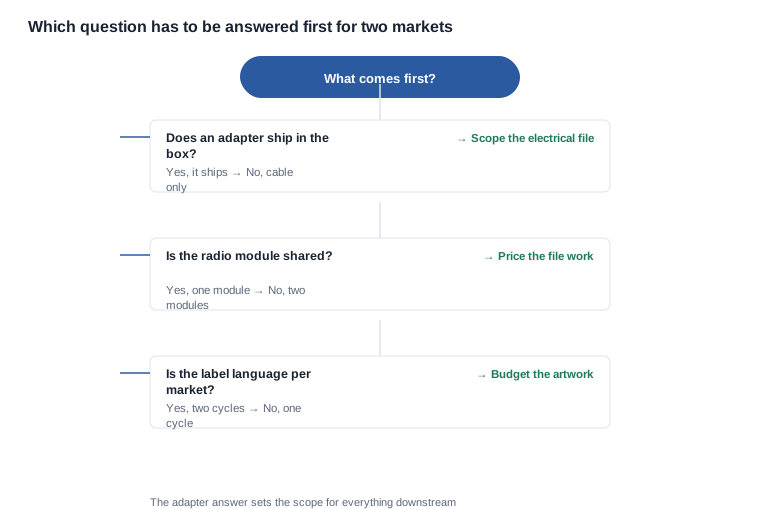
So the first question in this layer is a product question and it has to be answered before the compliance work is scoped: does the unit ship with a power adapter, and if so what is it. Our catalogue does not answer it, and neither the product record nor the specification pages do.
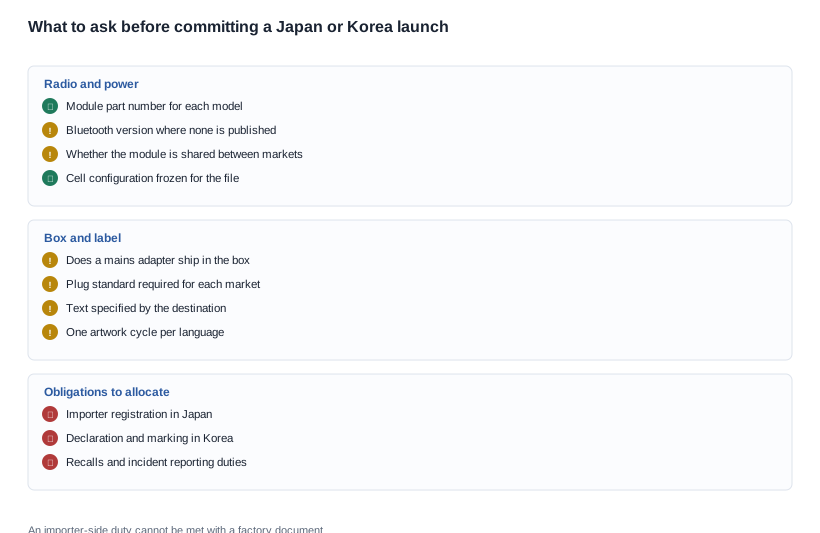
The second question is the product-safety classification. A wearable electronic product with a rechargeable cell, sold to consumers, raises questions about what has to be declared and marked on the product itself, what a consumer must be able to read in the local language, and how a safety incident or a recall is handled. Japan's regime is administered with importer registration as a central feature, and Korea's places the declaration and the marking on the party responsible for placing the product on the market. Both of those are importer-side obligations, and neither is satisfied by anything the factory can send you.
The third question is about the cells. Every one of the twenty-eight entries publishes a cell capacity, and the published cell values range from 40 mAh in the A05 and the A06 through 70 mAh in the A07, 70mAh2 in the YKC02, 90mAh2 in the K02 and the K01, 55mAh*2 in the LC-105-1 and the G07, and the YK12 and the LC-105-2, 100 mAh in the D11 and the D12, 115 mAh in the D17, and 200 mAh in the bone-conduction entry, up to 220, 260, 265 and 290 mAh across the camera models. The transport test summary, which is a separate instrument from any national conformity mark, follows the cell rather than the product, so the cell configuration is the item that has to be frozen in the purchase conditions.


Selecting the language and labelling layer: two single-language markets
Japan and Korea share one property that makes them easier than a multi-language region and harder than a single-language Europe: the consumer-information content has to be written, checked and printed in one specific language for each market, and neither language can be derived from the other or from English with a translation shortcut.
Our catalogue publishes no language row for any of the twenty-eight entries, no instruction-language set, no voice-prompt list and no translation entry. Our product record supplies a partial structural answer: seven recorded customisation axes for the camera category against five for the audio category, where the audio set omits both a logo axis and a firmware axis while adding a lens-material-and-colour axis instead, and the same record flags the children's category as unverified for both application and firmware customisation work.
What that means for Japan and Korea is a set of questions that a buyer should put in writing rather than assume:
- Which language is loaded on the device, and which language appears on the packaging, and whether the two are separately configurable.
- Whether the two markets share one build or need two, and if two, what the minimum order quantity for a market-specific build is and what it costs.
- Whether the instruction material is separate from the packaging artwork, and if so whether it is a line item in the quotation and what its lead time is.
- Whether any labelling text is specified by the destination rather than by the brand, because text that is specified externally cannot be finalised by a graphic designer alone.
- Which product information has to appear on the device itself rather than on the carton, because marking on the product means a moulding or a label change and therefore a different lead time again.
- Whether the model designation printed on the product and the packaging is the catalogue designation, and how a product with two published variant names is labelled for a market where only one can appear.
The last of those questions deserves a note, because it is the one that has caught buyers out in this category. The L2 Utral is published under one designation carrying two variant names and two case capacities, 1400 mAh and 900 mAh, with no published mapping between the names and the capacities. A market that requires a single, unambiguous designation on the product cannot have that ambiguity left open, and resolving it is a data question for the supplier rather than a design question for the buyer.
How to evaluate the answers, and when to stop asking
A procurement team that has sent four layers of questions will get four layers of replies of uneven quality, and the assessment has to be as disciplined as the request. Three criteria decide whether a reply is usable: does it name the model and its configuration, does it come from a party with the standing to give the answer, and does it carry a date or a version it applies to. Anything that fails the first criterion is not an answer about the product you are buying, whatever else it contains.
Sort the replies into three states. Closed answers can be written into the purchase conditions as they stand. Open with a named owner and a date are a working state that a buyer can plan a launch around, because the risk is quantified and the schedule is known. Open without an owner are not a plan; they are a list, and every open item in that state should be treated as a blocker for the affected model rather than as a task.
Two pitfalls recur in this category and both are cheap to avoid. The first is comparing answers across markets as though they were comparable — a Japanese file and a Korean file answer the same underlying questions to two different systems, and the useful comparison is not between them but between the shared technical work and the separated administrative work. The second is accepting a scope answer that does not name the product. A statement about "the audio range" leaves the eleven camera models unresolved, and in a two-market launch the unresolved model is the one that stops the shipment.
The shortlist rule that follows is worth stating before you order rather than after: a model that cannot produce a named, dated answer on the radio module and the adapter configuration is not shortlistable for either market, however strong its published rows look. The published rows let a buyer put a defensible shortlist of candidates together. The written answers are what let two candidates be compared on the criterion that actually stops a consignment, and what let an order be signed against them.
The trade-off to weigh is the one between a fast launch and a defensible one. Asking for the named answers adds weeks. Committing without them adds a risk that surfaces at import, where the options are a delay, a re-labelling or a withdrawal. Which of those is acceptable depends on the season and on the size of the first order, and it is a decision for the buyer — but it should be taken explicitly, recorded, and revisited when the second market is opened.
A worked walkthrough: one audio range into two markets
The scenario set out below is a constructed illustration. It is not drawn from a customer order and it names no customer.
A distributor takes four audio models and the K02 into two markets. The published rows let the distributor do the first narrowing immediately: all five models publish a Bluetooth version, and all five publish a charge method — magnetic on the YK12 and the K01, the LC-105-2 and the K02, and the G07 and the LC-105-1, and Type-C on the D11 and the D12 — so the radio and the power questions are documentation questions rather than product questions on this group. The camera models would have been the opposite case.
The second narrowing is on the packaging side and it cannot be done from the catalogue at all. Whether the unit ships with an adapter is unpublished, and that single unknown determines whether the electrical-safety instrument attaches to an item in the box or not. It also determines whether the plug standard becomes a product decision.
The third step is the one with a schedule attached. Two markets, two label sets, two artwork cycles and — if the language is loaded on the device — two builds, each with its own minimum order quantity. The commercial question is whether one artwork cycle can serve both markets, and the answer is usually no, because the consumer-information content is destination-specific even when the layout is shared.
The outcome of the exercise is not a compliance position. It is a decision about the shape of the programme: two market builds, one shared product group, one adapter decision to take before anything else is scoped, and a set of questions whose answers will determine whether the second market is worth opening at the first order or only at the second.

Selecting the commercial scope: what a two-market launch has to settle
Two destinations multiply the administrative work and often multiply the unit price, and a procurement team should know which of the two it is paying for before the quotation arrives. Our own records publish no per-market price, no per-market minimum order quantity, no lead time for either market, no certification handling fee and no warranty term, so everything below is a line to request rather than a figure we can quote.
- Whether the unit price differs by market, and whether the difference comes from the build, the paperwork, the artwork, the plug standard or the adapter.
- The minimum order quantity for each market, and whether a market-specific build carries a higher floor than the standard build.
- Whether one artwork cycle can serve both markets, and if not, the cost and the print lead time per language.
- Whether the adapter is included, optional or excluded, and what the unit price and the packaging volume do when it is included.
- The certification handling fee, whether it is charged per model per market, and whether a shared file reduces it.
- The lead time per market, including artwork, the technical file and the conformity step, as separate dates rather than one.
- Who bears the importer-side obligations — registration, declaration, marking — and how those obligations are allocated in the supply agreement.
- The warranty and defect terms per market, and whether a defect found in one market triggers a change in the other.
- What happens to the tooling and the NRE if a third market is added, and whether the engineering work is per market or per range.
- The sample terms for each market, including whether a market-specific sample is supplied and how the evaluation period is affected by a longer lead time.
Two negotiation points deserve to be raised early. The first is the shared-versus-separate question on the radio file: if the module is common, the technical work is common, and a supplier quotation that prices the two markets as wholly independent should be challenged on that basis. The second is the adapter, because it is the single item on this list that changes both the compliance scope and the packaging, and it is cheapest to decide before the artwork is commissioned.
The radio comparison with the United States route is in the radio conformity note, the mapping method sits in the certification mapping guide, and the European file chain is set out in the EU requirements guide. The destination logic as a whole is on the select by market page.
Selecting for Japan and Korea: the boundary of the published record
The published rows are what let a buyer narrow a range quickly: the power rows on every entry, a case capacity where a case exists, a resolution class on the camera models, a Bluetooth version where an entry carries one, the two ingress markings in the range, and a single published weight on the MT6. We do not publish an adapter row, a plug specification, a language set or a per-model conformity row, and we will not estimate any of them.
That boundary is why the guide above is a sequence of decisions rather than a list of instruments. The radio question narrows from the published protocol version and then stops, and the eleven camera models need the radio position asked from scratch. The electrical layer cannot be scoped until the adapter question is answered, and the adapter question is not in the catalogue. The labelling layer runs on two artwork cycles and possibly two builds. And in both markets the importer-side obligations belong to the party placing the product on the market, not to the factory, so they have to be allocated in the agreement rather than assumed away.
Next step: take the models you intend to sell in these two markets and write one request that covers all four layers, with a date against each answer. Ask the adapter question first, because it determines the scope of everything downstream, and ask for the radio position per model rather than per range.


