

Smart glasses quality consistency is priced, and the price is not in the unit quotation. It appears in four places — the units that come back, the inspection labour that grows, the schedule that moves, and the channel confidence that never reaches a spreadsheet — and a buyer who reviews only the unit price is reviewing the smallest of them. The way to price it is not to guess a percentage of order value. It is to name the trigger for each cost centre, attach the evidence that the trigger produces, and let the total fall out of the complaint record. A quotation that arrives with no cost ledger behind it is not a cheap quotation; it is an unpriced one. This page builds that ledger for a brand-side procurement manager, a channel buyer and an importer, written against the published rows of our 28-model catalogue — including the rows we do not publish, because the gaps are where most of the hidden cost actually sits.
Smart glasses quality consistency and the cost ledger
The decision this page answers
A buyer who suspects that quality inconsistency is costing more than the supplier's price gap has a specific decision to make: whether to keep the current supplier on the current configuration, keep the supplier on a frozen configuration, or change the configuration and the acceptance rule before scaling the programme. That decision is not answered by arguing about unit price. It is answered by a ledger that shows, for each cost centre, what triggers the cost, what evidence proves the trigger fired, and who carries it. The question of which model configuration to carry forward is settled on evidence, and the criteria for settling it are the subject of this page.
The two mistakes that make this decision expensive are both common, and both are red flags a procurement manager can spot in the first meeting. The first is to argue from a single anecdote: one channel partner reports one unit that will not hold a charge, and the buyer concludes that the factory is inconsistent. That conclusion is not supported, because a single unit cannot be separated from a case-and-unit mismatch, a handling event, or a misunderstood specification. The second mistake is to accept a percentage: someone on the commercial side quotes a typical defect rate for the category, the buyer applies it to the order value, and the number enters the budget without a single piece of evidence behind it. A percentage applied to an order value is not a cost estimate; it is a way of moving a decision out of the meeting and into the accounts.
The evidence available to avoid both mistakes is narrower than buyers expect. Our catalogue publishes the configuration rows — the resolution tiers, the case options, the charging interfaces, the cell capacities and the colour availability, the published runtime bands and, for one model, a whole-unit weight with its exclusions — and it publishes no tolerance, no defect rate, no cycle life rating, no acoustic measurement, no sensor model, no ingress test report number and no certificate number for any of the twenty-eight models. The absence is the point. Every cost a buyer attributes to inconsistency is a cost of a gap in the specification or in the evidence, and a gap can only be closed by asking for it.
What a variation event costs when nobody is counting
Consider the ordinary sequence. A lot arrives. Two units go back. Nobody records which lot they came from, so the complaint cannot be attributed. The channel reports a slow-moving difference in finish between two shipments, which is an opinion rather than a measurement, so it cannot be tested. The finance team, asked to justify the returns reserve in the model, is given a number that the procurement manager chose and the factory never agreed to. Each of these is a small event. None of them is a cost yet, and that is exactly the problem: an uncosted event is an event that will recur at the same size every time, because nothing in the system has changed since the last one.
The table below is the ledger. It is deliberately arranged as trigger, evidence and owner rather than as a list of expenses, because the trigger is the part a buyer controls and the part that tells you whether a cost is going to repeat.
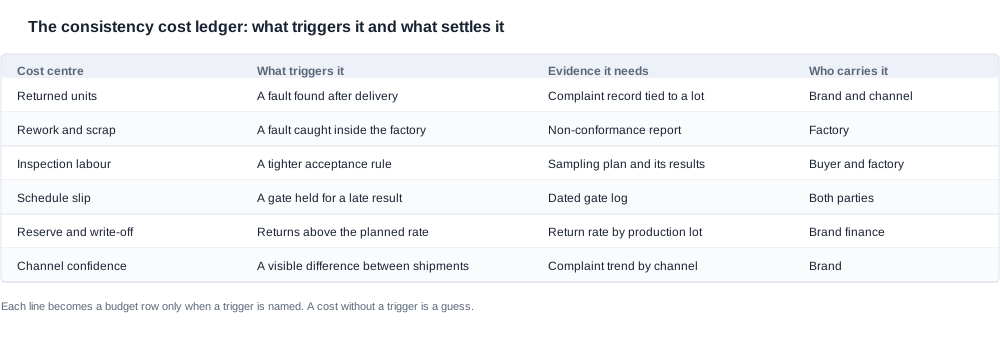
The second column is where most programmes fail. "A fault caught inside the factory" sounds like a non-conformance report, but the non-conformance report is the evidence, and without one the rework is invisible. "A tighter acceptance rule" sounds like a quality control decision, but the sampling plan and its results are what turn an inspection rule into a priced activity. A buyer who cannot produce the evidence for a cost centre cannot defend the cost, and a cost that cannot be defended will not survive a budget review.
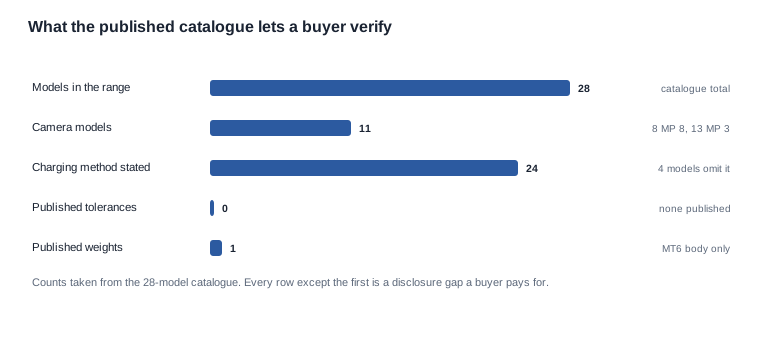
Read that chart as a cost map rather than as a scorecard. Out of twenty-eight models, one has a published weight, twenty-four state a charging method, and none publishes a tolerance. That means a consistency check on any of these models is a measurement the buyer has to define, on a method the buyer has to agree, against a limit the buyer has to set. Every one of those three facts is a cost centre, because each one is a decision that cannot be delegated to the catalogue.

Where the four cost centres actually sit
Cost centre one: the units that come back
The most visible cost centre is also the most frequently mismeasured, because returns are counted and returns are not the same thing as quality failures. A unit that meets its published specification and disappoints an expectation is a returns problem, and it is solved by fixing the expectation, not the product. A unit that fails its written specification is a quality problem, and it is solved by finding the variation source. Buyers who add the two together inflate the quality cost, chase the wrong cause, and end up with an acceptance rule that rejects good units, which creates a second cost centre rather than removing one.
The number that matters in this centre is not the return count but the rate by production lot, and the total cost of a quality programme is never the return count alone. The rate is the useful figure because a return rate that is flat across lots is usually an expectation or a case-and-unit match problem, and a return rate that spikes in one lot points at a configuration or component change. Our catalogue makes the second case concrete: the L2 Utral is published in two case options, 900 mAh and 1400 mAh, so a lot that pairs a 1400 mAh unit with the 900 mAh case will produce a charge complaint while every component in the pair remains inside its published figure. The camera models that ship with a case — the CY03 and the L1 Pro, and the CY05 — each at 1400 mAh, the L2 Utral at 900 or 1400 mAh, and the MT6 on its 1200 mAh folding case — are the rows where a case-and-unit match has to be written into the acceptance rule as a named check.
Cost centre two: the inspection labour that grows
The second cost centre is the one that hides inside a process improvement. A buyer who tightens incoming inspection before freezing the configuration is buying measurement of a moving target, and the tell is a reject rate that rises while the variation profile stays flat. That pattern is not evidence that the product got worse; it is evidence that the measurement changed. Inspection labour is also the cost centre most likely to be quoted as a percentage of order value and least likely to be substantiated, because a sampling plan produces results that a supplier can produce as well.
The structural point is that the first two cost centres are controlled by documents rather than by instruments, and the decision of when to increase incoming inspection is a decision about criteria, not about effort. A frozen configuration sheet removes the largest block of variation at a cost of an afternoon and a signature. A change-notification clause removes the invisible drift at the cost of a paragraph of agreement. Neither costs anything per unit; both are paid once. Measurement costs repeat on every unit for the life of the programme. When a procurement manager chooses between an afternoon of drafting and a year of extra inspection, the drafting is the cheaper purchase, and this is the part of the hidden cost that a unit-price comparison will never show.
Cost centre three: the schedule that moves
The third cost centre is schedule, and it is the one that arrives as a complaint from a channel partner rather than as a line in the accounts. A gate that holds a lot for a result extends the time between the deposit and the delivery, and in a programme with a fixed launch date, the extension is paid for in working capital, in freight slots and in a marketing commitment that has already been made. A quotation that shows a lead time and does not show the gates inside that lead time is quoting the shortest possible version of the schedule, which is rarely the one that happens. The three pitfalls in a schedule like this are to quote only the shortest version, to treat the gate list as the supplier's problem, and to discover the gates after the purchase order is placed.
Two catalogue facts make this centre harder than it looks. Charge time is published for all twenty-eight models — up to two hours on twenty-six of them and about one hour on the D17 and the ZH12 — but no starting state of charge and no termination criterion are published, so the published figure cannot be converted into a bench result or a shift handover time. And four camera models — the CY05 and the CY03, and the L1 Pro and the MT6 — publish a case capacity without publishing a charging method at all, so a buyer cannot plan the cable and dock logistics for those rows from the catalogue. Neither gap is a defect. Both are schedule inputs that have to be requested.
Cost centre four: the channel and the reserve
The fourth cost centre is the one that is hardest to put in a budget and hardest to argue for, because it is the confidence a channel partner has in the uniformity of what they receive. It is also the centre with the longest tail. A buyer who has once shipped two visibly different batches of the same model will not be trusted on the next claim, and that is a commercial fact rather than a technical one.
The reserve is where this centre becomes a number. A returns reserve set at a level nobody can defend is an admission that the variation is not understood, because an understood variation produces a rate and an unexplained one produces a guess. The reserve is also the line most likely to be quietly reduced in a planning cycle, and the reduction is usually the point at which the problem returns. If a buyer can attach a rate by production lot to a costed ledger, the reserve becomes a calculated number with a stated confidence, and it survives a budget review because it can be explained to the person challenging it.
Building a cost figure a finance team will accept
The ledger and its triggers
A cost figure that survives a budget review has four properties. It is tied to a trigger, so there is a named event that would have to happen for the cost to be incurred. It is attached to a population, so it is clear how many units or shipments the figure covers. It is derived from records that exist, not from an estimate of what the record would contain. And it names the owner, because a cost without an owner is a cost that a department will absorb quietly rather than a cost a programme will manage.
Worked in that order, the ledger produces a set of rows that look like this, and the sum of the rows is the number that goes into the model:
| Ledger row | Trigger | Population it covers | Records it comes from | Owner |
|---|---|---|---|---|
| Returned units | A fault confirmed after delivery | Units shipped in the affected lot | Complaint log with lot identifiers | Brand after-sales |
| Rework and scrap | A fault confirmed inside the factory | Units in the production lot | Non-conformance report | Factory quality control |
| Incoming inspection | An acceptance rule in force | Units received, sampled at the agreed size | Sampling plan and results | Buyer quality control |
| Schedule extension | A gate held past its planned date | Production days for that lot | Dated gate log | Procurement and factory planning |
| Reserve movement | Actual returns above the planned rate | Orders in the period | Return rate by lot against the plan | Finance |
The fifth row is the one that connects the ledger to the annual number, and it is also the one that is usually missing. Reserve movement is not the same as return cost: it is the difference between what the model carries and what actually happened, and a programme that has fixed three of the four upstream cost centres will find this row shrinking on its own.
What the catalogue cannot price for you
The catalogue can price a very little directly, and a buyer who knows exactly what it can price is far better placed than one who assumes a supplier's silence means the item is free. Nothing in the published material supports a defect rate, a yield figure, a first-pass yield, a rework rate, a scrap rate, a cycle life rating, a capacity figure for the factory or a per-model certification record. There is no published tolerance around any published figure, so every published number is a reference point rather than a limit.
There is also nothing published about the factory itself — no line count, no output per day, no staffing, no warranty performance, no on-time delivery record, no defect history and no test plan. The catalogue carries a company-level page on export certification that presents design patent certificates as images, and it does not carry a per-model certification row, and the catalogue text contains no CE, FCC or RoHS marking for any model. That is not a statement that the products lack those approvals; it is a statement that this document does not evidence them, and a buyer who needs that evidence has to request it in writing and treat the response as a due diligence item rather than as a marketing claim.
Numbers that must stay out of the model
Three numbers in particular have no business in a cost model, and each of them arrives with a plausible-looking source. The first is the typical defect rate for the category, which is quoted in trade material and which describes nobody's factory. The second is a category yield figure, which describes a process average and says nothing about a specific line, a specific bill of materials and a specific week. The third is a weight or a capacity figure copied from another model in the range, which is the error this catalogue makes most often and which the buyer inherits silently. The MT6 is the only model in the twenty-eight with a published weight — 158 g for the glasses body, including the 265 mAh cell and the camera and excluding the 1200 mAh folding charging case, whose own weight is not published. No other model has a published weight, and no model has a published frame weight.
A related discipline applies to derived figures. If a buyer totals two 55 mAh cells to reach 110 mAh, that total is an arithmetic result, not a published specification, and it has to be labelled as derived wherever it appears, because a table that shows a bare total will be read as an official figure by the next person who receives it. The catalogue publishes cell values and cell counts — 55 mAh × 2, 90 mAh × 2, 70 mAh × 2, 100 mAh, 115 mAh, 220 mAh, 260 mAh, 265 mAh and 290 mAh — and the totals are the buyer's own arithmetic.

Verifying a cost claim before it enters the budget
The evidence a cost figure needs
A cost figure that arrives from a supplier is a claim, and claims about quality cost are unusually easy to make and unusually hard to test. The test is short: ask for the population, the period, the record and the method. If the answer names a population ("units shipped in the March lot, 2,400 units"), a period, a record that exists ("lot report with defect codes") and a method ("final inspection against the written acceptance rule"), the figure can be used. If the answer is a percentage with a range and no population, it is a category average and it belongs in a discussion about strategy, not in a line of the model.
The same test applies to the buyer's own figures, which is the harder case because the buyer's own data is the data they trust most. Complaint data is usually a free-text field, which means it cannot be grouped, and the first task in costing a quality problem is not counting returns but making them countable. Assigning a model designation and a production lot to every complaint is a half-day of work and it is the step that turns a channel anecdote into evidence. Without it, no cost centre can be evidenced, and the ledger above stays a template.
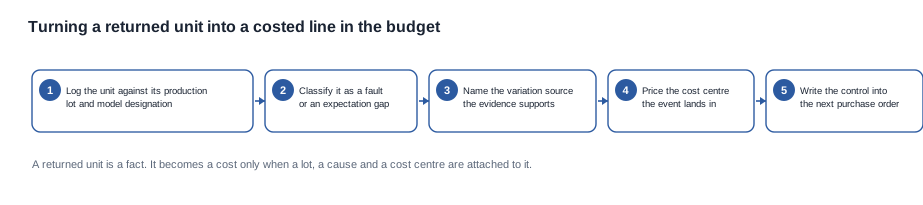
The order of the flow matters. The lot identifier comes before the classification, because a fault that cannot be attributed to a lot cannot be separated from a case-and-unit match or a handling event, and the classification comes before the pricing, because pricing a fault and pricing an expectation gap produces two different numbers and only one of them belongs in a quality budget. The last step is the one buyers drop: a control that lives in a meeting note does not survive the next change of account manager, and the cost recurs at exactly the same size.
Questions that produce a defensible number
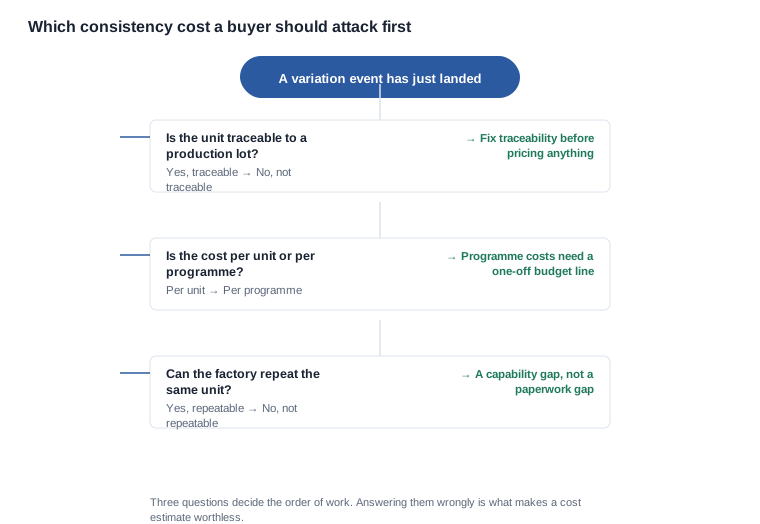
These are the questions to put, in this order, and each one has a completion test because a question without a completion test produces an answer that can mean anything. The list below is the what to ask core of a due diligence file, and a buyer should send it before you order rather than after the first complaint arrives.
- Which production lot did this unit come from, and what was in that lot? Completion: a lot identifier and a bill of materials version, both traceable on a physical unit.
- How many units from that lot are affected, and how many were shipped? Completion: a numerator and a denominator, not a rate alone.
- Which characteristic failed, and how was it measured? Completion: a method and a limit, both in writing and both applied before the result was known.
- Is the failure a fault against the written specification, or a gap against an expectation? Completion: a named category and the evidence that places the unit in it.
- What did the event cost, and which ledger row does it belong in? Completion: a cost centre, not a general allowance.
- What changes before the next lot? Completion: a named control in the next purchase order, with a date.
Six questions, in this order, are enough to establish whether a cost figure can go into a model. Two of them — the lot identifier and the bill of materials version — are also the two most commonly unavailable, and the buyer should find out which side of that gap the supplier is on before the first shipment rather than after the first complaint.

Moving the costs that can move
What a supplier can actually change
Consistency is priced, usually invisibly, and the useful negotiation is not about whether a supplier will accept the cost but about which of them are settled early and which are left to the moment of a dispute. The items that move most easily are the ones that trade convenience for evidence. A first-article inspection performed on the first shipment instead of at the end of a pilot run. A retained sample from every lot, with the lot identifier that links a unit to its production window. A defect remedy that can be a credit, a replacement or a rework, with the buyer choosing between them. The sample size in the acceptance rule, and what happens on the first failure. The warranty window and the claim route. The revision control on artwork and packaging, which is where finish consistency is usually decided in practice, long before anybody calls it a quality problem.
The items that move less easily are the acceptance rule itself, the change-notification clause and the remedy window, and the trade-offs inside each of them are settled once rather than order by order. These three are not priced because they are not convenient; they are the clauses that turn a supplier's process into something a buyer can rely on, and trading them away for a unit price moves the cost to the customer, where it arrives back as a return.
What does not move at all
Three things are not a negotiating position at all. The cost of producing a unit that meets the specification does not move, and a supplier who cannot hold a characteristic across lots does not have a documentation problem, because no clause creates the missing capability. The cost and cycle of the regulatory route for the destination market do not move; in the European Union that route runs through the Radio Equipment Directive (EU) 2014/53/EU, and the cost of the route and the time it consumes are a consequence of the requirement rather than a commercial concession. And the cost of the buyer's own incoming inspection does not move, because it is a decision the buyer has already made.
Where these costs break a programme
Four failures reach a buyer as a surprise, and each of them is a line in the order rather than a reason to change supplier. The good unit and the different lot happens when a programme is scaled on the evidence of a hand-built unit and the production lot is never compared against it; the control is to approve a second unit from a later lot before the programme scales, and to retain a sample from every lot. The characteristic that was agreed in words happens when a characteristic is named without a method, so the two parties measured different things and both believe they are right; the control is to attach a method and a limit to every critical characteristic and to test the method on the reference unit before it is used on a production batch. The change nobody announced happens when a component or process change has no notification clause, so the drift is invisible until it is significant; the control is to write the notification route into the agreement, name a recipient, and require the notice to name the affected model strings and the affected lots. And the inspection that grew instead of the source being fixed happens when inspection was tightened before the configuration was frozen; the control is to freeze the configuration, then measure, because a reject rate that rises while the variation profile stays flat is evidence that the measurement has changed.
A purchase scenario, and the boundary we hold
A scenario reasoned through
What follows is set out to make a point about where the money goes, not to describe a customer order. No customer is named and no order is claimed; the camera model, the two shipments, the single approved sample and the missing cost ledger are all assumed, so the sequence from complaint to costed line can be followed step by step. The questions to ask at each step are set out below.
A brand has received two shipments of a 13 MP camera model and the channel has reported that a number of units will not hold a charge. The brand has a good approved sample, a written purchase order, and no cost ledger. The published configuration for this family includes two case options on the L2 Utral, at 900 mAh and 1400 mAh, a 290 mAh cell across the CY03 and the L2 Utral, and the CY05 and the L1 Pro, and rated use of about seven hours. The brand's first instinct is to apply a typical category defect rate to the order value and to raise the incoming sample size at the same time, and the question of how to evaluate the two — one of which produces a number and the other a workload — is exactly what a buyer should be able to answer without a factory visit.
The first step is to refuse the category rate and to build the population instead. Every returned unit gets a model designation and a production lot, and the two shipments are separated into lots. The second step is to split the complaints. Roughly half are "the charge does not last the day" and roughly half are "the unit will not charge in the case" — two different problems, and the second one has a known mechanism, because a lot that pairs a 1400 mAh unit with the 900 mAh case produces exactly the reported symptom while every component stays inside its published figure. The published rows are enough to raise that possibility without a factory visit, and that alone removes a cost centre from the model.
The third step is to price what remains. The charge complaints that are genuine faults are priced against the returned-units row, the receipts that are expectation gaps are removed from the quality budget and go to the product brief, the inspection that was raised before the configuration was frozen is priced as a cost the brand chose and is stopped by freezing the configuration, and the schedule extension is priced from the dated gate log. The total that emerges is smaller than the order-value percentage the brand started with, and it is a number that can be defended because every row has a trigger behind it. The fourth step is the negotiation: the retained samples, the second unit from a later lot, the case-and-unit check in the acceptance rule and the change-notification clause go into the next purchase order, because each of them is cheaper than the cost centre it removes. The result is a short checklist of controls that a procurement manager can hand to a colleague, and it is the checklist, not the ledger, that changes the next delivery.
The reasoning matters more than the outcome. Nothing in it required a factory visit, and every step produced a document that survives the person who wrote it.
What we publish, and what we will not estimate
Concretely, the published material is the part of the specification we can stand behind, and the rest is a question for the supplier's own file. We publish the configuration rows exactly as the catalogue states them — the case options, the charging interfaces, the colour availability, the resolution tiers and the cell capacities, the published runtime bands and, for one model, a whole-unit weight with its exclusions — and we publish the absence of tolerances, defect rates, cycle life ratings and reliability reports with the same prominence. We will not quote an industry benchmark as if it were our own performance, and we will not estimate a defect rate from a typical value, because a buyer who builds a claim on an estimated number finds the error in the field rather than in the quotation.
The rows we do not publish for this category are these: sensor models, acoustic measurements and thresholds, ingress test report numbers, certificate numbers and validity dates, cycle life ratings, factory and line capacity, and the weight of any model other than the MT6. Where a model has no published figure, the useful answer is a question to the supplier rather than a number from us. Two limitations are worth stating plainly because they are the ones buyers ask about most: the catalogue publishes the IP54 marking on the V06 and the S7 as a catalogue annotation and not as a report-backed claim, and it contains no CE, FCC or RoHS marking for any model, so both belong in a request for documentation rather than in a specification that a buyer treats as settled.
What we can do is take a complaint file and a configuration, work out which variation source the evidence supports, and then tell you which controls belong in the next purchase order rather than in the next quarter. The broader treatment of the subject is at the quality consistency overview, the practical working practices are at the advanced guide, and the commercial side of the same decision is at how minimum order quantity reaches your margin. The pillar page for this topic is quality consistency.
The action to take now. Send us the model, the configuration, the complaint categories and the volume you are working with, and we will tell you which cost centres the evidence touches, which controls belong in the next purchase order, and which of the published rows the agreement has to name. A ledger that takes an afternoon is worth more than an allowance that takes a year and does not close the cause.
Related reading
- The full treatment — smart glasses quality consistency
- The working practices — quality consistency advanced guide
- The commercial side — how minimum order quantity affects your margin
Send us the model, the configuration and the complaint categories, and we will show you which cost centre each one belongs to — the arithmetic behind smart glasses quality consistency, without a single invented number.


