

Procurement teams frequently arrive at the same shortlist problem: two models sit in the same sport category, both are audio-style frames with Bluetooth connectivity, and both sit inside the same manufacturer portfolio, yet the published specification rows look almost identical at a glance. The catalogue lists both as sport-category models. The YKC02 is designated a sport model and carries a two-cell battery architecture. The D17 is also a sport model and carries a single cell with a faster charge cycle. Both ship with Bluetooth version 5.4. Both sit in the sport family rather than the audio family of eight models. Nothing published separates them on a price field, because the catalogue publishes no price, no MOQ and no tier for either model.
That absence is the single most important commercial fact in this comparison, and we will not paper over it. Any page that ranks the YKC02 against the D17 on a price scale without a written quotation behind it is describing a number that no supplier has committed to. What the published rows actually let a buyer do is infer structural position: how the battery is packaged, how the product charges in a customer's hand, what the feature row contains, and which questions must be answered in writing before a quotation can be compared like for like. This article works through that inferential structure so a brand owner or a channel partner can build a defensible comparison sheet without inventing a price band that does not exist in any published source.
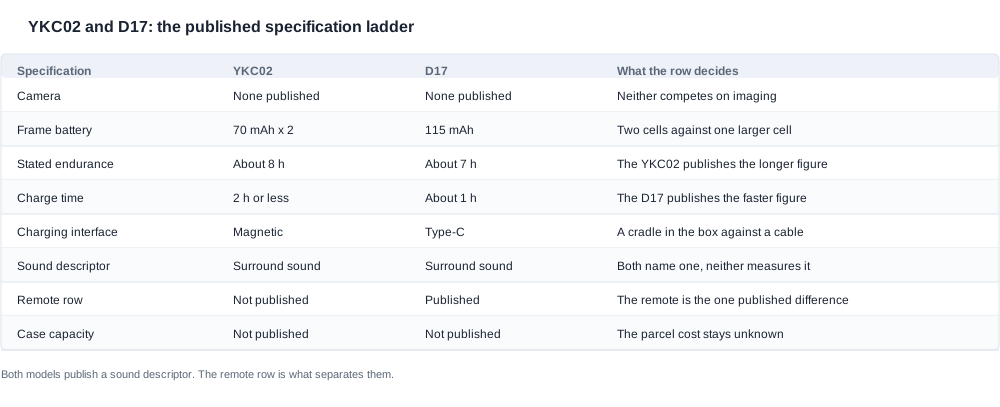
YKC02 rows the published sheet actually supports
The catalogue publishes a bounded set of rows for both models, and it is worth stating exactly which ones, because everything downstream depends on knowing where the boundary of published information falls.
For the YKC02, the published rows are the battery cell configuration (70 mAh x 2), the runtime figure (about 8 hours), the charge time ceiling (2 hours or less), the charging method (magnetic charging), and the Bluetooth version (5.4). The catalogue designates it as a sport-category model, which is a classification, not a capability. Critically, the YKC02 has no camera row. It is not a camera model, and it must never be placed into an enumeration of audio-tier models either, since the sport category is exactly three models: the YKC02, the D17 and the ZH12.
For the D17, the published rows are the battery cell configuration (115 mAh single cell), the runtime figure (about 7 hours), the charge time (about one hour), the charging interface (USB-C), the Bluetooth version (5.4), and two feature descriptors: remote control and surround sound. The D17 is one of only two models in the entire catalogue carrying an about-one-hour charge time figure, the other being the ZH12.
Everything else you might want to compare is not published for either model. The YKC02 publishes no camera resolution, no frame weight, no dimensions, no lens material, no colour options, no ingress or IP rating, no certification status, no price, no MOQ, no lead time, no sample policy, no warranty term and no battery capacity statement beyond the cell figures above. The D17 publishes no price, no MOQ, no tier, no camera resolution, no weight, no IP rating and no certification status either. Where this article says a row is not published, that is the honest state of the evidence, and we will treat it that way rather than guessing a plausible number.
Read as a set, the published rows support three legitimate inferences and rule out one tempting inference. They support inferences about battery packaging, about the charging experience a user or a retailer will handle, and about the feature row a channel partner must communicate. They rule out any inference about which model is more expensive, because no price, MOQ or tier row exists for either model in the published material.
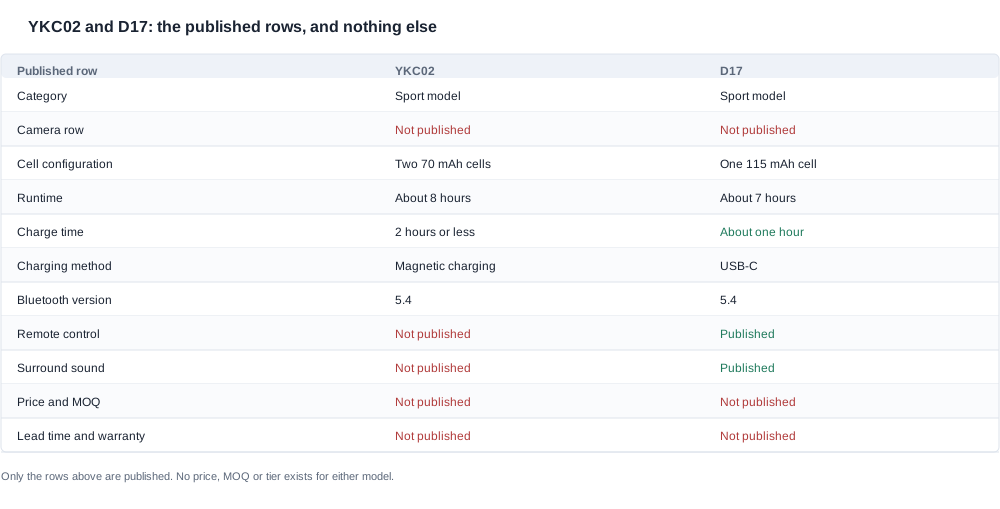
A practical way to use this table is to score the two models on architecture only, then mark every commercial field as an open question for the supplier. A comparison sheet that carries a column of blank commercial fields is far more useful to a purchasing manager than one carrying a fabricated band, because the blanks become the request list, and the request list becomes the quotation request.
The catalogue-wide context reinforces this. Across the full range of 28 models — eight audio, three sport, eleven camera, three kids and three with no model number — the charging method row is published as magnetic on seventeen models and USB-C on seven, with four models carrying no published charging method. Charge time is published as a two-hours-or-less ceiling on 26 models, with only the D17 and the ZH12 carrying the shorter about-one-hour figure. In other words, the D17 sits in a small minority on charge speed, while the YKC02 sits in the large majority on charge ceiling. That is a real, checkable position within the range, and it is one you can state in a buying memo without inventing a single price.

The YKC02 cell architecture behind the positioning
The most commercially meaningful difference between the two models is not a feature but a packaging decision, and it is the kind of difference that quietly reshapes a channel's cost story.
The YKC02 uses two 70 mAh cells. The D17 uses a single 115 mAh cell. Two cells in a frame means two physical battery bays, two charge contacts or a two-position magnetic interface, and a busier internal layout around the temples. A single cell means one bay, one contact set, and more free volume inside the frame. This is not a cosmetic difference; it changes tooling, assembly time, and what happens to the product when a buyer asks for a colour variant, a logo treatment or a revised packaging sleeve. Every retool of the battery compartment is a retool of two bays rather than one.
Here is where we will be direct about a trade-off, because pretending it does not exist is how sourcing projects go wrong. The two-cell architecture on the YKC02 is what supports the roughly eight-hour runtime figure, which is marginally above the D17's roughly seven-hour figure, and it is also what pushes the charge ceiling to two hours or less. The D17's single larger cell gives it the shorter charge time of about one hour, one of only two such figures in the whole catalogue, while giving up about an hour of runtime relative to the YKC02. These two advantages point in opposite directions. The buyer is not choosing better versus worse; they are choosing endurance against turnaround speed, and the correct choice depends on the use case, not on a spec sheet ranking.
For a channel partner the cost story shifts accordingly. A slow-charging product that holds a charge through a long day is easier to merchandise as an all-day endurance device; it also invites an accessory conversation, because the magnetic charging on the YKC02 is a different accessory from a USB-C cable. A fast-charging product is easier to demo in a store and to specify in a corporate gifting catalogue where the buyer is concerned about a device that is dead on arrival. Neither argument is a price argument. Both are commercial arguments, and both are things the supplier will respond to when you put the models side by side in a quotation request.
The charging-method difference deserves its own paragraph because it has accessory-bundle consequences that appear in packaging and spares costing. The YKC02 charges magnetically. The D17 charges over USB-C. A magnetic-charged model needs a magnetic dock or a proprietary magnetic cable in the box, and that dock becomes a stocking item, a spare item and a potential source of accessory revenue — but also a packaging line item and a failure point if the dock goes missing. A USB-C model ships with a standard cable that the end user may already own, which keeps the accessory box cheap and keeps the retail shelf simple, but it also means the charging cable is not a proprietary revenue line. Whichever way the channel leans, the accessory decision is downstream of the interface, not of a price list.
The feature row completes the published comparison. Both models publish a sound descriptor: the D17 publishes surround sound, and the YKC02 publishes surround sound next to its long-endurance row. The row that separates them is the remote control, which is published on the D17 and the ZH12 and not on the YKC02. This is not cosmetic: a remote control shutter is a genuine feature-row distinction that appears only on the D17 and the ZH12, and the YKC02 publishes no remote control at all. A channel partner who writes one product page for both models and implies the remote control is shared will create a customer service problem in the first week. The feature row is also a merchandising decision — the D17 carries a control row to position on, while the YKC02's published differentiators are the runtime figure and the cradle-based charging.
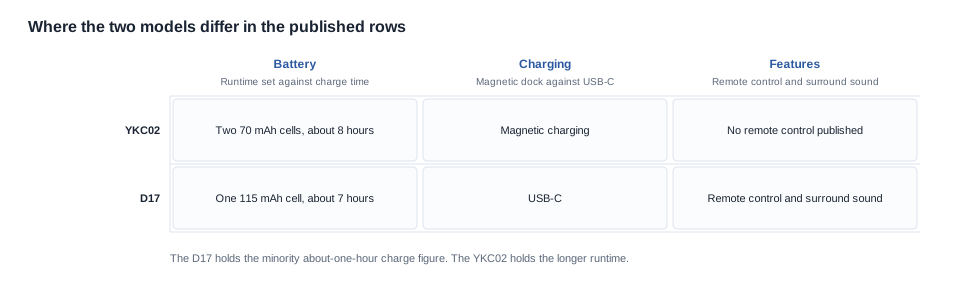
We will also make one negative statement that protects you from a common sourcing error: do not assume the YKC02 is a cheaper version of the D17, and do not assume it is a premium version either. Neither relationship is published. What is published is that the YKC02 trades charge speed for runtime and uses a different charging system, and the D17 trades runtime for a one-hour charge and adds a remote control. Position them in a range only after you have a written quotation in hand for both.
Two further cross-checks keep this comparison honest. First, neither model appears among the catalogue entries that publish an ingress rating — the only models with a published IP rating are the V06 and the S7 — so you cannot claim either the YKC02 or the D17 is weather resistant. Second, no capacitive-touch row and no translation row appears anywhere in the catalogue, so a product page that promises touch control on the temples or a live translation feature on either model is over-claiming relative to the published material. If your channel team has already written those claims, this comparison is the point at which to catch them.

What to ask in writing before comparing YKC02 quotations
A comparison becomes negotiable only when both models are quoted under the same commercial frame. The mistake most buyers make is asking for price per model separately, which produces two numbers that differ in everything except the thing being compared. Instead, send one request that pins the commercial terms identically and asks for one line per model.
Here is the request structure we will use, in this order, and we suggest you send it verbatim or adapt it line for line:
- Quotation format and validity. Ask for a unit price quotation for each model on identical terms, stated in a single currency, with a stated validity window. Ask whether the quoted figure is a catalogue tier or a project-specific figure, and request the tier structure in writing if one exists. We will not assume a tier exists for either model, because none is published.
- MOQ per model, and whether it differs. Ask for the minimum order quantity for the YKC02 and for the D17 separately, and ask explicitly whether the two share a combined threshold or require separate production runs. The two-cell versus single-cell architecture may make separate runs necessary, and that changes the landed cost of each model materially.
- Lead time, split into stages. Ask for component lead time, assembly lead time and total lead time to shipment, and ask what happens to the schedule if one model is ordered and the other is not.
- Incoterms and the cost boundary. Fix the incoterm in the request — the choice is yours to negotiate — and then ask for the quoted figure to state what it includes: tooling amortisation, packaging, certificates, freight, duty and any mould costs. Compare like with like or the comparison is void.
- Tooling and NRE. Ask what tooling or non-recurring engineering applies to each model, whether it is a one-time charge, and whether it is refundable against a pilot order or a subsequent purchase order. A new frame treatment or a logo mould on the YKC02 may carry its own tooling line.
- Samples and sample policy. Ask for the cost and turnaround of samples for both models, whether the sample is a production-equivalent unit, whether sample cost is credited against a first purchase order, and what the sample lead time is. Then ask for the policy on free samples versus paid samples.
- Packaging and accessories. Ask what packaging configuration is included in the quoted figure for each model, and confirm what ships in the box. For the YKC02, ask specifically what magnetic charging hardware is included. For the D17, ask whether a USB-C cable is included and whether the remote control is included in the box or sold separately.
- Spares and aftersales stock. Ask what spare-part ratios the supplier recommends, whether magnetic docks, charging cables and remote controls can be supplied separately, at what volume, and with what lead time.
- Warranty terms. Ask for the warranty period and scope for each model, what the remedy is, and whether it is a repair-or-replace policy. Do not assume a warranty term; none is published for either model.
- Certification evidence. Ask for the actual certification documents, test reports and declarations for each model, with issuing body, standard reference and validity dates. No certification status is published for either model in the catalogue, so the burden of proof sits entirely with the supplier's documentation. We will treat any verbal assurance as unverified until a document is in hand.
Send the same numbered list to every candidate supplier, including any alternative maker you are benchmarking, because the point of the list is that the answers become columns in the same sheet.
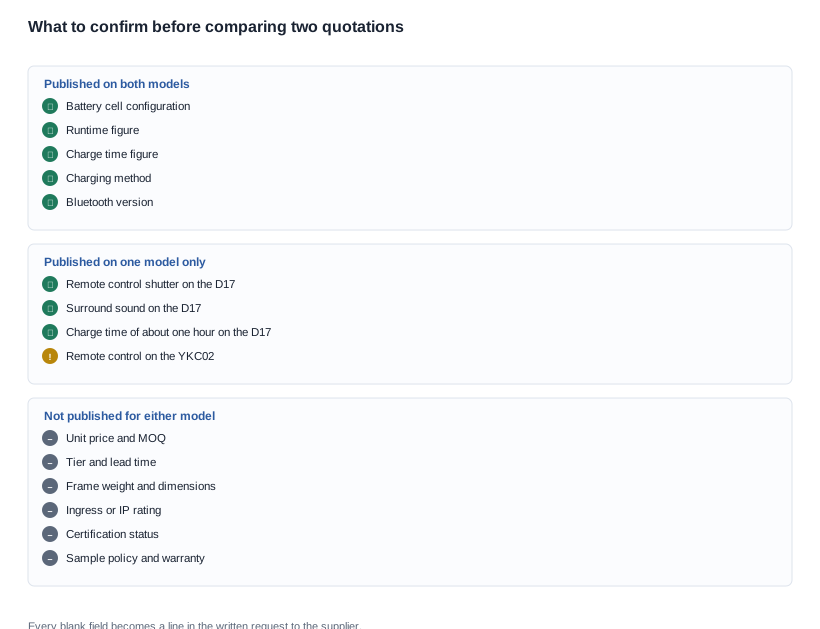
Two of these lines deserve emphasis because they change the outcome most often. The incoterm line matters because a unit price quoted under different delivery terms is not a price difference at all; it is a different contract. The certification-evidence line matters because a buyer who accepts "we are certified" without a document has not reduced risk, and the catalogue for this range publishes nothing on certification, so there is no baseline to fall back on. If the supplier cannot produce documentation, that is not a minor gap — it is an unquantified cost that belongs in your risk column, not in a footnote.
For runtime and battery comparisons that go deeper than this article goes, our companion piece on how to compare smart glasses battery life sets out the method, and the D17-specific breakdown in D17 smart glasses battery life covers the single-cell case in detail. The published D17 smart glasses specifications and features page covers the feature rows referenced above.

A YKC02 comparison sheet without invented prices
The practical deliverable of this comparison is a sheet your team can fill in and defend. Build it in four blocks, and keep them visibly separate so that a reader can tell published facts from pending answers.
Block one is the published specification block, and it should contain only rows the catalogue actually publishes: category, cell configuration, runtime, charge time, charging method, Bluetooth version, camera row presence, remote control, and surround sound. Every cell in this block is either populated from the catalogue or marked not published. Do not add a camera resolution row for the YKC02 even as a blank, because a blank row with a heading still reads as a promise on a spec sheet. If the field does not exist for a model, it does not go on the sheet.
Block two is the commercial block, and every line in it is empty at the start: unit price, MOQ, lead time, incoterms, tooling or NRE, packaging inclusion, sample cost and credit, spare parts, warranty, and certification documents. You will populate this block only from written responses. If a supplier gives you a number verbally, the cell stays empty with a note that a written figure was requested.
Block three is the derived position block, and this is where the value of the published rows finally lands:
- Charge-speed position. The D17 sits in the minority of the catalogue with an about-one-hour charge time; 26 of 28 models sit at the two-hours-or-less ceiling.
- Charging-interface position. The YKC02 sits on magnetic charging, the majority method in the range; the D17 sits on USB-C, the smaller group.
- Feature-row position. A remote control shutter is published on the D17 and the ZH12 only, so the D17 carries a control row to position on; the YKC02's published differentiators are its runtime figure and its two-cell, cradle-based charging.
- Category position. Both are sport models. Neither is in the eight-model audio tier, and the YKC02 has no camera row, so it cannot borrow credibility from the camera range either.
Block four is the risk and evidence block: certification documents outstanding, sample requested or received, pilot order volume under discussion, purchase order terms, and warranty scope.
Now the discipline that makes this work. A comparison sheet that says "YKC02 — cheaper" is wrong, because nothing published supports it. A sheet that says "YKC02 — about one hour of additional runtime, magnetic charging, no remote control, no camera" is right, and it is enough to take into a negotiation. In a negotiation you do not need a pre-existing price relationship; you need two fully specified configurations and a supplier willing to quote both. If you want a framework for how those tiers are typically structured once they exist, read OEM ready platforms and pricing tiers, and treat it as a framework rather than as a published schedule for these two models.
Two more points close the loop. First, when you evaluate the D17 for a buyer who asks about value for money, note that no price exists to evaluate against; the correct exercise is to compare configuration against use case, which is what D17 smart glasses value for money and D17 vs ZH12 use case fit help you do. Second, the sport range sits inside a broader family, so before you commit to either model, read YKC02 smart glasses specifications and features, YKC02 smart glasses best for and ZH12 smart glasses best for to confirm the sport trio is the right family for the channel you are building. If your customers are actually shopping for a camera device, our AI camera glasses shipping weight guide covers a different range entirely and neither of today's two models belongs to it.
So we will say plainly what this article cannot tell you: it cannot tell you which model costs less, what the MOQ is, when a pilot order can ship, or what incoterm the supplier will hold. Those numbers do not exist in any published source for the YKC02, the D17 or the ZH12. What it does tell you is that the two models differ in ways that will shape the quotation once you request it — two cells against one, magnetic against USB-C, a remote control on one side only, and a published charge-speed position that is a minority position rather than the range default. Use the sport smart glasses range page to confirm model availability, then take the numbered request list to the supplier and let the written quotation, not a guess, set the price positioning.


