

Risk in a smart-glasses development programme is rarely a dramatic event. It is almost always a small ambiguity that nobody closed, a substitution that nobody was told about, or a decision that arrived after the point at which it could still be made cheaply. By the time any of these become visible, they are usually visible as a delay, a cost, or a shipment that does not match what was approved. The purpose of risk management inside a development programme is not to prevent those outcomes through prediction. It is to make sure that each open item has a named owner and a written decision, so that when it does land it lands on a controlled surface instead of in a shipment.
This matters more in this product category than in many others, because a wearable is judged as a single object. A consumer does not know whether a pairing problem came from the radio module, the firmware, the pairing procedure written for a different model, or an antenna that lost clearance inside a changed housing. Everything is one product to the end user, and the only thing that keeps a defect diagnosable is a record that connects each symptom back to a specific cause.
The framework below is built around the six gates of the development process — requirements frozen, feasibility reviewed, engineering and tooling, samples built and verified, compliance file closed, and pilot run before mass production. Risk management is not a separate activity performed alongside those gates. It is the mechanism that moves an open item from one gate to the next, with its status either closed or explicitly carried.
The other thing to say at the outset is what this article deliberately does not contain. It does not contain likelihoods, percentages, schedule impacts, cost estimates, or lead times, because those are numbers that look precise while being guesses, and a buyer who negotiates against a guessed number negotiates against nothing. Everything below is a method and a question. The method is transferable between programmes; the numbers never are.
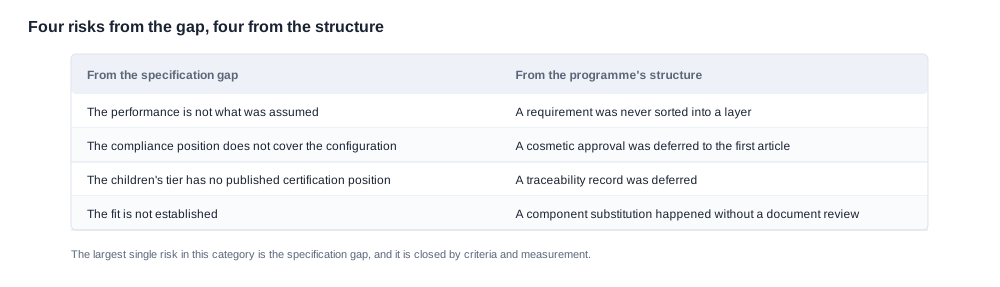
Development process risk management: the recurring programme risks
The following risk classes recur across smart-glasses programmes with remarkable regularity. They are listed as recurring classes rather than as a scored register, because the purpose of naming them is to help a buyer recognise one early enough to ask the right question, not to assign a number to it.
-
Requirement ambiguity. Two parties read the same requirement sentence and build different products. The classic cases are a feature described in the customer's language rather than the engineering language, an interface expectation that was never specified per model, and a performance expectation expressed as a general adjective rather than a measurable condition. In a catalogue spanning audio models, sport models, camera models and children's models, a single requirement written at family level will be implemented differently on every family, and the discovery usually happens at sample review. What to ask the supplier: "Show me the requirement document, and point to the line that specifies the behaviour for the specific model string I am ordering."
-
Tooling lock-in. Once tooling is committed, the commercial and specification flexibility of the programme narrows sharply. A change that would have been a firmware edit at the engineering stage becomes a tooling change at the tooling stage. The risk is not that the tooling is bad; it is that the moment at which it becomes expensive is not the same moment at which the decision to spend it is taken, and the two are often separated by a written confirmation that does not mention tooling at all. What to ask the supplier: "What happens to the tooling cost and the tool ownership if the programme stops at this gate, and what in our agreement already commits us to it?"
-
Component substitution and allocation. Parts allocated for the volume case are not necessarily the same parts used in engineering. Substitution may be invisible in a part number, visible only in behaviour, and may arrive without notice. What to ask the supplier: "What is the change-notification process for a substituted component, who signs it off, and what evidence will I receive when it happens?"
-
Firmware behaviour diverging from the frozen requirement. A firmware build can drift from the frozen requirement without anyone editing the requirement. Control behaviour, pairing logic, prompt language, and the interaction between physical controls and software may be settled during development by whoever was present, which is usually a small number of people. The frozen document then describes a product that is not quite the one being built. What to ask the supplier: "Which firmware build corresponds to the frozen requirement, and how do we confirm that a build and a requirement refer to the same set of behaviours?"
-
A claim that turns out not to be supportable. A feature name in a marketing plan, a specification in a channel listing, or a headline capability can be agreed at the start and later turn out to rest on an assumption that the engineering cannot support. This is common in camera-bearing models, where shutter behaviour and remote control shutter are feature claims that need to be verifiable on the specific model. What to ask the supplier: "For each claim we intend to print, which specific model carries it, and what document supports it?"
-
A compliance document that does not cover the shipping model string. A declaration of conformity issued for a product family is not a declaration for the individual SKU a channel will ship. Model naming is the usual weak point: a family, a variant and a market-specific string can all refer to the same physical product while pointing at different paperwork. What to ask the supplier: "Show me the declaration, and tell me exactly which model string appears on it, compared with the string that will appear on our cartons and on our listings."
-
A buyer-side decision that arrives late. Assortment, packaging design, market assignment, and channel commitments often move later than the engineering programme assumes. When they do, the cost lands on the stage in progress rather than on the stage that could have absorbed it. What to ask the supplier: "Which decisions are still open on your side, which ones are still open on ours, and what does each one change downstream?"
Two patterns that make these worse
Two structural patterns recur alongside the risk classes themselves, and both are worth naming because both are cheap to prevent and expensive to discover late.
The first is specification written at family level. The catalogue behind a typical smart-glasses programme holds audio models, sport models, camera models, children's models and variants that carry no model number at all. That breadth is a commercial strength and an engineering hazard, because the same sentence in one requirement document ends up meaning something slightly different on each branch. The entries where a feature is published for only some models in the range make the point clearly: remote control shutter appears on two sport models and nowhere else; an ingress rating appears on two models only; a Bluetooth version is published for a subset of the range and not for the camera models or the bone-conduction variant. Nothing here is a criticism of the catalogue. It is an illustration of the discipline required, because a buyer who assumes a feature is shared across the range will eventually ship a listing that the product does not support.
The second is the model string that reaches the customer is not the model string in the paperwork. Between the engineering designation, the internal build designation, the model printed on the carton, and the listing a channel publishes, there are four names for one product. A compliance document covers one of them. The risk file should carry, as a single line, the mapping between all four.
We will treat this list as a recognition aid rather than a checklist of things to fear. Its practical value is that each class has a corresponding question that can be asked early, and early questions are the only ones with cheap answers. The class we will spend most time on in practice is the first one, because an ambiguous requirement is the risk that quietly turns into several other risks later.
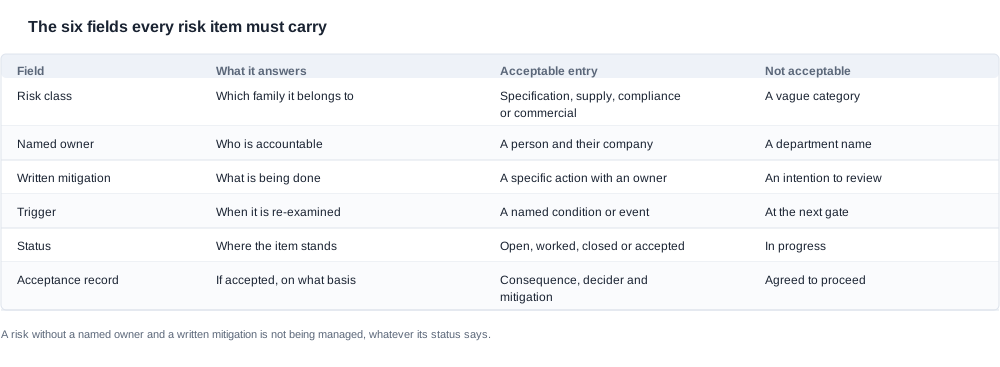

How a risk is classified and owned
Once a risk has been recognised, the question that decides whether it is actually being managed is not how likely it is. It is who owns it, and what is written down. A risk register that scores likelihood and consequence without an owner is a document, not a control.
The classification used in a well-run programme is deliberately simple, because a complicated taxonomy on a small programme produces a register nobody reads. Items are usually classified into four groups:
- Specification risks. The requirement is ambiguous, incomplete, or has been interpreted differently by the two sides. These are owned jointly, because a specification risk that sits with only one party does not get resolved.
- Supply and process risks. Tooling, allocation, substitution, line behaviour, and the repeatability of the build. These sit with the manufacturer, who holds the process and the suppliers.
- Compliance and claim risks. The product documentation, the declarations, and the claims that will be made about it. These sit with the manufacturer for the evidence and with the brand for the claim wording.
- Commercial and programme risks. Assortment decisions, channel commitments, packaging approvals, and the buyer's own timing. These sit with the buyer.
Each item carries a named owner, a written mitigation, a written trigger that says what will cause the item to be re-examined, and a current status. Status is one of four values and means exactly one thing each: open, being worked, closed with evidence, or accepted with a recorded reason. The fourth is the one that gets abused, and it is the one that most needs a written record.
The rule that makes the register work is simple: a risk without a named owner and a written mitigation is not being managed, whatever its stated status. This is not a philosophical position. It is a test you can apply to any item in any register you are shown, and it reveals immediately which entries are live and which are decorative. When you are given a risk file, read each item and ask who is accountable for it and what has been written. Items where the answer is vague are the items that will surface later as a surprise, because nothing about them was ever really decided. The test we will apply to any register we are shown is exactly that one, and it takes minutes rather than a review cycle.
Naming an owner is harder than it looks
The owner of a risk is a person, not a department. "Engineering" is not an owner, because engineering is a group of people and nobody in the group has been made responsible for the item. The same applies to "the factory" and to "both sides". The test is whether you can write the item down as "name, company, what they will do, and what they will tell us when it is done". If that sentence cannot be written, the item does not have an owner.
Joint ownership is legitimate but has to be split into two named halves. A specification risk will typically have one owner on each side: the manufacturer confirms the engineering interpretation, the buyer confirms the commercial intent, and each is separately accountable for their half. When the halves are not split, the item is owned by neither and it survives every gate.
There is a second question to ask of every owner, which is whether the owner has the authority to close the item. An owner who cannot commit a specification change, cannot commit a component substitution, and cannot commit a document revision is a reporter rather than an owner, and the item will circulate until somebody with authority picks it up.
Risk is not a task
A task is something someone will do and finish. A risk is something that might happen, and managing it means arranging for it to be either prevented, detected early, or absorbed with a decision already made. Registering a task in the risk list and marking it closed is a common way of producing a clean-looking file with the risk still live.
The distinction shows up in how an item reads. "Update the specification" is a task. "The specification for the camera models does not currently pin the shutter trigger behaviour, so the implementation may differ from what the channel listing will say" is a risk. The second one names the uncertainty, and it therefore has a mitigation, an owner, and a trigger. The first one has a date and no uncertainty, and it can be ticked off without the underlying risk moving at all.
Where the register is updated
The register is not a document produced once and archived. It is updated at each gate, and the update is part of the gate decision. This is what makes the gates meaningful: a gate is not passed because time passed, it is passed because the documents that the gate produces are complete and the open items that the gate produced have been either closed or explicitly carried forward with a decision attached.
This is also the mechanism that connects the development process to the commercial relationship. The behaviour a buyer sees in a risk file during development is the same behaviour they will see in a change notification, a delay notice, or a claim during supply. Programmes with written risk practice tend to produce written notice later, because the habit of writing down what has not been decided is the same habit that makes a late change a conversation rather than a surprise.
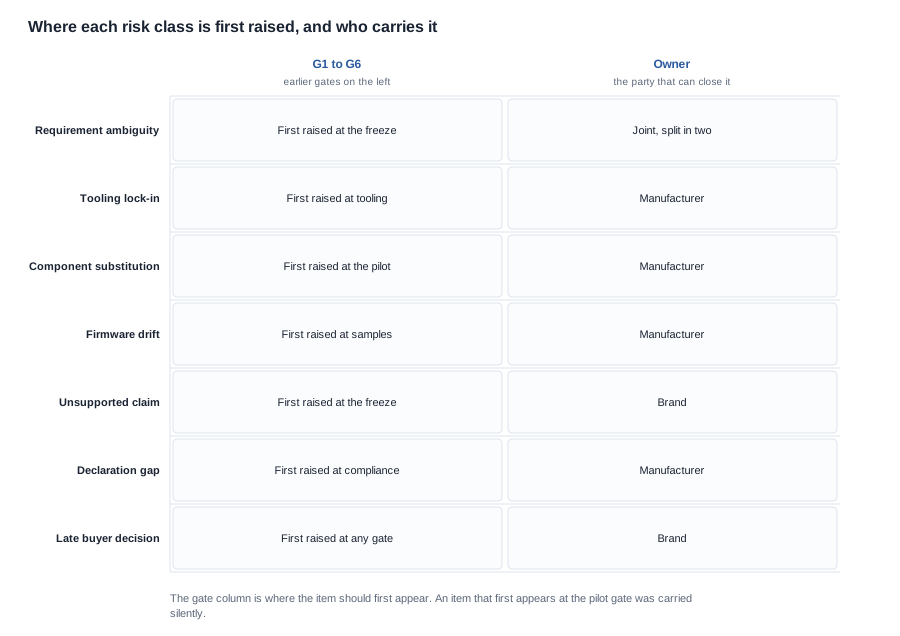

Risks that stop a programme and risks that are accepted
Most risk items in a healthy programme never stop anything. They are worked, closed, or accepted, and the programme continues. The distinction that matters is between an item that stops the programme and an item that is accepted, because both can look identical from the outside — the programme is still moving — and they have opposite consequences for the buyer.
The stop conditions
A stop condition is written in advance, before the item that triggers it is known. It names a specific state that prevents the programme from advancing to the next gate. In a smart-glasses programme, the conditions worth writing down include: a requirement that cannot be frozen because the buyer has not decided the intended claim, a tooling commitment that has been made without an agreed answer on what happens to the tooling cost if the programme ends at this point, a firmware behaviour that cannot be brought into line with the frozen requirement without a change the buyer has not approved, a compliance document that does not cover the shipping model string, and a claim that cannot be supported by any document the manufacturer is willing to issue.
Written stop conditions protect both sides. The buyer gets a clear statement that the programme is not being advanced on a basis the buyer has not accepted. The manufacturer gets a clear statement that the programme is not being advanced on a basis the manufacturer cannot deliver, which is what makes it reasonable to say no.
A stop condition that has not been written down is not a stop condition; it is a disagreement waiting for a deadline. This is why the conditions belong in the development agreement rather than in an email exchange during a difficult week.
Accepted items
An accepted item is one where the parties have looked at the risk, understood the consequence, and decided in writing to proceed anyway. The acceptance is not an apology and it is not a waiver. It is a decision to carry a known condition, and it is only legitimate when three things are true: the consequence has been described in the record, the decision has been made by someone with the authority to make it on behalf of their side, and the record says what will happen if the consequence actually materialises.
Some consequences are simply not negotiable once accepted, and a good acceptance record says so. If the claim in the channel listing is not supported by any documentation, accepting that risk does not make the claim true, and the acceptance record should make that explicit by naming the mitigation — typically a change to the listing itself.
We will also note the failure mode here. An acceptance that is recorded verbally, or recorded without naming a consequence, is not an acceptance. It is a deferral that nobody will revisit, because no one can tell whether the condition materialised. A record that names the condition, the consequence, and the mitigating action is auditable; one that says "agreed to proceed" is not. The item we will re-read at the next gate should arrive with its original context intact, and that context is either written down or it is gone.
Accepting is a decision, not a default
The most common way a risk file stops working is not a dramatic failure but a slow drift, where items migrate from open to being worked to accepted without anybody deciding to accept them. The mechanism that prevents drift is a rule requiring that an item can only reach accepted status through an explicit decision recorded at a gate, and that the record is re-read at every subsequent gate. An accepted item that nobody has re-examined for several gates is not an accepted risk; it is a deferred decision that has lost its context.
Who accepts, and how a buyer participates
Acceptance is a commercial act, so it belongs to whoever carries the commercial exposure. For a specification item that changes the product, the buyer accepts. For a supply or process item, the manufacturer accepts. For a claim, the party that publishes the claim accepts, which is usually the brand. For a compliance item, the party that signs the declaration accepts, which is the manufacturer.
The buyer's role is to make sure that every acceptance it is exposed to reaches it in writing before the gate closes, not after. And it is equally important for the buyer to accept consciously. Accepting a risk that has not been described is not risk management; it is a decision to stop looking, and it is the one failure mode that no amount of supplier discipline can compensate for.
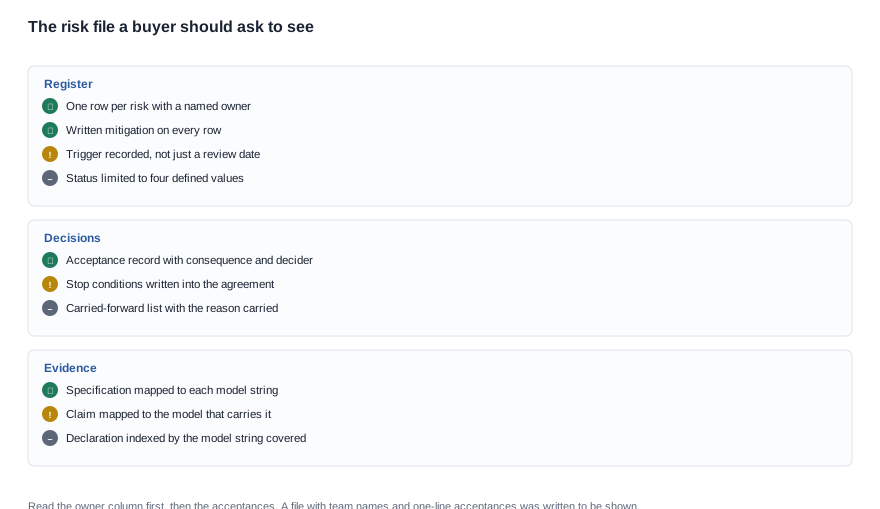

What the risk file should contain
A risk file is a working document that a buyer should be able to read in one sitting and use to form an accurate view of the programme's exposure. The following is what to ask to see, and what to check for in each item.
- The register itself, with one row per risk, a named owner against each row, a written mitigation, a trigger, a status, and the gate at which the item was last reviewed. Ask specifically for the column that names the owner; a register without it is a list of worries.
- The acceptance record, as a separate document, with the consequence, the deciding party, the date, and the mitigating action for each accepted item. Ask for the items accepted at this gate, not only the accumulated list.
- The stop-condition list, in the agreement rather than in the register, so that both sides are working from the same wording.
- The specification-to-model mapping, showing which requirement applies to which model string, including the variants that carry no model number, and the string that appears on the carton and in the channel listing.
- The claim-to-model mapping, showing which documented feature belongs to which model, so that a listing can be checked against what will actually ship. Features published for only part of a range are the usual source of accidental over-claim.
- The compliance evidence index, listing the declarations and reports held, and the exact model string each one covers, so the gap between a family-level document and a shipping SKU is visible rather than assumed.
- The change-notification procedure, describing what notice the manufacturer will give for a substituted component, a firmware build change, or a documentation revision, and who is notified.
- The open-items carry-forward list, showing every item that crossed the previous gate without being closed, with the reason it was carried and what had to be true for it to be carried.
How to read the file
The fastest way to assess a risk file is to read the owners column first and then the acceptances. A file where every owner is a named individual and every acceptance names a consequence is a file that was used to make decisions. A file where the owners are teams and the acceptances are single-line notes is a file that was produced to be shown. The difference is obvious in minutes and predicts how the programme will behave when something goes wrong.
The second useful check is coverage against the recurring classes. Take the seven classes named earlier in this article and look for each one in the register. Any class that is entirely absent is more interesting than any class that is present with a detailed plan, because absence usually means the class was not recognised rather than that it was handled.
The method we will follow is fixed; only the documents attached to it change from programme to programme. Nothing in this list asks for a number, and that is deliberate. Where a buyer wants the scale of something — how many units a line can hold, how long a stage occupies a calendar, what a delay would cost — the answer has to arrive as a document attached to a decision, because a figure quoted in conversation cannot be defended when it is challenged later. What to ask the supplier is therefore always the same shape: which document, covering which model string, signed by whom, and at which gate.
Questions to ask the supplier
- Which risks are currently open, and who owns each of them by name?
- Which risks have been accepted, what is the consequence of each, and who decided?
- Which risks were carried across the previous gate without being closed, and why?
- What are the stop conditions in our agreement, and has any of them been triggered?
- What would have to be true for you to tell us that a risk has materialised?
- If a component is substituted or a firmware build changes, what notice do we get, in what form, and at what point in the process is it raised?
- Which decisions remain open on your side, and which of them change something we have already approved?
- What in the current plan is a decision we have not made yet that you are proceeding on the assumption we will make?
- If we asked you which risk in this programme you personally think is most likely to cause us a problem, what would it be, and what is written about it?
- What has changed since the last gate that was not a risk when it happened?
That last question is the one that separates a real risk practice from a document that has been assembled once. In a programme where risk is genuinely managed, the answer is never nothing, because something always changes between gates. In a programme where the file is decorative, the answer is a clean nothing, and that is the answer to trust least.
Further reading on the surrounding method sits in the pillar overview at /oem-odm-process. The gate sequence is described in /blog/development-process-stage-by-stage, the causes of programme slippage are examined in /blog/development-process-common-delays, and the commercial drivers behind a development budget are separated out in /blog/development-process-cost-drivers. The early specification work is covered in /blog/odm-development-design-phase, and the overall sequencing view is in /blog/odm-development-timeline-overview.


