

The right smart eyewear range is the one whose functional claim you can defend with a document in every market you sell into. Most category mistakes are made by starting from a competitor's range structure rather than from your own channel, and the four questions below are designed to be answered from your side of the table. Only the fourth is a compliance decision; the first three are product facts.
This page is a category screen, not a range plan. The product line construction method covers what to do once a category is chosen, and this page covers the decision that comes first: which family of claims your channel is actually buying into.
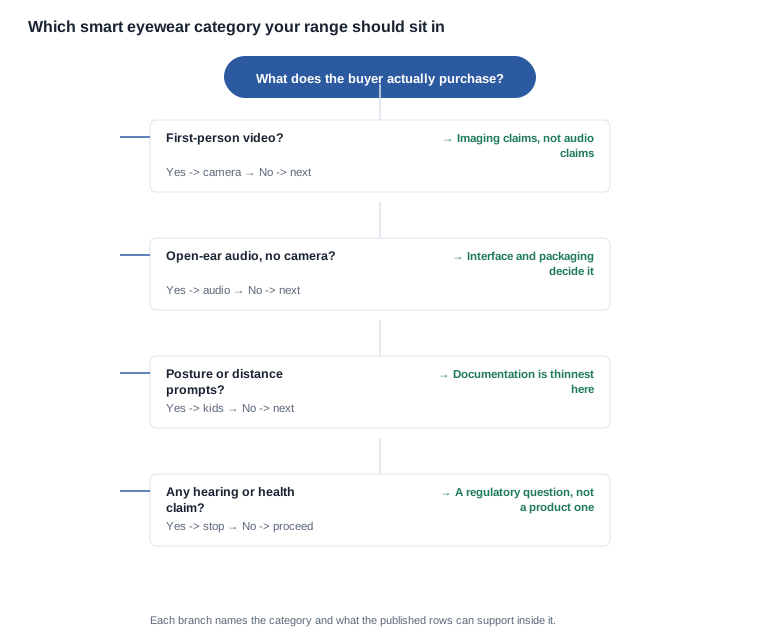
Smart eyewear range question one: do you need first-person video?
If yes, you are in the camera category and the selection is about imaging, not audio. This is the AI camera glasses range, and the published differentiation inside it runs along three axes: resolution tier, cell capacity and charging case configuration.
The resolution tiers are 8 MP and 13 MP, and those are the only two values published. Eight of the eleven camera models publish an 8 MP row and three publish a 13 MP row. That is a genuine, verifiable, spec-sheet-level difference — and it is the only imaging difference the catalogue publishes.
Here is the trap in this category, and it is a documentation trap rather than a product one. Resolution is the headline number and the least informative one. It tells you how many pixels the sensor can record, not how large they are, how much light they gather or how wide the lens sees. No sensor model, field of view, video resolution or frame rate is published for any camera model in this range. If your product brief depends on image quality, get those rows in writing before you commit — our reading of why is in how to read a camera datasheet.
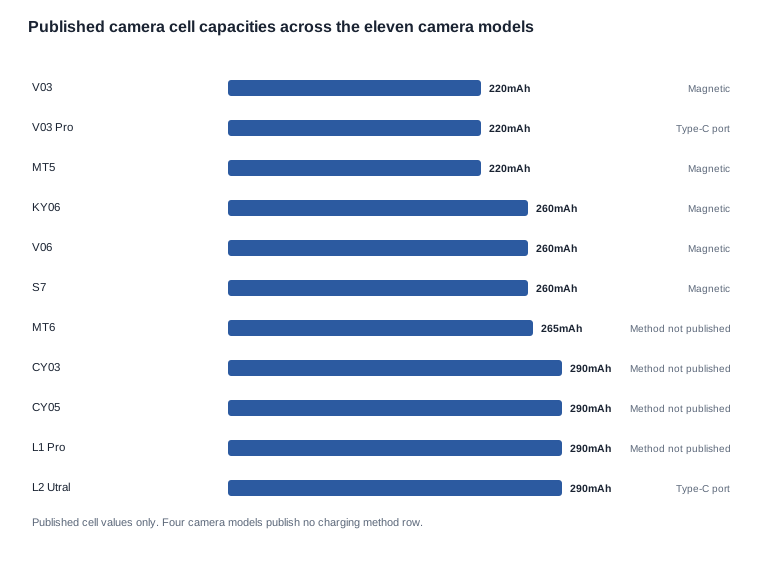
The cell capacity spread inside the camera family runs from 220 mAh through 260 and 265 mAh to 290 mAh, and those are published values rather than derived totals, so they can sit on a specification table as they stand.
The third axis is the one that most often gets mis-stated. The charging case position has three different states across the eleven camera models, and only one of them is a clean answer. Five models publish a case capacity: three at 1400 mAh, one with a choice of 900 or 1400 mAh, and one with a 1200 mAh folding case. Two more have a case whose capacity is not published. Four publish no charging case row at all, which means the catalogue is silent rather than stating that there is none, and a buyer who needs to know what travels in the carton has to ask for those four by name.
A buyer who writes "no charging case" for the three silent models is asserting something the catalogue does not say, and the correct position is to ask the supplier for the specific model rather than to infer it from a sibling. The camera charging case options analysis works through the states one by one.
Question two: open-ear audio with no camera?
If yes, you are in the Bluetooth audio category, and the differentiators are smaller and stranger than buyers expect.
Eight models make up this category, and they do not publish one shared set of rows. The cell arrangements run 55mAh2 on four models, 90mAh2 on two, and a single 100 mAh cell on two. The charging method splits them further: magnetic on the twin-cell models, Type-C on the single-cell pair.
What genuinely separates models here is interface and packaging rather than any headline number. Type-C against magnetic charging, a case or no case, and whether a remote shutter is published. Those are the rows a buyer can put on a page and a customer can check.
What does not separate them is endurance. The top published runtime figure in the range appears on several different models at once — the K-series, the LC-105 pair and the YKC02 all publish about eight hours — and no test condition is published for any of them. The endurance figure cannot be used to separate models in this category, and a category built on it is a category built on an artefact.
One more distinction is worth drawing, because it is the one most often confused with the camera family. The YKC02 publishes a sound descriptor and a long-battery descriptor, but it is published as a sport model with its own cell and charging rows — it is not one of the eight audio models, and treating it as one produces an enumeration that does not match the catalogue.
Question three: posture or distance detection?
If yes, you are looking at the kids detection models — the A05 and the A06, both publishing 40 mAh and roughly 20 hours, and both publishing the same feature lines. Whether the parent-side function runs on the device or on a phone is not published, and neither are the detection thresholds.
The published rows are specific and can be described exactly: the catalogue lists a fogging unit, correct and incorrect posture-and-distance prompts, and lens clarity and lens fogging for the A05 and the A06. That is a description of what the catalogue lists, and it is where the description has to stop — the rows are not a vision claim, a health claim or a prevention claim, and a product page that converts them into one is a compliance problem rather than a marketing one.
One point worth stating early: the A05 and the A06 publish identical rows, and the documentation does not state what separates them. A buyer listing both is carrying two designations without a documented difference, and the A07 is the model in that family that publishes neither detection function. The A05 versus A06 specification comparison works through what the possible answers mean.

Question four: is a health or hearing claim anywhere in your plan?
This is the only one that is not a product question, and it is the one that ends careers.
If bone conduction or any hearing-support framing enters the plan, the United States boundary is defined in FDA 21 CFR 800.30, which classifies over-the-counter hearing aids as air-conduction devices. A bone conduction product sits outside that classification. You may describe the mechanism — vibration through bone, ear left open — and you may not position the product as an OTC hearing aid or carry hearing-aid efficacy claims.
The published figure in this category is an amplification gain of 35 dB, and it can be quoted as a catalogue value. It cannot be turned into a statement about who the product suits.
For the EU, the general product safety regulation (EU) 2023/988 and the radio equipment framework both bear on what you must hold before placing goods. For the UK, the corresponding conformity routes apply. None of these are questions a copywriter should answer.
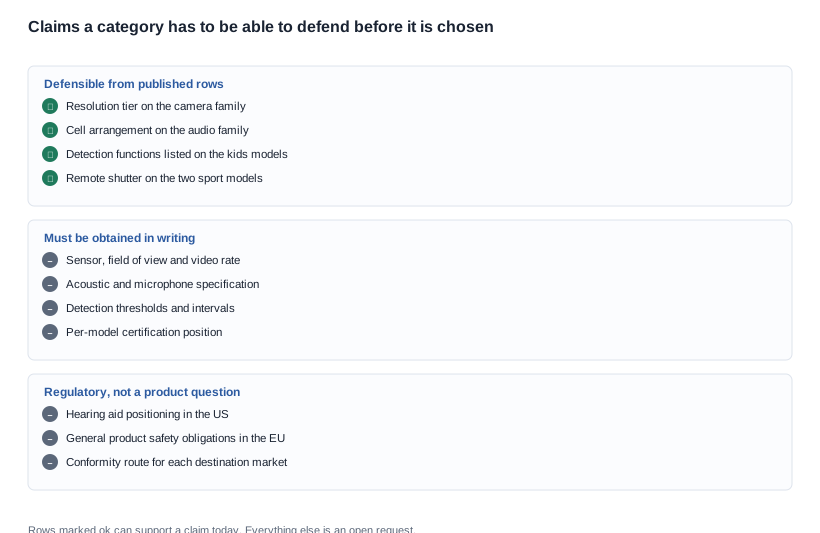
What a category choice costs once the channel is live
Choosing a category is a procurement decision with a long tail, and the tail differs by category. The four questions above decide which family of claims you are buying into; the questions below decide how much work that family generates after the first order.
The camera category generates imaging evidence and a certificate per model
A camera programme needs rows the catalogue does not publish: the sensor, the field of view, the video resolution and the frame rate. Those four rows have to come in writing for the model being ordered, and they determine whether the imaging claim on the listing is defensible or merely decorative. The how to read a camera datasheet piece covers what to ask for and in what form.
It also needs the case position settled per model, because the four case states mean the packed weight and the freight class differ between models that look similar on a specification table. And it needs the certification file opened against the exact model designation, because a designation change after the file is opened is a re-application.
The audio category generates an accessory decision and a comparison problem
An audio programme is simpler on imaging and harder on logistics. The accessory set has to be decided once across the range — magnetic or Type-C, dock or cable — because the dock minimum order quantity constrains the frame minimum, and that constraint is invisible until the quotation arrives.
The harder problem is the endurance row. Because the top published runtime figure appears on several audio models at once and no test condition is published, a buyer who builds a listing on it is building on a number that a competitor's product can quote identically. The comparison a customer performs will be on the specification block, so the specification block has to be one the catalogue supports. That means an explicit condition on any endurance claim, or no endurance claim.
The kids category generates an age band and a data position
A children's programme cannot be scoped by the specification rows, because the specification rows are the same on two of the three models. What governs it is the age band and the data position, and both are regulatory questions that have to be answered before the packaging, the app treatment and the privacy text can be written.
The published feature lines — a fogging unit, correct and incorrect posture-and-distance prompts, lens clarity and lens fogging — are describable as catalogue content and nothing more. They do not support a vision claim, a health claim or a prevention claim, and the posture monitoring analysis sets out what the detection functions are designed to observe.
The privacy considerations piece covers the seven questions that decide whether this product is a simple wearable or an operating commitment with obligations attached, and the age suitability analysis covers the inputs that establish the band.
The sport category generates a scope question before it generates anything else
Sport positioning is the category where the documentation is thinnest and the marketing pressure is heaviest, because sport claims are easy to make and hard to substantiate. The published rows are cell capacity, charging method, endurance and — on two models — a remote shutter. The IP54 rating is published for the V06 and the S7, which are camera models positioned for sport rather than members of the sport family.
Ask for the specific model list that any rating covers before the rating goes on a page. A category whose main differentiator is a marking that covers two models out of the catalogue is not a category to enter with a broad claim.
The commercial terms that are common to all four
Three terms apply whatever category is chosen, and they are worth settling early because they set the shape of the first order.
Minimum order quantity on the full delivered configuration — the frame plus the accessory that ships with it — rather than on the frame alone. This is the term that determines whether the channel can reorder in small increments, and it is very often larger than the frame minimum suggests.
Payment against inspection rather than against dispatch. The catalogue's thin documentation in the rows that matter most, weight, case capacity, certification and the conditions behind the endurance figures, is precisely why a buyer wants a retention point tied to named inspection steps.
Delivery splitting on the first order. The first order is the point at which no demand data exists yet, and splitting it across dates lets the second shipment follow a measured result instead of a forecast.
Certification cost and its timeline are fixed by the process rather than by the negotiation, and tooling is often amortised across a first order while certification sits per product family — ask which of the two is being quoted, because the two are frequently bundled into a single line that hides which one carries the volume.
Where the categories overlap, and why that is a problem
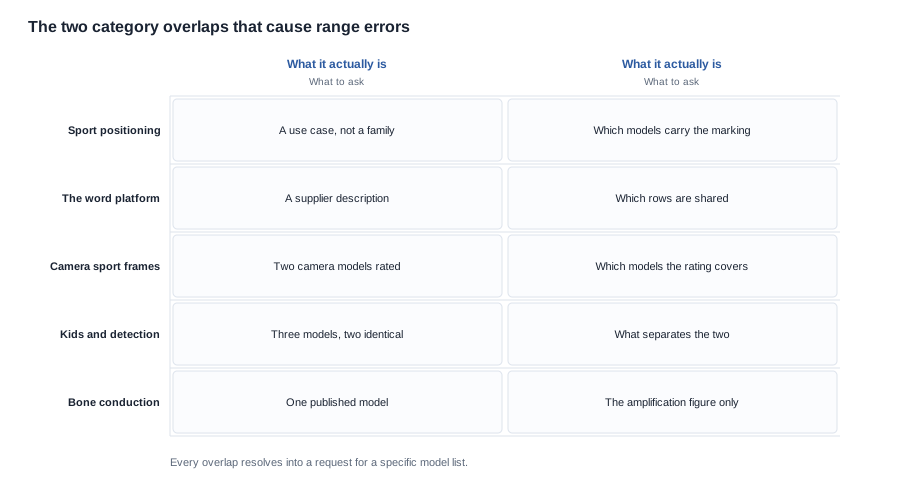
Two overlaps cause most of the errors we see.
Sport is a use case, not a category. A camera frame marketed to runners and a frame designed for cycling may be counted together in a competitor's range, and the IP54 marking published for two camera models says nothing about whether a given model carries it or is merely positioned near it. IP54 is published for the V06 and the S7 only. Ask which specific models a rating covers, because "the sport models" is not an answer a buyer can act on.
"Platform" is a supplier's word, not a buyer's. A supplier describing a camera frame as an AI-ready platform is describing an intention. The published position on what a camera glasses platform should actually evidence is covered in OEM-ready platforms.
The rows that decide the category, and the rows that only look like they do
| Category | Models | Published row that leads | What is not published |
|---|---|---|---|
| Camera | Eleven | Resolution tier and cell capacity | Sensor, field of view, video rate |
| Audio | Eight | Cell arrangement and charging method | Acoustic and microphone detail |
| Sport | Three | Cell and remote shutter | Any category-specific rating beyond IP54 on two camera models |
| Kids | Three | Detection rows and cell | Age band, detection thresholds |
Two things stand out of that table. First, in every category the row that leads is a specification row rather than a performance row, and that is because the catalogue publishes specifications and not performance. Second, the "not published" column is where the real work sits — it is the set of things a buyer must obtain in writing before committing, and it is longer in the camera and kids categories than the published column.
The practical test for a category choice is therefore not "which category looks best in the market" but "which category's leading published row can carry a claim my channel will make, and how long is the list of rows I will have to go and get". A buyer who answers the second question before the first tends to pick a category that cannot be defended in the market they actually sell into.
A third check: does the category still make sense at the volume you will order
A category screen is done once, at the beginning. The numbers that justified it are then carried for years, through volume changes, through a supplier change, and through one very good quarter and one bad one. The screen should be repeated at each of those moments, and the cheapest way to repeat it is to fix the three inputs now.
Fix the volume assumption. The category was chosen for an expected order profile. Write that profile down as an annual unit figure per model, and write down what the range assumes about the split between them. A category chosen for a two-model split becomes a different category when one model takes eighty per cent of the volume, because the accessory chain, the packaging run and the certification effort are all sized for a spread that no longer exists.
Fix the claim the category was chosen for. The published row that carried the decision should be named, not paraphrased. For the camera category that is the resolution tier; for the audio category it is the cell arrangement and the charging method; for the kids category it is the detection rows and the age band that has to be established. If the named row stops being a differentiator — because a competitor publishes the same row — the category has not failed, but the claim inside it has, and the next tier has to be cut on a different row.
Fix the evidence list. The rows you had to obtain in writing before the first order are the rows that will expire, be superseded or be found to have been stated loosely. Put them in a document with an owner and a review date, and re-request them at each review rather than assuming a file from two years ago still describes the current production unit.
None of this is a reason to hesitate on the category decision. It is a reason to build the decision so it can be re-checked, because the category you choose today is the one you will be defending to a successor in three years.
A fourth check: what the category does to the rest of the range
The last input to a category choice is not about the category itself. It is about what the category does to everything else you sell.
A camera programme brings an application and a firmware branch with it. An audio programme brings a much lighter one. A children's programme brings the heaviest compliance surface in the catalogue, because the age band, the warnings, the small-parts assessment and the data position are all obligations rather than features. Entering the children's category changes the risk profile of the whole operation, not just of the children's line.
So the practical sequence is to enter the category with the thinnest compliance surface that still supports the claim your channel needs, establish the channel there, and treat the heavier categories as the second move. The product line construction method covers how to hold several of these categories at once without letting the fixed costs multiply; the low-risk entry piece covers the same decision from the operator's side.
Before committing, run two checks.
The substitution check. Name the competitor product a customer would buy instead, in that category, and compare your proposed claim against its published claim. If your claim is a resolution tier and theirs is a resolution tier, the category is right and the execution is on you. If your claim is something the catalogue does not publish for your models, the category is not supportable however attractive the market looks.
The evidence check. Count the rows you will need in writing before the first order — sensor and imaging detail, acoustic detail, detection thresholds, age band, per-model certification for each destination market. A category with a short list is a category you can enter this year. A category with a long list is a category you should enter once the channel is established, because each item on that list is a schedule dependency rather than a document request.
The reversal check. Decide now what would make you leave this category, and write it down. A category exit is expensive in a different way from a category entry: the listings, the packaging and the certification file all name the category, and a change of direction means replacing them rather than adding to them. The buyers who handle a category exit badly are the ones who never wrote down what would trigger one, and who therefore treat the first hard quarter as a reason to keep going.
The useful discipline is to put a number and a date on it. A figure for the category that would make the channel unviable, and a quarter by which the range should be showing a trend rather than a single month's result, gives both the operator and the supplier a shared reference point for a decision that is otherwise made under pressure.
Where CYNRIN stands on category selection
A range should start from the claim you can document, not from the range structure you would like to end up with. Choose the category whose strongest claim is the one you can defend in every destination market, and leave the adjacent categories until that channel is established. Adding a category multiplies the certification surface, the listing work and the returns reasons — and on this evidence base, several of the models in these categories publish rows identical to their siblings, so the incremental documentation cost is real rather than theoretical.
We will also not fill a gap with a plausible number. Where the catalogue is silent — sensor detail, acoustic figures, detection thresholds, age band, per-model certification numbers — we will say it is not published and tell you it has to be obtained, rather than estimate a value that becomes a commitment.
There is one further position worth stating, because it is the one most often argued against us. A category we cannot fully document is still a category you can enter, and refusing to enter it is not the answer. The alternative is to enter it with a documentation gap you have named, priced and assigned an owner, rather than with a gap you have papered over with a plausible number. What we will not do is supply that number ourselves, because a number we supply is a number the customer will later check against the hardware and find wanting.
Related reading
- Moving between categories — smart eyewear range switching categories
- Entering cautiously — low-risk OEM entry
- The claims boundary — bone conduction health claims and limits
- Building the line once a category is chosen — how to build a product line from the smart eyewear range
Tell us the destination market, the channel and the claim you want to make, and we will tell you which category can support it.


