

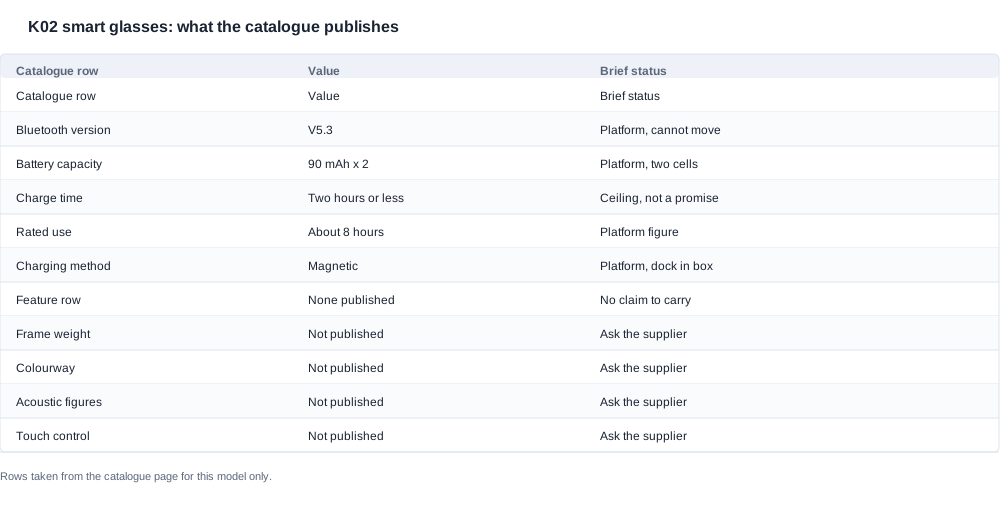
K02 smart glasses customisation is unusually constrained, because the catalogue page for this model publishes five rows and nothing else. Those five rows are Bluetooth V5.3, a battery capacity of 90 mAh × 2, a charge time of two hours or less, roughly eight hours of rated use, and magnetic charging. There is no feature row on the page, no colour row, no weight, no acoustic figure and no certification line attached to the model. A private-label programme built on this platform therefore starts from a narrow published base, and the first job in the sequence is to establish which parts of your brief the platform can carry at all.
That is a different starting position from a model with a long feature list, and it changes the order of work rather than the ambition of the project. Where a platform publishes twenty rows, a buyer can draft the listing first and verify later. Where a platform publishes five, the brief has to be written as a question set, because each unanswerable line has to be turned into a written confirmation before anyone pays for artwork, tooling or a first order.
K02 smart glasses customisation: what five published rows will carry
The catalogue page for this model, line by line
The published rows for the K02 are a Bluetooth version of V5.3, a battery capacity of 90 mAh × 2, a charge time of two hours or less, roughly eight hours of rated use and magnetic charging. That is the complete published set for the model. The product name carries an AI designation, but no row describes what that AI function does on this platform, and there is no row describing a sensing function, a translation function or a control scheme.
Two points follow from this immediately, and both of them shape the procurement conversation.
First, the absence of a feature row is not the same as the absence of a feature. It means the catalogue is silent, which means the capability is either not present, present but unstated, or present only at a level the supplier has not committed to in writing. Those three answers have very different commercial consequences, and the catalogue cannot tell them apart.
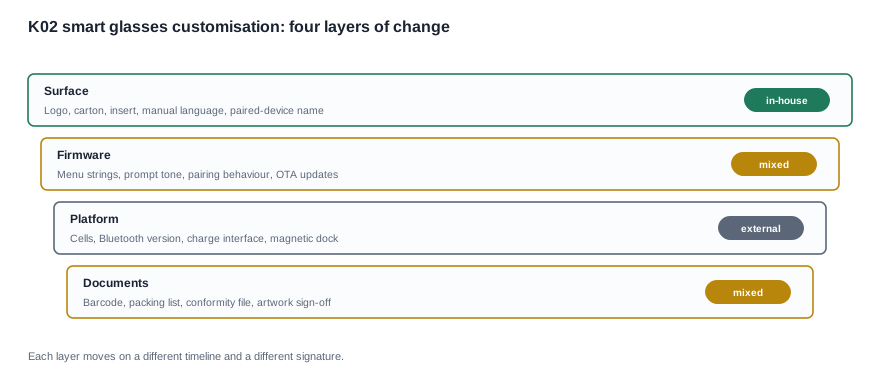
Second, a private label on this model has to be built almost entirely on the outside of the product. The published rows describe the electronics platform and the charging arrangement, both of which are fixed. Everything a brand owner actually wants to change — the name on the temple, the carton, the manual, the paired-device name in the settings menu, the language of the interface — sits on the surface layer, and the surface layer is exactly where the supplier has the most freedom and the least engineering risk.
Why a five-row base changes the brief you send
A buyer who has worked with a richly specified platform tends to send a specification document. That is the wrong instrument here, and it fails in a specific way: every line in it reads as a requirement, so a supplier who cannot meet four of them has to choose between refusing the whole brief and quietly accepting a document that is mostly wrong.
For a five-row platform the working document is a two-column sheet. The first column records your requirement as an outcome you would accept. The second column records the published basis for it — or the word Not published and the question you need answered. Where the second column holds a published basis, the requirement can be decided now. Where it holds Not published, the requirement is an open question, and it belongs in the section that stays unsigned until the supplier answers in writing.
That distinction also protects your quality control function later. When the first shipment arrives, the inspection plan is built from the same two columns. Anything you could answer from the catalogue becomes a pass-or-fail check with a published reference. Anything marked Not published becomes a check that can only be settled against a number the supplier committed to in writing beforehand. If that value was never committed, there is no basis for rejecting a unit, and the loss falls entirely on you.
The gaps that are open rather than answered
The open items on this model are worth listing plainly, because a buyer who knows the shape of the gap can plan around it, while a buyer who discovers the gap at inspection has no plan at all.
Frame weight. Not published. The catalogue publishes a weight for only one model in the whole range, and it is not this one. Any statement about how the frame sits on the head is therefore a statement you cannot support from documentation.
Acoustic figures. Not published. Driver size, frequency response, leakage and any sensitivity or impedance figure are absent. This constrains what you may write on a listing and what you may promise in a support script, because every sound-related claim in the copy has to originate somewhere other than the catalogue.
Colourway. Not published for this model. The catalogue lists colour options for two models and not for this one, so a colour request is a feasibility conversation rather than a pick from an existing run.
Touch or gesture control. The catalogue publishes no touch row for any model, so the control scheme on this platform is unknown from documentation. Whether the temple carries a touch surface, and how it is configured, has to come from the supplier.
Per-model certification. No CE, FCC or RoHS mark appears anywhere in the catalogue wording for this model; the one certification page the catalogue carries is a company-level page made of images rather than text. Because no per-model certification row exists, the scope here is a document request rather than a catalogue lookup. The certification checklist sets out the file a procurement team should expect to hold before any regulatory claim is printed on packaging.

Separating the surface from the platform on a five-row brief
Items that move on a private label
Logo and mark placement. On the temple, confirmed against a drawing rather than a photograph. The temple is also the part of the frame that carries the speaker and the electronics on a two-cell platform, so the drawing should be checked against the assembly, not only against a render.
Colour. Because no colour row is published for this model, treat colour as a new-material question rather than a pick-list question. A colour that already exists in production is a substitution; a colour that does not exist is a new material, a new sample and a new consistency question across a batch.
Packaging. Carton, insert, manual language, barcode and the paired-device name shown in a phone's settings list. The sequencing rule is the same across this range: barcode settled before artwork sign-off, and carton dimensions before the freight estimate, because carton volume is what you pay for. The packaging design article works through that sequence.
Interface strings. Menu language, prompt tone and the name that appears when the device pairs. This is firmware work with a support cost attached, and that name is what a customer reads when a unit will not connect. If it does not match your own support process, the problem lands on your desk rather than the supplier's.
Items that stay fixed whatever the artwork says
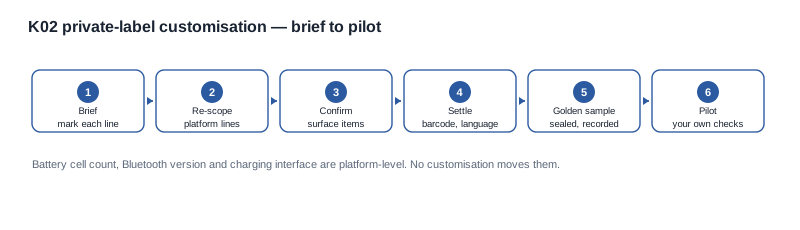
The battery cells and their count, the Bluetooth version, the charge interface and the magnetic charging arrangement are platform-level on this model. A unit branded for your channel remains a dual-cell V5.3 magnetic-charging frame regardless of what is printed on the packaging.
That sounds obvious, but it is the most common source of a failed project, because private-label buyers tend to arrive with a list of improvements that includes hardware items. The correct move is to mark every line of the brief before the first call, and to send the platform lines back as a model-selection question rather than as a change request. The customisation depth article sets out how deep each layer of change usually goes on an audio platform, and the brand guidelines article covers the artwork side.
The firmware layer deserves its own line
Surface work is visible and easy to sign off. Firmware work is neither, and it is the layer where a private-label programme most often quietly goes wrong. A paired-device name change, a menu language change or a prompt tone change may require a firmware branch, a version number, an update path and a support procedure for the units already in the channel that still run the earlier version.
Three practical consequences follow. Every firmware change needs a version identifier that you hold, because your support script and your firmware version map have to agree. Any change that affects the paired-device name is a change to the unboxing moment, which means the manual, the carton and the online listing all need to be updated together. And a firmware change made after the first shipment creates a population of mixed units in the channel, which is a field-service problem rather than a procurement problem.
Ask for the firmware version identifier, the update mechanism and the update policy in the quotation. A supplier who will not name the version identifier is telling you something about how the platform is managed.
The dual-cell line: 90 mAh × 2 and the total nobody published
Two cells, two figures, and no combined number
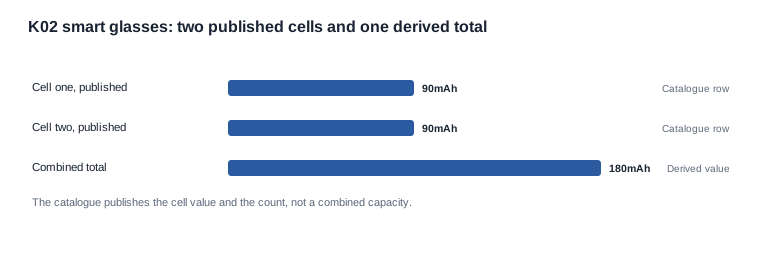
The catalogue publishes a battery capacity of 90 mAh × 2 for this model. That is a cell value and a cell count, published together. It is not a published capacity of 180 mAh, and it is not published as two separate rows either.
The distinction matters commercially in two directions. In a specification table, writing 180 mAh as though the catalogue published it would misrepresent the source, and any buyer comparing your sheet against the catalogue would find a number the catalogue does not contain. In a listing, the same substitution turns a published figure into an inferred one, which is a weaker basis for a claim and a weaker basis for an acceptance condition.
The published form also carries information that the derived total destroys. Two cells means two physical power elements, which means a charging arrangement that must bring both to state, which is the reason a magnetic docking contact arrangement is used on this platform at all. One published number of 180 mAh tells a procurement team nothing about the hardware.
Where the derived total may and may not appear
The derived total of 180 mAh is usable in analysis, provided it is explicitly marked as derived. In a body-text comparison, "two cells totalling 180 mAh" is accurate and useful. In a published specification table, in a catalogue PDF a customer downloads, or in a product listing, the cell form is the one that matches the source.
This is a small discipline that carries a disproportionate weight in a private-label file, because the derived figure is the one that travels. A buyer who uses the derived total in a pricing model is making a reasonable inference. A buyer who uses it in a customer-facing document has changed the source of the claim without noticing.
Neither the charge level it starts from nor the condition that ends the cycle is published, so the number cannot be turned into a claim about a part-charged cell or a shift-change interruption.

Pinning the model identity when two catalogue pages read alike
The K01 rows are identical on the page
Here is a procurement problem that does not appear anywhere on the page itself. The K01 and the K02 publish the same five rows: Bluetooth V5.3, 90 mAh × 2, a charge time of two hours or less, roughly eight hours of rated use and magnetic charging. Neither page publishes a feature row. Read the two catalogue entries side by side and there is no published difference between them at all.
To somebody browsing the catalogue that is merely an inconvenience. To a procurement team it is an identity problem, because every reference to "the V5.3 dual-cell model" in a brief, a purchase order, an inspection plan or a packing list is ambiguous unless the model designation itself is carried explicitly on every document.
The K01 and D11 comparison covers how the platform sits against a different family, and K02 limitations lists what this platform does not let you claim. What matters for the present exercise is narrower: make sure the designation you order against is the one that appears on the carton.
How to make the identity survive the packing list
Four document controls close this gap, and all four are cheap.
Put the model designation on the purchase order line and repeat it on the packing list. Neither the product name, which a supplier may shorten, nor the marketing description will do. The designation, exactly as the catalogue page writes it.
Bind the barcode to a designation in writing. A barcode identifies your product, and the designation identifies the platform. Both have to appear on the same line, otherwise a receiving team has no way to detect a substitution at the point the substitution is cheapest to detect.
Ask which unit the sample is. A sample sent for artwork approval is often the easiest thing in the process to identify incorrectly, because the sample is unbranded at that stage and carries no label. Get the designation confirmed in writing against the sample serial, and record the serial on the artwork approval sheet.
Tie the golden sample to the artwork. Once the artwork is approved, seal one unit, record its serial, and attach that serial to the artwork approval sheet. Every later dispute — a wrong logo, a wrong manual language, a wrong paired-device name — then has a physical reference that was agreed before the bulk order.
The audit trail that keeps them apart
Because the two pages read alike, the documentation you keep becomes the mechanism that distinguishes them. A procurement file for this model should hold the catalogue page as it stood at the time of the order, the written confirmation of every item you marked Not published, the approved artwork, the golden sample record and the inspection criteria built from those two columns.
This is a modest amount of discipline, and it is the same discipline that applies to any model in the range. Its value on this platform is higher simply because the published rows will not do the work of telling two models apart. Export documentation covers the file structure that the same requirement produces, and the models-ready article sets out how platform readiness is usually judged before a programme starts.
The order of work, and what the purchase order should hold
The sequence that avoids spending artwork money early
The working order is the same on every model, and it is worth keeping in this order because each step protects the next one.
- Mark every line of the brief as surface or platform.
- Send the platform lines back as a model-selection question.
- Obtain written confirmation of which surface items are available at your quantity, with the designation attached.
- Settle the barcode and the insert language.
- Approve artwork against a drawing, not a photograph.
- Build a golden sample, seal it and record the serial.
- Run a pilot and inspect against your own written criteria rather than the supplier's.
The sample evaluation guide expands on the two closing steps, and lead time and order planning covers the schedule question that follows a confirmed brief. The one point to underline is step three. Until the unverified lines have answers, every downstream cost — artwork, tooling, packaging, freight, listing copy — is being committed against a platform that may not be the one you assumed.
What belongs in the purchase order
Five terms are worth putting into the document rather than the email thread, and they are negotiable in the sense that they are open for discussion before signature, which is different from being left until after the first shipment.
Per-model designation on the order. Write the model and its five published rows onto the order. A line that says "dual-cell V5.3 magnetic charging frame" is a contract with an ambiguity in it; a line that names the designation is not.
The confirmed surface items, itemised. Each one with the method and the position. A single sentence listing "logo, packaging, manual" gives a supplier room to deliver a moulded mark on one model and a printed sticker on another.
The acceptance condition. A runtime figure with its measurement condition attached, and a charge behaviour against the published ceiling. Without conditions, the published numbers are marketing copy; with them, they are criteria you can withhold a lot against. The charging arrangement article shows the same discipline applied to the box contents, which is where a cable-charged platform and a dock-charged platform diverge.
The certification document set. Named documents, at named versions, with a delivery date. Given that the catalogue carries no per-model certification row, the file has to be created by agreement rather than read from a datasheet.
Payment nodes tied to the first shipment rather than the last. On a platform where the branding is the product, the first shipment is the one that proves the branding.

How to shortlist this platform, and which questions to ask before you commit
Five published rows will not separate one platform from another on their own. The separating variable is the blank part of each supplier's file and the speed at which that blank gets filled. So the shortlist is built on how much of the brief each supplier is willing to answer in writing, not on which page lists more numbers, and it is worked through a pre-order checklist rather than a feature grid. Once that list exists, the next job is how to compare two platforms that both leave the same rows empty.
Red flags in the answers you receive. A document set offered without a version number or a date is the first one. A charge time presented as a measured reading rather than the published ceiling it is, is the second. A certification claim naming a mark the catalogue never prints is the third. Each of the three is survivable on its own. Together they describe a file written to close a sale rather than to describe a product.
What to ask, in the order the answers are worth having.
- Which of the five rows are contractual for this order, and which are reference values only.
- Which columns of the brief you will answer in writing, and who signs them.
- Whether the cell configuration is a shipping fact or a manufacturing fact, because that wording decides how the warranty is written.
- Whether the charging arrangement ships with the unit or is ordered separately, and who carries the accessory cost.
- Which claims your customer-facing packaging will make in your market, and on what documentary basis.
Before you order. The due diligence step is small and procedural: convert every empty cell in the two-column sheet into a dated written answer, and attach that answer to the purchase order line rather than to an email thread. It is also the point at which a negotiation about packaging or documentation has evidence behind it. When the answers are attached, the platform's total cost stops being a catalogue question and becomes a number you can sign — the unit, the accessories it needs, the documentation effort, and the inspection time the silent rows would otherwise create at the first shipment. That last item is the one buyers forget, because it arrives after the goods.
When to walk away. If the supplier will not carry the model designation on the purchase order and on the packing list, the ambiguity moves out of the catalogue and into your warehouse, where it is more expensive to correct. The common pitfalls are predictable: a brief that mixes surface lines with platform lines, and a sheet that treats a published ceiling as a measurement. At the point where the designation is refused, the comparison has already been made and it does not favour proceeding.
K02 smart glasses: where our position sits on unpublished items
The claims we will not help you write
We will not publish a frame weight for this model, because we do not hold one. We will not estimate an acoustic specification, and we will not tell you what the sound of this frame is like, because the catalogue does not publish driver size, response or leakage. We will not attribute a colour to it, a touch surface to it, a translation capability to it, or a certification mark to it, because none of those appear in the published rows for this platform.
We will also hold the line that applies across this category: no claim about vision, myopia or eye health, and no health or medical benefit of any kind. A catalog that is silent about a capability is not a catalog that supports a claim about it, and a private label is where that silence is most likely to be filled in by someone with a marketing deadline rather than a datasheet.
What to send to get a first answer
Send the target market, the channel, the quantity, and the brief with its two columns marked. We will tell you which lines are already settled by the published rows, which are open questions for the production side, and which ones would require a different model entirely. Where a line needs written confirmation before it can be answered, we will say that rather than implying it is settled.
On a page this short, artwork is not the first conversation. The first conversation is which of your requirements can be answered from five published rows and which ones have to go on a written request.
Related reading
- The published limitations of this platform — K02 limitations
- How this model compares with a neighbouring platform — K02 against LC-105-1 and D12 against K02
- Getting a sample assessed before the first bulk order — sample evaluation
- Packaging artwork for a private-label launch — packaging design
- Bluetooth audio glasses range overview — bluetooth audio glasses
Send the country you are shipping into, the volume you need and the variant you have in mind, and we will tell you which parts of the range can be configured and which cannot.


