

A K02 smart glasses vs LC-105-1 use case fit rests on two published rows, and neither of them is the row most selection tables open with. Both catalogue pages give a stated endurance of about eight hours, a charge time of two hours or less, magnetic charging, and no feature line of any kind. On cell configuration the K02 publishes 90mAh2 while the LC-105-1 publishes 55mAh2; on the radio version the K02 publishes Bluetooth V5.3 while the LC-105-1 publishes V5.4. Every other row on the two pages is identical, so the practical question for a buyer is what the programme is actually being bought for, and the shared rows cannot answer it.
That leaves an unusual selection problem. The specification a buyer would quote to a customer — the runtime — is identical on both pages and therefore carries no information, while the two rows that do separate them are one a customer cannot evaluate and one a customer cannot see. Neither row becomes a benefit without evidence the catalogue does not publish, which is why the criteria that decide this comparison are evidence criteria rather than specification criteria.
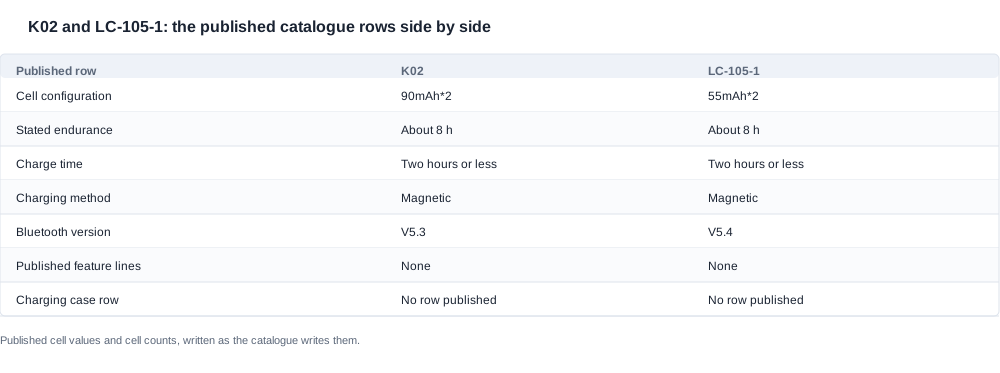
The two audio models and where they differ
Two rows separate the pages, four rows do not
Read as published, the K02 page and the LC-105-1 page carry the same five standard rows — cell configuration, stated endurance, charge time, charging method and radio version — plus the absence of a feature line. Four of those five agree exactly. The stated endurance on both is about eight hours, the charge ceiling on both is two hours or less, the charging method on both is magnetic, and neither page carries a feature line that a product listing could be written around.
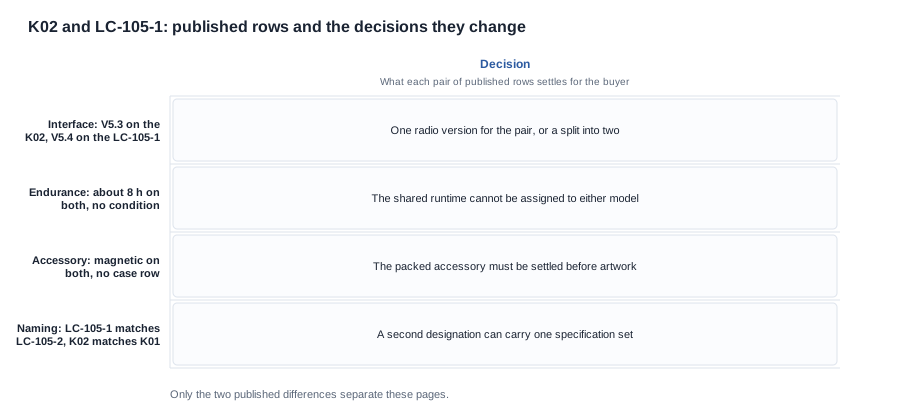
Two rows disagree. The first is the cell configuration, where the K02 gives 90mAh2 and the LC-105-1 gives 55mAh2. The second is the radio version, where the K02 gives V5.3 and the LC-105-1 gives V5.4. A buyer reading the two pages in full will find no third difference, and any comparison that introduces a third one is importing something the documentation does not contain.
The model designations themselves carry a further point. The LC-105-1 and the LC-105-2 rows are identical line for line, and the K02 and the K01 rows are identical line for line. Two designations on a range can therefore sit on a single specification set, which is a merchandising fact a channel should price into its SKU count rather than a specification argument it can win.
The range the two pages sit in
Both models belong to the eight audio models in the catalogue, alongside the D11 and the D12, the LC-105-2 and the K01, and the G07 and the YK12. Five of those eight publish no feature line at all — the K02 and the K01, the D12 and the LC-105-1, and the LC-105-2 — so a featureless pair is the normal condition on this part of the range rather than an unusual one.
Magnetic charging is the default across the audio group. Only the D11 and the D12 publish a Type-C charging method, which means a buyer handling both Type-C and magnetic accessory chains is sourcing two different charging approaches from one range. The whole audio group publishes no charging-case row, and the whole group publishes no ingress-protection row either; the IP54 marking in this catalogue appears on the V06 and the S7 only.
Frame weight, frame dimensions, sensor specification, storage, unit price, minimum order quantity, lead time, warranty and certificate numbers are all unpublished for both models and, for most of them, for the whole catalogue. The single published weight anywhere in the catalogue is 158 g, and it belongs to the MT6 eyewear body, a camera model that cannot be carried across to an audio frame. What remains for a buyer is a choice between two published rows and a long list of items to request.
| Question the buyer has to settle | What the two pages publish | What the buyer has to do |
|---|---|---|
| How long the frame runs on one charge | About 8 h on both, with no test condition published | Request the condition for both models in identical words |
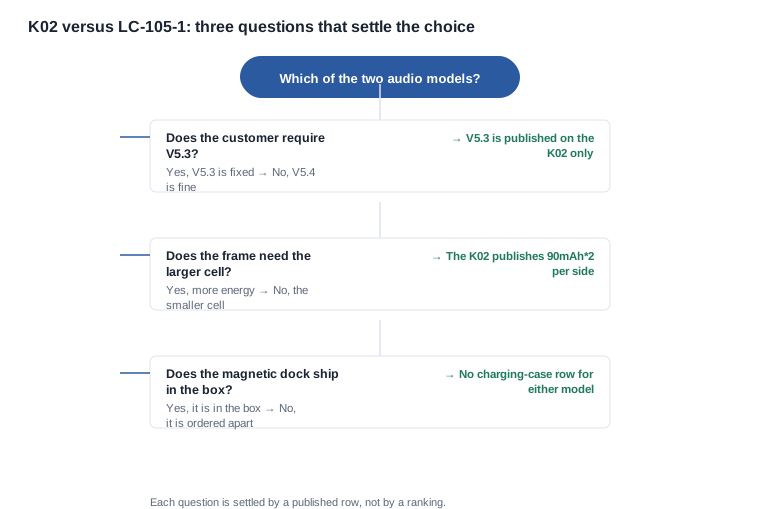
| How much energy the frame carries | 90mAh2 on the K02, 55mAh2 on the LC-105-1 | Decide whether the application needs the larger cell before anything else |
| Which radio version the channel quotes | V5.3 on the K02, V5.4 on the LC-105-1 | Confirm the customer platform and any supported-hardware policy in writing |
| What the listing may claim about the product | No feature line on either page | Treat both models as featureless until the supplier supplies evidence |
| What ships in the carton | Magnetic on both, no charging-case row across the audio range | Ask for the packed accessory list, its capacity and its own charge time |
| Which files the compliance route needs | No per-model certification row anywhere in the catalogue | Order the documentation per model and per destination market |
The cell configuration behind an identical runtime claim
What the two cell rows actually say
Written the way the catalogue writes them, the rows are 90mAh2 and 55mAh2. These are published cell values with a published cell count, and a buyer who quotes them in that form is quoting a number that can be traced back to the catalogue.
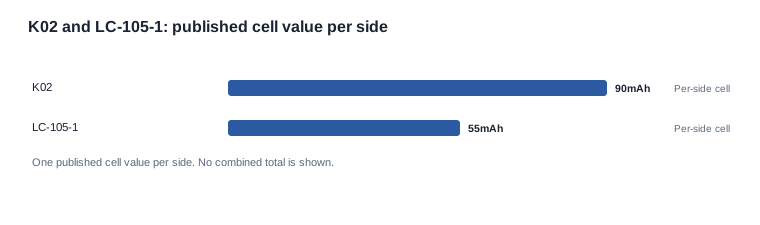
The ratio between them is the only usable output of the cell row. Measured one side against the other, the LC-105-1's published cell value is roughly three-fifths of the K02's. That is enough to say the K02 carries a larger cell on each side; it is not enough to say the K02 runs longer, and a specification block that states the larger cell as a longer runtime has made an inference the catalogue never made.
The same figure sits on four different cell configurations
Here is what makes the identical runtime row worth investigating rather than repeating. Six models in the catalogue publish a stated endurance of about eight hours: the K01 and the LC-105-1, and the K02 and the LC-105-2 among the audio models, and the YKC02 and the ZH12 among the three sport models. Between them those six cover four cell configurations — 90mAh2, 55mAh2, 70mAh*2 and a single 100 mAh cell — and not one of the six publishes the condition the figure was taken under.
Two consequences follow for a procurement file. First, a stated endurance of about eight hours is not a comparable measurement anywhere in this catalogue, because the same number appears on architectures that differ in cell value and cell count. Second, the K02 and the LC-105-1 share a number produced on two different cell configurations, so the shared figure cannot be used to allocate a runtime advantage to either model.
That is also why the request for the test condition is worth more than the cell comparison itself. If the supplier confirms one protocol in the same words for both models, the cell row becomes a real differentiator. If the supplier confirms two protocols, the eight-hour figure drops out of the comparison altogether and the cell row becomes the only remaining hardware statement. Either answer changes what a buyer can write; the identical figure changes nothing. The method for comparing runtime claims sets out how to ask for that protocol, and the K02 against the K01 comparison covers the pair that shares every row with the K02.
What the cell difference is allowed to settle
The cell row supports one narrow claim: how much energy the frame carries, per the published values. It does not support a claim about weight, because no frame weight is published for either model and the larger cell cannot be converted into grams from the catalogue. It does not support a claim about charge time either, since the ceiling of two hours or less is published identically on both pages and describes a ceiling rather than a measured duration.
For a buyer building a quotation, that limit is workable. A product file can state the cell configuration, the stated endurance and the charge ceiling as published rows, and it can state that the runtime condition is to be confirmed. What it cannot do is turn the cell row into a runtime advantage, because that claim would need the condition the catalogue withholds. The K02 battery reference and the LC-105-1 battery reference both sit inside that limit, and the range charging options note covers what magnetic charging does and does not settle about the packed accessory.
Bluetooth version and what it changes for a channel
Two radio versions on otherwise matching pages
The V5.3 and the V5.4 rows are the second and last point of difference, and they sit on pages that agree everywhere else. On the audio group as a whole, the K02 and the K01 publish V5.3 and the remaining six audio models publish V5.4.
A version number is a specification rather than an advantage, and the version difference cannot be promoted into a benefit by the buyer alone. A customer cannot compare V5.3 with V5.4 on a shelf, in a demonstration or in a purchase conversation. What the version can legitimately do is sit in a specification block, answer a platform question, and determine which conformity route a shipment has to take. That is a narrower job than a marketing line, and a channel that tries to give it more usually ends up with copy that cannot be defended.
Where the radio version actually lands in a purchase
Three things follow for procurement work, and they are worth separating because they arrive at different stages of the programme.
The first is the platform question. Institutional and corporate buyers often keep supported-hardware lists, and a radio version can be excluded by a policy nobody checked before the quotation was issued. This is the fastest route to an order that stalls, and it is the one item that can eliminate a model outright before any sample work begins.
The second is the conformity route. For radio equipment placed on the European Union market the applicable framework is the Radio Equipment Directive (EU) 2014/53/EU, with electromagnetic compatibility governed separately under 2014/32/EU. Those obligations sit with the party placing the product on the market rather than with the catalogue, and our documentation does not discharge them.
The third is what the catalogue itself records about certification. A company-level export certification page sits in the catalogue, and everything on that page is an image rather than extractable text. Nowhere in the catalogue text does the term CE, FCC or RoHS appear, and no certification row tied to an individual model exists for either the K02 or the LC-105-1. Every document that names a model is therefore a request with a lead time attached, and a request placed late becomes a shipment held at a border. The certification status note for the K02 and the certification status note for the LC-105-1 record what is open on each file.
The questions that have to be answered before the version is quoted
- Which platform does the customer actually run? If it is a known platform on V5.4, then a V5.3 model is a deliberate choice to run an older radio generation, and that choice needs a reason the customer's buyer can be given. If the platform mix is mixed, the product has to be shown to work across the versions in that mix.
- What changed between the generations for this product? Our catalogue does not record it and we will not guess at it. A version difference becomes a usable claim only when something the customer needs actually changed, and the supplier is the only party who can answer that.
- Does the customer's own policy exclude a version? A supported-hardware list is the one document that can rule a model out without any sample work, so it belongs in the first round of enquiries rather than in the last.
- Can the two models be quoted on one radio statement? If the range has to present a single platform to a channel partner, the pair cannot both appear in that statement while they publish different versions, and the buyer has to decide whether to narrow the range or to describe the split.
Three buyer situations and the model each one suits
The three situations below are separated by what the programme needs, not by how the two pages read on paper. Each one names the published row that decides it and the evidence that closes it, because a selection that cannot be traced back to a published row is a selection the buyer has to defend later without support. Where the two models can both serve a situation, that is stated rather than resolved, because the resolution belongs to the buyer's channel.
Situation one: a range that has to quote one radio version
A channel selling a range as a single platform cannot present the K02 and the LC-105-1 under one radio statement, because one publishes V5.3 and the other publishes V5.4. In this situation the radio row is the deciding row, and the LC-105-1 sits on the same radio generation as the rest of the audio models, which removes one compatibility question from every listing in the range.
What the situation does not settle is the platform itself. If the customer's devices are all on a V5.4 platform, the V5.3 model is the one carrying the compatibility question, and the reason for keeping it has to be a channel or programme decision rather than a technical one.
Situation two: a channel that needs a documented energy row
A programme whose product file has to point at a row that says more than "about eight hours" lands on the cell configuration, and the K02 is the model publishing the larger value on each side at 90mAh*2. The distinction that has to be preserved is between carrying more energy and running longer: only the first is published.
A buyer in this situation still has no runtime claim, because the condition behind the eight-hour figure is unpublished on both pages and, on the evidence of the range, on all six models that publish that figure.
Situation three: a buyer who needs a demonstrable feature claim
Neither model publishes a feature line, an acoustic figure, a control method or a structural feature, so a programme whose proposition depends on something a customer can hear or see cannot be written from the catalogue. In this situation the published rows are silent in both directions, and the only route is evidence obtained from the supplier before the artwork is commissioned.
This is the situation in which a buyer is most often tempted to pick a model on the specification rows that exist, because any row at all reads as support. It is also the situation in which a specification-led selection is most likely to fail in the channel, because the customer is waiting for a claim the file cannot supply.
The order of work, and why it matters
- Write the programme's proposition in one sentence before comparing anything. A sentence such as "open-ear audio for a fixed-site shift team on one charge" points at the cell configuration and the runtime condition. A sentence such as "a current-generation device for institutional buyers with a supported-hardware policy" points at the radio version.
- Hold the two pages against the proposition and discard every row that cannot support it. Runtime, charge ceiling, charging method and feature-line status are identical on the two pages, so none of them can carry the differentiator. What survives is the cell configuration and the radio version, and a shortlist built on anything else would be a shortlist of decoration.
- Establish the radio-version position in writing. The customer platform and any policy that applies to it are the cheapest items on the list and the only ones that can remove a model outright, so they belong in the first enquiry rather than in the due diligence file.
- Ask for the endurance test condition for both models in identical words. Not to separate them, but to convert a published figure into a usable one or to discover that it cannot be converted.
- Obtain the certification position per model and per destination market. This is the longest lead item and the one that stops shipments rather than orders, and it is where the total cost of a late request is paid.
- Measure the samples. Frame weight, temple length, lens width and bridge width are unpublished on both models, and a sample measurement closes them in an afternoon. The weight comparison across the audio range explains why the single published weight in the catalogue cannot be borrowed for this purpose.
Running the steps in that order is what keeps the selection defensible. A buyer who picks a model first and writes the proposition afterwards will find the proposition bending to match whatever the model happened to publish, and the resulting comparison table will contain a difference that nobody can source. The two most common pitfalls in a selection like this are exactly that inversion and the promotion of a radio version into a benefit.
The K02 versus LC-105-1 use-case fit
What survives once the shared rows are removed
Strip the four identical rows out of the two pages and a very small file remains. The K02 offers a larger published cell value on each side and an older radio generation. The LC-105-1 offers a smaller published cell value on each side and a radio generation shared with the rest of the audio models. Neither offers a feature claim, a frame weight, a dimension, a storage figure, a price, a minimum order quantity, a lead time, a warranty term or a certificate number.
That residual is the whole of the scenario mapping, and the way to read it is as a set of trade-offs rather than as a verdict. A programme that needs the larger cell row and can accommodate the older radio generation lands on the K02; a programme that needs the radio generation shared across the range and does not need the larger cell row lands on the LC-105-1; a programme that needs a demonstrable feature claim lands on neither until evidence arrives. The two published specification lists for the K02 and the LC-105-1 are the honest baselines for that mapping, and the K01 against the LC-105-1 selection piece covers the neighbouring pair built on the same two rows.
What to hold in writing before either model is fixed
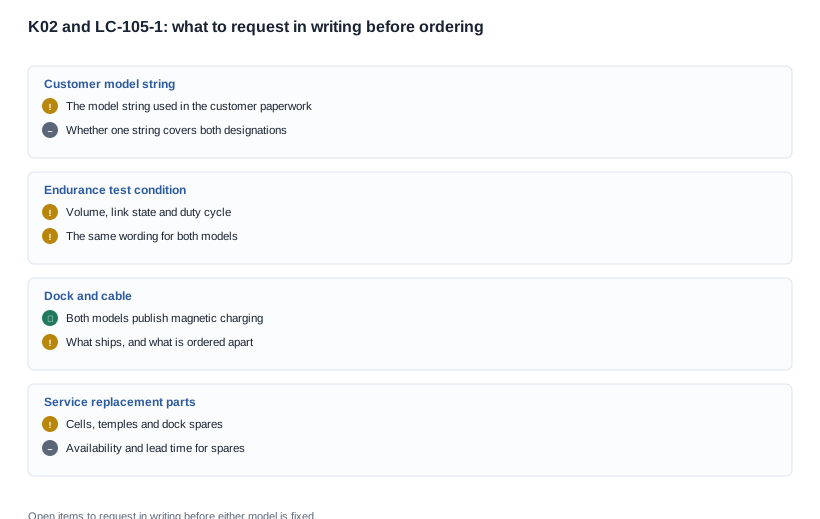
The model string the customer files under. Two designations on this part of the range can carry one identical specification set, so the string that appears in the customer's paperwork should be settled before artwork, packaging and the certification request are all raised. The K02 pre-order check and the LC-105-1 pre-order check set out the wider list.
The endurance test condition for both models, in identical words. Ask whether the Bluetooth link was active during the measurement, what volume was set, whether the sample was the production configuration and whether the same protocol produced both eight-hour figures.
The packed accessory for each. The catalogue publishes magnetic charging as the method on both models and does not say whether the object the charger belongs to is a pad, a dock or a case, nor does it give that object's capacity, its own charge time or its weight. Nothing in the audio range states what ships in the carton, so the request has to name the accessory, its capacity, its interface and its own charging time.
The service replacement position. Whether the cells, the temples and the charging counterpart are supplied as spare parts, whether they are field-replaceable and what lead time applies are all unpublished, and they determine both the warranty cost line and the defect rate the channel will carry.
The certification position per model per market. Two models and two sets of files if the documents name the model, with a lead time on each. This is the request that goes out first, because it is the one that can hold a shipment at the border rather than merely delay an order.
The boundary of what we can state
The position is narrow and deliberate. The K02 and the LC-105-1 are separated by two published rows and nothing else, and a comparison that reaches outside those two rows is comparing something our documentation does not contain. Where the catalogue is silent — on frame weight, dimensions, acoustics, control method, the accessory in the carton, the certification position, the price and the commercial terms — we will say that it is not published and set out the request that closes it, rather than supply a plausible figure that becomes a commitment later.
We also will not rank the two, because on the published rows there is nothing to rank, and we will not tell you which model to place a programme against when the evidence needed to make that call is not in our documentation. The audio range selection guide covers how the wider set of models is assessed, and the range itself is reached through the Bluetooth audio glasses category page.
Related reading
- Everything the catalogue lists for the first model — the K02 specification list
- Everything the catalogue lists for the second — the LC-105-1 specification list
- The neighbouring pair built on the same two rows — the K01 versus LC-105-1 selection piece
- How a runtime claim is tested and compared — the battery comparison method
- What magnetic charging leaves open — charging options across the audio range
Send us the customer platform, the endurance condition the programme needs and the two model strings, and we will tell you which published row settles the K02 smart glasses vs LC-105-1 use case fit.


