

If you are building a camera glasses range and the top tier has to win on image quality rather than on price, the L1 Pro is the flagship that fits: 13 megapixels on the 290 mAh platform, with the same 1400 mAh charging case the 8-megapixel models carry. It is the wrong pick for a customer buying on cost, and for any brief where the difference between 8 and 13 megapixels never appears in the delivered file. Working out l1 pro smart glasses best for is therefore a shortlist question, not a specification question, and this article is organised around the four branches that actually decide it.
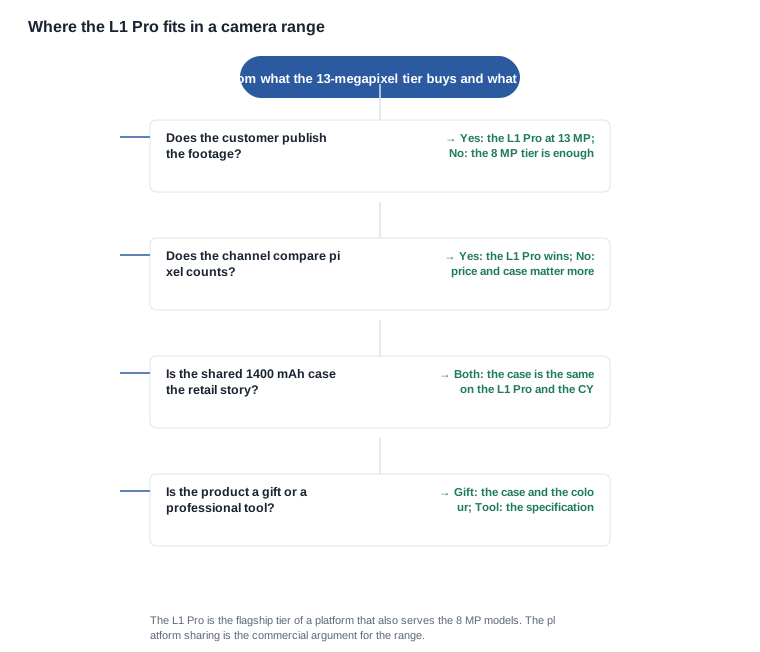
L1 Pro smart glasses best for: the four branches that decide it
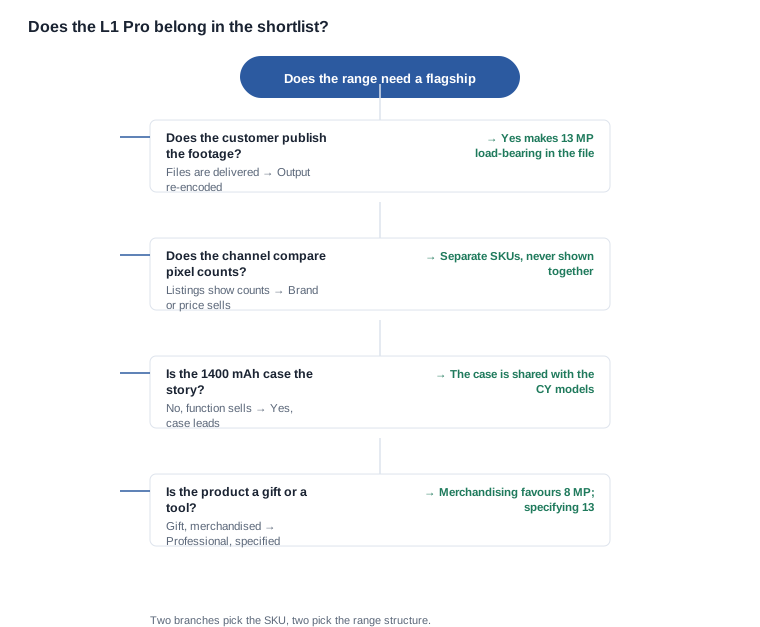
The four questions below are the ones that change the answer. Each is phrased so that a yes or a no produces a different shortlist, and each is followed by the reason it matters commercially rather than technically.
Does the customer publish the footage? If yes, the L1 Pro is the only defensible choice in this range at 13 megapixels, because a published still or a delivered clip is where resolution is visible to the buyer. If the output is a product walkthrough, a training clip or a livestream that gets re-encoded downstream, 8 MP is adequate and the L1 Pro is money spent on a number nobody sees in the final file.
Does the channel compare pixel counts in a listing? If yes, the L1 Pro wins that comparison outright, and it should not be shown beside the 8 MP models in a comparison table, because the adjacent number makes the tier read as an arbitrary step. If your customer buys on price, on the case or on the brand, the resolution tier is an internal range decision rather than a sales argument.
Is the shared 1400 mAh case the retail story? Note carefully that this branch does not separate the L1 Pro from the CY models. The same 1400 mAh case appears on the CY03, the L1 Pro and the CY05, and so do the same 290 mAh cell and the same roughly seven-hour endurance figure. A buyer leading a product page on endurance or on the case is not choosing between these models at all, and a range built around the case is a range built around the platform.
Is the product a gift or a professional tool? A gift buyer wants a case, a colour and an object that presents well on a shelf. A professional buyer wants a specification and a service story. The first is a merchandising decision that favours the 8 MP tier and the price gap between tiers; the second is a product decision that favours the 13 MP tier.
Two branches decide the range structure and two decide the SKU, and it is worth keeping them apart. The footage and the listing branches answer "is the resolution visible", which is the question the L1 Pro exists to answer. The case and the gift branches answer "what does the range sell as a whole", which is where the platform economics sit.
The published rows and the platform underneath them
The L1 Pro publishes 13 megapixels, a 290 mAh cell, a charge time of two hours or less, roughly seven hours of endurance, magnetic charging and a 1400 mAh charging case. Every one of those rows except the camera is shared with the L2 Utral and the CY03, and the CY05 adds a Type-C interface and a 900 mAh case option on the same platform.
That shared foundation is the commercial argument for the L1 Pro, and it is a stronger argument than the megapixel figure. It is the flagship tier of a platform that serves four models, so a brand can offer an entry, a mid and a premium SKU without running three separate engineering programmes, three accessory plans or three compliance tracks. The model readiness overview sets out how that platform structure works, and the OEM ready pricing tiers covers the commercial side of building a tier ladder on it.
The endurance figure deserves one caution before it is used in any range planning. Roughly seven hours is a rounded figure rather than a bracketed one, which means it was measured in a single condition that is not printed. Compare it against the models in this range that publish a band — the KY06 at six to eight hours and the V03 family at five to eight hours — and the difference in shape is itself informative: a single rounded figure hides the condition, and a band admits that more than one was measured. Plan on the figure as published and write the test condition into the request. The L1 Pro endurance note covers the behaviour behind the number, and the method for comparing endurance across the range covers the comparison rules.
The cell sits on the highest tier published in the camera section. Across the eleven camera models the cell figures fall into four groups: four models publish 290 mAh, three publish 260 mAh, three publish 220 mAh and one publishes 265 mAh. The L1 Pro is therefore on the top energy tier of the range, which is consistent with a flagship positioning and useful when you are arguing that the premium is not cosmetic.
The gap that the resolution tier does not close
Nothing about the camera is published beyond the resolution class. The sensor model, the field of view, the video format, the frame rate, the low-light behaviour and the storage arrangement are all absent, for this model and for the rest of the section.
This matters more for the L1 Pro than for the 8 MP models, because the entire argument for paying more is image quality. A 13-megapixel sensor with small pixels produces a worse image than an 8-megapixel sensor with large ones, so until you have the sensor model, the 13 MP figure is a shelf-planning fact and not a quality guarantee. That distinction is the difference between a specification you can defend and one you cannot, and it is the single most important request in the whole range.
The field of view is the second number to close, and it decides whether the product works for first-person video at all. A wide field of view and a narrow field of view produce two entirely different products under the same name, and a customer who bought for first-person capture will discover the difference in the delivered file. The frame rate and the video format are the third and fourth, because they determine whether the file can be edited at all: an unfamiliar container or a low frame rate turns a flagship into footage that a customer cannot use without transcoding, which removes the resolution advantage again.
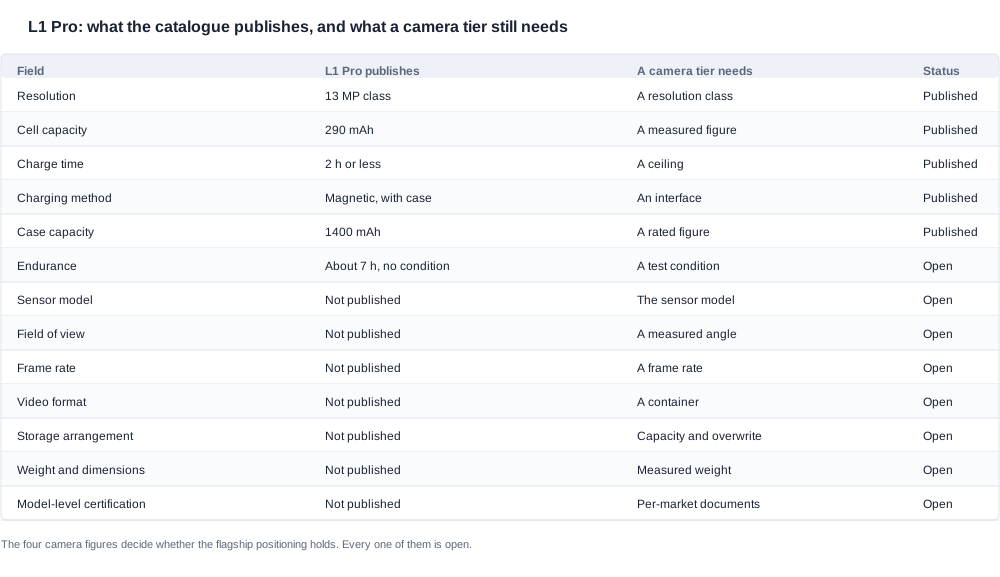
The published L1 Pro specification list is the honest baseline for what is on the row, and the camera imaging notes cover why the sensor and the field of view are the two numbers that decide whether a camera glasses product works for its purpose.
The honest way to present the model in the meantime is to state the resolution class and nothing more. You may write that the model records at the thirteen megapixel class, and you may state that a sensor model and field of view are available on request. You may not write that the image is sharper, clearer or higher quality than the 8 MP models, because none of those words is supported by a published figure. If a listing needs a quality argument, the argument has to wait for the sensor model.
Why megapixels alone do not settle image quality
The gap between a resolution figure and a quality claim is the most common error in camera glasses listings, and it is worth stating precisely why it is an error rather than a caution.
A resolution figure counts the pixels the sensor produces. It says nothing about how large each pixel is, and pixel size is what governs how much light each one gathers. Two sensors can carry the same resolution class and behave completely differently when the individual pixels are small, because small pixels collect less light per pixel and produce noisier, flatter results in exactly the conditions where a customer judges quality — indoors, in the evening, at a distance. So a higher resolution figure can coexist with a worse image, and the published catalogue row gives you no way to know which case you are buying.
There is a second effect that runs the other way, and it matters for first-person video specifically. A wide field of view spreads the same pixel count across more of the scene, so each object occupies fewer pixels and loses detail even though the file resolution is unchanged. That is why a 13 MP model with a narrow field of view can produce less usable detail than an 8 MP model with a wide one. If your customer's use case is first-person capture, the field of view decides the product, and the megapixel figure is a supporting number rather than the main one.
The practical test is therefore simple and it is a test rather than an opinion: photograph the same scene with the flagship and with the model below it, in the conditions your customer shoots in, and compare the delivered files rather than the specification sheets. That comparison is what the camera imaging notes are for, and it is the reason the sample order is not optional for this model.

Selling the flagship without over-claiming it
A flagship tier carries a specific commercial risk: the premium is visible to the channel but the justification is not. The price gap between tiers is on every quotation, and the customer who pays it will ask what they received. If the only answer available is the resolution number, the answer is weak, because a competitor's range may publish a higher one.
Four constructions keep the flagship defensible without over-claiming, and all four depend on evidence you can obtain rather than on adjectives.
Anchor the premium on the platform, not on the sensor. The strongest published argument for this model is that it shares its cell, its charging interface and its case with the CY03 and the CY05, so a range built around it runs on one engineering programme rather than three. Platform economics are a real reason to pay for a flagship, and unlike image quality they can be documented from the published rows alone. This is the argument to lead with while the camera figures are still open.
Sell the deliverable rather than the file format. Where the footage is published — a website, a listing, a social feed, a customer report — the resolution tier is visible in the result even when no sensor figure is available. Where the footage is re-encoded downstream, it is not, and in that case the premium has to be justified on the platform or on the service terms instead.
Separate the SKUs in the merchandising. Showing a 13 MP flagship beside an 8 MP model in the same comparison block makes the step between them read as arbitrary, because the customer can see that everything except the camera is identical. Giving each tier its own page, its own price band and its own use case removes that comparison from the shelf and keeps the premium intact.
Attach service terms the entry tier cannot match. A flagship can carry a longer warranty, a faster replacement promise or a spare-unit programme. None of those numbers is published by the factory, so they are commercial terms you negotiate rather than product facts you inherit — but they are the part of the flagship offer that is entirely within your control, and they are what a professional buyer is actually purchasing.
The failure case to avoid is the one where the premium is justified by adjectives in the copy rather than by evidence in the file. Once a listing says sharper, clearer or higher quality, a customer who compares the delivered file against the entry tier has grounds for a return, and the claim was the seller's rather than the factory's. The remedy is procedural: fix the claim set in writing, check it against the published row, and remove any word that no figure supports.

Where the L1 Pro sits against the CY models and the L2 Utral
Because every non-camera row is shared, the choice inside this platform is a choice about positioning rather than about hardware. That makes the comparison straightforward to run and easy to get wrong.
Against the CY05 and the CY03, and the L1 Pro's only published differentiator is the camera class. If your range needs three visually and commercially distinct tiers, the differentiation has to come from somewhere other than the catalogue row, because on the published evidence the three models are identical except for resolution. That is a real constraint, and the ways to work within it are to differentiate on the private label, on the packaging and the accessory set, or on the service and warranty terms you attach to the flagship. Where the platform fits a private programme is covered in the KY06 range comparison.
Against the L2 Utral, the differentiator is the interface rather than the camera: the L2 Utral publishes a Type-C interface and two case options at 900 mAh and 1400 mAh, while the L1 Pro publishes magnetic charging with a single 1400 mAh case. So a flagship-to-flagship choice is partly a charging-format choice, and the parcel weight and the accessory plan follow from it. The L1 Pro versus L2 Utral battery comparison covers that choice in detail, and the charging case options analysis covers the accessory economics across the range.
Across the whole range, the resolution tiers are 8 MP and 13 MP. That is a two-step ladder, not a continuous one, and it has a commercial consequence worth stating plainly: a customer comparing your flagship against a competitor's range may be comparing your 13 MP against their 16 MP or their 24 MP, and the catalogue gives you no way to bridge that gap. The range selection method for answering that comparison is covered in the AI camera glasses model selection guide.
Turning the range decision into an orderable configuration
The published row is the input to a configuration rather than the configuration itself, and for a flagship the sequence below is what turns a shortlist decision into a purchase order you can defend.
Freeze the published row as the fingerprint. Copy the entries exactly as printed — 13 megapixels, 290 mAh, two hours or less, roughly seven hours, magnetic charging, 1400 mAh case — and mark every absent field as not published. That baseline is what makes two quotations for the flagship comparable, and it is the column every later document is checked against.
Turn each absence into a named question with acceptance criteria. The camera gaps first, because they decide whether the flagship positioning holds at all: the sensor model, the field of view, the frame rate, the video format and the storage arrangement. Then the physical gaps, then the commercial gaps. A named question returns something evaluable; a general request for specifications returns a general reply.
Ask the supplier to quote against the configuration you intend to ship. A quotation written against a model name carries no scope; a quotation written against a configuration carries one. Ask for the unit price against the configuration you will ship, with the accessory set, the packaging and the private label work itemised, and with the exclusions listed explicitly. A quotation that lists its exclusions is easier to evaluate than a lower quotation with a silent list.
Run a sample order against a written scenario. For a flagship, the scenario is a still capture and a clip in the conditions your customer actually shoots in, including a low-light case, with the output inspected for artefacts and the settings recorded. State the scenario before the sample is made, keep the record in the technical file, and treat a sample that misses the stated criterion as a finding about the product rather than as a defective sample.
Put the commercial set in writing. Minimum order quantity, production lead time, the unit price and the tier it belongs to, bulk order pricing, tooling and non-recurring engineering, sample order terms, warranty period and its remedy, quality control and defect terms, production capacity, shipment terms, incoterms, payment terms, deposit structure, and the contract that governs all of it. None of this is published, so a number that arrives without a source is an invention rather than an estimate. If a factory audit is part of your supplier qualification process, run it before the artwork is locked rather than after the first shipment.
Close the compliance position per destination market. Ask for the technical file, the test report and the declaration that applies to each model in each market you intend to ship to, and record the result in the due diligence file. This matters more for a flagship than for an entry SKU, because a flagship usually carries the brand's highest-volume claim and therefore attracts the most scrutiny from a channel partner's own compliance team.
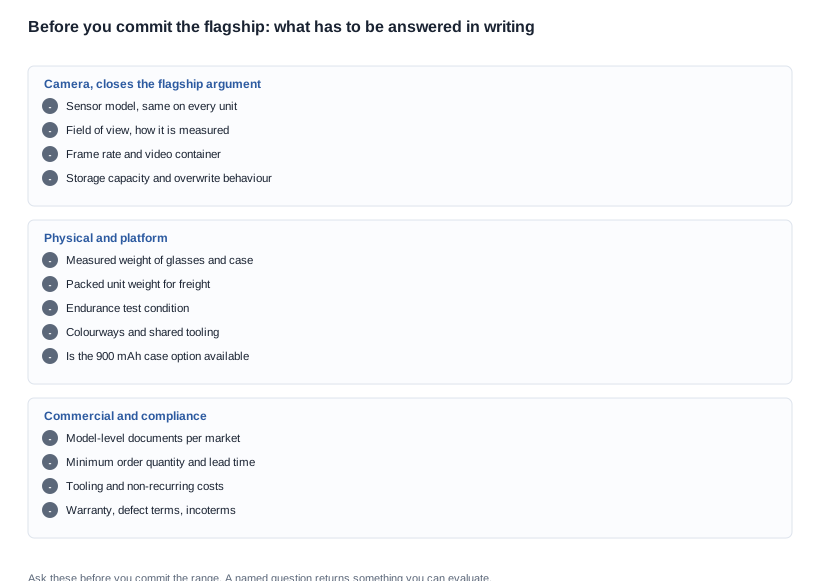
The questions below are ordered by how fast each one closes risk. Ask them before you commit, not after the first shipment.
- What sensor model is fitted, and is it the same on every unit in the bulk order?
- What is the field of view, measured diagonally or horizontally?
- What frame rate and video format does the camera record, and what container does it write?
- How is storage arranged, and what happens when it fills?
- What is the measured weight of the glasses and of the 1400 mAh case, and what is the packed unit weight?
- What endurance test condition produces the roughly seven-hour figure, and at what temperature and camera setting?
- Which colourways exist for this model, and is the tooling shared with the CY models?
- Is the 900 mAh case option available on this platform, or is the 1400 mAh case the only configuration?
- What model-level compliance documents and declarations exist for each destination market?
- What are the minimum order quantity, the production lead time and the bulk order tier structure?
- What are the tooling and non-recurring engineering costs, and which of them are refundable?
- What are the warranty period, its remedy, and the quality control and defect terms, and which incoterms and payment terms apply?
On our side of the table, our position is that the L1 Pro is the right flagship for a camera glasses range and that its premium has to be defended on image quality rather than on the resolution number. We will not present 13 megapixels as an image quality claim without a sensor model, we will not quote a weight, and we will not present the shared seven-hour endurance figure as a reason to choose this model over the CY models, because it is the same figure. The L1 Pro versus CY05 use case comparison covers the platform decision in detail, and the neighbouring buyer's field checklist is a useful companion when you are running the sample order.
Related reading
- The entries published for this model — L1 Pro smart glasses specifications and features
- The platform decision — L1 Pro versus CY05 use case fit
- Choosing across the camera range — AI camera glasses which model to pick
- Sample order field work — MT5 smart glasses buyer review checklist
- Where the models sit in the range — AI camera glasses
Send us the channel, the target price band and the markets, and we will tell you how to build the tier ladder and which figures have to be closed before you promote the top tier.


