

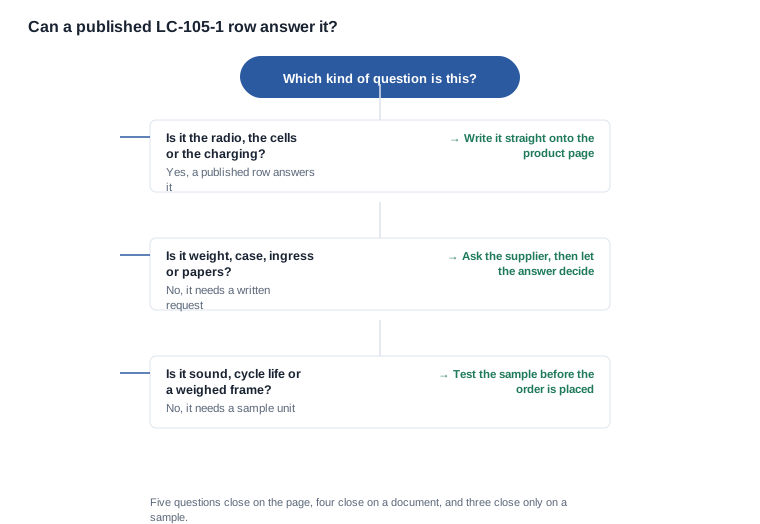
lc-105-1 smart glasses common questions arrive at a buyer in three different shapes, and the catalogue only answers one of them. The first shape is the set the LC-105-1's own rows already settle: the radio version, the cell configuration, the rated runtime, the charge ceiling and the charging method. The second shape is the set the catalogue simply never carries for this model, where the accurate answer is that the row does not exist and a request has to be made. The third shape is the set that no document will close and that only a sample on a bench can settle. This article sorts every common buyer question about the LC-105-1 into one of those three shapes and, for each one, names the party who can resolve it and the commercial decision it unlocks.
The LC-105-1 sits inside an eight-model Bluetooth audio group that also contains the D12 and the YK12, the K01 and the D11, the K02 and the LC-105-2, and the G07. Three of those eight carry a feature row on the catalogue page and five do not, and the LC-105-1 is one of the five that do not: the D11 publishes a surround-sound and long-endurance feature row, the G07 an ultra-slim and detachable-temple row, and the YK12 a surround-sound and slim-temple row, while the D12 and the K01, the K02 and the LC-105-1, and the LC-105-2 have nothing but their specification rows. That absence is the single most useful fact about the LC-105-1 for a buyer, because it tells you exactly how much of a product page you can write before you have to make a request.
Two housekeeping points apply to every LC-105-1 answer below. First, the model designations in this catalogue carry no hyphen: the MT5 and the V03, and the CY05 and the KY06, and the MT6 and the CY03 are written that way, so a search for "MT-6" will not reach the MT6. Second, the LC-105-1 and the LC-105-2 publish identical rows — radio, cells, runtime, charge ceiling and charging method — and the catalogue does not publish any difference between them, which is the subject of the LC-105-1 against LC-105-2 comparison and the subject of a question that a buyer cannot close without a written answer.
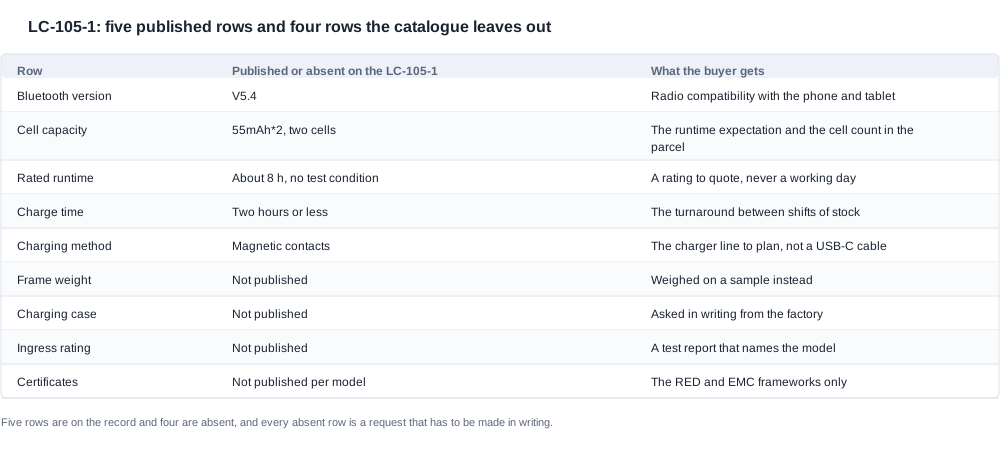
What the LC-105-1 publishes, in one table
The LC-105-1 publishes five specification rows and nothing else in its parameter column. Those five rows are the entire published specification of the model, and they are enough to write a specification block, to choose the charging line and to set a runtime expectation — and they are not enough to decide the SKU count, the freight class, the regulatory pack or anything that can be printed on a retail box.
| Published row on the LC-105-1 | Value as printed | What a buyer can build on it |
|---|---|---|
| Bluetooth version | V5.4 | Matching against the phones and tablets the software supports |
| Cell capacity | 55mAh*2 | The runtime expectation and the number of cells in the parcel |
| Rated runtime | ~8 h | A published rating, quotable with its rating status attached |
| Charge time | ≤2 h | The turnaround between shifts or between shifts of stock |
| Charging method | Magnetic | The charger line to plan, which is not a USB-C cable |
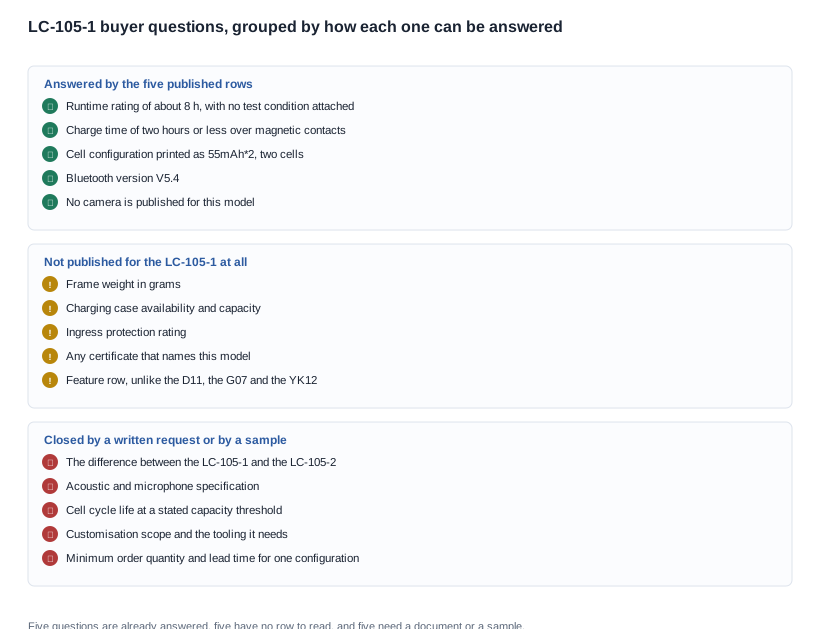
Four further parameters are absent for the LC-105-1, and their absence is structural rather than accidental: the catalogue simply does not print these rows for this model.
| Row the catalogue does not carry for the LC-105-1 | Where a related number does exist, and why it does not transfer |
|---|---|
| Frame weight | The catalogue's single published weight, 158 g, belongs to the MT6 glasses body, a camera model, and cannot stand in for an audio frame |
| Charging case | Only five camera models publish a case capacity; the eight-model audio group has no case row at all |
| Ingress protection rating | The catalogue's IP54 entries belong to the V06 and the S7, and no audio model carries an IP row |
| Per-model certification documents | CE, FCC and RoHS do not appear at all; the catalogue names the RED (EU) 2014/53/EU and EMC 2014/32/EU frameworks and stops there |
The LC-105-1 cell capacity is written here exactly as the catalogue prints it, 55mAh*2, which is the per-cell figure with the cell count attached rather than a bare total. The distinction matters in quotation work, where a document that says "110 mAh" and a document that says "55mAh*2" do not describe the same thing, and where a buyer who writes "110" into a spec sheet has silently changed the published row. The same discipline applies to the runtime. Six models across the catalogue publish the ~8 h figure — the K02 and the K01, the ZH12 and the YKC02, and the LC-105-2 and the LC-105-1 — and they do it across four different cell configurations, the 90×2, the 55×2, the 70×2 and the 100, without one of them publishing the test condition that produced it.
A further pattern in the LC-105-1 rows is worth stating before any question is asked: on the 55mAh2 configuration, the four models print two different runtimes. The LC-105-1 and the LC-105-2 print ~8 h, and the G07 and the YK12 print ~6 h on the same cell configuration. So the 55mAh2 tier across the catalogue spans a ~6–8 h band, and the LC-105-1's published figure sits at the top of that band. No test protocol accompanies either number, which is why the rating can be quoted but not compared. The LC-105-1 battery life analysis sets out the rating-versus-measurement distinction for this model, and how to compare smart glasses battery life sets out the questions that turn a printed rating into a usable one.
The questions the LC-105-1 published rows answer
The published rows close a surprising amount of a first-stage conversation, because most of what a buyer asks at the start of an evaluation is really a question about the radio, the cells, the charge and the absence of a camera. Below are the questions the LC-105-1's own rows answer, with the boundary of each answer drawn where the catalogue draws it.
How long does the LC-105-1 run on one charge?
The published answer for the LC-105-1 is a rated runtime of ~8 h. The boundary around that answer is narrow and should be drawn on the page itself: the rating carries no test condition, it cannot be converted into a working-day claim, it cannot be used to rank the LC-105-1 against another model in the group, and it cannot be reproduced on a bench without knowing the protocol that produced it. The evidence that the protocol is missing is inside the catalogue itself, because the G07 and the YK12 print ~6 h on the identical 55mAh*2 configuration. Two models with the same cells, the same radio generation and the same charging method cannot produce a two-hour gap for a reason a buyer can see on the page, so the number on the page is a rating and not a measurement.
How long does the LC-105-1 take to charge, and how does it charge?
The published answers are a charge time of ≤2 h and a charging method of magnetic. Those two answers together determine the accessory decision more than any other pair of rows on this model. Six of the eight audio models charge magnetically — the YK12 and the K02, the G07 and the LC-105-1, and the LC-105-2 and the K01 — and Type-C appears on exactly one pair in the audio group, the D11 and the D12. A buyer who reads the LC-105-1 row and orders USB-C cables will arrive with a parcel of the wrong accessory, and a buyer who publishes "USB-C charging" on the LC-105-1 listing will be describing an interface the model does not have. The charging options analysis works through the accessory economics of the magnetic group across the range.
How many cells does the LC-105-1 carry, and how big are they?
The published answer is 55mAh*2, which is two cells of 55 mAh. Three practical consequences follow. The runtime figure is a two-cell figure, so the ~8 h is the rating of a paired configuration and not of a single cell. The unit contains two lithium cells, which changes how the parcel is described and documented for transport. And a buyer who wants a spare or a second unit for comparison is buying the paired configuration, because there is no single-cell variant on the page. Nothing on the catalogue row speaks to cycle life or to degradation over time, so the number of charges a cell survives is one of the items that has to be requested rather than read.
Which Bluetooth version does the LC-105-1 run?
The published answer is V5.4, and that is exactly as far as the row goes. The version answers the compatibility question — which generation of radio the product speaks — and it answers nothing about range, codec, multipoint behaviour or the number of devices that can be held at once. It also sits above a documentation gap that a buyer has to notice early: the catalogue names the RED (EU) 2014/53/EU and the EMC 2014/32/EU frameworks, but it publishes no per-model certification row, so the version on the specification sheet is a product characteristic and not a compliance claim. Whether the radio is qualified and what document proves it is a separate question, and it is treated as one below.
Does the LC-105-1 record, and what is its camera resolution?
The published answer is that it does not record, because no camera row is published for the LC-105-1 and neither the LC-105-1 nor the LC-105-2 appears among the eleven camera models. This is a case where the answer comes from the structure of the catalogue rather than from a line on the model page: the camera rows exist for camera models, and the audio group's rows make no imaging statement at all. A camera question about the LC-105-1 therefore has a clean answer — there is no camera and there is no resolution — and the remaining task is commercial rather than technical, which is to make sure the product page, the box artwork, the listing and the customer's expectation all say the same thing.
What does the catalogue publish as the LC-105-1's selling feature?
The published answer is that there is no feature row for the LC-105-1. The catalogue page describes the platform as an ultra-light magnetic-charging audio configuration, and that description is positioning rather than a measurement — no gram figure sits behind the word "ultra-light" on this model, and the catalogue's one published weight belongs to a different model entirely. The consequence for a brand is concrete: a product page for the LC-105-1 has to be written from the five specification rows alone, and it cannot borrow the feature language that the D11, the G07 and the YK12 publish. The published LC-105-1 specification list is the honest baseline for that page.
What is the difference between the LC-105-1 and the LC-105-2?
The published rows for the two models are identical in every respect the catalogue prints: the cell configuration, the radio version, the rated runtime, the charge ceiling and the charging method. The catalogue publishes no difference, which means the difference is either a commercial packaging tier, a colourway, a lens option or nothing at all — and the catalogue does not say which. A buyer forced to shortlist two models with identical published specifications is shortlisting on a name rather than on a specification, and the name is currently the only thing that separates the LC-105-1 from the LC-105-2. That is also how to choose between the two orderings of the same request: the written difference first, because the difference decides whether the two models are stocked as two products or as one product with two shelf labels, and every other question about them follows from that answer. It has to be closed in writing before either model is ordered at scale, and the LC-105-1 against LC-105-2 comparison sets out what each possible answer means commercially.
The questions the LC-105-1 published rows do not answer
The questions below are the ones a buyer asks about the LC-105-1 that the catalogue cannot answer, because the row does not exist for this model or because the numbers that exist belong to other models. Each one is followed by the party who can actually resolve it and the decision that closes.
How heavy is the LC-105-1 frame?
No weight is published for the LC-105-1, and no weight is published for any of the eight audio models. The catalogue's single published weight of 158 g belongs to the MT6 glasses body, which is a camera model with a camera to power, and it cannot be carried across to an audio frame. The weight is resolvable in one of two ways: a written specification naming the LC-105-1, or a sample weighed with its cells fitted. The decision it closes is the parcel weight and therefore the freight class, and it is also the only way to quantify the "ultra-light" language that the catalogue uses for this platform.
Is a charging case available for the LC-105-1?
Nothing is published either way, because the eight-model audio group carries no charging-case row. Only five camera models publish a case capacity, and a case capacity for a camera model says nothing about the LC-105-1. The question is answerable by a written accessory or packing list that names the model and the case capacity if one exists, and it should also ask the case's charging interface, its own charge time and its weight. The decision it closes is whether a second lithium cell enters every parcel, what that does to the freight class and the transport documentation, and whether a case is a channel accessory line or a cost the brand absorbs.
What is the ingress protection rating of the LC-105-1?
No IP row is published for any audio model, and the catalogue's IP54 entries belong to the V06 and the S7. An unstated ingress rating is not a low rating, it is an absent one, and the practical consequence is that a channel which asks for a rating before it will list the product cannot be answered from the catalogue at all. The question closes with a test report that names the LC-105-1, obtained either from the factory's own laboratory or from an independent test house, and it decides whether the packaging may say anything about sweat, rain or dust at all.
Which certificates cover the LC-105-1?
The catalogue publishes no per-model certification row. CE, FCC and RoHS do not appear in it, and the only regulatory frameworks named are the RED (EU) 2014/53/EU and the EMC 2014/32/EU. A report held for another model does not cover the LC-105-1, because coverage follows the model designation and the date. This is the request with the longest lead time, which is why it belongs at the front of any enquiry rather than the back. The LC-105-1 certification status article lists the documents to request and who resolves each one, and the export documentation notes covers the paper that travels with the goods.
Can the LC-105-1 be customised for a private label?
No customisation row is published for the LC-105-1. What can be changed, how deep that change goes and what it costs are all outside the catalogue, and the request has to be scoped in writing — colourway, lens, packaging, logo placement, and whether any of those changes carries tooling. The unresolved LC-105-1 against LC-105-2 question sits underneath this one, because customisation is the most likely reason two otherwise identical models both exist. The decision it closes is whether the LC-105-1 can carry a private label at all, and how a two-SKU structure would be differentiated in practice.
What are the minimum order quantity and the lead time for the LC-105-1?
Neither is published for this model or for any other. Quantities, capacity, lead time and price are commercial matters that belong to a quotation against a named configuration, and they are not stated here for that reason — the minimum order quantity question and the production lead time question explain why a bare number without a configuration attached is meaningless to a buyer. The decision it closes is the size of the first order and whether the unit fits the channel's inventory plan.
How does the LC-105-1 sound, and is there a microphone for calls?
No acoustic specification is published for the LC-105-1: no driver size, no frequency response, no sound field description, no leak rate and no microphone specification. Nothing is published for the other audio models either, so the gap is the whole group's, not this model's. Two routes close it: a written acoustic and microphone specification from the factory, and a recording made on a sample, which is the only way to establish how an open-ear frame behaves in a real room. The decision it closes is what the listing may claim about sound and call quality, and the comfort and fit analysis explains why fit and acoustics cannot be separated on this form factor.
How many charge cycles does an LC-105-1 cell survive?
No cycle life is published for any model in the catalogue, and the LC-105-1's ~8 h rating carries no degradation curve with it. The question closes with a cycle figure tied to a test condition and a stated capacity threshold, and it decides what a warranty return looks like after eighteen months on a retail shelf, which is a cost that lands on the brand rather than on the factory.
The eight questions above also fail in one predictable way, because the phrasing of the request decides the shape of the reply. Asking for the battery life of the LC-105-1 returns about 8 hours, which is the catalogue row repeated and settles nothing, while asking for the test condition behind the figure returns a volume level, a codec, a radio state and a sample count. Asking for the certificates returns whatever the factory holds for the platform, while asking which document names the LC-105-1 returns a document that can be filed. The two common pitfalls in a request like this are avoidable, and both are avoided by the same rule: every question has to be answered by something that names the model and the condition.
The eight questions above resolve to four different parties, and confusing them is the most common way an evaluation stalls. A factory account manager can answer the customisation scope, the case question, the weight and the acoustic specification. A compliance owner or a test house answers the certification and ingress questions. A quotation answers the quantity, the lead time and the price. A bench on a sample unit answers the weight verification, the acoustic behaviour and the charge cycle, because those three are observations rather than declarations.
| Question the catalogue cannot answer for the LC-105-1 | Who can resolve it | What comes back | Decision it settles |
|---|---|---|---|
| Frame weight in grams | Factory, or a weighed sample | Spec sheet naming the model, or a recorded weighing | Parcel weight and freight class |
| Charging case availability and capacity | Factory account manager | Accessory or packing list naming the model | Whether a second cell ships in every parcel |
| Ingress protection rating | Compliance owner or test house | IP test report naming the model | Whether the packaging may claim weather resistance |
| Certificates covering this model | Compliance owner | Report or declaration naming the model and the date | Whether the goods can ship and be marked in your market |
| Customisation depth | Factory account manager | Written scope with tooling implications | Whether the model can carry a private label |
| Minimum order quantity and lead time | Quotation desk | Quotation against a named configuration | The size and timing of the first order |
| Acoustic and microphone specification | Factory, then a sample | Written spec, then a recording | What the listing may claim about sound and calls |
| Cell cycle life | Factory laboratory | Cycle figure with its test condition | The warranty cost after shelf life |

The questions to put to the supplier about the LC-105-1
The LC-105-1 enquiry fails in one of two ways. It fails when the buyer accepts a generic specification sheet that never names the model, in which case the reply will cover whichever platform the sheet was written for. And it fails when the buyer asks fifteen questions in one message and receives a partial answer to all of them. The request that works is short, numbered, model-specific, and asked in the order that closes the most money first. It also helps to state what to ask for in each case and which form of document is acceptable, because a supplier who can read the shape of the request will answer it in one pass rather than in six.
- What differs between the LC-105-1 and the LC-105-2, in writing, and is that difference a product change or a packaging change?
- What is the frame weight of the LC-105-1 in grams, measured with the cells fitted?
- What is the endurance test condition behind the ~8 h figure — volume, codec, radio state, temperature, sample count — and is the figure measured on the production configuration?
- What does the LC-105-1 ship with: a magnetic pad, a magnetic case, a cable, or nothing, and if a case exists what is its capacity, interface, charge time and weight?
- Is there an ingress rating for the LC-105-1, and if so which report names this model?
- Which test reports or declarations name the LC-105-1 specifically, and what are their dates and their covered model designations?
- What is the acoustic and microphone specification — driver size, frequency response, microphone type and any measured figures?
- What is the cell cycle life at a stated capacity threshold, and what is the replacement path?
- What can be customised on the LC-105-1 — colourway, lens, packaging, logo — and which of those carry tooling?
- What are the frame and temple dimensions, and what adjustability does the frame offer?
- Which configuration does the quoted minimum order quantity apply to, and what is the lead time for that configuration?
- What is the declared model designation for every document you will issue, given that this catalogue writes designations without hyphens?
The twelve questions above are the request checklist for the LC-105-1, and they are ordered by what each answer closes rather than by the order in which a buyer usually thinks of them. The two questions that come first in that list are the two that change the shape of the order rather than its detail. The LC-105-1 against LC-105-2 difference decides whether the brand runs one SKU or two, and the endurance test condition decides whether the ~8 h rating can be written as a working-day claim or has to be written as a rating with a condition attached. Both are answerable in a sentence by a competent supplier, and both are commonly left unanswered.
A reply is only an answer when it names the model. A line that reads "magnetic charging, two hours" tells a buyer nothing about the LC-105-1, because the K02 and the YK12, the G07 and the LC-105-2, and the K01 all charge magnetically and several of them charge in the same window. The same test applies to a certification document, where coverage follows the designation, and to an accessory list, where the presence of a case in one model says nothing about another. Asking for the model designation in the reply is not pedantry: it is the difference between a document that can go into a technical file and one that cannot.
Three red flags recur in replies to this kind of request, and each one is cheap to catch before the order is placed. The first is a runtime figure delivered with no condition attached, because that is the figure the catalogue already carries and it carries no more information than the catalogue did. The second is a certificate or test report that names another model designation, since coverage follows the model and the date. The third is a frame weight with no statement about whether the cells were fitted, because a frame measured empty and a frame measured ready to ship are two different numbers and only one of them reaches the freight agent.
Which acceptance criteria belong in the purchase order for the LC-105-1 is a separate question from which documents to request, and it is the one that decides whether the answers survive the order. Three of them are worth freezing at order stage: the endurance figure with its test condition attached, the frame weight with its measurement method stated, and the accessories that travel in the box. Without the condition attached, an accepted runtime figure means a number whose meaning depends on a protocol nobody has shown, and the first customer complaint about a flat battery arrives with that argument already made. The acceptance criteria are what the buyer argues for at order stage, and the published row is only the opening position.
What we can and cannot tell you about the LC-105-1 today
The information about the LC-105-1 exists in four layers, and the commercial mistakes come from treating one layer as if it contained the next. The first layer is on the record today: the five published rows. The second layer is one written request away from the desk. The third layer can only be produced by observation on a sample unit. The fourth layer will never be published for any model in this catalogue, and a buyer who waits for it waits forever.
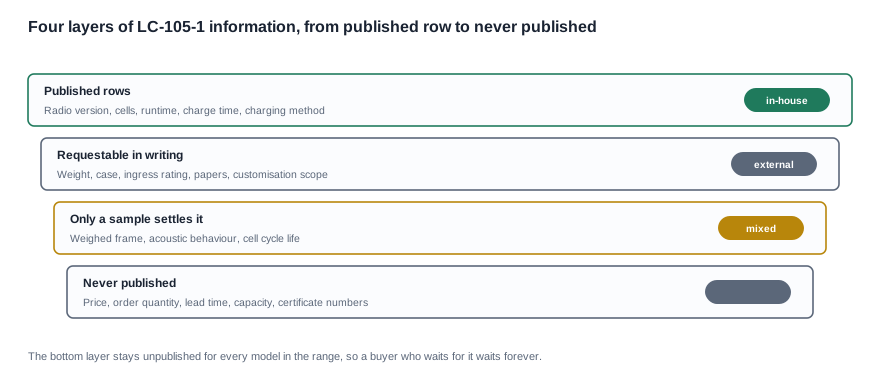
On the record for the LC-105-1 today: Bluetooth V5.4, a cell configuration of 55mAh*2, a rated runtime of ~8 h, a charge time of ≤2 h and magnetic charging. Those five lines can be published as they stand, with the runtime marked as a rating rather than a working-day guarantee.
Not on the record for the LC-105-1, and not invented here: a frame weight, an ingress protection rating for this model, a per-model certificate or test report, an acoustic or microphone figure, a charging-case capacity, a cell cycle life, a minimum order quantity, a lead time, a price, a production capacity figure and any certification identifier. No capacitive touch, gesture control, AI translation or noise-cancelling claim is published for the LC-105-1 or for any other audio model, so none of those belong in a listing for this product. The Bluetooth audio glasses buying guide covers how the range decisions are made once the rows are known, and which model to pick across the range covers the comparison that the rows do support.
The first two layers of LC-105-1 information are different in kind, and the difference is worth keeping visible. A published row is a fixed position that can be quoted identically on every order for the same configuration, while a requestable item is an argument that has to be reopened each time something changes. A buyer who treats the second as though it were the first spends a week chasing a number that was already available in writing, and a buyer who treats the first as though it were the second quotes a row as if it were a specification. The trade-off between those two errors is small in effort and large in cost, because the specification that was never argued for is the one the customer returns.
One item remains open and it is the one that blocks the order rather than the copy: the catalogue publishes no difference between the LC-105-1 and the LC-105-2, and until a written answer says whether that difference is a product change, a colourway, a packaging tier or nothing, the two models are the same product on paper. The LC-105-1 best-for analysis sets out what the model can carry once that question is closed.
If you send us the specification sheet you already hold for the LC-105-1, we will mark each of its lines as confirmed by the catalogue, not published and requestable, or resolvable only on a sample — so the request you send back is the shortest one that closes the most.


