

A quotation in smart glasses contains one number and leaves out most of the cost. It is not a dishonest document — a supplier who quotes a unit price and a production window has answered the two questions they were asked. The problem is that the two questions a buyer should have asked are different ones: what will this cost when it is landed, and what will the wait cost in capital and in risk while it is outstanding.
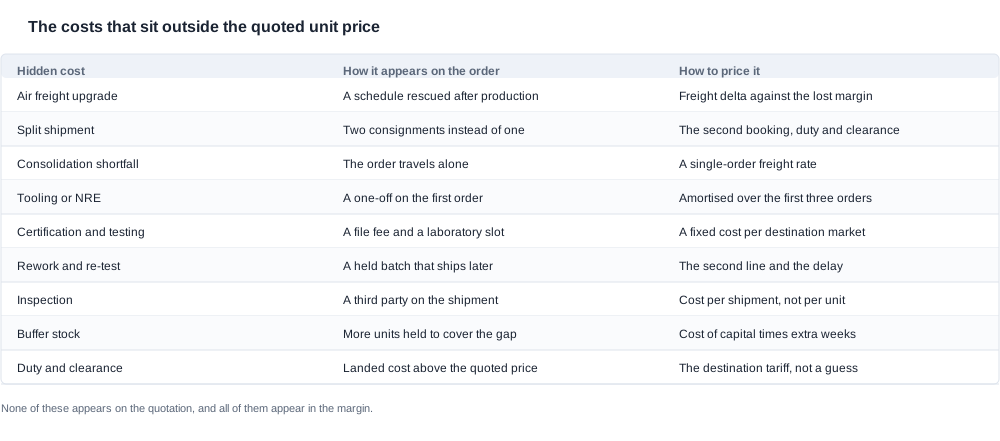
Those two questions have a name in procurement, and the name is total cost. The hidden costs are not exotic. They are the freight upgrade bought to rescue a date, the second consignment created by a shipment that could not be consolidated, the working capital held between paying a supplier and selling the goods, the rework line, the inspection, the buffer stock and the storage charges at the destination. Each of them is predictable before the order and expensive after it, and each of them is invisible in a unit-price comparison.
The practical conclusion is that a buyer should never compare two suppliers on the quoted unit price alone. Two quotations can differ by a few per cent on the unit and by a third on the landed cost, and the third is the number that decides whether the range works. The question worth asking before you order is which costs the supplier is carrying and which are being carried silently by the buyer.
Smart glasses lead time: the costs a quotation never shows
Five families of cost sit behind a quoted price in this category, and each behaves differently.
Schedule-rescue costs. These are paid when a programme is late and something has to be compressed. Expedited air freight is the obvious one. A split delivery, where part of the order ships by one route and the rest by another, is the second. A consignment that travels alone because it missed a consolidation window is the third, and it is the most common, because consolidation is decided by the goods being ready rather than by the booking being made.
One-off costs. These are paid once and then amortised or repeated. Tooling and non-recurring engineering are the large ones. Certification and laboratory fees are the second, and they are incurred per market rather than per order, which is why a buyer planning three markets should treat them as a portfolio rather than as three separate charges. Artwork, packaging development and print setup sit in the same family.
Time-carried costs. This is the largest family and the one buyers rarely price. Working capital is tied up from the deposit until the goods are sold. Buffer stock is held to cover a schedule that is not certain. Demurrage and storage are charged when a consignment sits at the destination. Each of these scales with the length of the wait rather than with the size of the order, which is why a long schedule is more expensive than it appears.
Quality costs. Inspection by a third party, a rework line, a re-test after a firmware change, and a returns process that sends units back across a border. These are costs of certainty, and a buyer who does not buy them does not avoid them — they buy them later, at a worse price and with a worse schedule.
Commercial costs. A price tier that the chosen quantity does not reach. A deposit that has to be funded. An incoterm chosen for convenience that leaves the buyer carrying the collection. A currency exposure between the order and the sale. These are usually the smallest items and the easiest to lose track of.
Why the catalogue reduces the number of unknowns
The published specification for this range removes a surprising number of the costs that would otherwise have to be priced from scratch. The catalogue states the battery capacity and the rated use for all twenty-eight models, the charging time for every one of them, the charging method for the twenty-four where it is stated, the Bluetooth version for the fourteen where it is published, the case capacity for the five models where it appears, and the ingress rating for the two that carry one.
That matters commercially in a specific way. A buyer who knows the cell capacity, the charging method and the case arrangement can price the shipping configuration, the certification route and the accessory packaging without guessing. A buyer working from a two-line description has to price all three as unknowns, and unknowns get padded.
The rows that are open are open for a reason: the charging method is not published for the CY03 and the MT6, and the L1 Pro and the CY05, the Bluetooth version is not published for the camera models, the weight is published for one model only, and the ingress rating is published for two. Each of those gaps is a line in the supplier's file that the buyer has to request, and a line that has to be requested is a line that can be answered with a convenient figure.

Where each hidden cost attaches to the schedule
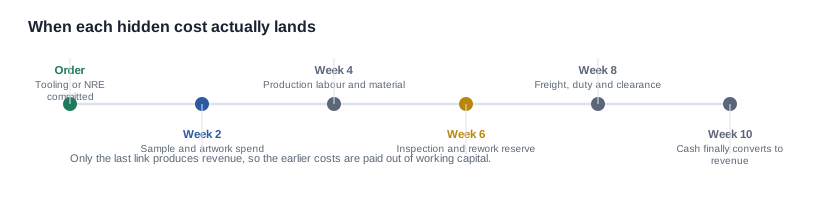
Hidden costs are not random. Each one attaches to a particular point in the chain, and that is useful, because a cost attached to a known point can be planned for, budgeted and — in some cases — negotiated away.

Costs that attach to the front of the chain
Tooling and non-recurring engineering are committed at the order, before a single unit exists, and they are the reason a first order carries a cost structure that the second order will not have. Certification and laboratory fees attach to the configuration freeze, because the evidence is written against a specific model and a specific variant. Artwork and packaging development attach to the same point.
These three are the easiest to control and the most often ignored. A buyer who knows at the quotation stage that the tool costs a stated amount and is owned by a stated party has a commercial negotiation. A buyer who discovers it in the invoice has a dispute.
Costs that attach to the middle
Labour and material sit in the middle of the run, and they are the part of the cost that a unit price represents. Inspection sits next to them, usually at the end of the run rather than in it, which means it is paid whether the goods are good or bad and whether or not it finds anything.
Rework sits in the middle as well, and it is the cost with the worst ratio of price to damage, because a re-test or a re-label consumes schedule time that has already been paid for. The way to keep it small is to decide in advance what is inspected, on how many units, and against which written criteria — which is a question about the quality agreement rather than about the schedule.
Costs that attach to the back
Freight, duty, clearance and storage are the back end, and they are where the schedule most often breaks after the factory has done its part. A consignment that missed a consolidation window travels alone, which is slower and more expensive, and it can also arrive with less free time at the destination before storage charges begin.
The buyer's own receiving cost is the last item in the chain and the one nobody plans: the carton count, the inspection window, the put-away capacity, the people who have to be available. A consignment that arrives on a Friday afternoon into a warehouse with no one scheduled to receive it has a schedule problem that nobody in the factory can solve.
The costs that scale and the costs that do not
The distinction that matters most for a first order is between costs that scale with volume and costs that do not. Freight, duty and material scale. Tooling, certification, artwork and the document set do not. That is why the first order in a programme is structurally more expensive per unit than the second, and why a buyer who compares a first-order quotation against a repeat-order price is comparing two different things.
A second-order price advantage is real and it is also a reason to plan the volume curve rather than the single order. If the tooling is amortised over three orders, the third order carries a materially different cost structure, and that difference is worth putting in the programme plan before the first order is placed rather than discovering it afterwards.
Building a landed cost that survives a budget review
A landed cost that will survive scrutiny has to be built from named components with a source for each. The exercise below is the one we would run, and it is deliberately unglamorous.
Start from the quoted unit price at the agreed quantity. Not the price at the minimum order, and not the price at a volume the buyer has not committed to. The quantity changes the tier and the tier changes the arithmetic, so the first input is the price that actually applies to the order being planned.
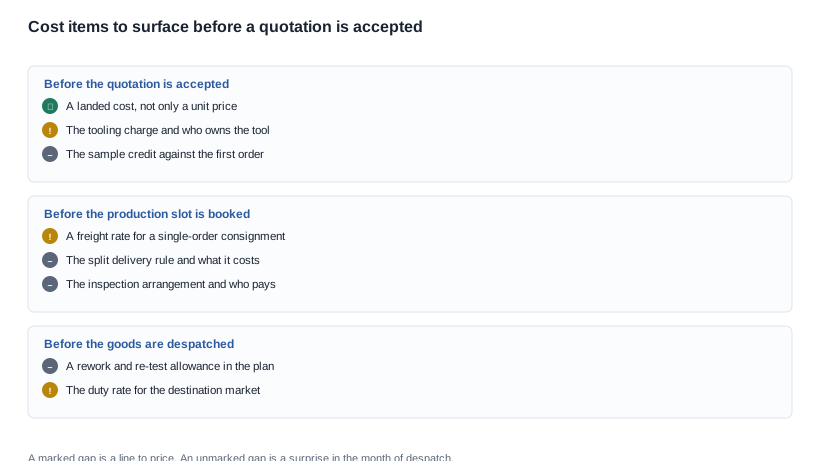
Add the freight for the consignment that will actually be used. This is where most estimates go wrong. A quotation is often built on a consolidated shipment, and a first order frequently travels alone. Ask for the single-consignment rate, because that is the rate the first order will pay.
Add the duty, the clearance fee and the inspection. The tariff for the destination market is knowable before the order, and a buyer who asks for it in writing gets a number instead of an allowance.
Add the one-off charges. Tooling, non-recurring engineering, the certification route, the artwork and the packaging development. For a first order these may exceed the value of the margin on that order, which is exactly why they need to be in the business case rather than in the invoice.
Add the working capital held during the wait. This is the cost buyers leave out, and it is the one that connects the schedule directly to the margin: the money is spent at the deposit and the revenue arrives after the goods have been sold. The longer the cycle, the more capital is locked, and the more the price has to carry to produce the same return.
Compare the total against the price the channel will hold. Not against the competing quotation, which is the wrong comparison at this stage, but against the price the business can sustain. If the landed cost exceeds that, the schedule is not the problem; the configuration, the quantity or the target market is.
The two tests that keep the arithmetic honest
Test the consignment assumption. If the order cannot be consolidated, the freight line is wrong, and it is wrong by a factor rather than by a percentage.
Test the tier assumption. If the quantity does not reach the tier the price came from, the price is wrong in the same way. Both tests are cheap, and both catch the two most common reasons a landed cost is wrong by a third.

Which of these you can negotiate and which you cannot
Not every hidden cost is negotiable, and a buyer who treats them all as negotiable spends credibility on the two that cannot move.
The component and certification durations are not negotiable. A laboratory slot and a sub-supplier's material schedule belong to third parties, and the only management technique that works is starting them earlier. What is negotiable is where they sit in the plan and who owns the handover.
Tooling cost is negotiable in structure, not in fact. The amount may be fixed; whether it is amortised, whether it is refunded at a volume, and who owns the tool afterwards are all negotiable and all commercially significant.
Freight is negotiable in the mode and in the timing. A booked earlier, consolidated shipment costs less than a rushed one; a split delivery is priced rather than negotiated. What is not negotiable is the destination tariff, which is a fact about the market.
Payment terms are the most negotiable item on the list. The deposit, the balance trigger and the credit period all change the cost of the cycle, and they change it without touching the unit price at all. This is where a buyer with two quotations and a preference for one of them can convert a commercial preference into a better commercial position.
Inspection and rework allowances are negotiable as scope. What is inspected, on how many units, and at what stage are decisions. Whether they happen at all is not a decision, because they happen either way.
The questions worth asking in the enquiry
These are the questions to ask, in the order that changes the answer rather than the order that is convenient to answer.
- What is the freight rate if this order ships alone rather than consolidated?
- What are the tooling and non-recurring charges, and who owns the tool afterwards?
- Which destination duties and clearance fees are assumed, and at what rate?
- What is the payment structure, and at what event does the balance fall due?
- What does the sample cost, and is it credited against the first order?
- What inspection is included, and what happens to the schedule if it finds a defect?
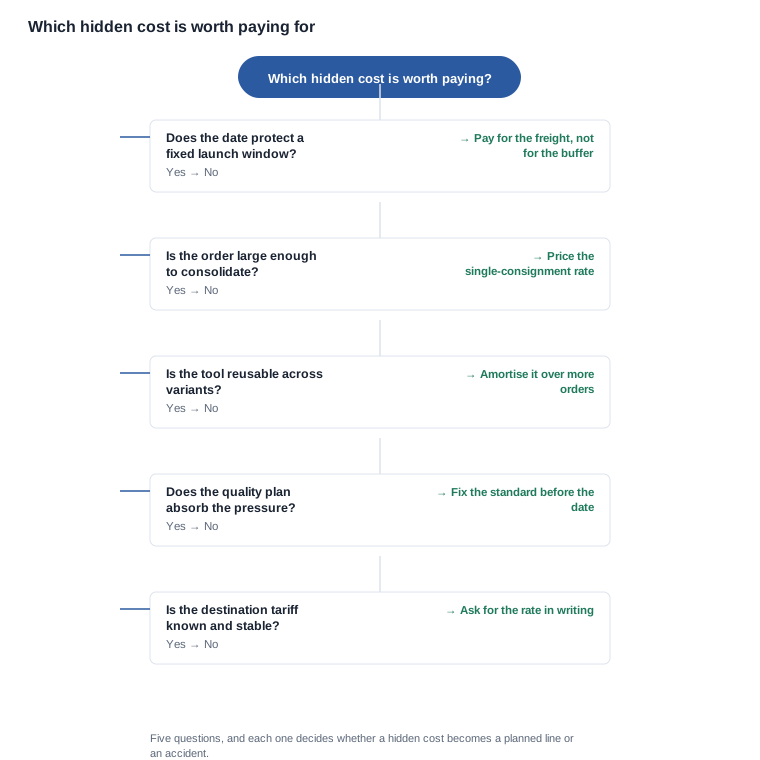
Each one has a short answer, and each answer either becomes a line in the landed cost or becomes a line in the risk register.

A worked programme, costed end to end
The case below is an invented scenario used to reason through the arithmetic. No customer, order or shipment is described; the model, the quantity, the destination and the durations are assumed so that the cost structure can be followed end to end.
The scenario. A brand is placing a first order for a camera model into a European market, with a retail set date eleven weeks away. The quoted unit price is firm at the agreed quantity. The quoted production window is eight weeks, stated from the order date, and the documentation route is described as included. Two costs are known in advance: the tooling charge and the certification route for one destination market.
Step one, the consignment. The order is small enough that it will not be consolidated with other shipments. The freight assumption in the quotation is therefore wrong, and the correction is a single-consignment rate on a route that the supplier already quotes. This is the largest single correction in the case, and it is discovered by asking one question.
Step two, the duty and clearance. The destination tariff is requested in writing and applied to the declared value. It is not large, but it is a permanent cost that belongs in the price the channel has to carry, and a buyer who discovers it after launch treats it as a surprise.
Step three, the one-off charges. The tooling is amortised over the first three orders rather than carried by the first one, and the certification route is treated as a market-level cost that will not recur for that market. Neither treatment changes what the supplier charges; both change how the programme is planned, which is where the value of knowing them lies.
Step four, the working capital. The deposit, the balance trigger and the sale date are placed on a single calendar. The result is that the programme holds cash for a period the business case did not account for, and the number is large enough to change the decision on whether the first order should be larger or smaller.
Step five, the quality reserve. A rework and re-test allowance is put into the plan at a stated level, because it happens. The alternative is to discover it as a delay in the month of despatch, when the freight premium is also being paid.
The outcome. A landed cost that is materially different from the quoted unit price, a programme plan that carries the real costs, and a decision about order size that could not have been made from the quotation alone.
Why the order size decision could not be made from the quotation
This is the point that surprises buyers most often. The total cost of the first order depends on the cost of the wait as much as on the price of the goods, so the quantity that minimises total cost is not always the quantity that minimises unit price. A larger first order buys a better tier and locks more capital for longer; a smaller first order risks a higher tier, a more expensive consignment and a worse tier for the second order as well.
That trade-off cannot be resolved from a unit price. It can only be resolved from a landed cost with the cycle in it, which is why the exercise above is worth doing before the order rather than after the invoice.
The boundary of what we will price
It is worth being precise: the published catalogue is the part of the commercial picture we can stand behind, and the schedule and the pricing belong to a conversation rather than to a published table.
What we publish is the specification that the cost structure is built on: the twenty-eight models and their published rows — the battery capacity and rated use for each, the charging time for every model, the charging method for the twenty-four where it is stated, the Bluetooth version for the fourteen where it appears, the case capacity for the five models where it is published, and the ingress rating on the two that carry one. We also publish the model codes and colourways that exist, because a cost estimate built on a configuration that does not exist is not an estimate.
What we do not publish: production lead times, minimum order quantities, unit prices, production capacity, tooling charges, certification fees and freight rates. Each of those depends on a configuration, a quantity, a destination and a date range, and publishing a single figure for any of them would be the blended number this article warns against.
What we will do is take a model, a quantity, a destination and a required date, and tell you which configurations exist for it, which published rows the cost and the schedule have to be built around, and which of the hidden costs above are the ones that will actually attach to your programme. We will also say plainly when a configuration cannot be made to the date you have asked for.
The same reasoning applies to the two supporting topics: the sample and its cost are covered at sample policy verification, the habits that create avoidable delay are at practical advice for buyers, the warning signs in a schedule are at lead time red flags, and the sample mistakes that recur are at sample policy common mistakes.
The action to take now. Take the last quotation you received and build the landed cost underneath it: one line for freight, one for duty and clearance, one for the one-off charges, one for working capital, one for the quality reserve. Then decide whether the schedule you were quoted is worth the total you have just calculated. If the two disagree, the disagreement is the negotiation.
Related reading
- Sample policy verification — what a sample does and does not prove
- Practical advice for buyers — the habits that cost weeks
- Lead time red flags — warning signs in a schedule
- Sample policy common mistakes — recurring errors in first orders


