

Smart glasses quality consistency is not the inspection. It is a method, and the inspection is only the fifth of its eight steps. A buyer who has agreed a sampling plan and nothing else has bought a check rather than a process, and a check tells them what one batch looked like on one day — which is a different and much weaker claim than the one they need when a second order is being placed.
This article sets out the eight steps in the order they have to happen, what each one catches, what evidence it leaves behind, and the two questions that separate a factory with a quality system from a factory with an inspection routine. We publish no defect rate, no yield figure and no capability number, and this article is about the method rather than about any of those, because in this category the method is the thing that can be agreed, evidenced and audited.

Read the sequence as a gate structure rather than a checklist. Each step has a moment at which it can still be done cheaply, and each one is worthless if it is attempted after that moment has passed.
Smart glasses quality consistency: the steps to set up before the run
Step one: the approved reference unit
One unit is signed off, photographed and kept. Everything after this step is measured against it, and the object itself is the cheapest and most important thing in the whole system.
Three attributes of the reference unit determine whether it works. It has to be a production build, because a pre-production unit is a different article and it will differ in finish, firmware and sometimes in parts. It has to be protected, because a unit that has been carried in a sample bag, dropped, recharged repeatedly and handled by a documentation team is no longer a reference for a finish. And it has to be labelled with the configuration it represents, because a reference unit without its colourway, case option and firmware build is a reference to nothing in particular.
The step is cheap. The step that follows is not, because a disagreement at step eight about whether the goods match the reference is a dispute about an object that may no longer exist.
Step two: the first article
A production unit is built and compared against the reference unit and the written specification. This is the step that catches a specification nobody actually agreed, and it is worth its time precisely because it is far cheaper than a shipment.
Buyers often skip this step because the sample has already been approved and the specification is assumed to be settled. That assumption is exactly what the step tests. A first article compared side by side against the reference unit exposes differences that a written specification cannot express: a seam, a lens tint, a temple shape, a case that sits differently in the box. It also exposes the reverse problem, where the factory has built to the specification and the specification turns out to be a poor description of what the buyer wanted.
The output of this step is a signature. Not an email saying it looks right — a signature, by a named person, against a dated configuration.
Step three: the in-process checks
The checks that happen at the stations where the defects actually appear, rather than a general line check at the end.
In this category the stations are specific. On an audio model the channel balance and the speaker seating are separate checks, because a unit that plays and does not balance will pass a functional test and fail in the channel. The charging contacts and the charge port are a check, and for the models that publish no charging method it is a check against the unit rather than against a method. The temple joint, the hinge and the finish are checks with a criterion, and the criterion is a comparison against the reference unit rather than a number.
The distinction that matters is the difference between a general line check and an in-process check. A general line check finds out at the end of the run whether the run was good. An in-process check finds out at the station where the defect was created, which is the only point at which the response is still cheap.
Step four: the sampling plan
What is checked, how many units, and against what. A sampling plan agreed after the first order has already shipped is a plan for the second order, and it will be agreed under pressure.
A sampling plan needs four things and is not a list of attributes. It needs the characteristic, the method, the sample size and the limit. A characteristic without a method is not being checked, it is being noticed. A method without a limit produces a measurement and no decision. A limit without a sample size cannot be defended when a batch is rejected, because the supplier will reasonably ask how many units had to fail.
Steps five to eight: the part that happens during the run
Step five: the final inspection
The final inspection runs against the reference unit, before the balance is due. The timing matters more than the count, because the balance is the buyer's only leverage and it expires at the point of payment. An inspection that concludes after the invoice has been paid has cost the buyer the argument, whatever it found.
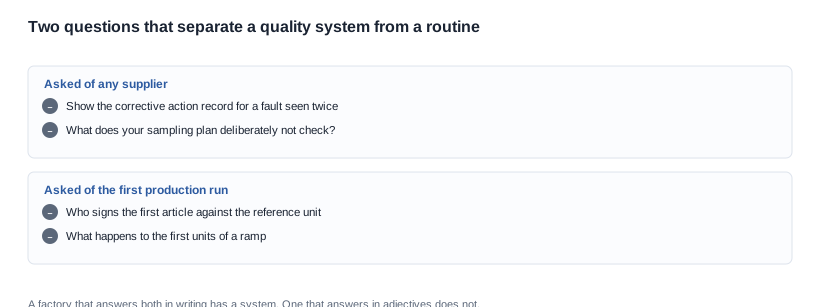
The final inspection is also where the ramp decision sits. A factory that holds the first units of a run back for comparison against the reference unit and a factory that ships them are different factories, and the published data will not tell you which one you have. A buyer who wants to know should ask what happens to the first units of a run, and should ask it before the first run, not after it.
Step six: the batch record
Which batch, which date, which line, which units, and which cell lot. This is the record that makes every other step auditable, and it is the record that is most often missing.
The test of a batch record is whether a complaint can be traced to a production event. Without it, a fault that affected one day of production becomes a fault attributed to every unit shipped, and the commercial consequence of that misattribution is usually a returns reserve that nobody budgeted and a relationship that cannot be repaired with a credit note.
Step seven: the non-conformance disposition
What happens to a unit that fails, and who decides. The disposition — reject, rework, downgrade, scrap, or accept under concession — has to be written down before the first one, because the decision taken in the moment is the decision taken badly, and the decision taken badly is usually the decision that costs the buyer money without a paper trail.
A concession is not a failure of the process; it is a process. A buyer with a written concession rule, a named approver and a limit on how many units can be concessioned in a batch is in a stronger commercial position than a buyer with a perfect quality system and no rule for the units that escape it.
Step eight: the correction
What was changed so that it does not recur. This is the step that separates a quality system from an inspection routine, and it is the one a buyer should ask to see before signing anything, because a factory that has corrected a recurring fault will have a record and a factory that has not will not.
The evidence is specific: the fault, the root cause, the action taken, the date, the person who approved it, and the result on the next run. A correction record that says a process was improved, without naming the process, is not a correction record.
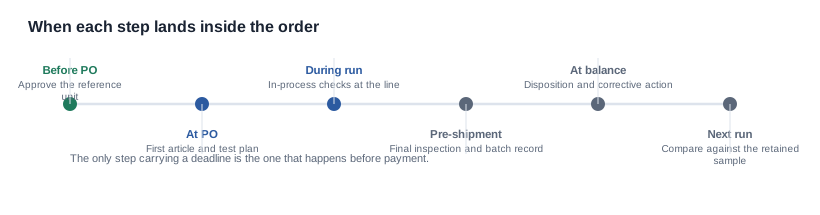
Notice where the deadline sits. Six of the eight steps are free if they are done in the right order and expensive if they are done late, and the one with a hard commercial deadline is the final inspection, because it runs against the payment term rather than against the production calendar.

The two questions that separate a quality system from a routine
Show the corrective action record for a fault you have seen twice
This is the most informative single question in this category. It separates a factory with a quality system from a factory that inspects, and it does so without any argument, because a corrective action record is a document that either exists or does not.
The wording matters. A fault seen twice is a fault with a cause; a fault seen once is a fault that may have been a one-off. Asking for the record on a single occurrence invites a supplier to explain it away, and there is nothing to contradict. Asking for the record on a repeated fault requires a named root cause.
The answers to expect fall into three shapes. A factory that hands over a record with a root cause, an action, a date and a result has the system. A factory that has a log but no root cause has a reporting habit. A factory that answers "we have not seen that twice" has answered a question you did not ask — and the correct response is to ask what they would do if it happened twice, and to write that down.
What does your sampling plan not check?
Every plan has an exclusion, and the exclusion is usually a decision rather than an oversight. A buyer who knows what is not being checked can decide whether that matters; a buyer who assumes everything is checked has simply not read the plan.
Common exclusions in this category are worth naming, because each one is a decision somebody made. Ingress protection, where a model publishes an IP marking but no test report. The case itself, where the case is in the box but not in the test plan. The charging contacts, where the unit is tested but the unit-and-case combination is not. Firmware update behaviour, where a unit is tested on the version it shipped with. The AI features, where a unit is tested for presence rather than for behaviour.
None of these exclusions is necessarily wrong. What is wrong is an exclusion nobody made deliberately and nobody told you about.
How to ask them so the answer is worth anything
Both questions are easy to ask and easy to answer with nothing. The technique that makes them productive is to ask for a document at the same time as the claim, so that the answer has a shape.
The first question is best asked as: show us the record, and tell us the date and the fault. A supplier who answers with a story is telling you the story is in their head; a supplier who answers with a record is telling you it is in their system. If the record is refused on the grounds of commercial sensitivity, the correct response is not to accept the refusal, but to narrow the ask — the fault, the root cause and the action, with the cost figures removed. Most suppliers will agree to that, because the parts you are asking for are not commercially valuable to them and are commercially valuable to you.
The second question is best asked in writing, before the sampling plan is agreed, rather than at a review meeting. A plan in front of you, with the exclusions visible, can be compared against another supplier's plan in a way that an answer in a meeting cannot. The comparison you want is not between two plans but between two plans and the requirement you wrote, because the requirement is the only document that states what actually matters to your programme.
The two questions together also tell you something a single question cannot. A supplier with a correction record and a stated exclusion is managing quality. A supplier with a correction record and no exclusions has not thought about what is not being checked. A supplier with no correction record and many exclusions is running an inspection routine and has been honest about its limits, which is better than the alternative but not what a consistency programme requires.

Where the method breaks down, and what a good answer looks like
The method fails in identifiable ways, and in each case the failure is traceable to a decision that was made earlier without being noticed.
The reference unit that is not the production build
Step one is the foundation and the failure here is invisible from the outside. A pre-production unit looks nearly identical to a production unit and behaves nearly identically in a demonstration, which is exactly why it gets approved. It differs in finish consistency, in firmware build, and in the parts that a production line sources differently from an engineering build. When the failure appears it appears as drift across the whole first order, and it is diagnosed as a supplier problem when it is a sample problem.
A good answer here is a build identity recorded against the reference unit, and a statement of whether the unit is from the production line.
The method that runs without a limit
A characteristic is agreed, a method is written, and no limit is attached. The result is a measurement on every unit and a decision on none. This is common because the limit is the hard part: it requires a judgement about what is acceptable that neither party wants to make in writing, and it is the point at which a quality discussion becomes a commercial negotiation.
A good answer is a limit that is written even if it is provisional, because a provisional limit that gets tightened is a working control, and no limit at all is a measurement programme.
The method that applies to one model
A quality system built for a single model does not survive a range. The characteristic that matters changes between an audio model, a camera model and a sport model: the failure modes are not the same, the published rows are not the same, and the case configuration that is part of the order for one model is absent for another.
A good answer is a method that names the characteristic per configuration rather than per company, and that gets re-written when the range changes.
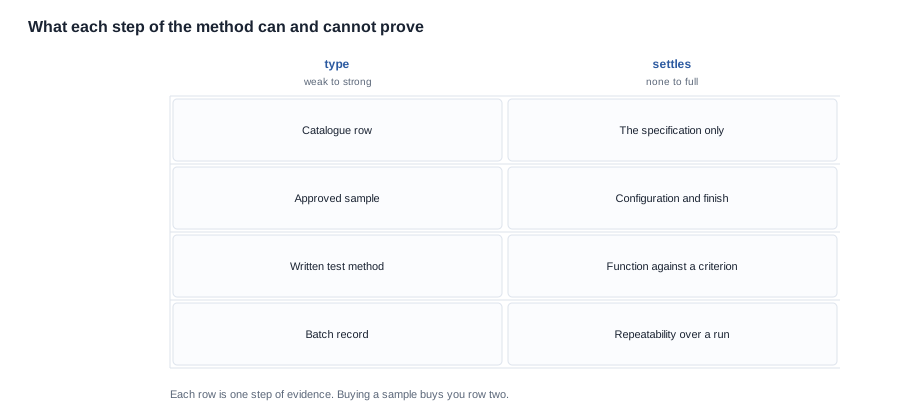
The matrix is the honest summary of the method. Buying a sample buys you the second row. The third row needs a method you write, the fourth needs a record the factory keeps, and the first row you already have. A programme that skips to the third row without the second has built a test on a moving target, and a programme that stops at the second row has bought a sample and called it a process.
The method that stops at the factory gate
The most common structural failure is not a missing step but a boundary drawn in the wrong place. The eight steps above describe what happens inside the factory that builds the goods. In this category, a substantial part of what determines the outcome happens before that: in the cell, the lens, the speaker and the chip. A factory can run all eight steps impeccably and still be unable to tell you whether the cell in a given shipment came from the supplier it was approved against, because the batch record on the factory floor records the lot the factory received, not the lot the cell maker produced.
A method that stops at the factory gate therefore produces consistency with respect to what the factory controls and no guarantee at all about the components inside. The commercial consequence is specific: the failure shows up as drift across a run, the returns data cannot attribute it, and the buyer's only remedy is a credit note rather than a fix.
The fix is not a factory audit. It is a component list written by part number, attached to the purchase order, with a written approval rule for any substitution, plus a change notification route with a named recipient and a notice period. It is a small amount of work and it is the only control that reaches past the gate. The same requirement appears in the worked example in this series, where a substitution at the same nominal capacity was invisible to every published row and took six months to find.
The method that is never re-read
A method written once and never revisited is a method that was written for a different programme. Ranges change, configurations change, and the characteristic that mattered two years ago may not be the one that fails now. The cheapest maintenance is a scheduled review against the current order book: which steps have not been executed in the last two runs, which records exist but are not being kept, and whether any step has quietly become a formality.
Buyers often discover this at the worst moment, when a dispute arises and the agreement turns out to describe a process nobody has run in a year. A one-page review, held once per half, is the cheapest insurance in the method.
The method that is never audited
A system that has never been checked from outside is a system whose effectiveness is unknown rather than a system that works. This does not mean a buyer needs to be on site. It means somebody should have asked, within the last year, to see the batch records and the correction records for a specific run, and compared them against what the returns data shows.
The comparison is the audit. If the batch records cover runs that produced no complaints, and the returns data covers a different set of runs, the two are not the same programme and one of them is not being kept. An external factory audit, where the scale justifies one, is covered in more detail elsewhere in this series; the point here is that the step exists in the method and has to be scheduled rather than assumed.

What to send us with your quality agreement
If you already have a quality agreement, a supplier evaluation form or a sampling plan, send it and we will tell you which of the eight steps it establishes, which ones it treats as a formality, and where the gaps sit. That reading is free and it is the fastest way to find out whether the agreement matches the process the factory actually runs.
If you do not have one yet, the useful starting point is the published specification set for the models in the programme, because it tells you which characteristics can be written as absolute limits and which have to be written as comparisons against a reference unit. Our position is that we publish the product configuration and the capability gaps, and that we will not publish a defect rate or a yield figure for a product we have not measured across a production series. We will also not present a first-article pass as a consistency claim, because a single pass is a fact about one unit and a consistency claim is a fact about a run.
The framework is under quality consistency, the contract clauses that carry it are in contract checklist, and the acceptance side is in certification buyer checklist.
Related reading
- How it is structured — quality consistency
- The contract clauses — contract checklist
- The acceptance side — certification buyer checklist
Send us your quality agreement and we will tell you which of the eight steps it establishes, which of them it treats as a formality, and what smart glasses quality consistency still has to prove.


