

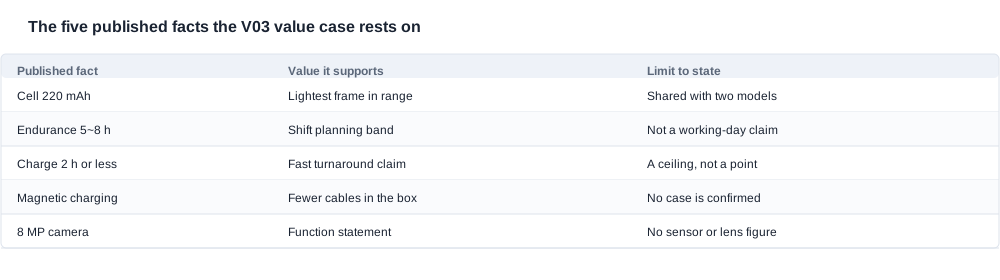
The V03 smart glasses earn their money in one place — the entry point of a camera range on the lightest platform in it — and lose it in another, because they publish no feature that a customer can see. The published configuration is 8 megapixels, a 220 mAh cell, a charge time of 2 hours or less, an endurance range of 5 to 8 hours and magnetic charging, with no colour list, no lens option and no weight.
That is an unusually honest starting point for a value argument, and it forces a buyer to build the case on something other than a specification advantage. This page sets out where the value genuinely sits, where the same value argument collapses, and how to test both before you commit money to a range.
V03 smart glasses value: the four branches that decide the answer
Value is not a property of a product; it is a property of a purchase. The same row reads as excellent value for one buyer and as poor value for the next, and the variable is not price. It is what the buyer has to defend to somebody else.
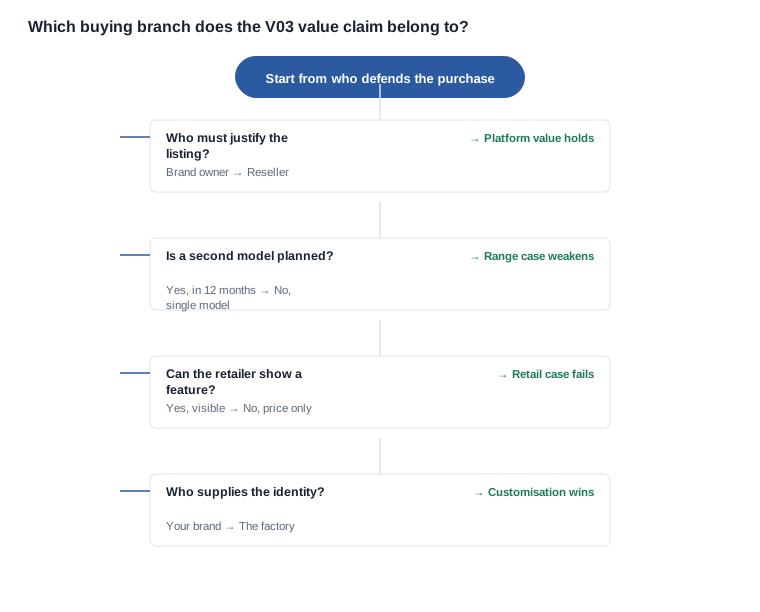
A brand owner who must justify a private-label range needs a platform she can build upward from, a shared accessory family and a documented customisation path. A reseller who must defend a specification on a storefront listing needs something the customer can see. A distributor who must move volume through a channel needs the cheapest parcel and the shortest qualification cycle. A programme that must survive a compliance review needs documents, not claims.
Is the lowest delivered cost the argument? Then the V03. 220 mAh is the smallest cell in the camera range, shared with the V03 Pro and the MT5, so the frame is the lightest here and the parcel is the cheapest to move. The shipping weight breakdown covers the arithmetic, and the entry level options analysis sets out the tier.
The saving is real but bounded, and it is worth being clear about where the bound sits. A smaller cell reduces unit weight, which reduces parcel weight, which reduces freight per unit — but freight is rarely the largest line in a landed cost calculation for a product at this size. The larger effect of platform sharing sits in qualification cost: one camera specification confirmed once serves three models, so engineering, tooling and compliance spend is amortised across the range instead of repeated per model. A buyer who models only freight will conclude the V03 saves almost nothing. A buyer who models qualification cost reaches a different answer, and for a brand building a range the second answer is usually the right one.
Is the product for a range on the entry platform? Then the V03, and the platform sharing is what makes it affordable. The 220 mAh tier serves the MT5 and the V03, and the V03 Pro, with a shared app, a shared firmware branch, a shared accessory family and a shared certification file. The model readiness overview maps the sharing, and the scaling up piece covers what each additional model costs.
The decision this branch turns on is whether the range you are building will actually contain more than one model. If it will, the platform argument is strong: the second and third models inherit the app, the firmware branch, the accessory kit and the documentation, so the marginal cost of extending the range becomes a tooling and artwork cost rather than a development cost. If it will not — if this is a single-model sale dressed as a range — the platform argument buys nothing, and the case rests on the other branches instead. Buyers who have never asked that question before signing tend to discover it at the second order, when the second model costs as much as the first.
Does the customer need a visible feature? Then not this model. The V03 Pro, on the same platform, publishes a photochromic lens, flexible temples, three colourways and a Type-C interface that removes the accessory from the box entirely. The how to customise the V03 Pro piece covers that model, and the V03 Pro versus CY05 price positioning covers the tier above.
This is the branch where the value argument usually fails, and it fails quietly. A retailer with a shelf or a storefront listing has to answer a question the catalogue never answers: why this one. If the answer is "it is cheaper", the retailer is now competing on price against models with a visible differentiator, which is the least profitable position available in this category. If the answer is "it is the same inside", the retailer has to prove sameness, which requires a published specification, and none is published. The absence of a visible feature is therefore not neutral; it removes the retailer's easiest sales argument and makes price the remaining one.
Is the product for a brand supplying its own identity? Then this model works well. The seven documented customisation axes sit on this platform — logo, colour, packaging, temple shape, system and UI, Bluetooth name and firmware — and the absence of a published differentiator means the brand supplies all of the difference, which is a legitimate position for a private-label programme. The AI camera glasses customisation options piece covers the axes.
This is the branch where the absence of a published differentiator stops being a weakness. A brand intending to put its own identity on the product does not need the factory to publish a differentiator, because the differentiator is the identity. What it needs instead is documented control over the axes it intends to change, which is a different question from what the catalogue prints. The seven axes are the answer to that question, and they are worth more to this buyer than a published differentiator would be.
What each branch costs to be wrong
The four branches are not equally recoverable, and the recovery cost is what a procurement manager should weigh when the answer is not obvious.
The cheapest branch to be wrong in is the range branch, because the discovery arrives late but the remedy is ordinary. If the second model turns out to cost as much as the first, the programme loses the amortisation it was counting on and continues with a single model, which is a worse position than not having planned a range at all but not an unrecoverable one.
The visible-feature branch is more expensive to be wrong in, because it fails at the point of sale rather than at the point of ordering. A listing with no feature to point at converts badly, and the returns and margin data arrive after the inventory commitment, which is the worst time to learn that price was the only argument available.
The private-label branch is the most expensive, and not because of tooling cost. If the seven axes turn out to be less controllable than documented, the brand has printed packaging carrying an identity it cannot deliver consistently, and that failure surfaces at the customer rather than in a review meeting.
The cost branch is the least dangerous of the four, because a delivered-cost shortfall is visible in the quotation before anything is committed. It is also the branch where buyers most often fool themselves, by modelling freight per unit and omitting the qualification spend that platform sharing actually eliminates.

What the value case can be built on
The cell tier. The lightest frame and the cheapest parcel in the camera range, and the platform a brand can build a range upward from. The tier is the part of the value case that survives contact with a competitor, because a smaller cell is a physical fact rather than a marketing position.
The endurance range. 5 to 8 hours, a range rather than a point, which is the more honest disclosure even though it is the less flattering one. The how to compare battery life method covers what to ask. A range costs a buyer something in the copy, because a retailer wants a single number, and it buys something in the risk register, because a point figure invites a dispute that a band does not.
The absence of a camera claim to defend. The V03 publishes no lens, no colour list and no protection marking, so there is nothing in the copy that a customer can disprove. This is the most underrated item on the list. A specification advantage is something a competitor can match by the next production run, whereas a claim you did not make cannot be tested, and the defect and returns conversations that follow a missing claim are far cheaper than the ones that follow a published figure that a customer measures differently.
Two further items belong on this list even though they are not product features.
The shared customisation path. Seven documented axes on one platform mean that a private-label programme can change identity, interface and packaging without changing the product underneath. That is what turns a single-model purchase into a range programme, and it is the difference between a supplier relationship that has to be renegotiated for every model and one that is renegotiated once.
The single qualification cycle. Because the app, the firmware branch, the accessory family and the certification file are shared across the tier, the compliance and engineering work for the second and third models is a review rather than a project. For a buyer modelling three years of channel volume, that avoided project cost is usually larger than the unit price difference the value argument is nominally about.
There is one item that belongs on this list and almost never is. The absence of published commercial terms — no price, no MOQ, no lead time, no warranty period — is usually treated as an inconvenience to be closed by a quotation. For a value argument it is an advantage, because every one of those terms is still negotiable at the point the buyer is ready to commit. A buyer who arrives with a value case already priced has given away the only leverage the partial row creates.

What it cannot be built on
A specification advantage. Every published row it has is shared with at least two other models. That is a structural fact about the tier, not a gap in the documentation, and no amount of additional supplier questioning will make 220 mAh or 5~8 h unique to this model. A value argument built on parity cannot survive a competitor who publishes the same figures at a lower price.
A comfort or portability claim. No weight is published, and it cannot be borrowed from the MT6 or any neighbouring model. The weight comparison across the range explains why. Weight is the field most often supplied by a distributor from a neighbouring row, and it is the field most likely to produce a returns problem, because a customer who receives a heavier unit than the listing promised will treat it as a quality issue rather than a specification error.
A picture quality claim. 8 MP with no sensor model, no field of view and no video format. The camera imaging notes cover why that matters. A resolution figure on its own describes a number rather than an outcome, and in this category it is the specification most often compared across brands as though it were comparable, which it is not when the sensor and the lens differ.
Two claims that buyers frequently want to add, and cannot.
An ingress protection claim. The catalogue attaches IP ratings to specific models, and the V03 is not among them. A protection claim that cannot be evidenced is a defect waiting to be reported, and in a hardware category it is also the claim most likely to be tested by a customer who simply runs the unit under water.
A case-in-the-box claim. The row carries no charging case field, so the box contents are not confirmed. This matters more for value than for specification, because the in-box contents are the most common basis on which two entry models are compared in a channel negotiation, and a claim made here that the factory does not honour becomes a fulfilment cost rather than a sales asset.
Two failures are worth naming because they look like strength from the inside.
A volume argument built on the tier. Being on the smallest cell in the range does not make the V03 the cheapest model at your volume. Tooling, artwork and compliance are fixed costs amortised across whatever quantity you actually buy, and a higher-priced model at a much larger volume can produce a lower cost per unit than an entry model at a small one. Value is a function of the order you place, not of the tier the model occupies.
A margin argument built on a low quotation. A low entry price that the factory later revises, or that a channel partner treats as the permanent list price, produces a margin that cannot be defended. Buyers who negotiate the unit price down hard without fixing the warranty, the accessory contents and the lead time in the same conversation frequently find that the saving has been spent twice: once on the price, once on the returns that follow an unagreed specification.

How to test the value claim before you commit
A value claim is testable, and testing it before the purchase order is the difference between a price negotiation and a dispute. Four tests matter, and they are cheap relative to what they prevent.
Test the total cost, not the unit price. Build the landed cost per unit from the quotation, adding packaging, freight, duty, the charging accessory if any, and the amortised cost of tooling and artwork. Then add the qualification cost: the engineering time, the compliance spend and the documentation work that the shared platform saves. For a three-model range, that last line is usually the largest, and it is the line most often left out of a value comparison. A quotation that looks uncompetitive on unit price can be the cheapest option on total cost, and the only way to know which is to write both numbers down.
Test the range assumption. Before you claim that the V03 is the entry point of a range, write the second and third models on a single page with their expected volumes and their incremental costs. If the incremental cost of model two is roughly the cost of tooling and artwork, the platform argument holds. If it resembles the cost of model one, the range argument is decoration and the decision should be made on the other branches.
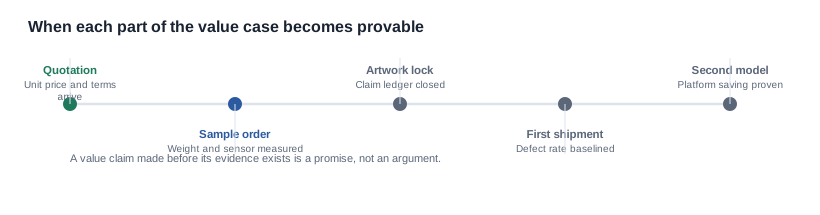
Test the claim set against the artefact set. Take the claims your product page will make, put them in a ledger, and mark each one with the document that authorises it. The published V03 specification list is the honest baseline to work from, and the entries with no authorising document are the ones that will move onto a retailer listing by accident. This test usually removes more claims than it keeps, and it does so before printing.
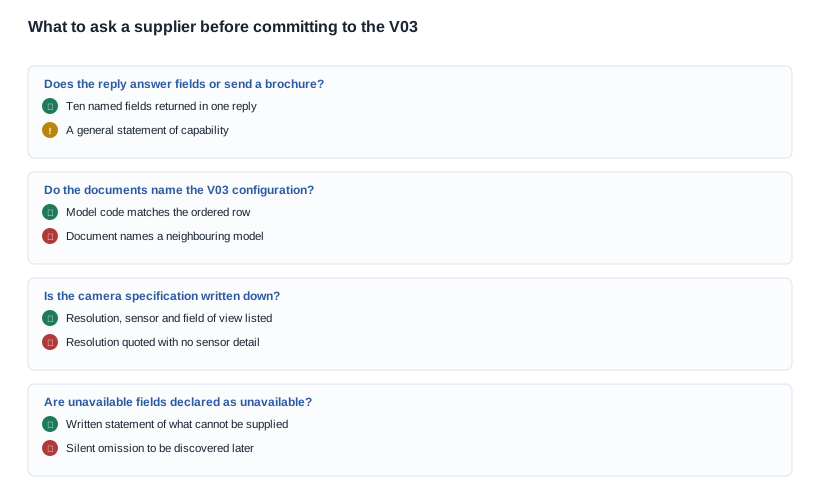
Test the supplier on the open items. The five open items listed below are the ones that decide whether the value case survives. A supplier who answers all five in writing, attaches documents naming the V03, and states plainly which are unavailable has given you something to build on. A supplier who answers with a general statement has given you a marketing asset instead.
Test the negotiation while you still have leverage. The value case is strongest before the first deposit, because the published row leaves price, MOQ, lead time, payment terms and warranty entirely open, and every one of those is a term rather than a fact. Write down which terms you would trade in which order, and take them in that order rather than starting with unit price, because a factory that concedes the unit price early has less left to give on the terms that decide whether the programme is workable.

The judgement we are willing to defend
The V03 is a good entry platform for a brand that supplies the identity and a poor choice for a reseller selling on specification, because nothing it publishes is unique to it. We will not present 8 MP as an image quality claim, we will not present the 5-to-8-hour range as a working day, and we will not quote a weight, a colour, a case capacity or a certificate number that the documentation does not contain. The published V03 specification list is the honest baseline, and the who should buy the V03 analysis covers the buyer fit.
Five things to close before the value case is made
- The camera specification, closed once for the 220 mAh platform.
- The endurance test condition behind both ends of the range.
- Frame weight, dimensions and the colour list.
- The charging accessory, its capacity and the packed unit weight.
- The certification position for the V03 in each destination market.
Each of those five is a question with a named answer rather than a paragraph of general caution, and each one is a line item in either the claim set or the cost model. Closing them converts the V03 from a plausible entry point into a defensible one, and it is the only route by which a value argument built on this row can be published without borrowing a number from somewhere else.
Related reading
- The specifications this model publishes — V03 smart glasses specifications and features
- The tier it belongs to — AI camera glasses entry level options
- The differentiated model on the same platform — how to customize V03 Pro smart glasses
Send us the channel, the target price band and the volume, and we will tell you whether the V03 is the right entry point for a range whose identity you supply.


