

Some smart glasses payment terms conversations are worth having and some are not, and the difference is not the credit period. It is where the risk actually sits. The terms you negotiate — the split between deposit and balance, the tenor, the method, the currency — are instruments for allocating a risk. If the risk is already controlled by other means, or if the exposure is small enough that the negotiation cannot change the outcome, the conversation is a formality. The milestone structure, on the other hand, is never a formality: the event that triggers each payment is what gives you the right to refuse the goods, and that has to be defined regardless of the credit period.
We publish no payment terms, because terms are a bilateral commercial agreement rather than a fact about a product. What follows is how to work out whether the negotiation is worth having, and what has to be written down either way.
Smart glasses payment terms: the negotiation and the structure are different things
Buyers routinely treat payment terms as a single item to be settled in one exchange, and that is why they either over-invest in it or under-invest in it. In this category there are two separable things, and confusing them produces the two common errors: a buyer who spends three weeks negotiating a percentage split that does not matter, and a buyer who accepts a standard terms sheet without noticing that the payment trigger does not line up with the acceptance right.
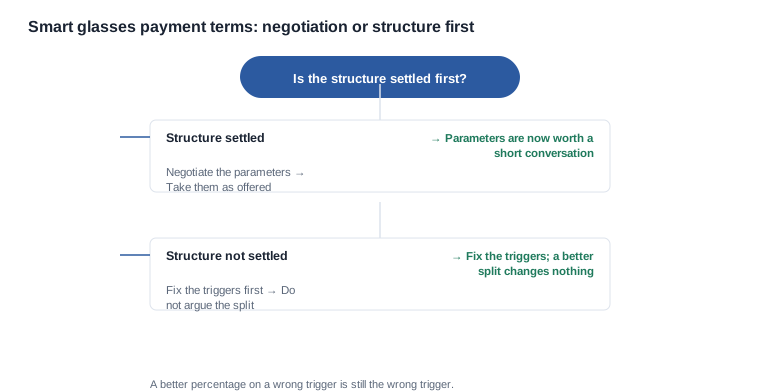
The structure is the set of events that trigger each payment and what happens to each event. It answers: what has to be true for the deposit to be paid, what has to be true for the balance to be paid, what happens to the money if the goods are rejected, and what happens to the goods if the money is not paid. The structure is the part that determines whether the buyer can inspect before committing the larger part of the money.
The negotiation is the adjustment of the commercial parameters within that structure. It answers: what proportion is paid up front, how many days of credit are given, in which currency, through which method, and on what terms if the payment is late. These are real but they are second-order, because they only matter once you have established that the structure is right.
The order of work follows from that. Decide the structure first, because a buyer who has agreed a structure in which the balance is paid before inspection has already given away the right that the structure was supposed to protect. Then decide whether the parameters need negotiating. A buyer who does it the other way round ends up negotiating a better split on a structure that transfers all the risk to them.
There is a third thing that is often folded into the same conversation and does not belong in it: the price. The pricing checklist lists what a comparable quotation has to contain, and one of the items is the payment structure, because a unit price quoted against one payment structure and another unit price quoted against a different one are not comparable. That is a comparison problem rather than a terms problem, and it is easier to fix by holding the structure constant than by arguing about terms.

Smart glasses payment terms: find out where the risk is actually sitting
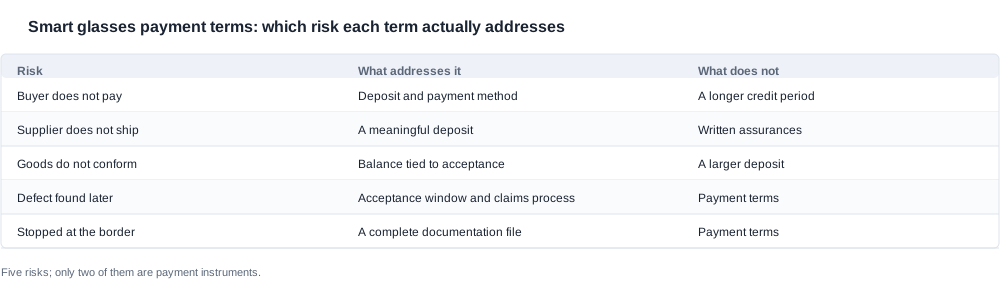
Before deciding whether to negotiate, a buyer has to be able to say what the terms are protecting against. There are four risks in a first-order transaction of this kind, and each is controlled by a different instrument, which is why a single negotiation cannot cover all of them.
The risk of not paying
The buyer fails to pay, or pays late, and the supplier is exposed for the goods already in production. This is what the deposit and the method address. It is the risk the buyer has least ability to assess, because it depends on the buyer's own treasury discipline rather than on the supplier's behaviour.
The risk of not shipping
The supplier takes the money and does not deliver, or delivers late. This is what a payment instrument addressed at the supplier's performance addresses, and in this category it is usually addressed by paying a meaningful deposit rather than by paying nothing, because a credit term extended to an unproven supplier transfers the risk without buying any additional protection.
The risk of receiving the wrong goods
The goods arrive and do not conform to the specification or to the approved sample. This is the risk that the milestone structure addresses, and it is the one most often left unprotected by accident, because a structure that pays a deposit and a balance on shipment leaves no point at which the buyer is holding the goods and has not yet paid for them.
The risk of a defective batch discovered later
A defect that shows up in the channel rather than at incoming inspection. This is the risk that the acceptance window, the inspection reference and the claims process address, none of which is a payment term, and a buyer who thinks the payment structure covers it is mistaken.
A fifth risk sits outside the negotiation entirely: the risk of a documentation or market-access gap that stops the goods at a border. That risk is controlled by the file, not by the money, and a buyer who improves the payment terms instead of completing the documentation has addressed the wrong exposure. The payment terms overview sets out the commercial structure these instruments sit inside.
There is a fifth perspective that belongs in this list, and it is the treasury view rather than the procurement view. A terms conversation is often really a question about the buyer's own working capital cycle, and the two parties can spend weeks negotiating parameters when the real question is internal. Before the negotiation starts, it is worth asking which of the four risks the buyer actually wants to reduce and whether the parameters reduce it. A deposit proportion reduces the supplier's exposure to the buyer's credit, which is a risk the buyer may not be able to assess at all. Extending the balance moves cash from the supplier to the buyer, which improves the buyer's position and improves the supplier's position simultaneously, and is therefore the parameter least likely to be reduced in negotiation. A currency or method change alters the cost and the delay of the payment rather than the risk, which makes it a treasury decision dressed as a terms negotiation. Once the risks are separated in this way, the negotiation becomes much shorter, because most of it turns out to have been an internal question.
Once the risks are separated, the negotiation question becomes answerable. If the exposure that the parameters would reduce is already controlled — because the buyer's own credit is not a risk to the supplier, because the order is small enough to be immaterial to either party, or because the buyer has an existing relationship in which the parameters are already known — then the parameters can be taken as offered. The structure still has to be written down.
Smart glasses payment terms: the milestone structure that is never skippable
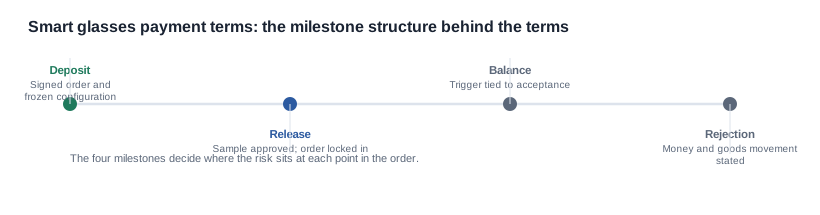
Whatever happens to the negotiation, four things have to appear in the order, and they are the four that determine whether the buyer can protect itself at the moment it matters.

- The deposit trigger. What has to be true for the deposit to be paid — a signed order, a confirmed configuration, an agreed artwork file. A deposit triggered by a conversation is a deposit triggered by a misunderstanding.
- The production release. The point at which the order becomes irrevocable for the supplier, and what the buyer gives up at that point. This is the milestone where the risk genuinely transfers, and it should not be earlier than the point at which the configuration is frozen and the sample approved.
- The balance trigger. The event that makes the balance payable. Shipment, arrival or acceptance are three different events with three different risk profiles, and the difference between them is the whole point. A balance triggered by shipment is a balance the buyer pays before it has seen the goods; a balance triggered by acceptance is a balance the buyer pays after it has a contractual right to reject.
- The rejection consequence. What happens to the money if the goods are rejected, and what happens to the goods if the buyer rejects them. This is the clause that turns the acceptance right into a remedy rather than a complaint, and it is the clause most often absent from a supplier's standard terms.
The contract clause answer works through the same logic from the document side, and the key is that the acceptance clock and the balance trigger should be the same event. Where they are not, the buyer has paid for the right to complain rather than for the right to refuse, and the difference between those two is the whole commercial value of an inspection.

Smart glasses payment terms: when the negotiation is worth having
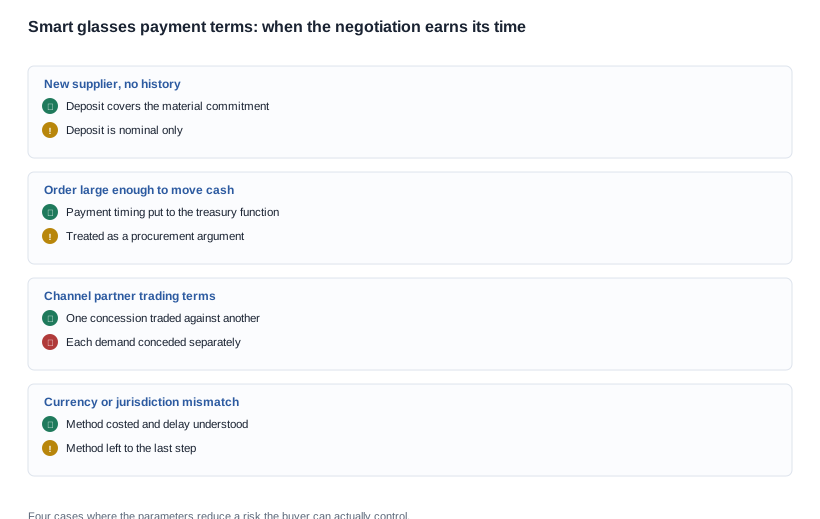
There are four situations in which the parameters matter enough to spend time on, and they share a feature: the risk they reduce is real and the buyer has the standing to reduce it.
A first order from a supplier with no history
Here the supplier's performance is genuinely unknown, and the deposit proportion is the instrument that decides who carries the risk of a production run that does not complete. The question to ask is not for longer credit but for a deposit large enough to cover the material commitment on the supplier's side.
An order large enough that the cash cycle matters
At a certain value the gap between paying on order and paying on acceptance is a working-capital problem rather than a negotiating point, and it belongs in the treasury conversation rather than the procurement one. The payment terms buyer profiles article covers who this is actually relevant for.
A channel partner who will trade terms for price
A channel that asks for better payment terms will also ask for a better price, a longer warranty and free samples. A buyer who has not decided which of those they would trade ends up with the worst of each, which is a pricing failure that arrived wearing a terms disguise. The pricing negotiation guide covers how to hold the trade-offs apart.
A currency or jurisdiction mismatch
Where the supplier and the buyer are in different currencies or different legal systems, the method of payment carries its own cost and its own delay, and the parameters that would otherwise be routine become worth a conversation. This is the case where a payment instrument genuinely changes the risk position rather than just the cash timing.
Against those sit the situations where the parameters are agreed as offered. An existing supplier on an existing payment structure, where the buyer knows what happens when a payment is late because it has happened. A small trial order, where the exposure is smaller than the cost of the treasury conversation. And a buyer whose own credit is the risk in question, where the answer is not to negotiate the supplier's terms but to fix the buyer's own process.

Smart glasses payment terms: when the negotiation can be skipped safely
The conditions under which the parameters can be taken as offered are worth stating as a positive rule, because "skip the negotiation" is a decision that has to be defensible later.
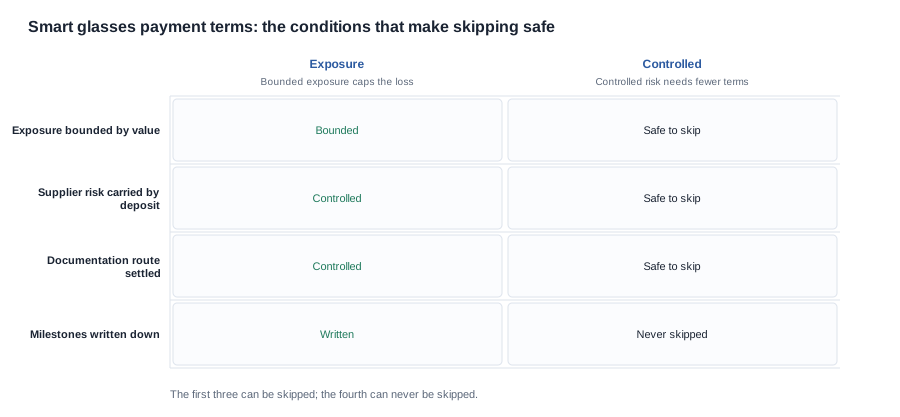
The negotiation is safe to skip when all four of these hold. The exposure on the order is bounded by the order value and is small relative to the buyer's own working capital. The supplier's performance risk is controlled by a deposit or a milestone that the buyer has already accepted. The documentation route is settled, so the risk of a border hold is not being managed through payment. And the milestone structure has been written into the order regardless of what was negotiated, because that part is never skipped.
The failure mode of skipping is not that a bad deal has been accepted. It is that a structure with the wrong trigger has been accepted, and nobody noticed because the parameters looked reasonable. The practical defence is to record, in the order file, which of the four milestones were decided and which were inherited unchanged from a standard terms sheet — because inherited terms are the ones nobody has checked against the acceptance right.
A second failure mode is the timing. A buyer who skips the negotiation on the assumption that the terms are standard may discover at the second order, when the deposit proportion changes, that the structure was never written down and that the change was made on the basis of the relationship rather than on the basis of an argument. The MOQ how it works article makes the same point about standing arrangements in a different context: the terms that get inherited are the ones that get skipped.
Smart glasses payment terms: a strong balance sheet, a slow cash cycle
The scenario below is a reasoning exercise rather than a customer story. No client is described and no figures are claimed; the order, the destination and the terms are assumed so that the reasoning can be followed, and every product fact referenced is taken from the published catalogue.
The situation: a strong balance sheet and a slow cash cycle
A brand-side procurement manager places a first order of a catalogue audio model in one colour, in a quantity that is modest for the brand, for a market where the documentation route is already known. The brand's balance sheet is strong and its credit is not a risk to the supplier. Its own cash cycle, however, is long: it pays its channel partners on a cycle that runs behind its own receipts by a quarter.
The temptation
The buyer sees that the supplier's terms are a deposit and a balance on shipment, and concludes that extending the balance to ninety days would solve the cash problem. That conclusion is wrong, and the reason is worth working through because the same reasoning is common.
Step one: separate the four risks. The risk of the buyer not paying is not real here, because the buyer's credit is not in question. The risk of the supplier not shipping is partially addressed by the deposit, and extending the balance does not improve it. The risk of receiving the wrong goods is a structural problem, and the answer is to move the balance trigger from shipment to acceptance, not to move it later in time. The risk of a documentation gap is not present, because the route is known.
Step two: work out what extended terms actually buy. Extending the balance to ninety days transfers ninety days of supplier working capital to the buyer, which is a real benefit and is also a real cost to the supplier, who will price it. For a modest order, the benefit to the buyer is a modest cash improvement and the cost is either a higher unit price, a smaller deposit, or a refusal. None of those is a win.
Step three: fix the structure instead. The buyer's actual problem is that money moves before it has inspected the goods. Moving the balance trigger from shipment to acceptance costs nothing to negotiate in a supply-constrained market and delivers a real improvement in risk. The sample policy answer explains why a sample is the instrument that makes acceptance meaningful in this category, and the shipment documentation article covers the file that has to be complete before the booking is made.
Step four: check the terms against the buyer's own cycle. Before agreeing that longer terms are wanted, the buyer establishes what the cash position actually is. A brand whose receipts run a quarter behind its payments is not helped by a supplier's terms moving by thirty days, because the binding constraint is internal. In that case the improvement has to come from the milestone structure and from the order size, not from the tenor. The MOQ how it works article makes the same point in a different context: the terms that get inherited are the ones that get skipped.
Step five: decide what is actually negotiated. The parameters are taken as offered, because the exposure they would reduce is either absent or already controlled. A 1.6% cost of funds on a modest order is not worth a week of treasury time, and the week is the real price of the negotiation. The balance trigger is moved to acceptance, the acceptance window is written into the order, and the rejection consequence is stated. The decision to skip the negotiation is recorded with its reason, and the four milestones are listed in the order file so that the second order starts from a check rather than from an assumption.
Step six: set the review trigger. The file records what would reopen the terms conversation: a second order of a different configuration, a supplier change, a move into a market with a different documentation route, or a channel partner who asks for terms as part of a wider trade. Without a trigger, the decision to skip becomes a permanent assumption, and the assumption is usually wrong at exactly the moment it starts to matter. The pricing practical advice covers the same discipline for the commercial terms that sit alongside the payment ones.
The boundary we hold: we publish the configurations that exist and the electrical and physical rows that determine what has to be built, and we do not publish payment terms, unit prices, minimum order quantities, capacity figures or lead times. Terms are agreed between two parties and we will not present a set we have not agreed as a published policy. What we can do is set out the milestones against the product's actual behaviour — which configurations produce which documents, and what a unit in this range physically is — so that the structure reflects what will really happen in the factory.
If you want to work through a specific order, send the model, the configuration, the quantity, the destination market and the cash cycle you are working to, and we will tell you which of the four milestones actually carries the risk on that order and which of the terms you would be negotiating would change anything.


