
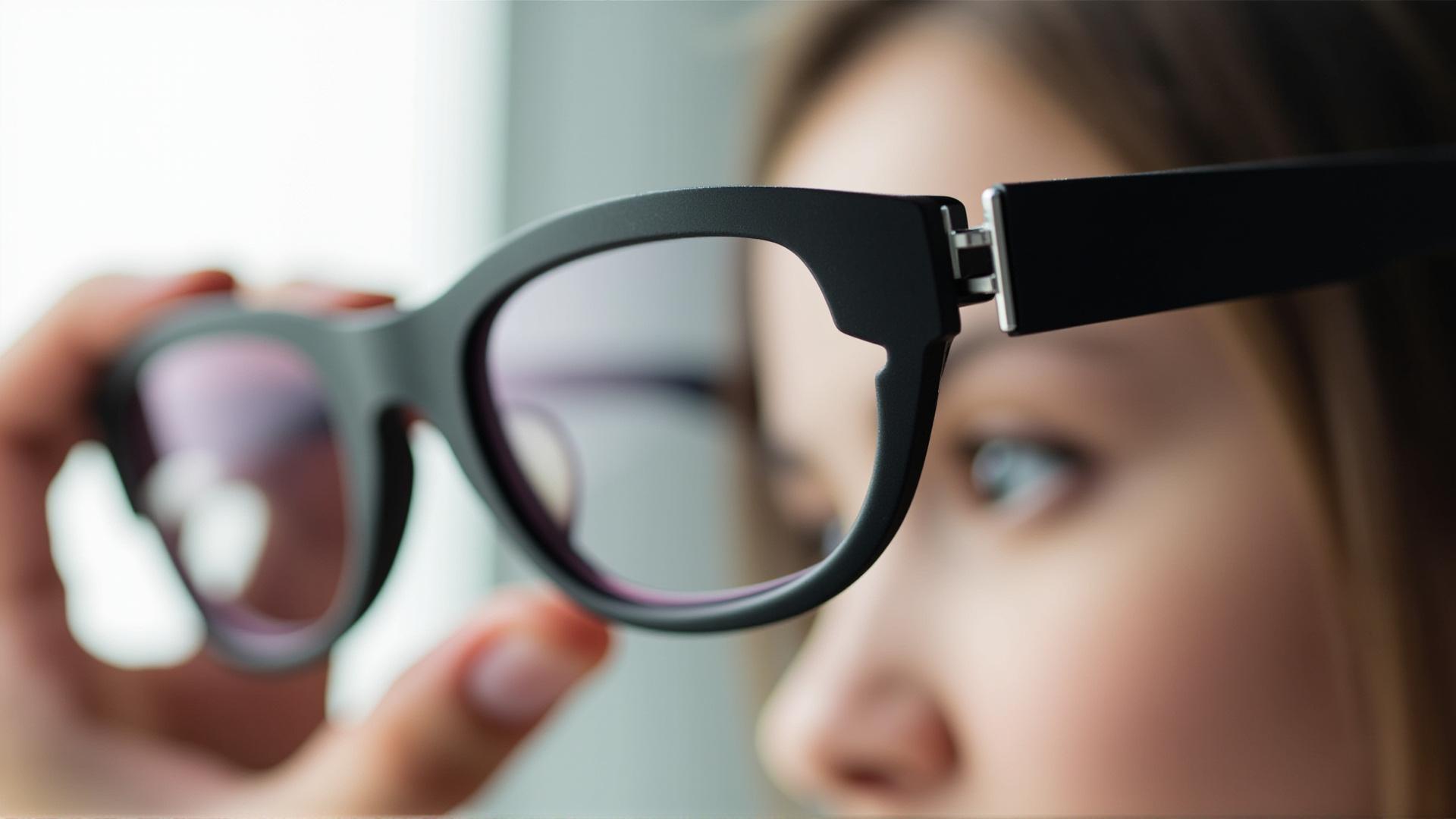
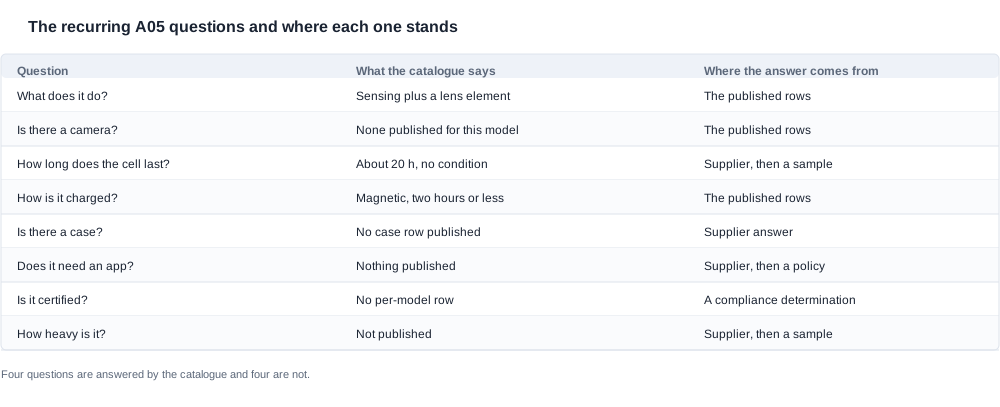
The A05 smart glasses are a camera-free children's protection model with a lens-type electronic fogging element, posture and distance sensing, a 40 mAh cell, magnetic charging and a published endurance of roughly twenty hours. Eight questions come up repeatedly in this category. Four of them the catalogue answers, and four it does not — and the four it does not are the ones that decide whether a listing can go live or a tender can be scored.
This article sets out those eight questions in the order a buyer should ask them, with three parts each: what the catalogue publishes, what it does not, and the one thing that closes the gap.
A05 smart glasses and the seven questions that keep coming back
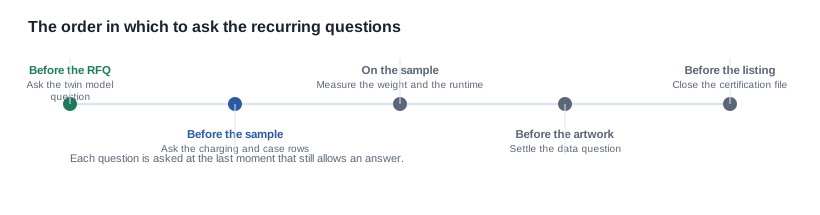
Three kinds of question, and they close in different ways
Every question that reaches a supplier in this category belongs to one of three kinds, and the kind decides how long the answer takes and who has to give it.
Specification questions are answered from published rows. What is the cell capacity, what is the charging method, is there a camera. These close immediately, at no cost, and there is no reason to delay them.
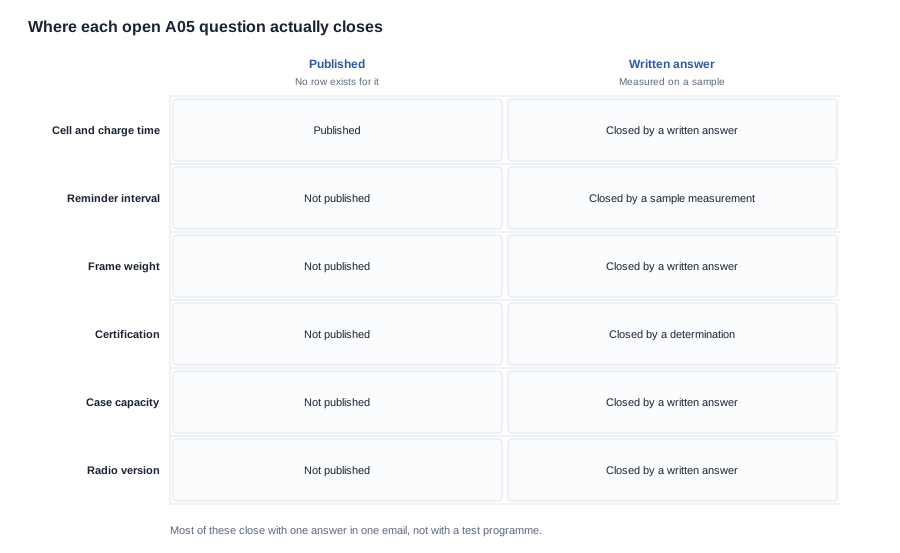
Supplier question s are answered by someone who holds information we do not publish: the weight in grams, the input current, whether a charging case exists at a quantity, whether the A05 and the A06 differ. These close with one written answer, and the only difficulty is that a buyer who does not ask will never have it.
Determination questions are answered by nobody in the supply chain except the buyer: is this product compliant for my market, with my age band and my labelling. These do not close with an email at all. They close with a categorisation, a test programme and a date, and the position of the model in the supply chain makes no difference to them.
The mistake buyers make in this category is treating all three kinds with the same urgency and the same method. A determination question asked at the last minute is a launch delay. A specification question asked at the last minute costs nothing, because it was never a risk in the first place.
The four the catalogue answers and the three it does not
The A05 publishes five rows on its page: a lens-type electronic fogging element, a 40 mAh cell, a charge time of two hours or less, roughly twenty hours of rated use, and magnetic charging. Alongside those it carries two sets of functional illustrations, one contrasting correct and incorrect posture and distance, and one contrasting a clear lens against a fogged one. No camera is published for this model.
That answers four recurring questions outright: what the product is, whether it records, how it is charged, and roughly how long the cell lasts.
It does not answer the four that matter commercially: what the reminders actually do, where the detection data goes, what the frame weighs and who certifies it for the destination market. The A05 certification status sets out the fourth of those in full, and the A05 specifications list is the baseline behind all of them.
The question that gets appended to every other one
There is a ninth question that arrives after the other eight, usually in a second email, and it is the one that decides whether the range works: how does the A05 differ from the A06?
Our own documentation records the difference between the two as an open item, and the two publish identical rows — the same 40 mAh cell, the same two-hours-or-less charge ceiling, the same roughly twenty hours, the same magnetic charging, the same lens element and the same sensing illustrations. They also carry the same catalogue product name, that of a children's smart protection model, with only the designation differing.
That makes it a question with two possible answers and both of them are useful. If they are the same product under two designations, the range decision is simpler and the compliance work is one set rather than two. If they differ on something that is not published — a colour, a fit revision, a shell design, a firmware revision — then that attribute is the only thing you can position on, and it needs to be in writing before any artwork exists.
The A05 versus A06 specification comparison works through what the possible answers mean for a range, and the answer takes one email and one reply.
What the product does, and how the sensing is described
The published functions and the illustrations that accompany them
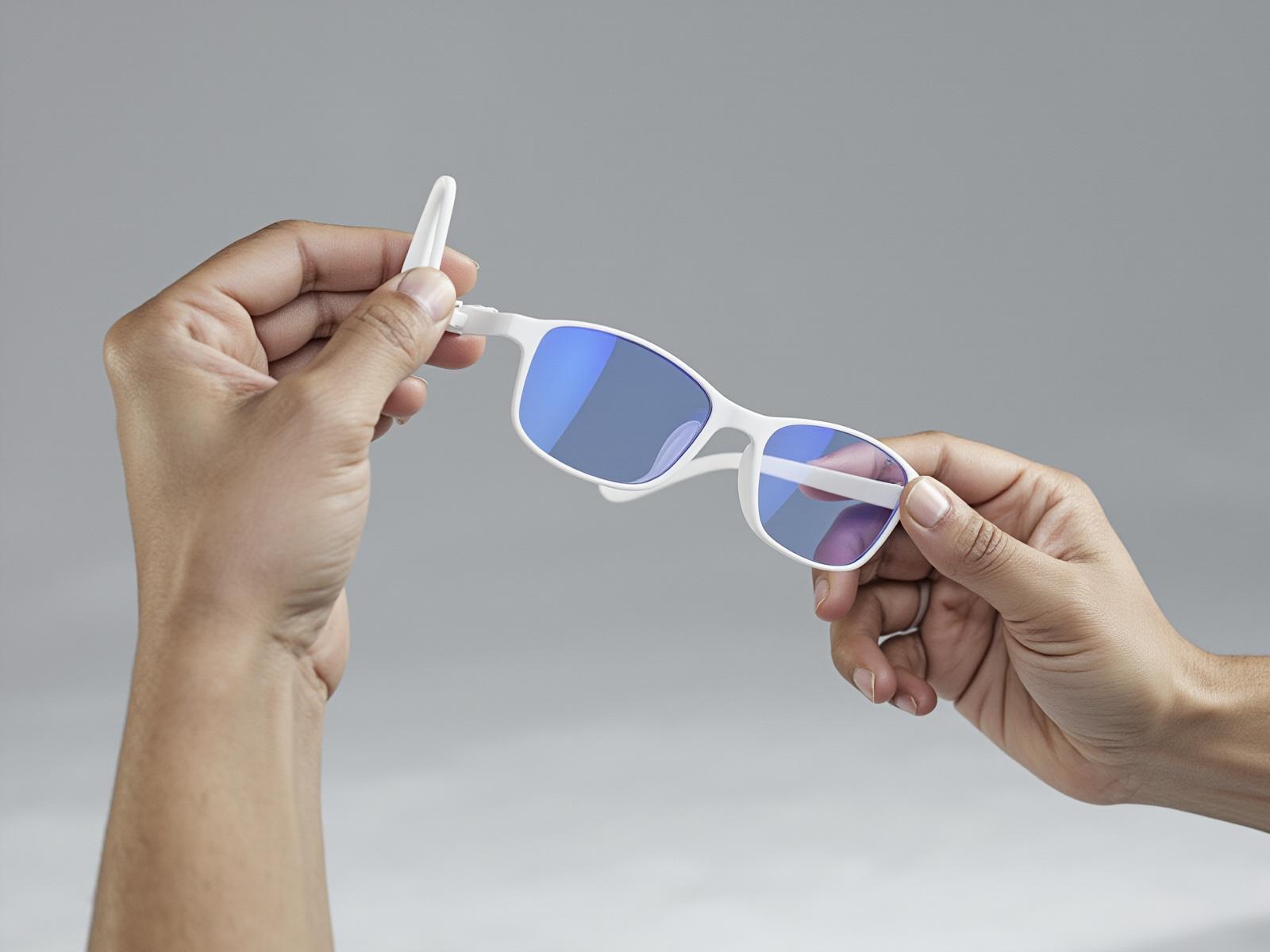
The published functions of the A05 are a lens-type electronic fogging element and posture and distance sensing. The catalogue illustrates both: a correct and an incorrect posture and distance, and a clear lens beside a fogged one. The illustrations are the closest thing this model has to a functional description, and in a category where no product photograph, no video and no test report exists for any model, they carry more weight than their simplicity suggests.
Two commercial facts can be drawn from them directly. The first is that the detection state is visible on the lens, which means the feature can be demonstrated and photographed, which is what a product page needs. The second is that the fogging element has a visible state, which means it is a demonstrable mechanism rather than an invisible one, and that a buyer can check it on a sample in a minute.
The A05 versus A07 comparison covers the functional split within the category, and the posture monitoring analysis goes into the detection question in more detail.
The four things the illustrations do not settle
An illustration shows a state. It does not show a threshold, and in this category that gap is the whole of the commercial risk.
The threshold at which a reminder fires. Not published. A product with a reminder interval has to be specified somewhere, and if it is not specified it is set by a default, and if the default is wrong the product fails silently.
Whether a reminder can be dismissed or disabled. Not published. This decides whether the product is a persistent reminder or a configurable one, and it decides the copy on the product page.
Whether the reminders are configurable from a parent device. Not published, and this is the question that separates a wearable from an operating commitment.
Whether the sensing accuracy and range are specified. Not published. The illustrations show correct and incorrect states; they do not say how close to the threshold the boundary is, which is the difference between a product that helps and a product that nags.
All four close with a single questionnaire sent to the supplier, and all four are on the A05 buyer review checklist as sample-stage tests.
The battery, the charging and the accessory
The runtime figure and the condition it is missing
The published figure is roughly twenty hours on a 40 mAh cell, which is the highest endurance figure in our range and the smallest published cell in it. The architecture explains the combination: a small cell, a low-power radio, and an endurance dominated by standby and detection duty rather than by continuous processing.
The test condition is not published, and it matters here for a specific reason — twenty hours is the number a parent and a buyer will both rely on. Ask what was running during the measurement, what was idle, at what reminder frequency, over how many units, and whether the figure is a mean or a best case. The A05 battery life analysis covers the same point in more detail, and the family comparison with the A07's 70 mAh cell is what proves the figure describes a duty cycle.
The charge time is two hours or less. That is a ceiling, and the distinction from "within two hours" is real: the catalogue publishes no starting state and no termination criterion, so the figure cannot be converted into a promise about a partly charged cell. The A05 charging options article covers that distinction and the rest of the charging arrangement in detail.
The case question that has no published answer
Magnetic charging is published for this model, so a dock is in the picture. Whether a charging case is available at a given quantity is not published, and the catalogue's silence is worth distinguishing from a negative answer — some camera models in our range publish no charging-case row at all, and this one is simply silent.
The commercial consequence is larger than it sounds. A dock that is only a dock is a low-cost accessory with a loss rate and a mis-seating failure mode; a dock that also holds charge is a second battery with its own replacement economics; and a separately sourced accessory puts a proprietary item into the buyer's own supply chain. Those are three different products with three different costs, and no amount of reading the catalogue will tell a buyer which one is being quoted.
The question to ask is therefore three-part: what is supplied at my quantity, what does it cost, and what is the replacement position if it is lost.

The application, the data and the parent-side question
What a buyer can test on a sample in an afternoon
The catalogue documents no parent-side application, whether one is required, what the detection produces, whether any of it leaves the device, who operates it or where anything is stored. Three of those questions can be answered on a sample without any supplier involvement, which makes them the cheapest information in the whole set.
Put the frame in aeroplane mode and leave it running. Whatever it does next is the behaviour a customer sees on a day with no connectivity. Record whether the sensing continues, whether the reminders continue, and whether the cell behaves differently. This single test answers the question a parent will ask first and it cannot be answered from any document.
Count the reminders across a full worn day. The count, the trigger for each one, whether it can be dismissed and whether it can be disabled. This is the number that decides whether the product works in a family, and it is the number the catalogue omits.
Watch the lens element through its states. Clear, fogged, recovered. Whether the fogged state clears on its own, how long it takes, and what the state presents at a low cell level. This is the feature the customer will look at most often, and it is the feature with no published cycle life.
Why the data question is a commercial decision before it is a legal one
The data question is usually framed as a compliance question, and it is one. But the decision that follows from it is a commercial one, and it is made earlier than the compliance work.
If the frame is fully functional with no application present, the data question is a policy question: what your organisation does with the information, who operates it, and what you tell the customer. That is manageable, and it is a decision you can make internally.
If the frame is not fully functional without an application, then selling it means operating an application, supporting it, answering questions about it and possibly changing it when the law changes. That is a permanent cost line attached to a product whose unit price is small, and it changes which model a sensible buyer chooses. In this category the A07 is the alternative if an application is not wanted, and the category comparison is worth making explicitly before the sample arrives.
The privacy considerations piece sets out the seven questions in full and the parent concerns analysis covers the commercial side of the same ground.

Certification, weight and the questions a buyer should stop asking us
The certification answer, precisely
No per-model certification row exists for the A05 in our catalogue, and the catalogue text contains no reference to CE, FCC or RoHS anywhere. What the catalogue carries is a single company-level export certification page whose content is images rather than text.
That is the answer, and it is a more useful answer than a vague one. It tells a buyer exactly what they will and will not receive from us, and it tells them that the documentation they need has to be requested in writing from the supplier, with the model string and the destination market on the request. It also tells them that this is a determination question rather than a supplier question, which means it belongs in their compliance plan and on their calendar rather than in a list of things to chase.
The school requirements checklist sets out the route for the institutional channel, and the certification checklist sets out the document set a file should hold before a claim is made.
The weight, the age band and the small parts
Frame weight, temple length, lens dimension and the recommended age band are not published for this model, and for a product worn by a child for hours the weight is the first thing a parent notices and the number that decides whether it stays on.
Weigh the sample and measure it, then fit it on a child of the intended age rather than on an adult. And find the smallest detachable part, because a detachable accessory sets a floor on the age band independently of everything else — including, in this model, the magnetic dock itself.
This is the point at which the published rows stop being enough and the sample becomes the instrument. A buyer who has a catalogue and no sample has a specification; a buyer who has both has a product.
The questions a parent asks that no catalogue will answer
Three questions reach the support desk in this category more often than any other, and none of them is a specification question. They are worth separating out because the buyer inherits them whether or not they appear in the specification.
Does it protect my child's eyesight? This is the question that turns a specification question into a regulatory one, and the answer is that we make no claim about myopia, vision development or eye health, in any market, for this model or any other. We hold no clinical data for the category. A listing that implies an eyesight outcome is a regulatory exposure and a reputational one, and no unit price makes it acceptable. The sensing notes for the kids range set out what the published functions are, and the medical boundary guidance sets out where the line sits.
Will it be charged every night, and by whom? A parent wants to know that the routine will not become their problem, and the honest answer is that the routine depends on an accessory whose specification is not published. The response that works is not a claim about the routine but a clear description of the dock, the indicator behaviour if one exists, and what the family should do if the dock is lost.
What happens when it is not working? A parent needs a support answer, and a support desk that has to answer from a catalogue will guess. The two decisions that prevent that are writing the customer instruction leaflet from the answers rather than from the specification sheet, and deciding in advance which questions the business will not answer — and saying so plainly, with a commitment to come back with the answer.
How to use the answers, and what to send us
Turning the answers into a sourcing document
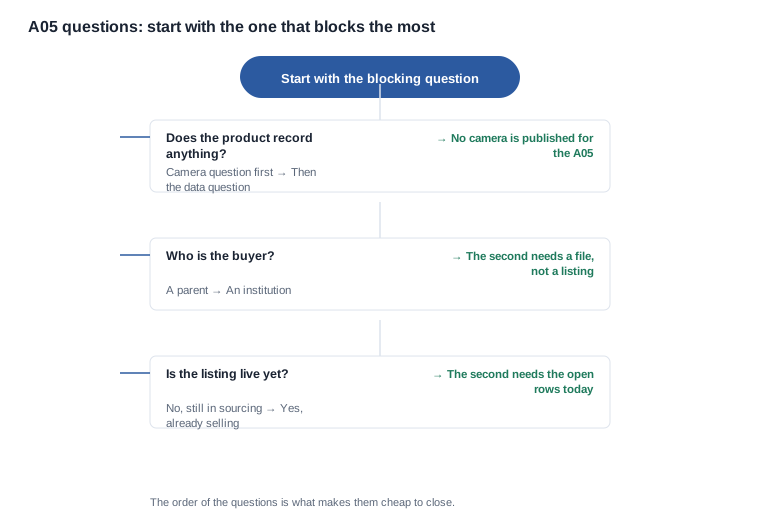
The point of collecting answers in this order is that they assemble into a document rather than a pile of emails. Eight questions produce three outputs.
A specification sheet with the published rows and the measured figures side by side, each measured figure carrying its condition. The published rows go on the product page; the measured figures go in the training material and the support script.
A request list for the supplier, containing only the questions the catalogue did not answer, each one attached to the decision it blocks. A request that is not attached to a decision gets treated as an optional extra, and optional extras do not get answered.
A determination plan for the compliance work, with the market, the age band and the labelling identified, and the dates owned by the buyer rather than by the supplier.
Most of this assembles in one exchange. The supplier question list is short, the sample tests take an afternoon, and the determination is the only part with a calendar that the buyer controls.
What we publish and what we will not
The A05 is a well-specified product whose documentation is strong on the hardware and absent on the software, and the software is the part a buyer's customers will actually ask about. We will describe the published detection functions and the illustrations that accompany them, and we will not attach any health, vision or prevention claim to them, because the category carries real regulatory risk and no supporting evidence is published for it.
We will also state plainly that the certification position for this category is not published in our material and has to be closed with a test house before a listing goes live in a market that requires it. We do not publish a weight, a lens material, an ingress rating, a radio version or a charging case capacity for this model, and we would rather show the empty row than a plausible number.
Send us the buyer, the age band and the destination markets, and we will tell you which of these questions are answered today and which need a sample or a test house.
Related reading
- Which category it is — A05 smart glasses versus A07
- What this model publishes — A05 smart glasses specifications and features
- Selling this category to institutions — kids smart glasses school requirements
Send us the buyer, the age band and the destination markets, and we will tell you which of these questions are answered and which need a sample or a test house.


