

Bone conduction glasses technology: the regime you build
Bone conduction glasses technology smart glasses quality control is a subject where the quality question is unusually well posed and unusually badly answered, and the reason is on the face of the published position. The entry publishes an amplification gain of 35 dB; a 200 mAh cell; a charge time of two hours or less; and a runtime of roughly seven hours and Type-C charging It publishes no model designation, and no certification position.
A gain figure is a verifiable claim, and to verify it you need a defined measurement: a defined input signal, a defined coupling to the transducer, a defined reference point and a defined instrument. None of those is published for this entry. So the factory can build to 35 dB and a buyer cannot confirm 35 dB, and the quality control regime has to be constructed rather than read off a sheet.
That construction is the actual subject of this article, because the construction is where the commercial risk lives. A buyer who assumes a quality regime exists because a specification exists will discover the gap in one of two places: at the pre-shipment inspection, when the lot fails an acceptance criterion nobody agreed, or at the second production run, when a process that was stable by accident is no longer stable.
Three conclusions to take away. First, the electrical rows in this category are ordinary production checks and can be verified per unit. Second, the gain and the coupling are quality variables that can only be controlled through an internal reference, because no external method exists to compare against. Third, the cost of building that reference is small and the cost of not building it is not, because without it the only quality signal you ever get is a complaint.
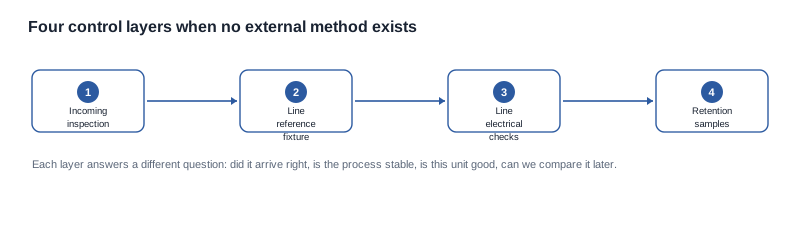

The four control layers and what each one can catch
A quality regime is not one activity. It is a set of layers, each answering a different question, and each catching a different class of defect. A programme that implements only the first layer is doing incoming inspection, which is necessary and far from sufficient.
Layer one: incoming inspection. Does the material or finished unit that arrived match what was ordered — model designation, configuration, packaging artwork, cell, interface, and the accompanying paperwork? This layer catches substitution, wrong artwork and missing documents. It is the cheapest layer to run and the one most likely to be skipped by a brand that assumes the factory handles it.
Layer two: the line reference fixture. Is the process stable, unit to unit? This is the layer that a thin category has to construct for itself, because there is no published method to compare against. A fixture holds a defined input, a defined coupling position and a defined reference point, so the reading is repeatable even though it is not comparable to a third-party figure. It converts the gain from an assertion into a controlled variable.
Layer three: line electrical checks. Is this unit good? Cell behaviour against the published rows, charging interface, power on, radio and pairing. These are ordinary, fast, and the only layer that produces a per-unit pass or fail that is binding.
Layer four: retention samples and the field trial. Can this be compared later, and does it survive contact with a wearer? Retention samples let a future lot be compared against an earlier one. The field trial is the only layer that catches the defect this technology actually produces — the coupling-dependent complaint — and it is the layer most programmes skip because it takes days rather than minutes.
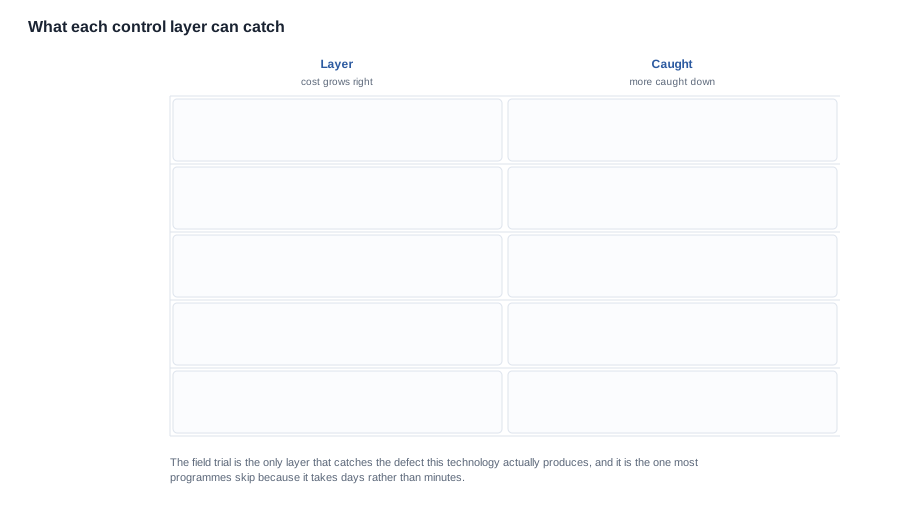
The honest way to prioritise is by what the category actually fails at. In an open-ear audio platform, the failure profile is dominated by electronics: dead cells, bad ports, radio pairing. In a bone conduction platform, the electronics failures still exist and are still handled by layers one and three, but the dominant commercial risk is a wearer who cannot hear what they expected, and that risk is only visible in layer four. A regime that weights its effort according to the wrong failure profile will pass every inspection and still return a third of the units it ships.

Writing an internal reference when no external method exists
This is the technical centre of the problem, and it is the part that most supplier conversations skip because it sounds like an abstraction. It is not an abstraction. Without an internal reference, "the gain is 35 dB" is a claim on a datasheet; with one, it is a controlled process that can drift, and drift can be detected.
The construction has four components, and each one has to be pinned down, because the whole value of the reference is in the pinning.
A defined input. A source with a stated level, stated impedance and a stated signal type, applied at a stated connector. Without a stated input level, a gain reading is not a number, because the same amplifier produces different readings at different input levels. This is also the specific thing to ask a supplier about, since a supplier with a real measurement habit will already have one and will describe it without being asked twice.
A defined coupling. A repeatable way of presenting the output to whatever is being measured, at a repeatable position. In this technology the coupling is the frame contact, and a coupling that varies by the way the fixture is held produces a spread in the readings that has nothing to do with the units.
A defined reference point. Where the measurement is taken, and against what. A reading that has no stated reference point cannot be compared with any other reading, including a reading from your own line the following week.
A defined limit. A pass band derived from the fixture, not a number copied from a datasheet. The limit should be tight enough to catch drift and wide enough that the line can hold it without rejecting good units, and the only way to know the second half is to run the fixture against a real batch and look at the spread.
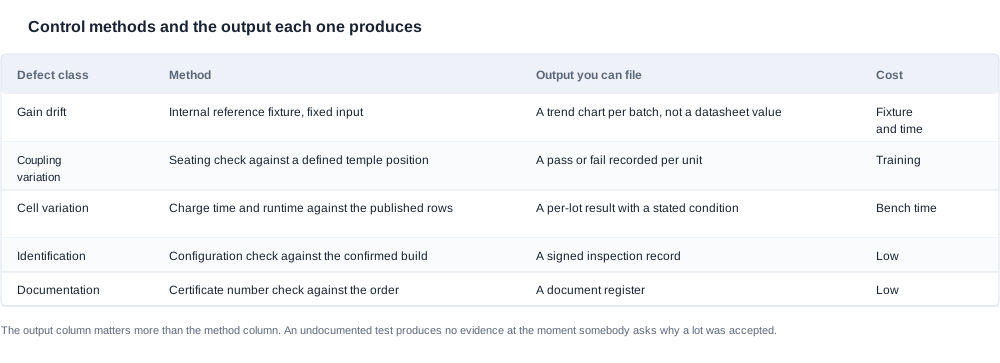
What the fixture produces is not a datasheet value. It is a trend: a per-batch distribution, a mean, and a drift line. A supplier who has been running this for a year can show you a chart rather than a number, and a chart is what lets a buyer tell a stable process from an erratic one. That is the difference between "the gain is 35 dB" and "the gain process is in control and here is the evidence".
The common mistake is to treat the fixture as a certification step rather than a control step. A fixture that is used to pass or fail individual units will be tuned so that it passes, and it will stop detecting drift. A fixture used to characterise a process — sampled at a stated frequency, charted, and trended — catches drift long before it becomes a complaint. The second use is the one that pays.

The incoming inspection sheet, row by row
The incoming inspection sheet is the document that turns a quality intention into a procedure, and in this category it is unusual in that a significant number of its rows are deliberately empty. That is a design choice, not an oversight: a row that cannot be completed should be visible on the sheet so that it stays on the negotiation, rather than disappearing between two versions of the form.
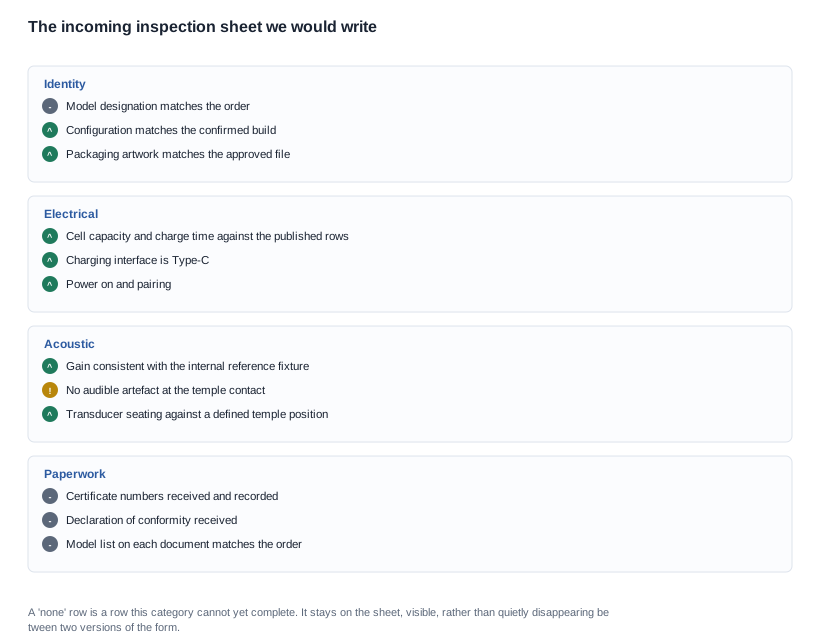
Identity rows. Does the model designation on the unit match the designation on the order? Does the configuration match the confirmed build, including colour, logo and packaging? Is the artwork the approved artwork? In a category where the published entry carries no model designation, the designation the order uses is a private label for a factory SKU, and the risk of that private label drifting away from what the factory ships is higher than usual, because nobody else is watching it.
Electrical rows. Cell capacity and charge time against the published rows of two hours or less; charging interface confirmed as Type-C; power on; radio pairing; and a runtime observation against the roughly seven-hour rated figure with the condition recorded. The condition is the part that matters. A runtime observation without a condition is not a measurement, and a quality sheet that records "6h" without recording what the device was doing is a sheet that will eventually produce a false failure.
Acoustic rows. Output consistent with the internal reference fixture. Absence of an audible artefact at the temple contact. Transducer seating against a defined temple position, which is the mechanical check that corresponds to the coupling variable. None of these produces a published number, and all three produce a per-unit pass or fail that the factory can act on.
Paperwork rows. Certificate numbers received, recorded and checked against the order. Declaration of conformity received. The model list on each document checked against the order. Every one of these is currently empty for this entry, because our catalogue publishes no certification status and no model designation for it, and an empty row is the honest state rather than a fabricated one.
The mechanism that makes the sheet work is the lot record. Every inspection produces a record tied to a lot or batch number, and the record is retained. Without it, the incoming inspection is a gate rather than a dataset, and the second time a problem appears you cannot tell whether it is a new problem or a recurring one.
Who owns the regime, and what it costs to operate
The reader here is a brand-side quality or sourcing lead, or a product manager who has been told to approve a supplier on quality grounds and has been handed a six-row specification. The specific difficulty is that "quality" in this category is not a certificate you can check but a set of processes you can either inspect or construct, and the distinction determines the entire cost.
There are three ownership models, and they are not equivalent.
The supplier owns everything. The factory runs the fixture, the line checks and the field trial, and the brand audits the results. This is the cheapest for the brand and the most common. Its weakness is that the brand's quality signal is only as good as the reports it receives, and the reports a factory produces about its own process are biased in a predictable direction.
The brand owns the reference. The brand builds or commissions the fixture, runs it on samples and on retained units, and uses it to challenge the factory's own data. This costs the brand engineering time and it is the only model that lets the brand detect drift independently. It is worth it in a thin category, where the alternative is having no independent measurement at all.
The brand owns the acceptance criteria only. The factory runs the process, the brand writes the criteria and the purchase order binds them, and the brand runs a spot check on a sample of units. This is the most common middle position and it works well enough when the failure profile is dominated by electronics, which is why it underperforms in this category.
The operating cost is worth pricing, because buyers in this category tend to assume quality assurance is free. The fixture is a fixture: a jig, a defined source, and the engineering time to set it up and to keep it honest. The line checks are bench time per unit, and bench time per unit is a unit cost that either the brand absorbs or the factory prices. The field trial is days rather than minutes and it needs wearers who are not the engineering team. The paperwork reconciliation is a half-day per lot. None of these is large, and all of them together are smaller than one reprinted packaging campaign.
The market context matters here too. Our catalogue publishes twelve open-ear audio platforms with full electrical detail on each, and exactly one bone conduction entry. A buyer moving between the two families will find that the quality conversation with an open-ear supplier is a conversation about datasheets, while the same conversation with a bone conduction supplier is a conversation about methods. The supplier that can describe its method has a quality system, whether or not it has published anything.
Operating the regime once production starts
A regime that is designed but not operated degrades quickly, and the degradation is invisible from inside. Four habits keep it alive.
Trend the fixture, do not just record it. A per-batch chart, kept for the life of the programme, is the artefact that makes drift visible and the reason a customer complaint can be answered with a number instead of an opinion.
Reconcile the paperwork on every lot, not once a quarter. The certificates, the declarations and the model lists change with the product, and the reconciliation is what catches a change that was not communicated. A quarter of un-reconciled lots is a quarter in which a substitution could have shipped without anybody noticing.
Keep retention samples from every lot, and keep the field trial running. The retention samples are the only way to answer a question that arrives in month eight, when a customer reports something the current units no longer show. The field trial is what keeps the coupling variable in view, because it is the only measurement of it that a production line cannot fake.
Re-run the criteria when the product changes. A change to the frame material, the temple geometry, the transducer or the firmware can move the process without changing a single line of the specification. A regime without a change-triggered review will certify the old product and ship the new one.
Putting the regime into a quality agreement
The commercial conversation in this category is usually about unit price, and the quality conversation is usually separate. That separation is a mistake, because the quality terms are the ones that decide the total cost of a programme.
Negotiable: the sample quantity and whether evaluation units are credited against the first order; the inspection and reporting cost per unit, and whether the brand's own incoming inspection is performed at the factory or at the brand's warehouse, which changes both the labour and the shipping terms; the frequency and format of the returns and cause-code summary; the production and inspection sample plan, and how many units are pulled from a lot for destructive or teardown checks; the retest and rework terms for a lot that fails the acceptance criteria, including who pays the freight in both directions; the retention period for documentation and for samples; and the notice obligation before any change to the transducer, the frame or the acoustic configuration, since each of those invalidates a measurement and therefore invalidates the reference.
Not negotiable, and worth saying early: the cost of the compliance route and the laboratory queue, which are fixed costs and elapsed time set by the laboratory rather than by the order size; the characterisation of the process itself, which is a fixed setup cost amortised over the programme rather than a rate; and the acoustic behaviour of the product, which is set by the transducer and the frame. A supplier who will not discuss the reference method is telling you the process is fixed, and the programme should be built around that rather than against it.
The clauses that carry the most weight are the boring ones. The acceptance criteria from the fixture, written into the purchase order, with the method attached, so that a lot that fails is a lot the brand can refuse. The notice obligation on configuration change. The requirement that the documentation package arrives with the order rather than afterwards. And the cost allocation for a failed lot, because that clause is what makes the criteria binding rather than advisory.
A worked case: a first production run with no reference product
Read the next passage as a teaching example of how the steps are sequenced. It is not a record of a shipment.
Assume a brand that has sampled a bone conduction platform, has a purchase order for a first production order of a few thousand units, and has no reference product of its own. The published specification against the order is a 35 dB amplification gain, a 200 mAh cell, a charge time of two hours or less, a rated runtime of roughly seven hours and Type-C charging, with no model designation and no certification status.
The first decision is to build the reference before the first lot ships. The brand commissions a fixture: a defined source at a stated level, a defined coupling position, a stated reference point, and a limit derived from the samples it has in hand. It runs the fixture against the samples and gets a spread. Where the spread is wide, that is a finding about the product, and it is found at the point where it is still cheap to act on.
The second decision is the limit, not the nominal. Rather than accept the published figure as the limit, the brand sets the limit from the observed distribution. This is the decision that sounds like a compromise and is actually a strengthening: a limit derived from a population is a limit the line can hold, whereas a limit copied from a datasheet is a limit somebody has to be lucky to meet.
The third decision is where the fixture lives. The brand runs the fixture at its own inspection point, on a sample from each lot, and does not rely on the factory's readings alone. The cost is a shipping and a bench time per lot. The benefit is that the brand has an independent number, which is the only thing that makes a drift conversation possible.
The fourth decision is the paperwork rows, which are empty. The brand asks for the model designation the certificates name, and the certificates are not yet in hand. Rather than proceeding on an assumption, the brand makes the documentation package a condition of the final payment and states the model designation on the purchase order. The lot ships; the final payment waits.
The fifth decision is the field trial before the launch, not after. The brand runs the trial on the production units rather than on the earlier samples, because the production units are the ones with the confirmed configuration. Two findings come out of it: the seating instruction is improved as a result, and the expected-behaviour language in the quick start is rewritten. Both changes are made before the listing goes live, which is why the first returns cluster does not reproduce the seating problem.
The sixth decision is the second-order terms. The brand asks for a monthly returns summary broken down by cause code, and for the retest and rework terms for a failed lot to be written into the order before the first shipment rather than negotiated when a lot fails. The second of these is the one that has an effect, because it changes what the factory is measuring on its own line.
The result is a programme whose quality position is built rather than inherited, and whose evidence — a chart, a set of cause codes, a reconciliation, a field trial — is entirely its own.
What our quality position is, and where it stops
The boundary we hold: we publish the electrical rows and the gain figure for this entry, and we do not publish a measurement method, a reference point, a tolerance band, a defect rate, a yield or a certification status for it, because none of those has been given to us. A buyer who checks a quality claim should be able to check ours first, and there is very little here to check, which is exactly why the article above is about building rather than reading.
We will not quote a typical frame weight, a typical runtime condition, a typical gain tolerance or a typical failure rate for this product, and we would rather tell a buyer that than offer a figure that cannot be verified. We will not describe the product as a hearing aid and we will not make a medical claim on it. And we will not present a maximum output capability as a result a wearer receives, because the coupling is the variable and the coupling is not published.
What we will do is tell you which rows exist and which do not, and what to ask the supplier to complete them. If you send us the acceptance criteria you have written for a bone conduction lot, we will tell you which of them our published rows can support directly, which need a measurement the supplier has to make, and which depend on a variable — the coupling — that has to be established on wearers before it can be used as a criterion.
Actions for the next two weeks
Start the reference fixture with the samples you already have. A stated input, a stated coupling position, a stated reference point and a limit derived from what you measure. It is the cheapest quality investment available in this category.
Write the acceptance criteria into the purchase order, with the method attached. A criterion without a method is a discussion, and a criterion in the order is a standard the factory can be held to.
Leave the impossible rows visible on the inspection sheet. The certificate rows, the model list rows and the acoustic reference rows are empty today. An empty row on a sheet is a live negotiation; a missing row is a forgotten one.
Run one field trial on production units, before the launch. It is the only measurement that touches the coupling, and it is the layer that catches the failure this technology actually produces.
The method behind the reference fixture is covered under bone conduction audio technology, the fit variable that makes the coupling unstable is discussed in bone conduction comfort and fit, and the durability regime a frame that transmits vibration has to survive is in bone conduction durability.
Where this comes from
- Bone conduction audio technology and its limits
- Comfort and fit in bone conduction frames
- Durability in bone conduction products
- Quality control in a factory operation
- Bone conduction glasses in the range
Send us the acceptance criteria you have written and we will tell you which of them our published rows can support.


