

EN 18031 and cybersecurity compliance what it is needs a careful answer, because the phrase covers a family of standards, the requirements those standards support, and a mode of working that people mix together. The shortest accurate version is this: it is the harmonised way of demonstrating that a connected radio product meets the cybersecurity-related essential requirements for market access in the European Union. Everything else follows from that, and most of the confusion in this category comes from treating it as a certificate rather than as a way of working.
The part that matters commercially is this. A product catalogue can tell a buyer what the radio is and what the battery does, and it can tell a buyer almost nothing about how the device behaves once it is connected to a network and to an application. That behaviour is where the cybersecurity obligation lives, so for a buyer the entire subject reduces to one question: which parts of the shipped configuration actually connect, and who is going to document them.
EN 18031 and cybersecurity compliance: where the file actually lives
Three conclusions for a connected launch
Three conclusions will make the rest of this subject tractable. First, the compliance route is a conformity assessment, but the evidence it needs is an operating record rather than a document: update path, default configuration, data handling, support period and disclosure route. There is no certificate to collect and no test report to file, so a buyer asking "send us the certificate" is asking for something that does not exist in this regime. Second, the assessment is scoped to the product as configured, which means a firmware branch, a paired application or a re-enabled radio function can each reopen it. Third, the scope of what a product connects to is the first thing to establish, because a device with no network connection and no paired application creates a very different evidence set from a device that does both.
The practical instruction follows directly: before asking for anything, write down which functions are enabled in the configuration you are ordering, which of those functions connect, and which of those connections carry data. That list is the request. Everything after it is the supplier's job to answer.
The reader of a connected-product file, and what sits at stake
The reader is a brand-side compliance lead, a procurement manager or an importer who is placing a connected product on a European market and has to assemble a file that a customer, a marketplace or a market surveillance authority may ask to see. Some of them are opening a new programme and need to write the requirement into the specification before anything is quoted. Others already have a product running and have been told, in the middle of a channel review, that their file does not cover the behaviour of the application.
What such a reader is managing is not a testing fee. It is the risk that the product is fine at the factory gate and unmanaged once a customer configures it, which is a risk that grows with every firmware release rather than shrinking. The second thing they are managing is the knowledge that the answer is distributed: part of it sits with the factory, part with the application developer, part with the cloud provider, and nobody has put it in one place.
That last point is the reason a buyer in this category keeps a register rather than a folder. A folder assumes one party holds the answer. A register names the party for each line, so the line can be chased when it is outstanding instead of being assumed to be covered because a general statement exists somewhere.
Why the product catalogue settles nothing here
The catalogue publishes what a catalogue can publish: the cell capacity, the charging time, the rated runtime and the charging method for each model, and a Bluetooth version row for fourteen of them. It publishes the pixel class for the camera models, an IP54 marking on the V06 and the S7, and a 158 g weight for the MT6 glasses body with its 1200 mAh folding charging case. It publishes no capacitive touch row for any model.
It publishes nothing at all about the cybersecurity behaviour of any product, and that is not an omission that a buyer should read as a negative finding. The catalogue text contains no reference to EN 18031, to the Radio Equipment Directive, to CE, to FCC or to RoHS, and it carries a company-level export certification page whose content is images rather than text — ten patent certificates, eight appearance-design patents and two utility-model patents. There is no per-model certification row anywhere in it.
So the correct reading is that the catalogue settles the hardware specification and stops there, and that the cybersecurity file for any model is written material you have to request from the supplier and, in some lines, from the party who builds the application. A request that comes back with a general statement instead of a document is the finding, and it is the same finding whether it arrives from a factory or from a cloud provider.
The four layers, and which one is actually an assessment
The evidence a connected product needs, layer by layer
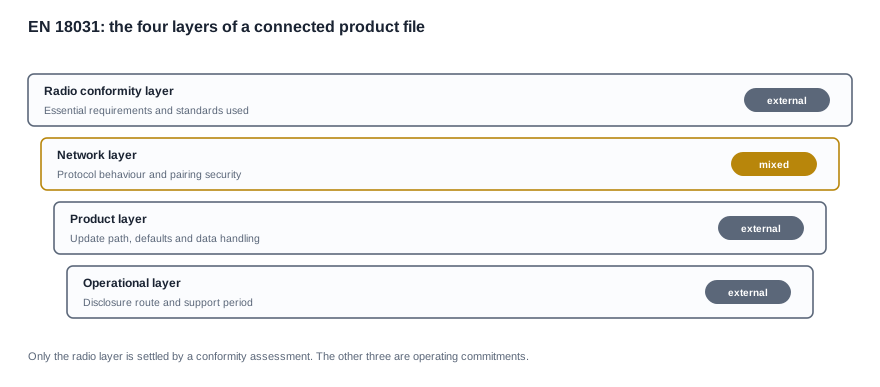
A connected product's compliance position is easier to reason about as four layers, because each layer is owned by a different party and each can be closed independently. Only one of them is settled by a conformity assessment with a defined method. The other three are commitments that have to be written down, evidenced and kept current.
The radio layer covers the essential requirements and the standards used to demonstrate them. This is the layer most suppliers are used to, and it is the layer that produces a file a buyer can file. The network layer covers protocol behaviour, device binding and the security properties of the connection itself, and it is where a configuration default does the most damage: a device that ships in a permissive binding state is not made compliant by a declaration that it is compliant. The product layer covers the update path, the default application settings and what the device does with the data it handles. The operational layer covers the disclosure route and the period over which the product will be supported.
The reason this layered picture is useful commercially is that it tells a buyer where to push. A buyer cannot change the radio layer much, because it is fixed by the chipset. A buyer can change the product layer substantially through the specification — default binding state, update behaviour, whether a data path exists at all — and can change the operational layer entirely through contractual language about support period and disclosure. Asking for the whole framework at once and receiving a radio file is the predictable outcome.
The requirement register, and what an uninspectable answer looks like
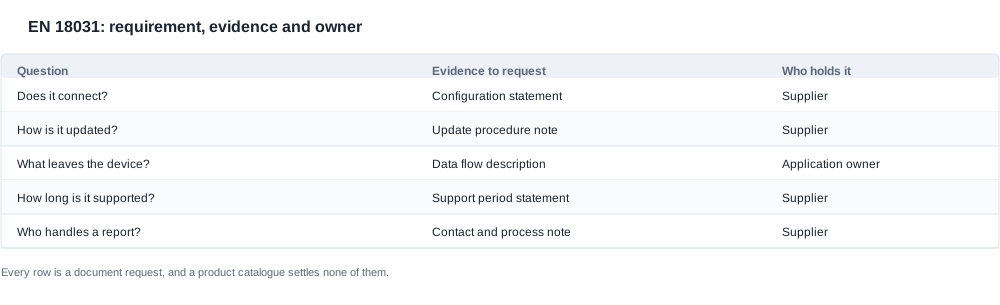
Cybersecurity evidence is collected against requirements, so the table below is written as a requirement register rather than as a wish list. Each line states how it is measured, the line it has to meet and the shape a weak answer takes, and the final column is where the due diligence value of this subject sits, because on a connected product an assurance that cannot be inspected is worth the same as an assurance that is absent.
| Line to test | How it is measured | The line it has to meet | How a weak answer shows up |
|---|---|---|---|
| Connected functions in the shipped configuration | Ask which functions are enabled by default and which can be enabled by the user. | The list covers the configuration in the order, not the model range. | A list of every function the platform can do, including ones switched off. |
| Network connections | Ask what the device connects to and over which interfaces. | Every connection is named, including paired-device links. | An answer that describes only the cloud path. |
| Data leaving the device | Ask what data is transmitted, stored locally and retained. | The answer names each category and its destination. | A general statement that no personal data is processed. |
| Update mechanism | Ask how updates are delivered, signed and rolled back. | Updates are authenticated and a failed update can be recovered. | An assertion that updates are over the air, with no signing detail. |
| Default configuration state | Ask what the device does before the user changes anything. | Secure defaults, and a way to restore them. | A device that leaves debug interfaces reachable in production. |
| Binding and credentials | Ask how a device is bound and how the default credential is handled. | No shared or unchangeable default credential ships. | A default binding phrase printed in the manual. |
| Support period | Ask how long the product will receive updates and security fixes. | The period is stated in writing and is long enough for the channel. | A supplier who says the period is decided commercially. |
| Vulnerability intake | Ask how a report reaches a person who can act on it. | A published route with a response commitment. | A general mailbox with no owner named. |
| Coordinated disclosure | Ask whether the supplier works with an external programme. | The process and the position on public disclosure are documented. | Silence on the question. |
| Scope of the assessment | Ask which models and which firmware branch were assessed. | The scope names the models and the branch, and it matches the order. | A scope written at product family level with no branch named. |
| Reassessment trigger | Ask what change forces the evidence to be revisited. | A change to functions, firmware or connections reopens the file. | No trigger, so the file drifts as the product evolves. |
| Evidence retention | Ask who holds the record and for how long. | A named owner and a retention period are recorded. | The record sits with one engineer. |
Two of these rows are routinely compared as though they were the same kind of evidence, and the comparison produces a false result. A statement that the product collects no personal data is not comparable with a data flow description, because the first is a conclusion and the second is an inspection that can fail. And a support period given verbally is not comparable with a support period in a contract, because the first can change on the next price negotiation and the second cannot without a conversation.

Assembling the evidence into something a buyer can hold
The sequence that turns a scope question into a register
The work in this category is a mapping task. The requirements are known, the evidence that supports each one is known, and the gap between them is what has to be closed. Doing it in the wrong order produces a pile of documents that nobody can read against the requirement that made them necessary.

-
Establish which product functions are enabled in the shipped configuration, and write them down as a list rather than as a description.
-
Ask which of those functions connect to a network, to a paired device, or to both, and record the answer against each function.
-
Request the security documentation for each connected function, from the party that actually builds it. A request sent to the factory for an application behaviour gets a factory answer.
-
Map every requirement to the document that supports it, and mark the lines with no document. The empty lines are the deliverable of this mapping.
-
Record the support period and the update path in the purchase order rather than in a side email, so that a change to either has to be negotiated.
-
Name the party that will answer a vulnerability report, and record the route in the same place as the specification.
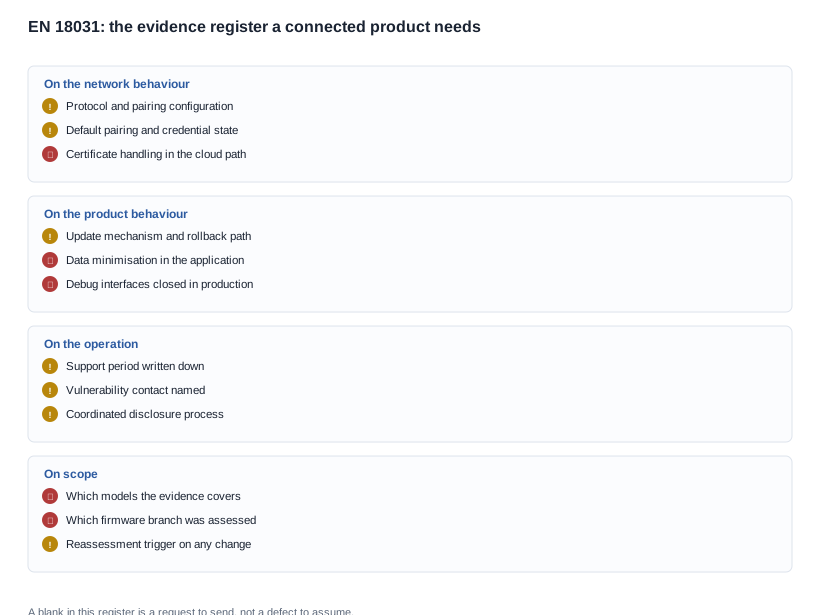
The register above is grouped by layer because that is where the gaps cluster. The network group fails when the binding and credential behaviour was never documented. The product group fails when the update path and the data handling were assumed rather than recorded. The operation group fails when nobody owns the disclosure route. The scope group fails hardest, because a register written at family level tells a buyer nothing about the units in the carton.
The check that costs a buyer least
If one check gets made before the order is placed, make it the configuration statement. Ask for a written list of the functions enabled in the configuration you are buying and the connections each of them makes. It takes one document and one hour to read, it is the only artefact that determines the size of everything else, and it is the artefact that a supplier can produce without commissioning anything.
The second check worth making is the scope check on the assessment itself, read against the firmware branch that will actually ship. A scope written at family level, or written for a branch that has since moved, is the most common way a file ends up nominally valid and practically empty.

Where the evidence goes missing, and what can still be negotiated
Five ways the register stays empty
The function list that lists the platform, not the product. The supplier describes every capability the chipset supports, including the ones switched off in the configuration being sold. The symptom is an enormous evidence request that will never close. The cause is a questionnaire written at the level of the platform. The prevention is to ask for the configuration in the same request and to treat the two lists as one answer.
The application behaviour held by somebody else. The factory builds the device, an outside party builds the companion application, and neither assumes the other's behaviour. The symptom is a radio file with nothing about the data path. The cause is a supply chain that passes the hardware without passing the compliance context. The prevention is to name the application party in the supply agreement, or to require the factory to warrant that it has collected that evidence.
The firmware branch that moved after the assessment. The evidence was written against a branch that has since been refactored, and the register still points at the old branch. The symptom is a question, from a customer, about whether the shipped software is the assessed software. The cause is a release process that does not know a compliance boundary exists. The prevention is a release-note line that says whether the change touches assessed scope.
The support period that was never written down. The supplier's position is that the period is a commercial decision, and every conversation reopens it. The symptom is that nobody in the buying organisation can state how long the product will be supported. The cause is leaving a contractual question to a technical conversation. The prevention is putting a number in the purchase order.
The disclosure route with no owner. A general mailbox exists and nobody monitors it. The symptom is a report that arrives and is not acted on. The cause is treating vulnerability handling as a matter of goodwill rather than of process. The prevention is a named contact, a monitored route and a response commitment, all three of which cost nothing to agree.
Assurances like that are not processes until somebody owns them. They are reasons to convert an assurance into a document with an owner.
What the specification can and cannot buy
The commercial conversation here splits into two groups of items the buyer controls and items it does not. The buyer controls the configuration: which functions are enabled, what the default binding state is, whether a data path exists, whether debug interfaces are closed, and how the update path is specified. Every one of those is a line in the purchase order and every one of them reduces the evidence the supplier has to produce. The buyer also controls the contractual layer: the support period, the disclosure route, the notification duty for a change to assessed scope, and the retention of the evidence.
What the buyer does not control is the chipset and the standards it was assessed against, the time the assessment takes against a specification that moves, and the cost of a fresh assessment when the product changes materially. Arguing hard about those is the wrong use of a negotiation.
The total cost of this category is therefore driven by how many configurations a buyer creates and how many times the product changes, not by the size of a single assessment. A buyer who freezes the configuration early and requires a written change trigger gets one assessment per platform rather than one per season, and that is where the commercial value sits.
A connected launch worked through, and the limit of what we publish
A hypothetical connected launch, step by step
This scenario is constructed to show how the reasoning runs. No client is described, no figures are claimed, and the model, the configuration and the market are assumed, because the point is the order of the steps rather than the outcome of any real programme.
The scenario. A buyer is placing a camera-equipped smart glasses model on a European market through a channel customer that will run a compliance review before listing. The camera model is in scope, the application is built by a third party, and the first order is in the low thousands of units.
Step one, the configuration. The buyer asks which functions are enabled in the configuration being ordered and which of them connect. The answer establishes the size of the file before anyone has committed to producing it, and it establishes that the camera path and the binding path both exist.
Step two, the parties. The buyer establishes who builds the application and who operates the cloud path, and discovers that neither is the factory. The request is split accordingly, and the factory is asked to warrant that it holds the application-side evidence rather than to produce it.
Step three, the register. Each requirement is mapped to a document, and the lines with no document are listed. The empty lines turn out to be concentrated in the data path and the default binding state, which are also the two lines the buyer can close in the specification.
Step four, the specification. The default binding state, the closed debug interfaces and the update path are written into the purchase order as requirements, with a change trigger attached. The support period is written in as a number, because a buyer who has to ask for it at every renewal will not get one.
Step five, the check. Before the deposit, the buyer confirms that the assessment scope names the models in the order and the firmware branch that will ship, and that the configuration statement in the file matches the configuration in the order.
The specification we publish, and the operating commitment we do not
The honest limit of a product catalogue is visible in this subject, so we will state ours plainly. What the catalogue supports is the hardware: cell capacities, charge times, rated runtimes, charging methods, the Bluetooth version where a row exists, the pixel class, the IP54 marking on the V06 and the S7, and the 158 g weight of the MT6 glasses body. What it does not and cannot support is the connected behaviour — no security assessment, no support period we have not agreed, and no statement about an application that somebody else builds. That is not a gap in the product; it is the boundary between a specification sheet and an operating commitment, and we would rather mark the boundary than blur it.
We will also say the uncomfortable part plainly: a product catalogue cannot evidence the connected behaviour of a product, and a company-level certification page cannot be read across to a per-model conclusion. What we can do for a specific model and configuration is confirm the radio configuration and the protocol features the product uses, confirm which published rows exist for it, and tell you plainly where the evidence has to come from instead. Where we do not know, we would rather say so than produce a plausible paragraph.
The register to open this week
If you are working on this now, the next step is short and specific. Send the model, the configuration, the connected functions and the target markets, and ask for the evidence against that configuration rather than for the range. We will tell you which published rows exist for that model, which parts of the file sit with the factory, and which parts have to be collected from the application and cloud parties.
The EN 18031 and cybersecurity compliance documents needed article sets out the evidence set in full, when EN 18031 and cybersecurity compliance took effect puts the dates against the sequence, and EN 18031 and cybersecurity compliance common myths covers the beliefs that most often leave a register empty. The EN 18031 and cybersecurity compliance pillar holds the requirement set.
Tell us the model and the configuration, and we will tell you which half of the file we can help you assemble and which half you have to go and collect.


