

An AI camera glasses use case guide is usually a list of activities a device can be used for, and that format is close to useless for the person who has to buy a range. "Hands-free documentation" and "content capture" describe what a buyer wants to happen, not what has to be true of a product for it to happen, and the gap between the two is where the cost, the failure and the return rate live. The useful version of this guide is a different format: for each deployment, name the constraint that governs it, name the published specification row that expresses that constraint, state the acceptance criterion you would write into the purchase order, and list what the catalogue does not publish for it. That is the structure below, and it converts a use case guide into a range planning instrument. We do not publish prices, lead times or market data for any of the scenarios here, because our documentation does not contain them.
AI camera glasses use case guide: start from the constraint, not the scenario
The reason the usual use case format fails is that a scenario is a wish and a constraint is a test. A scenario says what the buyer hopes will happen; a constraint says what must be true for it to happen and what will be measured. A scenario produces a range plan that can be assembled from whatever looks right, and a constraint produces a shortlist that can be defended.
Four constraints do most of the work in this category, and each of them corresponds to a row our catalogue publishes for the eleven camera models.
The length of the working period. This governs the runtime band, and the band is published for every camera model: five to eight hours for the S7 and the V03, and the V03 Pro and the V06; six to eight hours for the KY06 and the MT5; and about seven hours for the CY03 and the L1 Pro, and the MT6 and the L2 Utral, and the CY05. A deployment that involves a full shift without a charge point is constrained by this row, and nothing else.
The exposure of the working environment. This governs the ingress rating, and the position here is unusually narrow: only the V06 and the S7 publish IP54, and no other camera model in the range publishes any ingress rating at all. A deployment in a wet or dusty environment is therefore either served by two models or not served at all, and that is a fact about the documentation rather than a judgement about the products.
The charging arrangement. This governs the charge interface, and it splits the camera models three ways: magnetic charging published for the MT5 and the V03, and the KY06 and the S7, and the V06; a Type-C port published for the V03 Pro and the L2 Utral; and no published interface for the MT6 and the L1 Pro, and the CY03 and the CY05. A deployment where the unit is charged away from a desk is constrained by the dock or cable the channel can stock.
The output requirement. This governs the resolution tier and, critically, the fact that no video output is published for any model. Three camera models publish a 13 MP row — the S7 and the L1 Pro, and the L2 Utral — and eight publish an 8 MP row, but a deployment whose output is a video stream is constrained by a row that does not exist in the catalogue at all.
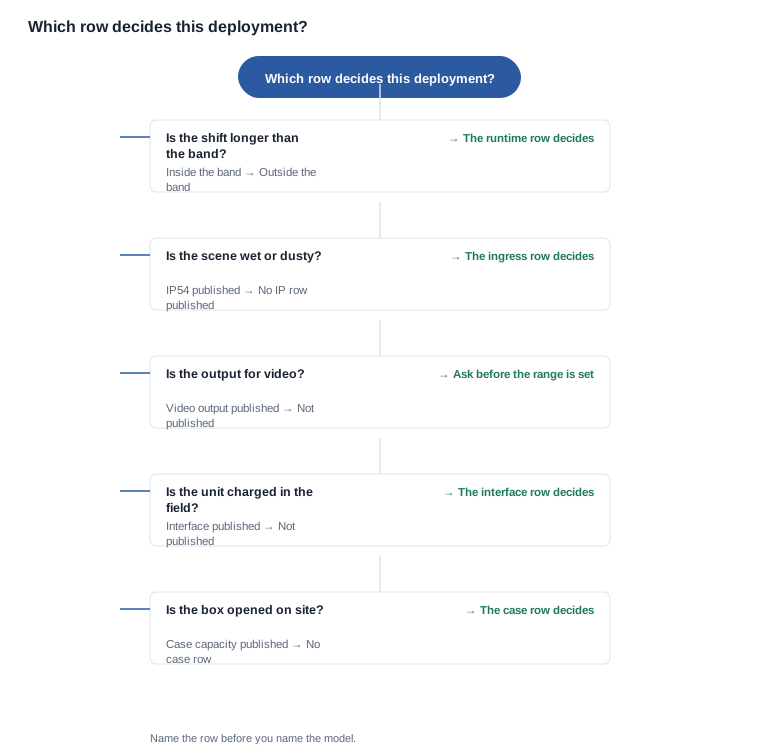
A fifth constraint sits alongside them and is the one a range planner forgets earliest: the accessory arrangement. Five camera models publish a charging-case capacity — the L1 Pro and the CY03, and the CY05 — each at 1400 mAh, the L2 Utral at 900 mAh or 1400 mAh, and the MT6 at 1200 mAh in a folding case — and six publish no charging-case row at all. A deployment where the unit is charged from a pocket or a vehicle rather than from a desk is constrained by whether a case is in the box, and that decision also changes the packed weight, the freight class and the battery transport documentation.

Six deployments and the published row that governs each one
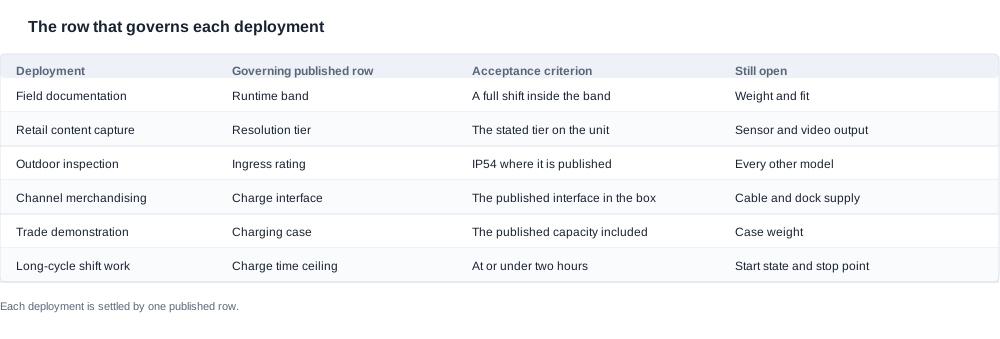
Read as a planning instrument, six deployments cover most of what camera-glasses programmes are actually bought for. Each is stated here in the same format: the deployment, the row that governs it, the criterion that would be written into the order, and what the catalogue leaves open.
Field documentation by a site team. The governing row is the rated runtime band. The acceptance criterion would be that the unit completes a full working shift inside the published band for the model, measured under a stated workload, with the charge state at the start of the shift recorded. What remains open: the mass of the unit, which is published for the MT6 alone, and the ergonomic question, which no published row addresses for any model.
Retail and catalogue content capture. The governing row is the resolution tier. The acceptance criterion would be that the model designation on the unit corresponds to the tier the listing claims, and that a sample frame under stated conditions is held on file as the reference for what the channel will publish. What remains open: the sensor, the field of view and the capture format, none of which is published for any model, so the listing cannot be written beyond the tier. The AI camera glasses for content creation material and the AI camera glasses competitor landscape piece cover how that tier is argued in the market.
Outdoor inspection with variable exposure. The governing row is the ingress rating. The acceptance criterion would be that the model is one of the two that publish IP54, and that no wording in the listing, on the carton or in the insert asserts a dust or water behaviour for the other nine camera models. What remains open: everything else about environmental exposure, because no other rating exists.
Channel merchandising and counter demonstration. The governing row is the charge interface. The acceptance criterion would be that the interface published for the model is the interface the channel has stocked, and that the accessory in the box is the one the published position implies. What remains open: the dock or cable specification, which is not published for any model, and the four camera models whose interface position is not published at all.
Trade demonstration and handover. The governing row is the charging-case capacity. The acceptance criterion would be that a case is included where the model publishes one, with the capacity matching the published figure, and that the packed configuration matches what the freight plan assumed. What remains open: the case mass, which is published for no model, and therefore the packed weight. The AI camera glasses charging case options piece covers the accessory economics model by model, and the AI camera glasses shipping weight piece covers why the packed figure has to be measured.
Long-cycle shift work with limited charging points. The governing row is the charge-time ceiling. The acceptance criterion would be that a unit reaches the published ceiling of two hours or less from a stated starting state, and that the starting state and the completion point are written down, because the published figure is a ceiling rather than a measured cycle and cannot be interpreted without them. What remains open: the charging case's own turnaround, which is not published for any model.
How to turn a deployment into an acceptance criterion
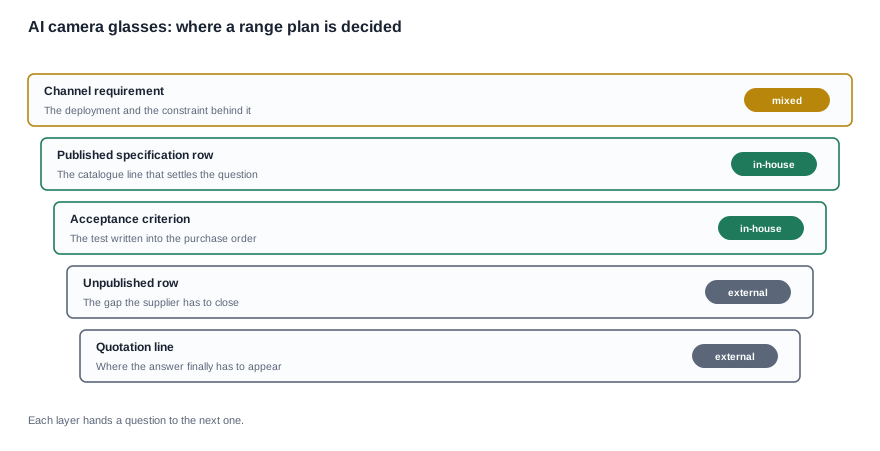
An acceptance criterion has four parts, and a buyer who writes all four has something that can be applied to a lot, argued with a supplier and used in a claim. The parts are the reference, the measurement method, the threshold and the consequence.
The reference is the published row, quoted with its model designation. Not "about seven hours" but "the about-seven-hour runtime published for the L1 Pro and the CY05, the L2 Utral and the MT6, and the CY03". The designation matters because the bands are shared across several models, and a criterion without it cannot be applied to the unit in front of you.
The measurement method is the part most often omitted, and it is what makes a criterion comparable between a sample and a shipment. For a runtime criterion that means the workload, the ambient conditions and the charge state. For a charge-time criterion that means the starting state, the charger and the definition of completion. For a resolution criterion that means checking the designation against the row, since no instrument measurement is available.
The threshold is stated in the terms the row uses. Where the row says two hours or less, the criterion says two hours or less, and not "under two hours" — the first allows exactly two hours and the second does not, and a criterion written the second way will be failed by a conforming unit. Where the row gives a band, the criterion gives the band and states which workload the band was measured under.
The consequence is what happens when the criterion is not met. A criterion with no consequence is a note. The consequence is usually one of three: the lot is not accepted, the lot is accepted and the deviation is recorded, or the unit is accepted at a reduced rate with a claim raised later. Which one applies is a commercial decision, and it is a decision worth making in advance rather than at the moment the first deviation appears.
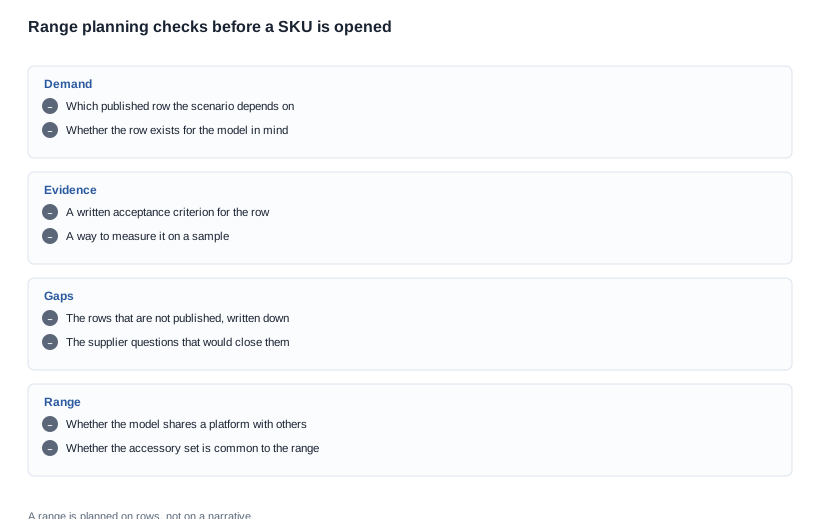
The four parts apply to every row in the catalogue, including the rows that are not published. Where a row is absent, the criterion becomes an open item with a named owner and a date, and the question to the supplier is written down. A criterion that is missing is a different thing from a criterion that has been waived, and the difference is what a buyer needs when a claim is raised against a supplier who did not know what was being asked of them.

What the scenario approach cannot tell you
The format has limits, and a range planner should know them before relying on it. Four of them matter.
It cannot tell you which model to choose. The published rows narrow the candidates; they do not select one. Three camera models publish a 13 MP row and five publish a charging-case capacity, and those sets overlap only partially — the L1 Pro and the L2 Utral publish both, while the S7 publishes the resolution tier without a case and the CY03 and the MT6, and the L1 Pro and the CY05 publish a case without the higher resolution tier. A deployment that needs both narrows to two models. A deployment that needs one of them and not the other leaves a genuine choice, and that choice is a commercial decision rather than a technical one. The AI camera glasses which model to pick piece covers how that decision is structured.
It cannot tell you the demand. Nothing in our documentation says how many units a scenario will absorb, and no scenario in this article carries a volume figure, because there is no published basis for one. Demand has to come from the channel's own data, and it is the input most often missing when a range is planned from a use case list.
It cannot tell you the price, the lead time or the minimum order quantity, and it cannot tell you the supplier's production capacity, its quality control arrangements or its warranty position, because those belong to a supplier evaluation rather than to a product document. Those belong to a quotation, and the questions to ask are the ones in the OEM ready platforms which models are ready piece and the commercial structure discussed in the AI camera glasses bulk ordering piece. The scenario work tells you what to ask about; the quotation tells you what it costs.
It cannot tell you whether the channel will buy it. A scenario that is technically well specified can still fail commercially because the channel's customers will not accept the form factor, the styling or the price point, and none of those three is a published row for any model. The photochromic smart glasses buying guide piece covers the related question of when a lens or configuration route is worth opening, and the sport smart glasses for cycling piece covers a category where the channel preference and the specification have to agree.
The honest summary is that this approach plans the product side of a range well and the market side not at all, and that a buyer who needs both has to source the market side from their own channel data rather than from a catalogue.
A range planning walkthrough for a brand opening a line
The following is a hypothetical walkthrough, written to show the decision sequence rather than to report a result from a client project.
Assume a brand in industrial services that has decided to open a camera-glasses line for its field teams, with an existing channel that already sells to the same customers. The brand's constraint is that it will be asked, by its own customers, to show a product working in the conditions their teams work in, and it does not want to sell a configuration that cannot survive a wet site.
The brand's first step is to convert the deployment into constraints rather than a wish list. It writes down four: a full working shift with limited charging points, an environment that may be wet or dusty, an output that is documentation rather than video, and a channel that will hand units over and expect them to be charged on site. Each constraint is mapped to a published row, and the brand immediately sees that the ingress row leaves it with two models rather than eleven.
The second step is to check the remaining three constraints against those two and against the wider range, and to discover that the runtime band and the charge interface point in different directions. The brand writes the candidate set with the governing row beside each model, and where two rows conflict it records the conflict rather than resolving it silently, because a conflict is usually a requirement that has not been specified tightly enough.
The third step is to convert each surviving candidate into an acceptance criterion with all four parts, and to send the unpublished ones to suppliers as written questions. The list it sends is short — the packed weight, the case mass, the interface for four models, the storage behaviour, the sensor and the field of view — and every item on it has a named owner and a date.
The fourth step is to look at the range rather than the model, because a procurement decision about a range is not a set of decisions about models and the supplier evaluation has to be run at the right level. It asks whether its chosen models share a platform, a common accessory set and a common artwork, and it learns that a range spanning the case-bearing models and the bare models is two accessory configurations rather than one, each with its own minimum. It also asks what a configuration change would do to the documentation, and adds a change-control clause.
The fifth step is to take the criteria into the quotation, where they become acceptance terms rather than intentions, and to put them in front of the supplier evaluation rather than in a separate document nobody reconciles, and to send the draft listing copy to the same list that produced the criteria, so that every sentence in the copy traces to a row or to an answer received.
The outcome is a range that is smaller than the catalogue and better specified than the wish list, with every open question named rather than assumed.
What we publish about use cases, and where the planning has to happen
On AI camera glasses use case guide, our position is that a deployment is only useful to a buyer when it is expressed as a constraint with a published row behind it, and that we are better placed to supply the rows than to supply the verdict. We publish the eleven camera model designations, the resolution tiers, the rated runtime bands, the charge-time ceilings, the charge interface positions where they exist, the charging-case capacities where they exist, the ingress rating for the two models that carry one and the mass for the one model that carries it. We do not publish which scenario a model suits, because suitability is a relationship between a product and a requirement, and the requirement belongs to the buyer.
The practical instruction is to work from the constraint backwards. Name the deployment in one sentence, list what has to be true for it to work, map each of those to a published row, and treat every one that has no row as a supplier question with an owner and a date. Then take the surviving candidates and write the acceptance criteria, and then take the criteria into the quotation. The AI camera glasses entry level options piece covers how the lower end of a range is usually approached, the MT6 smart glasses comparison piece covers the only model in the range with a published mass, the L1 Pro against CY05 comparison piece covers two models that differ on the resolution tier while sharing a cell, and the how to build a product line smart eyewear range piece covers the sequencing once the models are chosen.
Send us the deployments you are planning for, the conditions your units will work in and the channels you are selling through, and we will tell you which published rows govern each deployment, where the rows do not exist, and which questions have to be answered before a SKU is opened.
Related reading
- The model decision behind the deployment — AI camera glasses which model to pick
- The other end of the range — AI camera glasses entry level options
- The accessory the deployment implies — AI camera glasses charging case options
- The parcel the deployment produces — AI camera glasses shipping weight
- The only published mass — MT6 smart glasses how it compares
- Two models, one cell — L1 Pro against CY05 comparison
- The sizing question in another category — sport smart glasses fit and sizing
- Where the configuration leads — V03 Pro smart glasses best for
- Building the range — how to build a product line smart eyewear range
- Which models are ready — OEM ready platforms which models are ready
- The commercial sequence — AI camera glasses bulk ordering
- The lens route — photochromic smart glasses buying guide
- A category where the channel decides — sport smart glasses for cycling
- The wider market framing — AI camera glasses market trends


