
The MT5 smart glasses suit a buyer who brings the identity, the positioning and the price point themselves, because the model itself publishes no differentiator. Everything it has is shared with another model: 8 megapixels, a 220 mAh cell, a charge time of 2 hours or less, an endurance range of 6 to 8 hours, magnetic charging and a charging case, with a photography and sport positioning in the source.
That is not a weakness to apologise for. It is a different kind of product, and the buyers who succeed with it are the ones who understand from the start that the differentiator has to come from somewhere other than the specification table.
There is a version of this that goes wrong, and it is worth naming before the branches. A brand sees a light frame, a case in the box and a low cell figure, reads "cheap and complete", and buys it to compete with a camera model at twice the price. The MT5 then arrives beside a product with a photochromic lens or a published weight, and the customer has a question the listing cannot answer: why is this one less. The answer is usually that it is not less — it is differently positioned — but the answer has to be on the page, and if the brand has not written it, the customer concludes the product is the inferior one and the brand loses margin on both SKUs.
Mt5 smart glasses: a platform that expects the brand to supply the difference
Read the published rows with the question "what does this model not have?" rather than "what does it have", because on this model that is the more productive direction.
It has no published colour list, no published case capacity, no published frame weight, no published ingress marking, no published sensor model, no published video specification, no certificate number, and no removable inner frame. Every one of those gaps is an opportunity for a brand and a risk for a brand at the same time, and which one it turns out to be depends entirely on what the brand intends to put on the page.
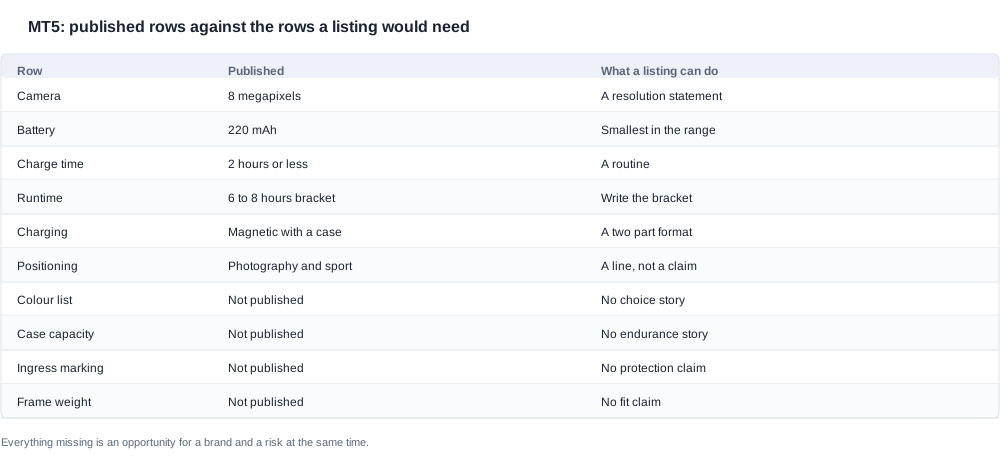
The two rows that do work are worth understanding properly rather than skimming. 220 mAh is the smallest frame cell in the camera range, shared with the V03, the V03 Pro and this model, which makes it the lightest frame to ship and the cheapest to move per unit — that is a real commercial advantage in any channel where freight is a meaningful share of the retail price. And magnetic charging with a case in the box makes this a two-part product proposition, which is the format most customers in this category understand intuitively.
What neither row gives you is a reason to choose this model over another on the same platform. A 220 mAh cell is not a specification; it is a price point. Two models sharing it cannot be separated by a customer comparing datasheets, and a channel that sells on comparison will treat them as interchangeable.
The endurance bracket deserves the same treatment. Six to eight hours is a spread, not a figure, and no test condition is published for either end. Write the bracket rather than the upper bound, and note that the camera may or may not have been active during the measurement — because on a camera product that single detail can account for most of the two-hour difference, and a listing that quotes the upper bound without it is making a claim the customer will test on their own longest day.
That is the central fact about the MT5, and every decision below follows from it.
One more property of a small cell that matters commercially rather than technically. A smaller cell means a shorter charge time in practice, which means the customer's routine is more forgiving and the product is easier to demo in a shop without a battery anxiety. That is a real merchandising advantage on a camera product, where a customer who picks it up and finds it flat at the counter has already formed an opinion. Ask what the charge time is from flat, because the published figure is stated without a starting state.
The four branches that decide it for the MT5
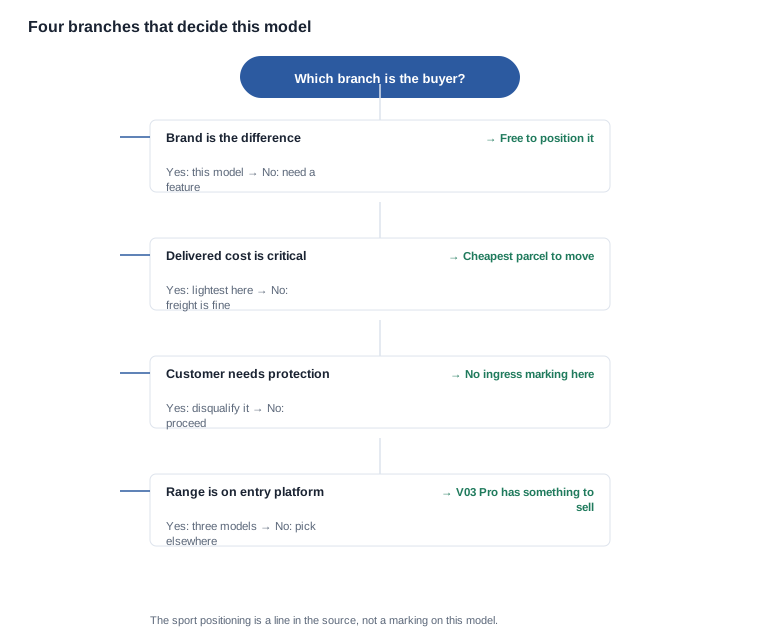
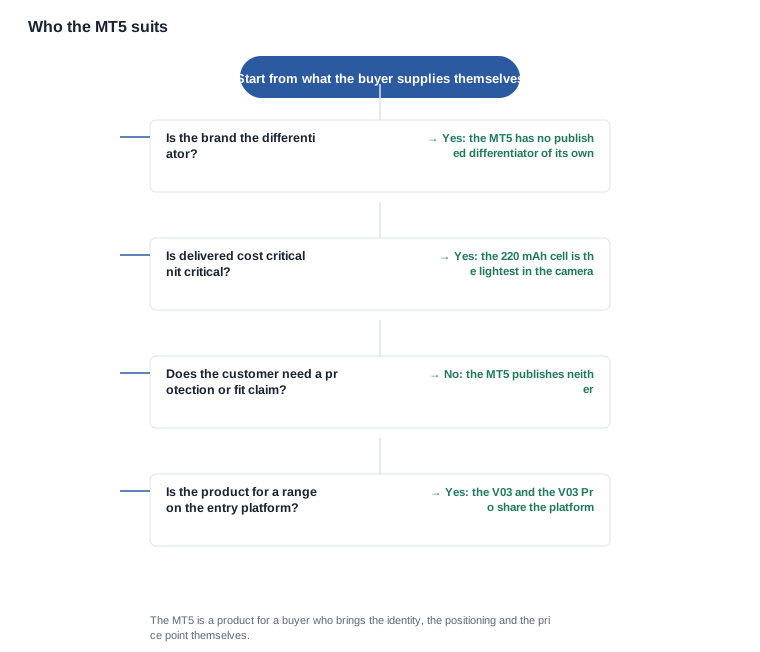
Branch one: is the brand the differentiator? Then this is the model. There is no published feature, colour list, case capacity, weight or protection marking that separates the MT5 from its neighbours, so a brand on this platform is free to position it however the channel requires. The AI camera glasses customisation options piece covers the seven axes available here, and the model readiness overview maps where the sharing is documented.
Branch two: is the delivered cost per unit critical? Then also this model. 220 mAh is the smallest cell in the camera range, so the frame is the lightest here and the parcel is the cheapest to move. The shipping weight breakdown covers the arithmetic, and the entry level options analysis sets out the tier. This is the strongest argument for the model and it is an internal one — the customer never sees the cell figure as a benefit, the margin does.
Branch three: does the customer need a protection or fit claim? Then no. The MT5 publishes no ingress marking, no removable inner frame and no ergonomic frame language, unlike the V06 and the S7. The sport water resistance analysis covers what a marking means where one does apply, and it is worth reading that before any copy is written.
Branch four: is the product for a range on the entry platform? Then the MT5 is the third option alongside the V03 Pro and the V03, and the V03 Pro is the one with something visible to sell: a photochromic lens, three colourways and a Type-C interface. The how to customise the V03 Pro piece covers that model, and it is the article to read if the brand needs a feature rather than a blank page.
A fifth branch applies last and settles several of the others: can your compliance team carry a product whose sport positioning is not evidenced? The source positions this model for photography and sport. No ingress marking and no fit data are published for it. If your channel is outdoor, that is disqualifying. If your channel is general retail, the positioning is a marketing line rather than a claim, and it becomes acceptable the moment the copy stops implying protection or fit.
How to evaluate a model whose documentation is thinner than its positioning
A thin specification is not a reason to skip the sample. It is a reason to write the acceptance criteria yourself, because nobody else has.

Take photographs in four lighting conditions, as on any camera model, because the sensor model is not published and the sample is the only evidence that will exist. Outdoors in daylight, outdoors in shade, indoors by a window, indoors under overhead light. A camera whose specification is one pixel count and nothing else has to be evaluated on its output, because there is nothing else to evaluate.
Then test the case, because it is in the box and its capacity is not published. Weigh the empty case, weigh the case with the frame in it, charge the case from empty and time it, and charge a deliberately flat frame from it and time that. If the case charge time is close to the frame charge time, the case is a dock and not a second charge, and the listing should say so.
Establish whether any of the sport features are physically present. The source positions this model for sport. Ask directly what that means on this specific frame — is there an ingress seal, a different temple, a gasket, a nose pad material change, or is it positioning alone? A supplier who answers with the category position rather than the model position has told you the answer is positioning, and that answer is the one you act on.
Weigh the packed unit across several cartons, not one, because variance on a light frame is normal and the freight model has to survive the worst unit rather than the average one.
And compare the frame weight against the one model in this range that publishes a figure. The MT6 publishes 158 g. That is the only published weight anywhere in the camera range, and it belongs to a different model, so it cannot be attributed here — but it is a useful reference point for deciding whether the MT5 feels right in the hand during the sample.
Then run the receiving check, which on this model is mostly about the case. Open three cartons from the same delivery and confirm the case is actually present in each, because a camera model sold on a two-part format will not be recognised as incomplete by a customer who expected a frame. Record the packed weight from one unit in each carton rather than averaging across the delivery. A missing case is the most likely failure on this model and the most damaging one, because the format is the argument and the customer finds out from an empty box.
Finally, set the acceptance criteria in writing before the bulk order. State which measurements must match the sample, what must be present in every carton, and what the remedy is if they are not. On a shared platform with three sibling models, the receiving team also needs a way of telling the models apart, and that is a labelling decision as much as an inspection one.

The buyer profiles that fit the MT5
A private-label or white-label programme. The brand supplies the name, the colours, the packaging and the price point, and what matters is a light, simple camera product with the lowest delivered cost on the tier. This is the model where that brief is satisfied directly rather than by negotiation.
A volume distributor on a tight price band. The lightest frame in the camera range and the smallest cell make this the economical product to move, and the AI camera glasses bulk ordering piece covers where the parcel measurement belongs in the pricing. On a tight band, freight is usually the largest controllable cost, and this is where the model has a genuine edge — as long as the brand measures the packed unit rather than assuming it.
A brand that already owns the 220 mAh platform. Adding the MT5 to an existing V03 and V03 Pro programme costs a colourway and an artwork version rather than a new qualification. That is the strongest form of the argument for this model, because the platform work is already paid for and the incremental cost of one more model in the same family is close to the cost of the artwork alone.
A brand whose differentiator is price plus service rather than features. Plenty of channels do not reward features; they reward a low price, a fast delivery and a support contact that answers. This model fits that shape well, provided the brand is willing to run the support function properly, because the documentation gaps become support contacts at exactly the moment the product is popular.
A brand entering a market where photography framing has to be shown rather than described. In markets where a customer will not read a specification and will not watch a demonstration, the pictures have to do the work, and the pictures have to be produced by the brand rather than borrowed from the supplier. That is a photography budget rather than a product decision, and it is the hidden cost of a model with no published differentiator: the marketing has to create the argument instead of repeating one.
And a brand that wants to start small and expand the range later. Because the platform is shared, buying this model first does not lock the brand out of the siblings. If the first SKU works and the brand wants a photochromic lens or a colour list in the second year, the platform is already in place and the incremental model is an artwork exercise rather than a qualification. That option has real value for a brand testing a market, and it is the strongest strategic argument for this model that is not visible on any specification page.
The buyer profiles that do not fit the MT5
A reseller selling on specification. Every published row the MT5 has is shared with another model, so it cannot win a datasheet comparison. This is the most common way the model gets bought for the wrong reason, and the result is inventory that competes with a sibling rather than selling against it.
A channel that needs a protection or fit claim. The MT5 cannot carry one, and a page that implies it will be tested by the customer. The absence of an ingress marking is not a gap to be filled with careful wording; it is a claim that cannot be made, and careful wording does not change that.
A brand looking for a hero product. The MT6 at 158 g is the only model in the range with a published weight, and the V03 Pro is the only one with a photochromic lens and a colour list. A hero product needs something to be the hero about, and this model publishes nothing that survives a comparison page.
A brand that cannot run a private label programme. If the differentiator has to come from the product and the brand supplies none, the model has no argument at all. The MT5 is a canvas rather than a picture, and a canvas with nothing on it is not a product proposition.
And a buyer whose due diligence requires a complete file before a supplier is selected. As with every model in this range, the sensor, the weight, the ingress marking and the certificate numbers are unpublished. Where a buyer can hold an open row for the launch period, that is manageable. Where it cannot, this model is not eligible regardless of its price.
What to close before the first order
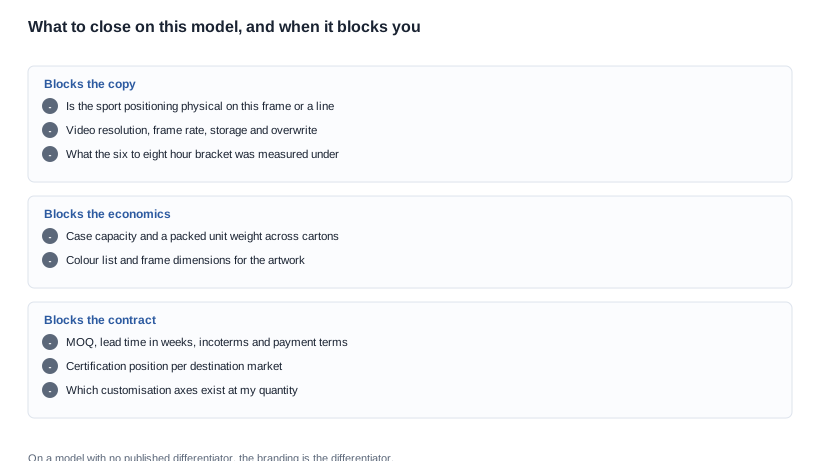
- Whether any of the sport features are physically present on this model, as distinct from being a positioning line.
- The camera and video specification, storage behaviour included — resolution, frame rate, capacity, format and what happens when it fills.
- What the six-to-eight-hour range was measured under, and whether the camera was active during the measurement.
- The case capacity, plus a measured packed unit weight across several cartons.
- Frame weight, dimensions, the colour list and the certification position for each destination market.
- Minimum order quantity, lead time, price, incoterms, payment terms and the warranty position — none of which we publish.
Two of those deserve more attention than a list gives them. The storage and overwrite behaviour decides whether the product can be sold to anybody who records more than occasionally, and the three possible answers produce completely different customer experiences. And the lead time is the number most likely to be estimated rather than planned on a model like this, because the platform is shared and the schedule is not necessarily yours. Ask for it in weeks, ask for it in writing, and ask what happens if it slips.
On the private label programme specifically, ask which customisation axes are available at your quantity rather than at a sample quantity, and ask for a written confirmation of what each axis costs in tooling and in minimum order. On a model with no published differentiator, the branding is the differentiator, so the cost of getting it right is the whole commercial case.
On the order to ask in, the product rows come first because they decide whether the copy can be written at all. Whether the sport positioning is physical, what the video specification is, what the endurance bracket was measured under, what the case holds — those four answer whether a listing exists. The economics rows come second because they decide whether the purchase works: case capacity, packed weight, colour list. The contract rows come last because they are necessary everywhere and rarely the reason two models are being compared. Checking them in that order stops a freight question from displacing a claim question, which is the most reliable way a shortlist on this platform goes wrong.
On negotiation, the useful question is not about unit price. It is about which of the published rows the supplier will put into the purchase order. A supplier who will commit to the cell configuration, the case contents and the packaging set has made a commitment that survives a receiving dispute; one who will not has given you a brochure. The red flags to watch are specific: a lead time given as a range rather than a date, a case described as "included" without a contents list, and a colour list that changes between two emails. Any one of those is survivable. Two together are a pattern, and the pattern is the finding.
We will not present the sport description as a protection or fit claim, we will not present 8 MP as an image quality claim, we will not present the endurance range as a working day, and we will not quote a weight, a case capacity, a colour or a certificate number that the documentation does not contain. The published rows are in the MT5 certification status note, the model on its own terms is covered in the MT5 best-for analysis, and the MT6 comparison covers the alternative with the only published weight in the range.
Send us the channel, the price band and the markets, and we will tell you whether the MT5 fits a product whose identity comes from your brand rather than from a published feature — and if it does not, which model on the same platform does have something to sell.
Related reading
- Where it sits in the range — MT5 smart glasses how it compares
- The commercial grounds — MT5 smart glasses value for money
- The tier it belongs to — AI camera glasses entry level options
Send us the channel, the price band and the markets, and we will tell you whether the MT5 fits a product whose identity comes from your brand rather than from a published feature.


