

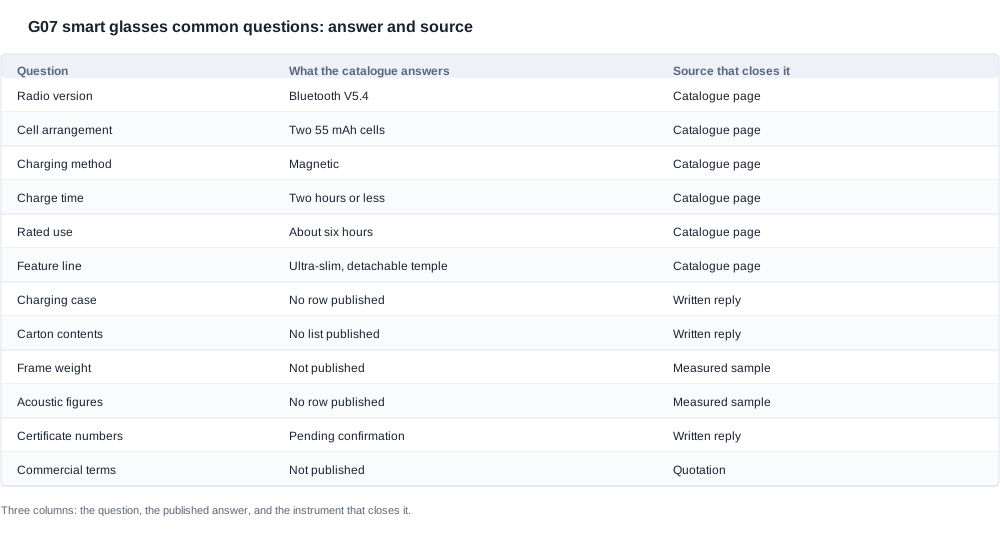
The catalogue answers more of the questions buyers ask about the G07 than it is usually credited with, and it answers them in a form that is short enough to quote and thin enough to misread. This page sorts those questions by the instrument that can actually close them: the catalogue page, a measured sample, a written reply from the supplier, or nothing that exists yet. A question that the page answers in four words and a question that the page answers in four words but leaves three caveats hanging over it are not the same kind of question, and treating them the same is the reason a specification file ends up with entries nobody can defend.
The practical output is a sorting method rather than a set of answers, because we do not publish a price, an order minimum, a lead time, a warranty period or a certificate number for this model, and not for any other in the range. What we publish is which instrument closes which question, so that a buyer can spend a sample order and a written request on the right items instead of on the ones the catalogue already answers.
Questions the page answers for the group rather than for this model
Some of the questions buyers ask about the G07 are answered by the catalogue, but not specifically for this model, and the distinction has to be kept. Whether the audio group shares a common platform is not something the document says at all: it prints matching rows for several models, and matching rows are not the same thing as a shared platform. Whether the G07 and the YK12 are interchangeable is likewise unanswered, because the document gives no relationship between models beyond the rows each one prints.
This matters because a buyer who reads a group-level answer as a model-level answer writes a sentence that cannot be defended. "The G07 shares the platform with the YK12" is not something the catalogue says. "The G07 and the YK12 publish the same five standard rows" is exactly what it says, and it is enough for most screening purposes.
The general rule is simple: where the catalogue prints a row, the row can be quoted for the model; where the catalogue prints nothing about a relationship, the relationship is a question for the supplier rather than an inference drawn from adjacent rows.
G07 smart glasses common questions: the questions a catalogue page answers in full
A catalogue page answers a question in full when the answer is a value, the value is specific to the model, and nothing about the answer depends on a condition that the page leaves out. Several of the most common questions about this model meet that test, and answering them from the page is the correct answer rather than a shortcut.
Eight answers the page gives without help
The radio version is Bluetooth V5.4, and it is specific to this model rather than inherited from a group. The cell arrangement is two 55 mAh units. The charging method is magnetic. The charge ceiling is two hours or less. The rated use is about six hours. The feature line reads as an ultra-slim build with a detachable temple. The model's place in the catalogue is the AI Bluetooth audio glasses group, listed as the G07 and the LC-105-1, the K01 and the YK12, the D12 and the K02, and the D11 and the LC-105-2. And the category of the product is audio rather than camera or sport, which matters because the three groups publish different sets of rows and answer different questions.
Those eight are the ones to take from the page and put straight into a specification, with the model name attached to each. The published specification rows for the G07 is the version to hand to whoever drafts the specification, because it is itemised and sourced.
What "in full" means for each one
The test above is stricter than it looks, and it excludes two answers that most people would count as complete. The first excluded answer is the endurance figure. The page prints about six hours, which is a value, and it is specific to the model, but the answer depends on a condition the page does not print — the starting state, the workload and the endpoint of the measurement. A question about endurance is therefore answered, but answered in a form that carries a caveat, and the caveat belongs in the specification next to the figure.
The second excluded answer is the detachable temple. The page states that the temple detaches, which is a value and is specific to the model, but the practical question behind it — whether a replacement can be obtained, and how the joint behaves — has no published answer at all. The feature line opens the question rather than closing it.
Two questions the page leaves open rather than answered
Two common questions have no answer in the catalogue and no negative answer either, and the difference matters. Whether the G07 has a charging case: the catalogue publishes no charging-case row for this model, and that silence says nothing about the hardware. Whether the G07 carries an ingress protection marking: no protection marking is published for it, and the only markings in the catalogue sit on two camera models. In both cases the correct entry in a file is "not published" and a request to the supplier, not a negative. The limitations of this model separates the two cases properly, and the range note on charging options covers the accessory programme in full.

The questions that only a weighed sample can close
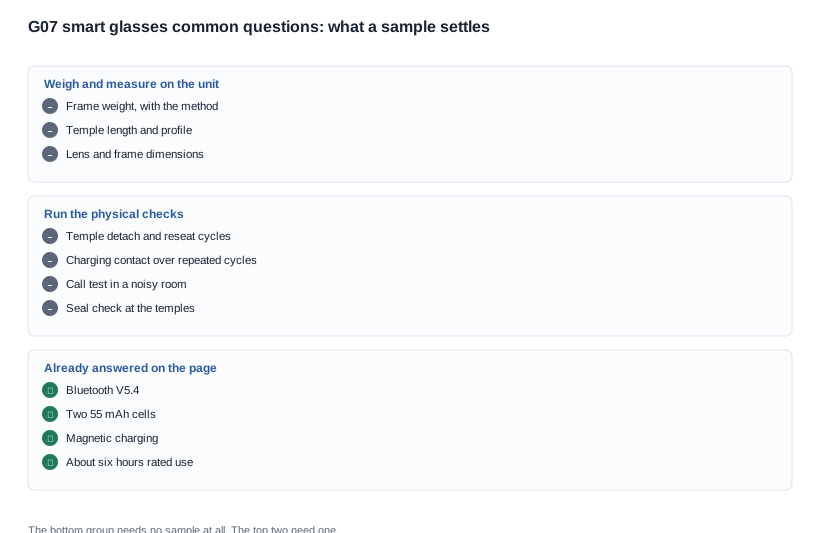
Some questions are not answered by the catalogue and cannot be answered by a supplier's written answer either, because they are properties of the physical object. A sample closes them, and closes them well, provided the sample is measured rather than handled.
Four weights and dimensions nobody publishes
The catalogue publishes a weight for exactly one model in the whole range, and it is a camera model at 158 g for the eyewear body. For the eight audio models there is no frame weight, no temple length, no lens dimension and no temple profile figure. That means every quantity a buyer computes from the physical object — freight per unit, the carton design, the presentation of the product on a shelf — starts from a measurement rather than from a specification.
The measurement itself is simple. A scale, a ruler and a record of the method. What matters is that the method is written down, because a weight without a method cannot be compared against a weight from another supplier. The weight comparison across the audio range sets out why an assumed figure cannot be carried into a freight calculation, and the range note on frame geometry and clearance covers the dimensional side.
The questions about the object
Three further questions are closed only by handling a unit. How the temple behaves when it is detached and reseated, including whether the unit keeps working when the temple is off and how many cycles the joint survives. How the charging contact behaves over repeated docking, whether it holds alignment and whether it shows scuffing. And how the frame sits over a long day, which is a geometry question that no number in the catalogue answers.
The first of those is the one that matters most for this model, because the detachable temple is the published feature that a channel would build a service proposition on. The buyer review checklist for the G07 covers that operation in full, and a photograph does not close it.
Running the sample so the answer is reusable
A sample session produces reusable answers when it is scripted. Write down the questions before the unit is opened, record the observation against each one, and note the method used for every measurement. A session run in that way produces a document a second buyer can act on; a session run exploratorily produces notes that have to be redone.

Questions the supplier has to answer in writing
Five questions can be answered only by the supplier, and only in a form that can be filed. They are the ones a buyer should put in the first message rather than discovering later, because each of them changes something concrete downstream.
Five questions for the supplier
Whether a charging case exists for the G07, and if it does what its capacity, interface and weight are. What physically ships in the carton, since no box-contents line is published for this model. What condition the published endurance figure was measured under, so that the figure can carry its condition in the same sentence. What the commercial terms are — order minimum, production lead time, warranty period, defect allowance — none of which is published for any model in the range. And what the certificate position is for this model: we publish no certificate number, no issuing body, no validity date and no per-model certification row for the G07 or for any of the other twenty-seven models, and no test report exists for any of the twenty-eight models in the range. The certification status of the G07 works through what to ask for, and the cost terms of this model covers the commercial half.
Why written, and what a written answer must carry
The reason for insisting on writing is not bureaucracy; it is that a written answer can be attached to an order, quoted in a listing and defended later. A verbal answer can be repeated accurately to nobody. A written answer carries a date, an author and a model reference, which are exactly the three things a specification file needs in order to be trusted six months later.
The model reference is the part that gets dropped. Because the audio range contains models with identical published rows, an answer that says "the battery is two 55 mAh cells" without naming the model it applies to is ambiguous by construction, and it is ambiguous precisely where it matters most.
Recording a partial reply
Partial replies are ordinary rather than a failure, provided they are recorded as partial. The practical method is to log each of the five questions against one of four states: a document received, an assertion received, an item still open with a date attached, or an item still open without a date. The second state is the one to chase, because an assertion is not a document a market authority will accept, is not evidence a distributor can pass on, and is not a basis on which a listing claim can be made.

The answer that must arrive with a number attached
One of the five supplier answers is different in kind from the other four. A case exists or it does not; a carton contains a list of items; a warranty period is a term; a certificate position is a status. All of those are yes-and-no answers or short answers, and they are easy to request and easy to record.
The endurance condition is different, because the useful answer is a set of values rather than a decision. Starting state, workload, radio condition, ambient condition, endpoint, sample size and tolerance: seven items, and a supplier who answers "about six hours, as usual" has answered none of them. This is the answer most likely to come back in a form that sounds complete, because the figure itself is the same one already printed on the catalogue page.
The test for a usable answer is whether it can be quoted with the figure attached. "About six hours under the conditions described in the attached test note" is usable. "About six hours" is not, because it adds nothing to the catalogue and it creates the impression that the condition exists. A buyer who asks for seven items and receives one of them back has still learned something, but the file is no further forward, and the catalogue figure has now been endorsed by a conversation that did not examine it.

Where one question points at two models
One of the commonest questions about the G07 has two correct answers, and it is the question most often logged against the wrong model.
The question that has two answers
The question is: which model in the range publishes the same electrical rows as the G07? The answer is one model — but the G07 is one of two models in the audio range whose published endurance is about six hours on the 55 mAh × 2 cell arrangement, and the question can be read in two directions. If it is asked as "which other model shares the six-hour figure and the two-cell arrangement", the answer is the YK12, and the YK12's own feature line is a surround-sound descriptor with a slim temple rather than a detachable one.
So the G07 and the YK12 are tied on every electrical row — radio version, cell arrangement, charge ceiling, charging method and rated use — and separated only by the feature line. A question phrased against the electrical rows therefore cannot separate them, and any answer that claims to has silently borrowed the feature line from one of them.
How to phrase it so only one model answers
The fix is in the wording of the question. Ask about the feature line explicitly and the question separates cleanly: which audio model publishes a detachable temple, and which publishes a surround-sound descriptor. Ask about the electrical rows and the answer will be a list of two. The G07 comparison across the range and the G07 against the LC-105-2 both work through this method, and the buyer brief for the G07 applies it as a selection screen.
The two models in question, stated plainly
For the avoidance of doubt, the two models sharing this position are the G07 and the YK12. Both publish Bluetooth V5.4, two 55 mAh cells, magnetic charging, a two-hour charging ceiling and about six hours of rated use. The G07's page carries an ultra-slim note with a detachable temple. The YK12's page carries a surround-sound descriptor with a slim temple. Neither model publishes an acoustic figure, a weight or a case row, so on every other question the two are equally unanswered.
Keeping the answers attached to the order
The last stage of answering questions is the part that decides whether any of it was worth doing: making sure that when the order is placed, and when the goods arrive, and when somebody asks six months later why a figure was written into a page, the answer is still attached to the paperwork.
Four places an answer should live
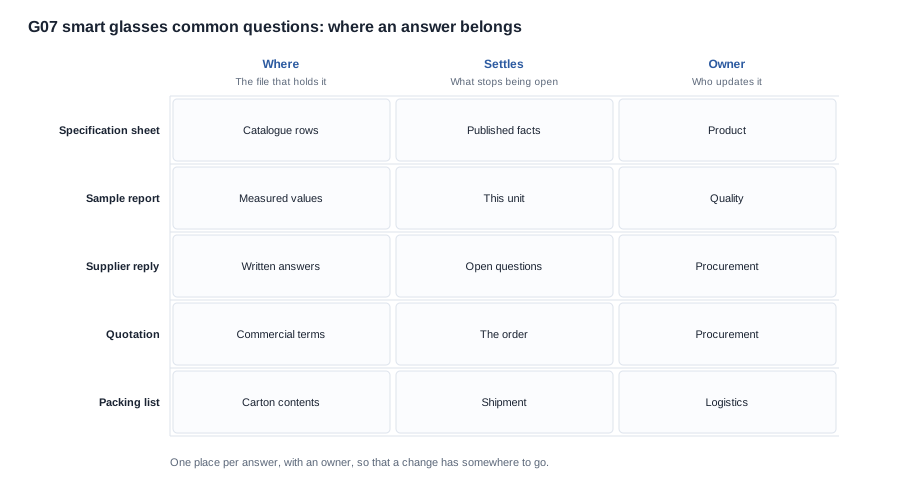
Every answer belongs in one of four places, and it belongs in exactly one of them. A catalogue-published value belongs on the specification sheet, with the model named. A measured value belongs in the sample report, with the method recorded. A supplier's written answer belongs in the correspondence file, with its date and author. A commercial answer belongs in the quotation and in the order, attached to the line it applies to.
The failure mode is duplication without ownership, where the same answer appears in four documents and updating it in one leaves three stale copies. The fix is to name an owner for each document, so that a change has somewhere definite to go.
A naming convention that makes the file usable
A simple convention makes the file navigable later: every answer gets an identifier, and every document that uses it repeats the identifier rather than the text. A specification sheet that quotes "six hours" without the identifier cannot be traced back to the condition that makes the number usable; a sheet that quotes the identifier can. The same convention applies to the answers that arrive later than the specification, which is the normal case for commercial terms.
What to do when an answer changes
An answer that changes is not a failure, and treating it as one is what pushes people into keeping the old figure. The procedure is to re-issue the affected documents with a new date, mark the superseded version, and check what else quoted the old value — including listing copy that a channel may already have published. The export documentation note for OEM platforms covers the same discipline for a different set of files, and the G07 comparison across the range is the reference for what the published rows can and cannot settle.
The short version of this page is that the catalogue closes a small number of questions for the G07 exactly, a sample closes a second group, a written request closes a third, and one question has to be asked twice before it has one answer rather than two. Keeping that map in the file is what makes the specification for G07 smart glasses defensible when somebody asks where a number came from.
A short checklist to run before the order is placed
Before a purchase order leaves, six checks on the question file take a few minutes and prevent the commonest later discovery.
First, every figure in the specification traces to either the catalogue, the sample report or a written answer, and the trace is written down. Second, every model-specific answer names the model in full. Third, every answer that arrived verbally has been confirmed in writing. Fourth, the one question that points at two models has been split into its two halves and answered separately. Fifth, the answers marked as assertions have either been converted into documents or listed as open items on the order. Sixth, the identifier scheme is in place, so a later change has somewhere to propagate to.
None of these checks takes long, and each of them has a version that fails routinely. The one that fails most often is the second, because a model reference is dropped when an answer is copied from one file into another, and the file then carries a value that belongs to a different product in the same range.
Where to go next
- The row-by-row specification — the catalogue entries
- The endurance row behind the six hours — the rating and its condition
- Sample checks that close gaps — measurement, not paperwork
- The written request — how a file begins
- Grouping the eight audio models — a range read by row
- Telling silences from facts — the two kinds of limitation
- Cost structure of this model — the commercial questions


