

Payment terms do not appear in a margin calculation, which is why they are frequently the biggest controllable number in one. Below is a worked account of how a single first order's margin moved purely through the payment structure. The unit price never changed, the goods never changed, and the supplier never gave anything away.
Smart glasses payment terms reach the margin through three separate routes, and only one of them is about cash. The cash route is the obvious one: money that moves later is money that can be earning something, or at least not being financed. The risk route is less obvious and usually larger: the structure decides who carries the consequences of goods that are not what was ordered. The third route is the one buyers rarely think about at all — a long acceptance window converts the supplier's working capital into an unfunded discount on the next order, which shows up not in this order's margin but in the price of the one after it.
The scenario below is hypothetical rather than a client project, and it is written to show the method rather than to argue for a particular structure.
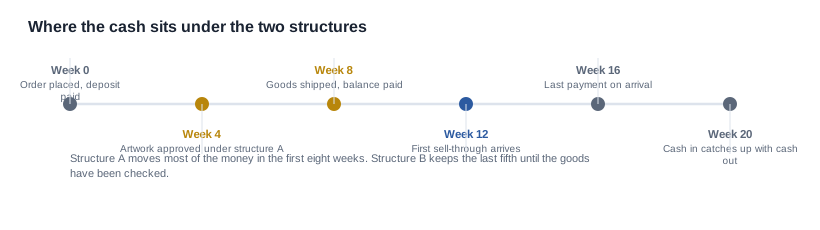
Smart glasses payment terms: cash, risk and margin
The order is an audio-glasses configuration. Our range carries eight audio models, and the configuration in this scenario is a single model at a single volume — the simplest commercial case there is, and therefore the clearest place to see what the structure does.
The goods cost was fixed, the freight was fixed, and the unit price was agreed. The structure offered was the common one: forty per cent deposit at order, forty per cent against approved artwork, twenty per cent against pre-shipment inspection.
On paper this is reasonable. In practice it concentrated eighty per cent of the cash outflow into the first six weeks — before a single unit existed, before the packaging had been produced, and before there was anything on which the buyer could base a decision to stop. Those six weeks are precisely the period in which the buyer has no leverage and no product, and they are the period in which a first order in a new category is most likely to be decided on optimism rather than on evidence.

The situation, and the arithmetic nobody ran
The buyer's objection was not that the structure was unfair. It was that the buyer could not tell, from the schedule alone, what the structure was costing.
That is worth pausing on, because it is the normal condition. A payment schedule is read as a set of percentages against a total, and the percentages are compared against the percentages of another schedule. What the schedule does to the buyer's cash position over time — the funding requirement, the inventory days, the point at which the goods exist and the money has already gone — is invisible in that reading.
So the buyer did something unusual and, in hindsight, entirely sensible: they built the cash plan for both structures on the same sheet. Three columns, cash out by week, cash in by week, and the difference between them. The unit price was held constant. The dates were held constant. Only the payment structure changed.
The result was not dramatic, and it is important that it was not dramatic. The cash difference at week twelve was a few weeks of funding, which is real and which is not the main effect. The main effect was in the second column.
There is a detail of the method worth naming, because it is what makes the comparison trustworthy: the buyer built the cash plan before arguing about the unit price. That order matters. A buyer who negotiates the price first has already spent the negotiating capital and arrives at the payment discussion with a position to defend rather than a problem to solve. The payment structure is the part of the agreement that affects the buyer's own business rather than the supplier's, and it is the part that a buyer is best equipped to evaluate.
The second detail is that the buyer asked for the supplier's own view of the schedule before proposing anything. A supplier who believes the goods will leave the factory in week six and the buyer who believes week nine will build two different cash plans from the same quotation, and the disagreement will not surface until week seven. Establishing that both sides are working from the same date is worth more than any percentage in the schedule.
Three effects, and only one of them is obvious
The cash cycle lengthened. Moving a tenth of the order value from week zero to a later point extended the period over which the buyer's money was committed without producing anything sellable. On a first order in a new category, where the first channel sell-through typically lands around week twelve, that is most of a month of sell-through moved backwards — which on a thin margin is the difference between a comfortable launch and a launch funded out of the buyer's own pocket.
The artwork risk transferred. This was the larger effect and it is the one that does not appear in a cash plan at all. Under the original structure, the artwork milestone was released against an approval, which means a decision. A decision is a point at which the buyer can say no, and a no at that point is only useful if the money has not already gone. Under the original structure, forty per cent of the order value had left by the time the artwork was approved, so a rejection at that point was a rejection with no leverage behind it.
The proposal replaced that milestone with a payment tied to a physical pre-production proof being approved and shipped. The trigger moved from "we have decided" to "you have something in your hand". With a proof in the buyer's possession, an error is found at the proof rather than at the pallet, and the money that has not yet moved is the money that makes the correction affordable.
The final payment gained a trigger the buyer controls. Under the original structure, the last fifth was released against a pre-shipment inspection performed at the factory. That report is real evidence, and it is not nothing — but it is evidence produced by a party whose interest is in the shipment going out, and it is produced in a place where the buyer is not present. Under the proposal, the same fifth was released against arrival at the buyer's warehouse rather than against a factory-side inspection. The acceptance criteria written before the order became enforceable rather than advisory, because the buyer now had something in hand at the moment the money was due.
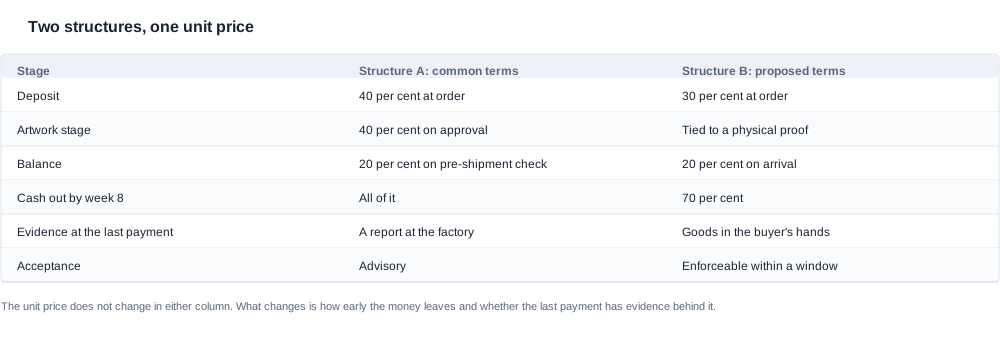
| Stage | Structure A: common terms | Structure B: proposed terms |
|---|---|---|
| Deposit | 40 per cent at order | 30 per cent at order |
| Artwork stage | 40 per cent on approval | Tied to a physical proof in the buyer's hands |
| Balance | 20 per cent on a factory inspection | 20 per cent on arrival and checking |
| Cash out by week eight | All of it | Seventy per cent |
| Evidence at the last payment | A report produced at the factory | Goods the buyer has received |
| Acceptance | Advisory | Enforceable within a stated window |
None of these changes reduced the supplier's cost or the unit price. All of them moved the buyer's cash later and, more importantly, moved the trigger points to moments where the buyer could see what they were paying for. That is the mechanism, and it is the reason the same structure produces a different margin for two buyers: the margin effect is a function of the buyer's cash cycle and the buyer's ability to stop, not of the percentages.

The counter-argument, and how to price it
The supplier is now carrying more working capital, and that cost exists. In a competitive market it appears somewhere — usually in the unit price at a later order, sometimes not at all if the supplier's cash cycle was never the constraint.
The fair way to handle this is to ask, not to assume. What does the alternative structure cost you? If the answer is nothing, the original structure was a negotiating position rather than a requirement, and the buyer has just learned something useful about the relationship. If the answer is a specific figure, the buyer has something to trade against: a longer price validity period, a firmer forecast, a larger single-configuration quantity, or a smaller deposit with the balance tied to arrival.
There is a second, more sophisticated version of the argument, and it is worth taking seriously because it is correct in a way that flatters the buyer only sometimes. A supplier who is asked to carry the goods longer will eventually price that. The mechanism is not usually a surcharge; it is a change in behaviour at the next order — a tighter payment term, a less flexible price, or a refusal to hold a slot on the buyer's schedule. In a competitive market with several suppliers, this is real; with a single supplier it is less so.
The practical response is to put the argument where it belongs. The question of what the structure costs the supplier is a question about the price of the next order, and it is best raised at the point where the next order is discussed rather than inferred from the current one. A buyer who asks "what does holding this cost you, and can we amortise it across the next three orders" gets a useful answer. A buyer who assumes the cost is zero and is surprised by a changed term at order three has done the arithmetic on the wrong side.
It also helps to name the trade explicitly rather than to imply it. The buyer in this scenario had three things to offer and used all three: a longer price validity period on the configuration, a larger single-configuration quantity that reduced the number of production runs, and an earlier configuration freeze that let the supplier commit to materials with less uncertainty. None of those was a concession in value, because each of them costs the supplier something real and none of them costs the buyer anything beyond the structure being discussed.
That is the test of whether a payment negotiation is genuine rather than performative: both sides should be able to state what the other is giving up. When a buyer cannot say what the supplier gains from a longer schedule, the request is a favour rather than a trade, and it will be treated as one.
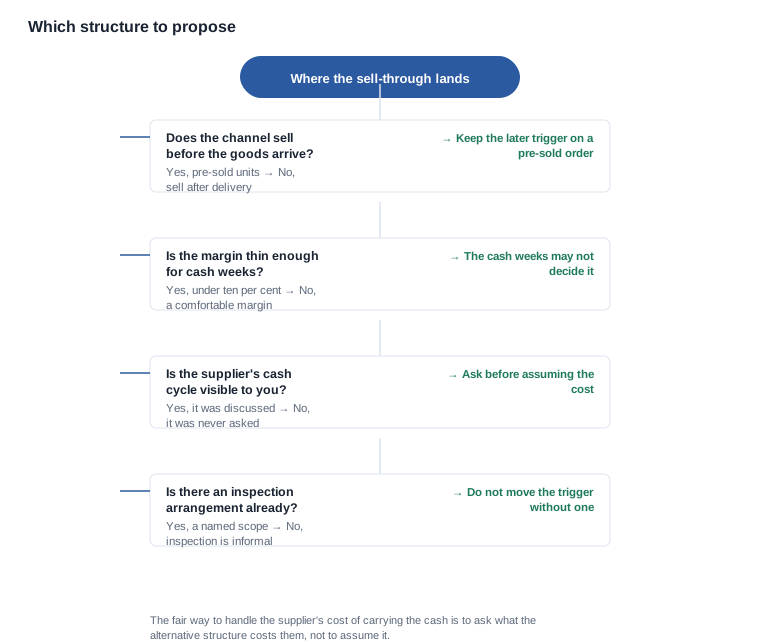

Running the calculation on your own numbers
The calculation is worth doing on every first order, and it is worth doing before the order rather than after, because a structure that has been agreed cannot be re-cut against a different cash profile.
Three columns, one sheet, two structures, the same unit price and the same dates. Then four questions.
- At what week does the first meaningful cash come back? For a channel order it is usually the first sell-through, and it is usually not week one. That week is the number that matters, because it is where the funding requirement and the return meet.
- What is the peak funding requirement between now and then? Not the total order value — the peak, which is usually a specific week and usually earlier than the order is complete.
- At what point in the timeline would you want to be able to stop? That point is where the last payment trigger belongs. Everything before it is a negotiation about timing; the trigger itself is a negotiation about control.
- What does the final payment actually buy? If the answer is "nothing that arrives with the goods", the trigger is protecting the supplier's risk position rather than the buyer's, and it is worth questioning.
The third question is the one that produces the most useful conversations, because it is about the buyer's own business rather than about the order. A buyer who knows the week at which they would want to be able to stop can express a trigger position in terms of their own cash cycle, and a supplier can respond to that in a way it cannot respond to "we would like a longer term".
There is also a version of the calculation for the second order onwards, and it is the one that determines whether the first negotiation was worth having. Run the same sheet with the actual first-order dates and the actual sell-through, and compare the peak funding requirement against the margin on the order. If the peak is a significant fraction of the margin, the structure is not a working-capital detail — it is the single largest variable in the order's profitability, and it deserves to be negotiated as such.
What the first order teaches the second one
The most valuable output of the calculation is not the number on the first order. It is the baseline that makes the second order a comparison rather than a fresh negotiation.
Three things carry forward, and each of them is worth more than the cash saving.
The peak funding week. If the first order's peak funding requirement fell in week six and the sell-through arrived in week twelve, the second order's plan can be built around that interval rather than around a guess. A buyer that knows its own peak week can negotiate a schedule around it — asking for the balance later than usual, or for a smaller deposit on a second order where the supplier already knows the configuration.
The actual sell-through curve. A first order is a research project into the market, and the payment structure was chosen before the answer was known. The second order is where the structure can be set against a real curve rather than an assumed one, and that is the moment the negotiation is worth having, because both sides now have a fact in common.
The risk events that actually occurred. Every defect, every artwork round, every document that arrived late is a data point that the first order produced and the second order can be priced against. A buyer who recorded them has a factual basis for asking for an inspection scope or an acceptance window, and a supplier who recorded the same events has a factual basis for the opposite. Neither side has to argue from principle, and the argument is shorter and better.
There is one caution about carrying the structure forward unchanged. A structure that was right for a first order, when the buyer had no leverage and no data, is frequently wrong for the second. The first order is bought with risk; the second order is bought with information. A buyer who keeps the first structure because it worked is paying for the risk premium twice, and the second time it is not being spent on anything.
Who carries the cash at each stage
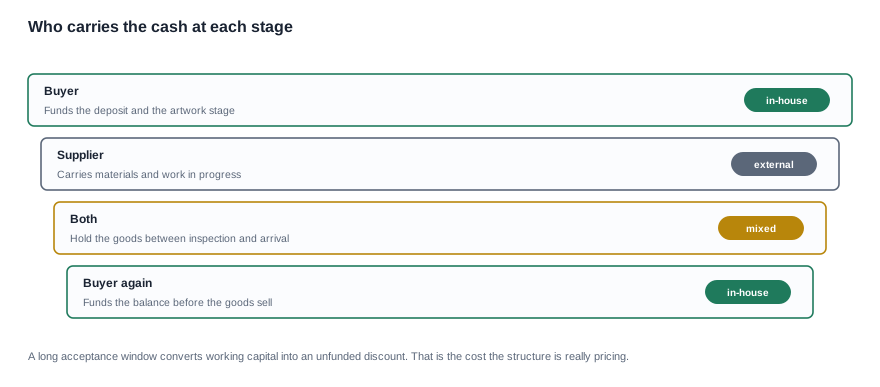
The layer diagram is the honest summary of the negotiation. The buyer funds the deposit and, under the original structure, a large part of the order before anything exists. The supplier carries materials and work in progress. Both parties hold the finished goods between the factory inspection and the buyer's warehouse. And then the buyer funds the final fifth before those goods have sold.
Read that last layer carefully, because it is where the quiet cost sits. A buyer who has paid for goods that have not yet sold is carrying inventory risk, and in a category where the sell-through curve is not yet established, that risk is not a known quantity. Moving the last payment to arrival does not eliminate it — the goods still have to sell — but it places the payment after the buyer has physically verified what it bought, which is the difference between carrying an inventory risk and carrying a verification risk.
The MOQ and the cash cycle article covers the other side of the same arithmetic, and the payment terms step by step article covers the order in which these decisions should be taken.
What we will propose, and what we will not reprice
We will propose a milestone structure and state what triggers each one and what we can do if a milestone is missed. We do not offer open terms to a relationship we have not run, and we will not change a structure mid-programme without a reason given in writing.
Margin is where payment terms stop being a finance question and become a pricing one. Our unit prices, production lead times and minimum order quantities are not published, so we will not quote a margin impact against a number you cannot audit, and we will not present a worked calculation as though it were our own result. What we will do is show which cost lines in your model are fixed by our side and which move with the payment structure, so that the arithmetic stays on your side of the table.
The payment terms section covers the structures themselves, and the payment terms myths article deals with the beliefs that do not survive a first order.
What we will ask for is the buyer's own numbers rather than ours: the configuration, the quantity, the destination market, the week the first meaningful cash comes back, and the week at which you would want to be able to stop. With those five we can show you the sequence the money moves through, and you can run the arithmetic on it. What we will not do is publish a margin impact, because the margin belongs to your business and not to ours, and a number we invented for it would be the least useful figure on the page.
Related reading
- Payment terms step by step — the order of decisions
- Payment terms myths — what the terms really do
- MOQ and the cash cycle — where the money goes
Send the configuration, the quantity and the market, and we will show you the sequence the money moves through, so the arithmetic stays on your side of the table.


