
AI camera glasses premium options are usually discussed as a price tier, and a price tier is the one thing nobody in the supply chain can evidence. A tier that can be checked is a different construct: it is a named set of published specification rows, and every claim in it traces back to a line in the catalogue. This article works through the five differentiating rows our range publishes, shows which claims each one supports, and marks the claims that no published row can carry. We do not publish prices, price tiers or minimum order quantities, because our documentation does not contain them, so the tier question here is settled entirely on specification content and on the questions a buyer should put to a supplier.
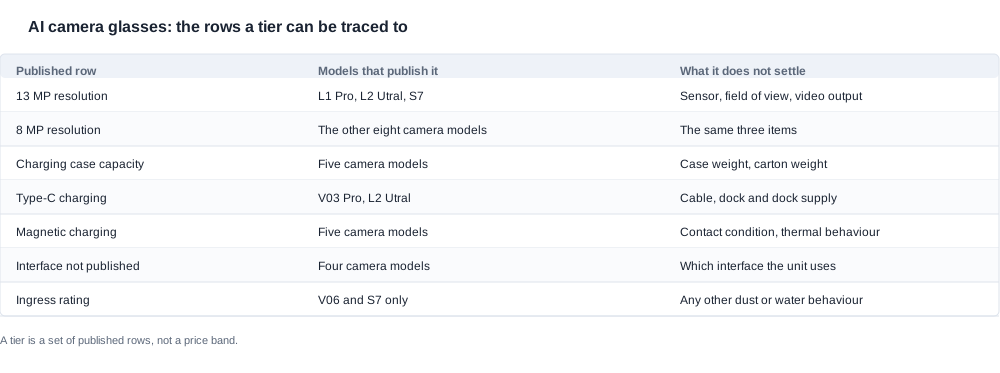
AI camera glasses premium options: what a tier can be traced to
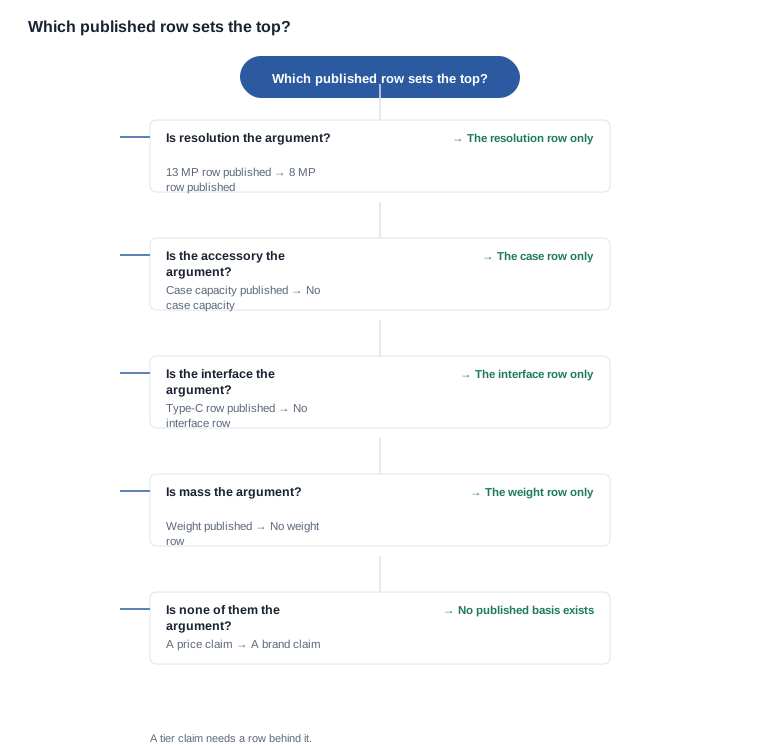
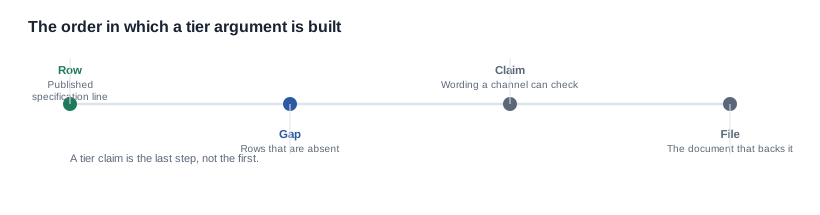
The test for any tier claim is simple and it is entirely documentary: take the claim, write down the row that supports it, and check that the row exists for the exact model being quoted. If the row is there, the claim is defensible. If the row is absent, the claim is a marketing adjective and the buyer has learned nothing about what will arrive.
Applied to our range, that test is unusually productive because five differentiating rows are published, and they divide the eleven camera models into groups that are stable and checkable.
The resolution row. Three camera models publish a 13 MP resolution: the L1 Pro, the S7 and the L2 Utral. The other eight publish an 8 MP row. That is the only published resolution structure in the category, and it is an exact two-tier split rather than a gradient. A tier claim built on it is defensible in the precise form "this model publishes the 13 MP row"; it is not defensible in the form "this model has better image quality", because no sensor model, lens or capture format is published for any of them.
The charging-case row. Five camera models publish a charging-case capacity: the L1 Pro and the CY03, and the CY05 — each at 1400 mAh, the L2 Utral at 900 mAh or 1400 mAh, and the MT6 at 1200 mAh in a folding case. Six publish no charging-case row at all. A tier claim built on the case can say that the capacity is published and can name it; it cannot say the case is better made, heavier, or more durable, because no case mass and no case material are published anywhere.
The charge-interface row. Two camera models publish a Type-C port, the V03 Pro and the L2 Utral. Five publish magnetic charging, the V03 and the KY06, and the MT5 and the V06, and the S7. Four publish neither, the L1 Pro and the MT6, and the CY03 and the CY05, and those four are exactly the ones that do publish a case capacity. That last detail is worth internalising: the models whose interface is unstated are not the bare models. They are the accessory-led models, which means the interface is a more consequential gap here than the count suggests.
The ingress row. Only two camera models publish an ingress rating: the V06 and the S7, both at IP54. Nine publish nothing. A tier claim built on durability has the thinnest evidentiary base of the five, and it is the claim most often made in listings.
The mass row. Exactly one camera model publishes a mass: the MT6 glasses body at 158 g, excluding its folding charging case. Ten publish nothing. A tier claim built on lightness therefore rests on a single model, which makes it a model-level statement rather than a tier-level one.
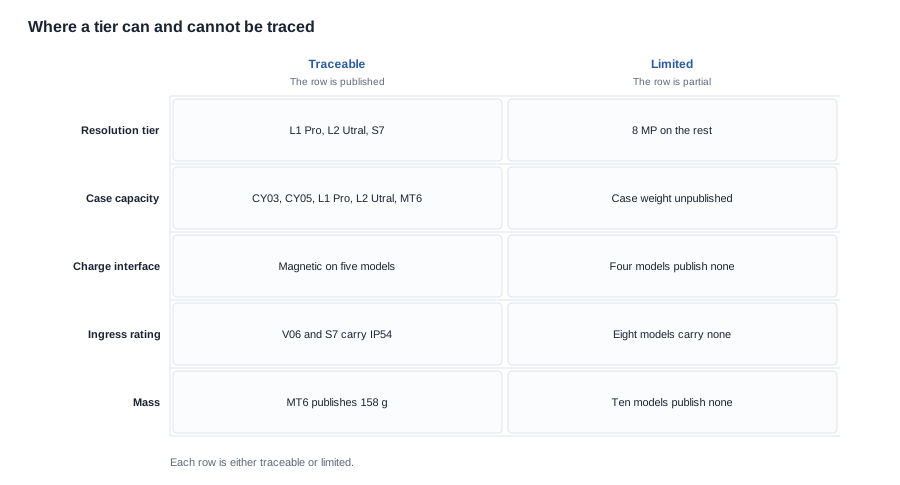
Read together, these rows describe a range whose upper end is defined by published accessory content and published resolution, and whose edges are defined by rows that do not exist. The two camera models that publish both a 13 MP resolution and a charging-case capacity are the L1 Pro and the L2 Utral. The third 13 MP model, the S7, publishes no case row. That asymmetry is the whole argument for doing this properly: a tier assembled from published rows is precise, and a tier assembled from adjectives is not.
Why a price tier and a specification tier are different things
A price tier is a market construct. It describes what buyers pay relative to each other, and it depends on factors that sit entirely outside the catalogue: the seller's cost base, the volume committed, the incoterm, the accessory bundle, the certification work done for the destination market and the margin the seller intends to hold. Two suppliers quoting the same model can occupy different price tiers, and neither is wrong.
A specification tier is a document construct. It describes what the catalogue states about a model, and it can be checked line by line without talking to anybody. That is why it is the only kind of tier a catalogue can responsibly publish, and why the word "premium" in a product context tends to cause trouble: it invites the reader to assume a price position that the document has no way to support.
The distinction matters commercially, because the two kinds of tier answer different questions and get used in different places. A price tier belongs in a quotation, in a margin model and in a channel negotiation. A specification tier belongs in a listing, in a comparison sheet and in a technical file. Conflating them produces a specific and common failure: a supplier presents a price ladder to a channel buyer, and the buyer reads it as a quality ladder. The buyer then writes copy that claims a quality the specification file does not support, and the first customer complaint or marketplace review becomes a dispute about a claim nobody had actually evidenced.
The way to avoid it is to keep the two vocabularies apart in the document as well as in the conversation. Write the specification tier as rows with numbers or named designations. Write the commercial tier as quotation lines with a price, a quantity band and a validity date. Never let an adjective that sits in one vocabulary appear in the other. A product described as "premium" in a quotation and "premium" in a listing means two different things, and one of them is usually wrong.
How to evaluate a tier claim from a supplier. The evaluation criteria are the same as the criteria for evaluating any specification claim: does the claim name a model designation, does it name a row that exists for that model, and would the claim still be true for the configuration you intend to order. A tier claim that fails the second test is not a weaker claim, it is an unsupported one. The red flags to watch for are consistent across suppliers, and they are worth naming because they are easy to recognise once you have seen them: a tier name with no model designation, a specification figure attributed to a family rather than to a model, an adjective where a number was available, and a durability or certification statement with no document behind it. When you are comparing two suppliers' tier claims, apply the same three tests to both before you compare anything else, because a claim that cannot be traced will otherwise be evaluated on how confidently it was stated.
There is a commercial reason to prefer the specification tier as the primary structure, beyond honesty. A price tier invites a buyer to negotiate down from a named position, and the supplier who has a price tier has to defend it with numbers the buyer cannot verify. A specification tier is a narrowing: it tells the buyer which models satisfy a stated requirement, and the negotiation that follows is about commercial terms rather than about which object is being compared. Buyers who arrive with a narrowed requirement generally close faster, because the technical comparison has already been done by the published rows.
The published rows that separate one end of the range from the other
Read the five rows together and the structure of the range becomes legible in a way that a price list never makes legible.
The cell and runtime rows cut across the tier rows. The cell capacities in the camera range run at 220 mAh for the MT5 and the V03 Pro, and the V03; 260 mAh for the KY06 and the S7, and the V06; 265 mAh for the MT6; and 290 mAh for the L1 Pro and the CY05, and the CY03 and the L2 Utral. The rated runtimes are grouped at about seven hours for the 290 mAh group and the MT6, six to eight hours for the KY06 and the MT5, and five to eight hours for the V03 Pro and the V03, and the V06 and the S7. Charge time is published for every camera model at two hours or less.
Those three rows are worth reading carefully because they cut across the tier rows rather than aligning with them. The L1 Pro, which publishes the 13 MP resolution, sits in the 290 mAh and about-seven-hour group alongside the CY05 and the CY03, and the L2 Utral, all of which publish an 8 MP row. The S7, the third 13 MP model, publishes a 260 mAh cell and a five-to-eight-hour band, and it publishes an ingress rating. So a tier assembled purely on resolution would put the S7 with the L1 Pro, while a tier assembled on the accessory rows would not, because the S7 publishes no case row and the L1 Pro does.
That divergence is not a defect in the catalogue. It is the catalogue doing its job, and it is exactly the kind of thing that a price tier conceals. A buyer who wants one coherent tier has to choose which rows the tier is built on, state that choice, and accept the models that fall outside it. The alternative is a tier that is a slogan.
The charging row is where the accessory tier becomes concrete. Magnetic charging is published for five camera models and a Type-C port for two. The two Type-C models are the V03 Pro and the L2 Utral, and both publish different case positions from each other: the V03 Pro publishes no charging-case row, and the L2 Utral publishes 900 mAh or 1400 mAh. So even within the two-model Type-C group, the accessory story differs. That is a difference in the published rows, not a difference in quality, and it is exactly the kind of detail that gets lost when a range is described with adjectives.
The rows that do not exist are as informative as the rows that do. No camera model publishes a sensor model, a field of view, a capture format or a frame rate. No camera model publishes a Bluetooth version. No model in the catalogue publishes a touch row. No camera model publishes a per-model certification number, and the catalogue's company-level export certification page carries images rather than text, with the catalogue text containing no reference to CE, FCC or RoHS. A tier claim that rests on any of those is resting on nothing a buyer can check, and it is worth knowing that before a channel partner asks.

What a tier claim cannot carry on its own
There is a short list of claims that resemble specification claims but are not, and the reason they fail is always the same: the row that would settle them is absent.
Imaging claims beyond the resolution tier. "13 megapixels" is checkable against a row. "High-definition capture", "wide-angle lens", "studio-grade imaging" and anything about video output are not, because no sensor, lens, format or rate is published for any model. A listing that runs from the resolution row into a general imaging claim has left the document at the first step. The camera imaging notes cover why the resolution figure is a shelf argument rather than a performance result, and the competitor landscape piece covers how the same argument is made by others.
Durability claims beyond the two rated models. IP54 is published for the V06 and the S7. Any wording that implies dust or water behaviour for the other nine camera models has no published support, and the specific risk is that such wording reaches the carton and the insert as well as the listing.
Lightness and ergonomic claims beyond the MT6. One published mass, on one model, excluding its case, cannot carry a range-wide claim, and subjective handling wording is weaker still because it has no row at all. It also cannot carry a model-level claim for any model other than the MT6.
Certification claims. There is no per-model certification row in the catalogue, and the export certification page is images rather than text. A tier claim of the form "fully certified" is therefore a claim about a document set the buyer has not yet seen, and the tier it implies may not exist.
Technology claims about the radio or the interface. The camera models publish no Bluetooth version, and four of them publish no charge interface at all. A tier claim that says "one cable across the range" is false on the published rows unless the range is restricted to the seven camera models that publish an interface.
Building a tier argument a channel partner can check
The method is worth writing down because it is reusable across suppliers, and because it converts an adjective into a document.
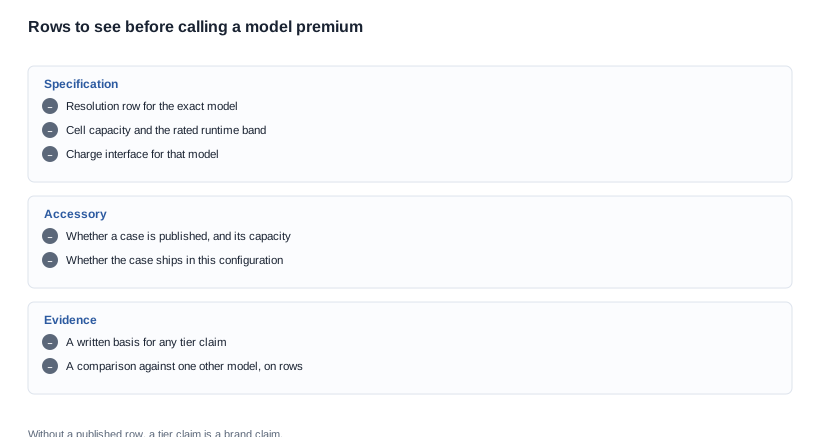
Step one, state the requirement, not the aspiration. Write the requirement as a constraint a unit either satisfies or does not: the runtime needed for a shift, the interface the channel can support, the accessory the customer needs in the box. An aspiration ("we want the best camera glasses") cannot be checked and will be answered with adjectives.
Step two, list the published rows for every candidate model side by side. Build the table from the catalogue, not from a supplier's summary sheet. The columns are the five differentiating rows plus the model designation; the rows are the candidate models. Whichever candidate falls out on the published rows is the shortlist, and the reasons it falls out are on the page.
Step three, mark every row that is absent rather than leaving the cell blank. A blank cell is read as "no problem". A cell marked "not published" is a diligence item, and it is a question for the supplier. In this range that step immediately produces four interface questions, nine ingress questions and ten mass questions.
Step four, test the wording against the table. For each sentence the listing will carry, find the row that supports it. Where a row exists, keep the sentence and attach the figure to it. Where no row exists, either remove the sentence or mark it as an open question to the supplier, with a date.
Step five, write the surviving tier definition into the quotation as a specification. Not "premium model" but the model designation, the published rows it satisfies and the rows it does not. That is the version a channel partner can check, and it is the version that survives a review.
The questions to ask a supplier at this stage are short, and they are better asked before the artwork is approved than after the listing is live. Ask which published rows the supplier treats as the tier, and in what document. Ask what the supplier's own sample verification measures, and against which criterion. Ask what evidence would be produced if a customer challenged the tier claim, and whether that evidence would name the model. Before you order, put the tier definition itself into the purchase order as a specification, so that a lot that does not meet it is a lot you can refuse. A tier described only in a sales conversation is not a constraint you can enforce, and the total cost of a tier claim that turns out to be unsupported is paid after the launch rather than before it.
To show the method working, consider a hypothetical case. A brand plans a two-tier retail line and needs the upper tier to be defensible in a marketplace listing that its channel partner will audit. It writes the requirement as a resolution row and an accessory in the box. Reading the eleven camera models against those two rows produces a group of five models that publish a charging-case capacity, of which two also publish the 13 MP row. The brand's tier is therefore defined by two published rows, and its copy says so. It then discovers, at the artwork stage, that the packaging for one of those two models has to carry a certification mark it has no number for, and it removes the mark rather than the model, because the model satisfies the requirement and the mark was an addition. The tier survives because it was built from rows rather than from adjectives.
What we publish about the upper end, and what we do not
On AI camera glasses premium options, our position is that a tier in this category is defensible only when it traces to published rows, and that we would rather publish a narrow tier than a wide one. We publish twenty-eight models with their electrical rows, eleven of them camera-equipped, and we publish the five differentiating rows in full: the resolution tier with its 13 MP and 8 MP groups, the charging-case capacities for the five models that carry them, the charge interface for the seven camera models that publish it, the IP54 rating for the two models that carry it, and the 158 g mass for the single model that carries it.
What we do not publish is the part that would turn a specification tier into a price tier: no unit price, no price tier, no minimum order quantity, no lead time, no production capacity, no warranty period, no certificate number and no customer case. The catalogue carries a company-level export certification page whose content is images rather than text, with ten patent certificates shown as images — eight appearance-design patents and two utility-model patents — and the catalogue text contains no reference to CE, FCC or RoHS. None of that is a weakness in the range; it is a description of where our documentation stops.
The practical consequence for a buyer is that the tier question is settled on specification, and the commercial question is settled in a quotation. The AI camera glasses buying guide piece covers how to narrow the range before a supplier conversation, the L1 Pro specifications and features piece covers the rows for one of the 13 MP models, the L1 Pro against CY05 comparison piece covers how two models with the same cell sit differently on the resolution row, and the MT6 comparison piece covers the only model in the range with a published mass.
If you are building a range and need a tier that survives an audit, The practical instruction, then, is to make the specification tier the primary structure and let the commercial tier sit on top of it. When you know exactly which published rows your upper tier rests on, the quotation conversation becomes about quantity, configuration, payment terms and delivery schedule, which are the four things you can actually negotiate. When you do not, the conversation is about adjectives, and the negotiation is about which supplier is willing to use the most confident wording.
Send us the requirement you are working from and the models in consideration. We will tell you which published rows each one satisfies and which rows remain unpublished.
Related reading
- The decision across the range — AI camera glasses buying guide
- The model decision — AI camera glasses which model to pick
- One 13 MP model in detail — L1 Pro smart glasses specifications and features
- The only published mass — MT6 smart glasses how it compares
- Two platforms compared — MT5 against V03 specification comparison
- The other end of the range — AI camera glasses entry level options
- The accessory cost picture — AI camera glasses charging case options
- The endurance rows — AI camera glasses battery comparison
- Building a range — how to build a product line smart eyewear range
- The commercial structure — OEM ready platforms pricing tiers
- Which models are ready — OEM ready platforms which models are ready
- Adding models later — OEM ready platforms scaling up
- The photochromic route — photochromic smart glasses buying guide
- Why the resolution figure is a shelf argument — camera imaging
- The range itself — AI camera glasses
- The OEM programme — OEM ready platforms
- The photochromic product line — photochromic smart glasses


